












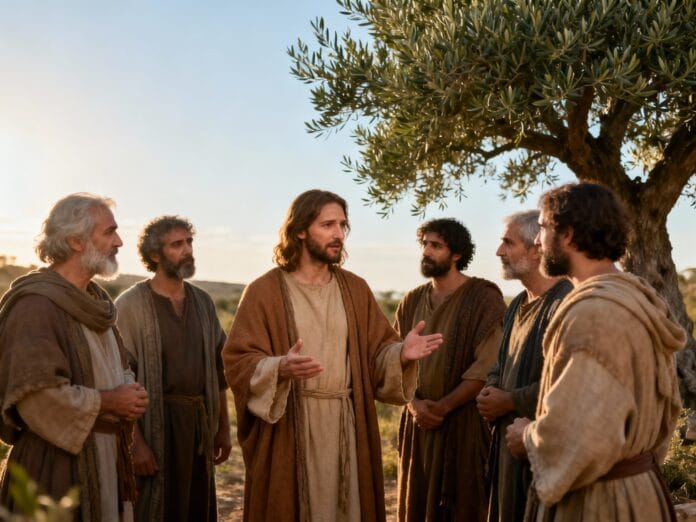
Gospel of Jesus Christ according to Saint Luke
At that time, Jesus said to his disciples: «It is inevitable that occasions of falling will arise; but woe to him through whom they come! It would be better for him to have a heavy millstone hung around his neck and to be thrown into the sea, rather than for him to cause one of these little ones to stumble.
Be mindful of yourselves! If your brother sins, rebuke him firmly, and if he repents, forgive him. Even if he sins against you seven times in a day, and seven times returns to you saying, «I am sorry,» you must forgive him.»
The Apostles said to the Lord, «Increase our faith!» The Lord replied, «If you have faith as small as a mustard seed, you can say to this tree, «Be uprooted from the ground and transplanted to the sea,» and it will obey you.»
Forgive without counting the cost in order to become free
Find joy to love through the demand of daily forgiveness and the faith that heals wounds.
The passage of Luke 17,Chapters 1-6 place the disciple before the most human of tensions: to forgive again and again, even those who fall back, while maintaining faith in the power of a seed of trust in God. This text, intended for any believer struggling with moral weariness, offers a path to inner liberation. It is addressed particularly to those who desire to unite truth and mercy: educators, couples, priests, and peacemakers in families or communities.
- The text of Luke 17: context and primary meaning
- The heart of the message: the faith that gives forgiveness possible
- Three key areas for navigating the struggle for forgiveness
- Practical applications according to our spheres of life
- Biblical roots and spiritual scope
- A daily practice of forgiveness
- The contemporary challenges of genuine forgiveness
- Liturgical prayer and final contemplation
- Conclusion: to live as "witnesses to the word of life"«
- Practical guidelines and references
The Gospel of Luke 17:1-6: an educational and fraternal framework
This short passage belongs to the final section of Jesus' journey to Jerusalem. We are on the threshold of the Passion events, where the pedagogy of mercy becomes the most radical. Luc, physician of the soul and attentive witness to human frailties, chooses this scene to link scandal, fraternal correction, forgiveness, and faith.
Jesus' tone is initially serious: "It is inevitable that scandals will occur." No one escapes the reality of evil: the evil suffered, the evil we unintentionally cause, the evil that wounds the "least." Here, Christ introduces a responsibility: not to become a source of sin ourselves. The image of the millstone and the sea is not a call to fear but a metaphor for the gravity of the link between conscience and loveLosing this link is like drowning.
Then comes the abrupt order: "Rebuke him sharply; if he repents, forgive him." Jesus unites correction and forgiveness, demandingness and tenderness. Brotherhood Christianity does not consist of excusing everything: it is born from a truth spoken with compassion.
Finally, the crux of the text lies in the impossible: «Even if he sins against you seven times a day… you must forgive him.» The hyperbole of the number seven—a symbol of totality—expresses the perfection of forgiveness. The apostles react instinctively: «Increase our faith!» Like them, the reader senses the disproportion: how can one forgive endlessly? Jesus responds with an image of hope: faith, tiny as a mustard seed, possesses such transformative power that it can uproot even the most deeply entrenched resentment.
The text thus draws a parallel between two movements: that of forgiveness, humanly impossible, and that of faith, invisible but fruitful. Together, they form an art of living.
The inner logic of forgiveness: proof and promise
The key to the passage can be summarized as follows: forgiveness Forgiveness is not a heroic moral act, but a fruit of faith. Forgiving does not mean forgetting or downplaying the harm suffered; it means choosing to break the cycle of inner violence. Jesus connects mercy to trust.
This logic is based on three experimental proofs:
- The psychological experience: resentment consumes the one who bears it more than the one who provoked it. Forgiveness becomes an act of spiritual hygiene.
- The community experience: when the word of forgiveness circulates, it repairs collective trust. Families and teams who know how to apologize grow in maturity.
- The theological experience: God alone can inspire true forgiveness, because he is its source.
Luke shows a gradual progression: from scandal (a wounded relationship) to correction (the truth spoken), then to forgiveness (mercy restored), and finally to faith (union with the God who makes this possible). Thus, forgiving is not an isolated act, but an educational process: Jesus trains his disciples in a loving realism.
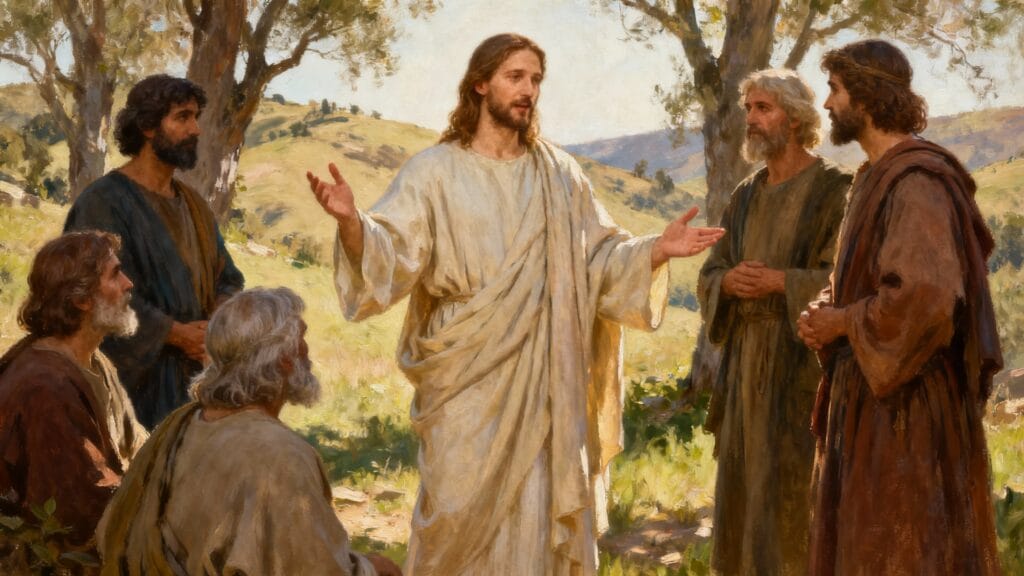
Forgiving is not about denying the wrong, but about accepting the truth.
Forgiveness begins with acknowledging the wrong. Too often, forgiveness is confused with passivity. But Jesus rejects avoidance: "Rebuke him sharply." To speak of the wrong is to loosen it.
In real life, we can observe this:
- In a relationship, what is left unsaid fuels the wounds; naming without accusing opens a path forward.
- In a team, hidden tension destroys trust; a sincere face-to-face meeting restores it.
- In the spiritual life, confession gives new life: it is the space where truth meets mercy.
THE Christian forgiveness He is clear-sighted: he goes through suffering, he does not avoid it. He does not minimize the weight of tears; he transforms them.
The Endurance of Forgiveness — The School of "Seven Times a Day"«
The number seven, repeated throughout the Gospel, symbolizes fullness. Jesus therefore asks for repeated forgiveness, like a daily breath. This implies a work of the heart more than a simple moral effort.
This repetition reveals several stages:
- The initial shock: accepting that you've been hurt without running away from the pain.
- The intention to forgive: a weak but sincere choice.
- The memory to be purified: revisiting the event while asking for light and peace.
- Freedom regained: the wound becomes fertile.
Forgiveness Repeating it is like spiritual training. The more you practice it, the more supple your heart becomes. Saint Augustine He said that "the habit of doing good becomes second nature." Thus, to forgive without growing weary is to practice loving like God.
Faith, the invisible seed of an immense tree
The apostles' reaction – "Increase our faith!" – reveals the root of the problem: without faith, forgiveness is humanly untenable. Jesus replies: "If you had faith like a mustard seed..." The seed is tiny, but it carries within it the power of a tree.
In the spiritual life, faith does not eliminate difficulty; it gives the strength to overcome it. To believe is to entrust to God what one can no longer untangle oneself. Through faith, the heart expands; it understands that its forgiveness is a participation in that of the Father.
This faith is nourished by three attitudes:
- Inner silence: accepting that healing is not immediate.
- Confident prayer: to ask for the grace of impossible forgiveness.
- active hope: to nevertheless perform acts of kindness.
Faith then becomes the energy of reconciliation.
Forgiveness in action: concrete applications across different spheres of life
In personal life
Forgiveness frees one from inner prisons. By rereading one's wounds in the light of mercy, we discover a lasting peace. A useful exercise is to write a letter (without necessarily sending it) to the person concerned: this releases the weight of the past.
In family and married life
Within a couple, the ability to say "I forgive you" rekindles tenderness. Parents teach best. forgiveness through their own reconciliation rather than through speeches.
In social and professional life
The tensions within a team reflect the difficulties of the world: competition, ego, fear. Forgiveness Experienced concretely (asking for forgiveness publicly, re-establishing contact) restores trust, an essential factor in human performance.
In ecclesial and community life
Divisions among believers call for mutual forgiveness. The unity of the Church is not uniformity, but a tapestry of mercy. Each Eucharist reminds us of this calling.
In civic life
Forgiving is not neglecting justice; it is opening it up to reconciliation. Initiatives like truth and reconciliation commissions show how faith can inspire the rebuilding of a people.
Biblical roots and theological scope
Title : Mercy, face of faith
The theme of forgiveness runs throughout Scripture: from Joseph forgiving his brothers (Genesis 45) to the crucified Christ saying: "Father, forgive them". Luke 17 It follows in this tradition.
The theology of forgiveness is rooted in the revelation of a God who loves the sinner while hating sin. Saint Thomas Aquinas saw in mercy «"the greatest of virtues," because it expresses love in action.
Spiritually, to forgive is to become an icon of God. The mustard seed represents faith incarnate: a tiny point of trust produces a tree of charity. The early Church understood this: faith without forgiveness becomes rigid doctrine., forgiveness Faithlessness dissolves into sentiment.
Liturgically, forgiveness It is a celebration: each mass begins with the petition: "I confess to God...". The penitential act symbolizes this constant openness: each day its "seventh" beginning.
Practice track and daily meditation
Five movements for living forgiveness :
- Breathe: to stop, to acknowledge one's anger without denying it.
- Read again: to present the offense to God, not to excuse it but to understand it.
- Decide: to make the internal choice of forgiveness, even without feeling.
- Make a gestureprayer, letter, word, or simple kindness.
- Thank: to reread the evolution, to perceive the serenity born from letting go.
This micro-liturgy of the heart, if repeated every evening, expands faith and makes the tree of peace interior.
Contemporary challenges of genuine forgiveness
Between hypersensitivity and a call for justice
Our era values the authenticity of emotions, but struggles to tolerate fragility. Three challenges dominate today:
- Moral relativism: everything is justified, so much so that true forgiveness loses its necessity.
- The rise of collective resentmentSocial media amplifies anger without offering any redress.
- The confusion between forgiveness and impunityHow can we forgive without absolving others of responsibility?
Faced with these tensions, the Christian response is not naivety but discernment. Forgiveness It presupposes truth, justice, and renewal. It opposes hatred, but it presupposes the recognition of wrongdoing.
The voice of Christ in Luke 17 It invites us to a spiritual realism: evil exists, but it does not have the last word. To forgive is to believe that good is stronger. This conviction is the foundation peace social life as much as inner life.
Prayer: May faith become a tree
Title: Oration on Repeated Forgiveness
Lord Jesus,
you who never tire of coming to us,
Make our hearts soils where the seed of your faith germinates.
Teach us to take the path of forgiveness seven times over.,
not to be afraid of stares,
to correct without hurting, to love without counting the cost.
When anger burns, pour it into us gentleness of your Spirit.
When the memory of an old wrong returns,
put on our lips the word that liberates.
Grant that your Church may be a sign of reconciliation,
and for our families to enjoy a snack joy to start again.
For you, Lord, are the strength of the weak;
It is your mercy that recreates us each day.
Amen.
Dwell in God's tenderness
Forgiveness Endlessness is not a burden; it is a path to freedom. Luke 17 It does not impose an impossible morality on us: it reveals to us a dynamic of faith. The seed planted by Jesus can, if we nurture it, transform loneliness, resentment, and collective wounds.
To live this message is to choose each day to shine, according to the acclamation of Philippians 2: «You shine like stars in the universe as you hold firmly to the word of life.» To forgive is to let this light shine through the crack in our hearts.
For daily practice
- Reviewing one's day, noting a hurt and a blessing received.
- Offer a prayer for the one who has offended you.
- Take ten minutes of silence before reacting.
- Say "I understand you" before saying "I forgive you".
- To offer an act of service as a sign of reconciliation.
- Repeat the phrase "Lord, increase my faith" like a breath.
- Receive the sacrament of reconciliation at least once a month.
References
- Gospel according to Saint Luke, chapter 17:1-6.
- Saint Augustine, Sermons on the Psalms.
- Thomas Aquinas, Summa Theologica, II-II, q. 30.
- Catechism of the Catholic Church, §§ 2840-2845.
- Pope François, Fratelli Tutti, Chapter 7: "The Paths to Lasting Peace".
- Éloi Leclerc, Wisdom of a poor man, Franciscan Editions.
- Jean Vanier, The community, a place of forgiveness and celebration.
- Anselm Grün, Forgive and reconcile.