












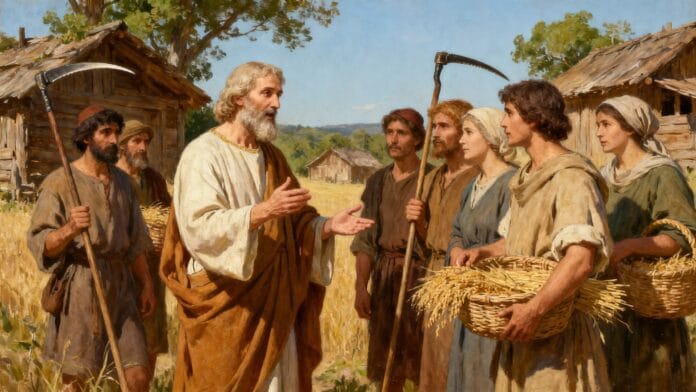
Reading from the second letter of Saint Paul the Apostle to the Thessalonians
Brothers,
You know perfectly well how to act to follow our example. We did not lead an undisciplined life among you; and the food we ate, we did not obtain without compensation. On the contrary, we worked day and night, toiling and exhausting ourselves so that we would not depend on any of you.
Of course, we could have been supported, but we wanted to set an example for you. And when we lived among you, we passed on this instruction: he who refuses to work must not eat either.
Now we hear that some among you are living in disorder, bustling about and producing nothing. To such people we give this command and exhortation in the name of the Lord Jesus Christ: to work quietly and earn their living.
Dear friend,
«If anyone is not willing to work, let him not eat.» Let’s face it, this little phrase from Saint Paul (2 Thessalonians 3:10) is enough to make us uneasy. It rings out like a verdict, it sounds harsh, almost merciless. We’ve heard it so many times, often brandished as a weapon to justify a rigid work ethic, to condemn those who are «on the sidelines,» or to sanctify performance. We can almost picture the Apostle as a stern foreman, pacing the Church workshop with a whip.
But is that really what Paul wants to tell us? Are we condemned to a mere "earning a living," a sad necessity for the right to survive? What if this verse, far from being a condemnation or an economic slogan, were in fact a pressing, almost fervent, invitation to rediscover the profound dignity of our daily work? What if it were less about economics than about spirituality, less about production than about… inner peace?
This message is addressed to you. To you who seek, perhaps with difficulty, to give a Christian meaning to your work, whether it be paid, domestic, voluntary, or even invisible. To you who question the delicate balance between prayer and action, between waiting for Heaven and building up on earth. Let us plunge together, without fear and with friendship, into this demanding passage of the Second letter to the Thessalonians. We might well find there, not a judge, but a guide, and a wisdom much gentler and more relevant to our busy lives than it seems.
- First, we will set the scene: the heated historical and theological context of Thessaloniki, where the expectation of Christ's return turned everything upside down.
- Next, we will analyze the heart of the problem: the "disorder" (the«ataxia) that Paul is fighting against, this sterile agitation which is not at all the same thing as laziness.
- Then, we will develop Paul's message along three main lines: the dignity of work as co-creation, the peril of modern agitation, and the true articulation between charity and responsibility.
- Finally, we will see how the Church tradition has meditated on this link between prayer and work, to draw very concrete paths for our spiritual life today.
Ready to deconstruct a cliché to find a treasure? Let's go.
A community in turmoil
To understand Paul's statement, we absolutely must leave our 21st century and land in Thessalonica, around the year 51 or 52. Thessalonica is a metropolis, a major commercial port teeming with activity, the capital of the Roman province of Macedonia. Paul had recently founded a Christian community there (you can read about it in the Book of Acts, chapter 17). It's a young, fervent community, composed mainly of former pagans, and living in a… let's say, electric atmosphere.
Why electric? Because the heart of Paul's first sermon (which we read in the first (letter to the Thessalonians) was the Parousia : the glorious and imminent return of the Lord Jesus. This was not a vague belief about the end times; for them, it was about tomorrow. This waiting was their joy, their strength, their absolute hope.
But this beautiful hope had an unexpected side effect, which Paul had to correct in his second letter. Some members of the community, convinced that the end of the world was literally for the next morning, drew a logical conclusion for them: "What's the point of working? What's the point of building, planting, managing, taking care of the affairs of this world that is going to disappear?"«
These people were therefore not simply "lazy" in the way we understand the term (slouching on a sofa simply out of a lack of motivation). They were what we might call "idle mystics." They had ceased all professional activity, not out of laziness, but because excess of eschatological zeal. They thought they were more spiritual than others by devoting themselves solely to waiting, to prayer, and... that's where the problem lies... to endless discussion.
The result? A double problem, which Paul identifies with great psychological and social acumen.
- A community problem: By ceasing to work, these "spiritual" people became financially "a burden" (v. 8) on the other members of the community. They lived off the backs of the fraternal charity. This created an obvious tension, an unfair imbalance within the fledgling Church.
- A spiritual and social problem: Idleness did not lead these people to peaceful contemplation. On the contrary, it made them "disorderly" (ataktos), a military term meaning "to break ranks." And Paul uses a brilliant play on words (v. 11): he learns that some are periergazomenous (busy, busy with everything and nothing, "busybodies" as the English would say) instead of being ergazomenous (working). They do not they did nothing, but they were very busy They spread rumors, caused a stir, questioned, criticized, and sowed discord in the community. Their idleness had become a source of unrest.
It's in This This is a very specific context, as Paul recalls his own example. Let's reread the text you already know:
«Brothers and sisters, you yourselves know how to imitate us. We were not idle when we were with you, nor did we receive the bread we ate without paying for it. On the contrary, we worked night and day, toiling and laboring so that we would not be a burden to any of you. We certainly have a right to be a burden, but we wanted to set an example for you to imitate. For even when we were with you, we gave you this rule: »If anyone is not willing to work, let him not eat.’ Now we hear that some among you are leading a disorderly life, busybodies doing nothing. To such people we command and urge in the Lord Jesus Christ that they work quietly and earn their living.” (2 Thessalonians 3:7-12)
Paul's challenge, therefore, is to restore order, to calm this eschatological fervor, and to remind everyone of their responsibility. The time of the Church, the time between the first and second coming of Christ, is not an empty time spent waiting on a train platform. It is a full time, a time for building, for loving, and… for working.
Imitation against disorder
Paul's guiding idea is not to establish an economic theory. His goal is pastoral and theological. The key word is the antidote to "disorder" (ataxia): it's imitation, the mimesis.
Look at the structure of his argument: he doesn't start with the law ("you must work"), he starts with his own testimony ("you know very well... what needs to be done to...") imitate us«Paul's authority does not come from a decree, it comes from his own life. It is a pedagogy of the incarnation.
And what is this model? That is the paradox of verse 9. Paul, as an Apostle, as the founder of the community, had the right (L'’exousia) to be materially supported by the community. He states this very clearly in other letters (for example, in 1 Corinthians 9). He had the right to "eat" without "working" (in the manual sense of the term), because his work was preaching. But in Thessalonica, faced with this specific problem of mystical idleness, he renounced to his right.
Why? "To be for you a model (Typos) to imitate.»
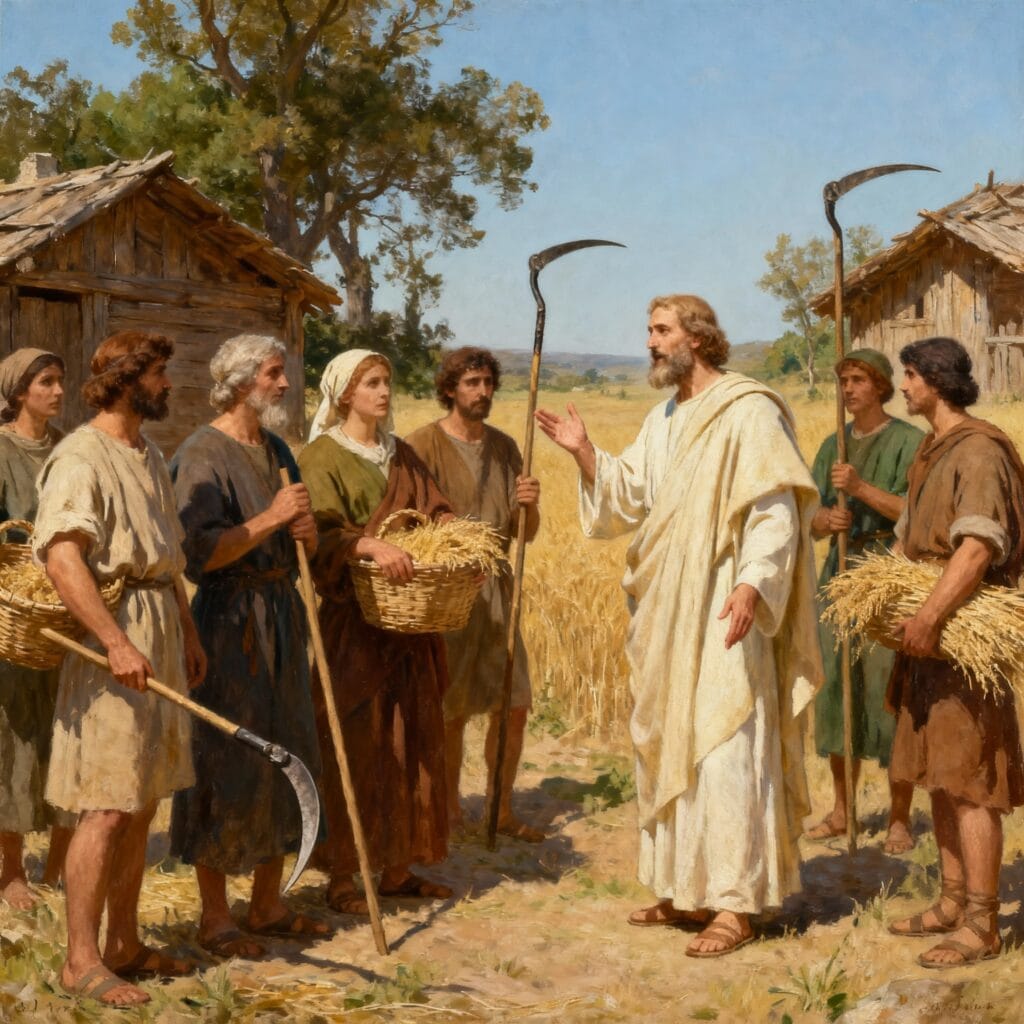
Paul continued his manual labor. We know from the Acts of the Apostles (Acts 18:3) that he was a tentmaker. And he didn't do it part-time. He states it emphatically: "In toil and hardship, night and day we worked." It was grueling work, extending into the night, by lamplight, after days of preaching. Paul wasn't playing at work. He was working. Really, harshly.
His work has a dual meaning:
- Independence (Not being a burden): He shows that he is not a charlatan who came to take advantage of people's credulity (a common criticism of itinerant philosophers of the time). His preaching is free, his love is selfless.
- The model (The imitation): He shows the Thessalonians that the work manual, the work of this world is absolutely not incompatible with the highest holiness and the expectation of the Lord. On the contrary, it is the very place where faith is lived.
The heart of the message is therefore this: the agitation (ataxiaThe behavior of "disorderly" people disrupts community harmony. The antidote is to return to calm and reality by imitating the concrete example of the Apostle, who himself imitates Christ (1 Cor 11:1).
And what is Paul's final prescription for these restless people? "Let them work" in peace (meta hēsychias) to eat the bread they will have earned.» (v. 12). The word hesychia (Calm, tranquility, peace) is fundamental. It is the exact opposite of agitation (periergiaPaul is not just asking for a return to production; he is asking for a return to the inner peace. The work It is not a punishment, it is the path to pacification. It anchors the feverish mind in reality, it orders the soul, it heals it of anxiety (even the spiritual anxiety of waiting).
The work It becomes an ascetic practice, a spiritual discipline, an act of faith that says: "Lord, I am waiting for you, but in the meantime, I am taking care of the world you have entrusted to me and the community you have given me."«
The dignity of work: labor as co-creation and a path to sanctification
When Paul exhorts the Thessalonians to work, he is not simply applying a band-aid to a local problem. He is drawing, perhaps without explicitly mentioning it, from a much deeper theology, that of origins: the theology of Creation.
We often have a distorted view of work, inherited from a quick reading of Genesis. We believe that the work is the consequence of the Fall, Adam's punishment. That's a mistake. Let's reread chapter 2 of Genesis, Before The Fall: «The Lord God took the man and put him in the garden of Eden to cultivate it and keep it. » (Gen 2, 15).
The work It is not a curse. It is humanity's original calling. It is the sign of our dignity. God, the Creator, makes man a co-creator. He entrusts the world to her not as a museum to contemplate, but as a garden to cultivate, a work to perfect. The work, Creativity, in its very essence, is participation in God's creative work. It is our way of responding to his "Let us make man in our image." We are in his image, among other reasons, because we are, like him, creators.
So what did the Fall (Genesis 3) change? It didn't introduced the work, She has abyss. She introduced into it "sorrow", "the sweat of your brow", thorns and thistles. The work, What was once a joyful collaboration with God has become labor, a struggle against a nature that has become resistant, and often, a source of alienation and exploitation of man by man.
But Christ came to redeem All man and All reality, including the work. And how so? This is an absolutely central point of our faith, and yet so often forgotten. For thirty years, almost his entire earthly life, what did Jesus do? He worked. He wasn't an idle monk, nor a salon philosopher, nor a political agitator. He was the Tektōn, the craftsman, the carpenter of Nazareth (Mk 6, 3).
These thirty years of "hidden life" are not a parenthesis, an insignificant "before." They are a theology in action. Through his daily labor, the smell of sawdust, the fatigue of his arms, the precision of the plane, and the negotiation with customers, the Son of God sanctified the work human. He showed that one could be fully united with God, be God made man, in the midst of the most ordinary, the most material, the most "down-to-earth" tasks. The work is not an obstacle to holiness; it is the ordinary path to it.
When Paul, the tentmaker, exhorts the Thessalonians to "work quietly," he is following this same line of thought. He is not asking them to "come back down to earth" by abandoning their spirituality. He is asking them to to find their spirituality in the land, in reality, in the work with their own hands. The work then becomes a form of embodiment of our faith.
Think about it: every time we work carefully, strive to do "good work," and put our intelligence and heart into a task (whether it's coding software, raising a child, cooking a meal, managing a file, or cleaning a floor), we perform an act of order. We take part in the chaos (a blank page, raw data, a messy room, hunger) and we put some cosmos (a written text, a clear analysis, a peaceful living space, a shared meal). This act of ordering the world is a profoundly divine act.
Paul reminds the Thessalonians that their vocation is not to flee the world, but to sanctify it from within. The work is the first place of this sanctification. It is an ascetic practice. It confronts us with our limits, with the resistance of reality; it demands of us patience, perseverance, the’humility. It protects us from the spiritual pride that consists of believing ourselves to be "above" material contingencies.
The work, In the Pauline vision, work is therefore not merely a means of "earning one's bread." It is a means of "gaining one's soul," of structuring it, pacifying it, and making it fruitful. By working, man builds himself up in the image of Christ the craftsman.
The danger of agitation: "Busy without doing anything" (Periergazomai)
Let us now enter into the heart of the pathology that Paul diagnoses. It is a spiritual illness that is perhaps one of the most widespread of our time: sterile restlessness.
Paul uses this famous Greek wordplay in verse 11: mēden ergazomenous alla periergazomenous. " Born working (ergazomai) to nothing, but busying (periergazomai) to everything. »
The verb ergazomai (Working) is noble. It comes from ergon, The work, the product, the tangible result. It is the work that which builds, that which nourishes, that which produces something real. The verb periergazomai (To busy oneself) is pejorative. It means "to work." around »"(peri-). It's being a "busybody", a jack-of-all-trades, a restless person. It's the kind of restlessness that stirs up a lot of air, makes a lot of noise, but produces nothing good.
The "disorderly ones" of Thessaloniki were not passive. On the contrary, they were hyperactive. But their activity was meaningless and unhealthily outward-looking: they interfered in the affairs of others, propagated feverish doctrines, and sowed discord. For them, idleness was not rest, but a playground for anxiety. Lacking the anchor of real work to weigh down their souls, their minds wandered in all directions, swept away by the fever of imminence.
Dear friends, does this not tell us anything, in the 21st century?
We perhaps live in the most periergazomenoi of history. We are constantly "busy." Our phones buzz with notifications, our inboxes overflow, our calendars are filled with "meetings" and "calls." We rush from one "emergency" to the next. We pride ourselves on being "busy." Busyness has become a marker of social status. If you're not busy, you're not important.
But let us ask ourselves the question Paul poses: in all this commotion, how many ergon, Real work? How much "bread" is "earned"? How much time do we spend "working" around » (answering all emails, being in every loop, scrolling through social media to "stay informed") and how much time do we spend produce the work itself (writing the report, coding the function, truly listening to the child, praying in silence)?
The Thessalonians' agitation was eschatological in nature (the end of the world). Ours is often technological or social (the fear of missing out, FOMO, performance pressure). But the spiritual result is the same: anxiety, distraction, and an inability to be "at peace" (hesychia).
Paul radically opposes agitation (periergia) and calm (hesychia). Agitation is a disease of the soul that is afraid of emptiness, afraid of reality, afraid of silence. The work, In the noble sense, it is the remedy.
Why? Because the TRUE work requires the presence. You can't write a profound text while looking at your notifications. You can't craft a beautiful piece of wood while thinking about ten things at once. You can't have a heart-healing conversation while being "busy." ergon It demands that we be there, present in what we are doing. It anchors us in the present moment. It forces us to confront matter, reality.
Paul's remedy is astonishingly modern. He tells these anxious and restless people: "Stop worrying about what is beyond you (the date of Christ's return) and what doesn't concern you (the affairs of others). Take one task. Just one. And do it. 'Work in peace.'"«
It is a call for inner order. It is a call to find our way back to peace through the path of reality. The work is a incarnation. It prevents us from escaping into disembodied spiritualities or frenetic distractions. It tells us: "Your place is here. Your duty is now. Sanctify yourself in this task, however humble it may be."«
Let us think of the Gospel. To Martha and Married (Luke 10). Martha is the one who is "agitated" (periespato, (a word from the same family) for the service. Married is the one who stands "in calm" at the feet of Jesus. Monastic tradition will say that the goal is not to oppose the two, but to become a "Martha with a heart of Married »That is to say: to act, to work, to serve (ergazomai), but to do it with a unified, peaceful soul, focused on the essentials (hesychia).
The "disorderly ones" of Thessalonica are a tragic parody of this synthesis. They have neither Martha's action (they serve no one and do not work) nor the contemplation of Married (They are restless, not at peace.) They are the worst of both worlds. Paul's call is a call to rediscover the unity of being: let your action be peaceful, and let your peace be active.
Charity, responsibility, and justice: "Let him not eat either."«
Let us now turn to the most striking and difficult sentence, that of verse 10: "If anyone is not willing to work, let him not eat."«
Taken out of context, this phrase is a bombshell. It has been used to justify the worst social abuses, to "break"« the poor, to refuse help to those in need. This is a total and tragic misinterpretation of Paul's thought and of the entirety of biblical revelation.
To understand it, you need to keep three key points of interpretation constantly in mind.
Key #1: The subject is not "the one who does not can not,» but «he who does not wanna not ". The Greek text is explicit: ei tis ou thelē ergazesthai. Thelō means "to want," "to have the will to." Paul is not talking at all about people who cannot work. He doesn't talk about the sick, the infirm, people with disabilities, the elderly, widows with young children (who were the very image of poverty in Antiquity), nor even those who, in our modern societies, can't find of work despite their efforts. All these people, the Bible (Old and New Testaments combined) commands us to support with radical generosity. Paul himself spent years of his life organizing a massive fundraising campaign for the poor of the Church of Jerusalem! Love for the poor is the very criterion of the Last Judgment (Matthew 25: "I was hungry, and you gave me something to eat"). Paul's statement does not apply than at a very specific group of "disorderly" people from Thessaloniki, able-bodied people, capable of working, but who refused to do so by choice, in the name of a flawed theological pretext.
Key #2: The context is that of charity community-based, not welfare-state-based. At the time, there was neither social security nor unemployment insurance. The survival of the most vulnerable depended entirely on the koinonia, communion and fraternal charity within the small Christian community. The first Christians "shared everything" (Act 2 and 4). Meals were shared, and the needs of widows and orphans were provided for. The "disorderly" people of Thessaloniki were abusing of this system. They took advantage of the generosity of their brothers and sisters who, in turn, worked hard. They "ate the bread of others without paying" (v. 8). Paul's problem is not to limit charity ; it's from protect. If the generosity of workers is constantly exploited by able-bodied people who refuse to contribute, what happens? Charity It's running out of steam. Donors are getting discouraged, becoming cynical. And in the end, who will be penalized? The true poor. Those who cannot work (widows, orphans, the sick) will have nothing left, because the "spiritual profiteers" will have taken everything. Paul's order is therefore an act of social justice internal to the community. It protects workers from exploitation and it protects the truly poor from the deprivation that the abuse of the "disorderly" risks creating.
Key #3: The goal is not punishment, but fraternal correction. «Let him not eat either» (v. 10). Does this mean that Paul is ordering them to be left to starve to death? Certainly not. It is a shock measure, a «pedagogy of consequence.» You must read the rest of the chapter. Paul says (vv. 14-15): «If anyone does not obey what we say in this letter, report him; do not associate with him, so that he would be ashamed (ina entrapē). But do not consider him an enemy, warn him like a brother."That's the key! The goal is the shame (in the biblical sense of "awakening") which leads to conversion. It is a therapeutic measure, not a death sentence. In practical terms, "that he not eat" probably meant: "Stop inviting him to communal meals (agape) where he comes to freely eat the fruits of others' labor. Let him feel, in his body, the consequence of his refusal to participate in the common effort." It is a form of temporary and educational "separation," to "shake him up" and bring him back to reason, "like a brother.".
Seen from this perspective, this verse is no longer a harsh capitalist slogan. It is a rule of profound communal wisdom. It teaches us an essential truth: charity Responsibility and food are not opposed. They are the two pillars of a just community. The "right to eat" (the right to live, the right to dignity) is fundamental. But for those who... can, This right is inseparable from the duty to contribute. True love (the agapeIt is not dependency that absolves people of responsibility; it is love that calls others to their own dignity, their own responsibility, their own capacity to "earn their own bread" and, in turn, to become a source of giving to others. Paul invites us to an intelligent charity, a charity that empowers, that does not confuse love with complacency, and that always protects, first and foremost, the most vulnerable.
The Echo of Labor: Work in the Rule and the Reform
Paul's reflections in Thessalonica have profoundly influenced the entire Christian spiritual tradition. The Church has constantly meditated on this balance between expecting Heaven and the work of the earth, between prayer (ora) and labor (labora).
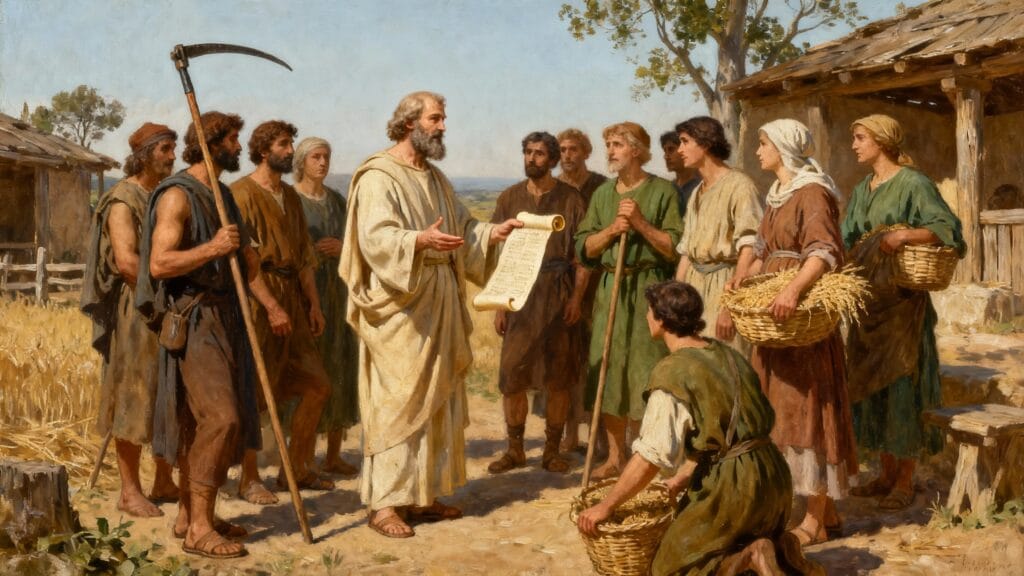
One of the greatest heirs to Pauline wisdom is undoubtedly Saint Benedict of Nursia, in the 6th century. His famous Ruler, which shaped European civilization, is a masterful implementation of 2 Thessalonians 3. Chapter 48 of the Rule begins with a sentence that appears to be Paul's direct commentary:« Otiositas inimica est animae »"(Idleness is the enemy of the soul).
For Benedict, as for Paul, idleness is not rest; it is an emptiness that gives way to the agitation of the mind, to the "wandering of the heart," to what the Desert Fathers they called it acedia (spiritual boredom, a distaste for effort). The antidote? A balanced life, punctuated by liturgical prayer (Opus Dei) And the work manual or intellectual. The famous Ora et Labora.
For the Benedictine monk, the work is not a "livelihood" (the community provides for its needs). It is a spiritual discipline.
- He anchor the monk in the’humility of reality, preventing it from soaring into spiritual pride (the same peril as that of the Thessalonians).
- He pacifist the mind. By concentrating on a manual task (gardening, copying manuscripts, baking), the soul gathers itself, it finds "calm" (hesychia) which Paul is talking about.
- He built the community. The work what each person contributes to all. It is the concrete expression of the fraternal charity and interdependence.
Later, the Protestant Reformation, notably with Martin Luther and John Calvin, brought about another revolution in the theology of work, still following in Paul's footsteps. They developed the notion of "vocation" (in German, Beruf, which means both "profession" and "calling"). Against a medieval vision that tended to over-spiritualize the monastic life or priestly (the "perfect life") at the expense of secular life, the Reformers asserted that All Honest work is a "vocation", a calling from God.
The baker who makes good bread, the mother who raises her children, the magistrate who dispenses justice, the farmer who plows his field… all perform a divine service, a «priesthood» in the world. There is no longer a hierarchy between the «spiritual» and the «temporal.» The whole world becomes the place of encounter with God, and the work is the preferred means. It is a tremendous revaluation of ordinary life, a sanctification of the everyday, which draws its lifeblood from the example of Christ the carpenter and Paul the tentmaker.
Finally, closer to home, the social doctrine of the Catholic Church developed this idea at length. In encyclicals such as Rerum Novarum (Leo XIII, 1891) or, in a striking manner, Laborem Exercens (John Paul II, ( , 1981), the Church affirms the eminent dignity of work. John Paul II wrote that the work is "a key, and probably the essential key, to the whole social question." He reminds us that the work is "for man" and not "man for the work »He defends the "priority of labor over capital" and the right to a just wage. This tradition, while combating the alienation and injustices of the world of work, constantly reminds us, with Paul, that labor is a path to fulfillment for humankind, a participation in God's work, and a service to the community.
From Paul to Benedict, from Luther to John Paul II, A common thread emerges: the work It is not an option, nor a curse, nor an idol. It is a path to holiness, a place of peace, an act of justice, and a service of love.
Anchoring one's soul in reality
How can we make this teaching of Paul resonate in our lives today? How can we move from theory to practice, so that our work (or lack thereof, or our restlessness) becomes a place of spiritual growth? Here are a few simple suggestions to try "in peace and quiet".
- Morning prayer (The offering of Ergon) : At the start of your day, take thirty seconds. Don't just ask for "courage to get through it." Offer your workday ahead. Offer your future tasks, your encounters, your difficulties. Ask for the grace to experience them not as a "busy" person (periergazomenos), but as a "craftsman" (ergazomenos), which seeks to do good, peaceful work, in service to others and for the glory of God.
- The anchor of reality (The antidote to’Ataxia) : When you feel yourself drifting into agitation, anxiety, and distraction (notifications, a thousand thoughts): stop. Breathe. And perform a very simple, very concrete action, mindfully. Put away a file on your desk. Wash a mug. Look out the window for a minute. Use this micro-task as an anchor, to bring your mind back to the present, "to calmness" (hesychia) what Paul is asking.
- Grace Revisited (Eating One's "Own" Bread): When you eat, whether it's a quick sandwich or a family meal, take a moment to be grateful. Give thanks for the meal. But connect it, like Paul, to work. Give thanks for the work (yours, or someone else's) that made this meal possible. If you work, recognize the dignity of "eating the bread you have earned." If you cannot work, receive this bread as the fruit of solidarity (the "work" of love for others), uniting yourself with them in prayer.
- Discerning agitation: In the middle of a task, ask yourself the question: "Am I currently to work or from meto do Am I focused on the work to be produced, or am I just wasting time to give myself the illusion of being busy? Does my action produce order or disorder?
- The hidden service: Identify a person whose the work, Often invisible, this work allows you to live or do your own job (housekeeping staff, IT support, administrative assistant, your spouse managing the household, etc.). Take a moment to recognize the dignity of this work and, if possible, express your gratitude. It is recognizing the "labor" of others that allows you to "eat.".
- Charity just : Examine your way of giving (your time, your money). Is it fair? Does it help the truly poor (those who don't can (not)? Is she empowers those who can Am I practicing? charity or to finance "the unrest"? It's a difficult question, but essential to understanding Paul.
The "calm" revolution«
We started with a sentence that seemed to us like a wall, a cold judgment: "If anyone is not willing to work, let him not eat." And, by putting it back into its context, by reading it with Paul, in the workshop of Christ the carpenter and under the gaze of the monks at work, we discovered an immense landscape.
No, Paul does not sanctify performance-based work, nor exploitation, nor harshness towards the poor. It's quite the opposite. He's calling us to a revolution. The revolution of the dignity Our work, whatever it may be, is the place where we participate in God's work. The revolution of the peace Our work is the antidote to the frenetic agitation of our souls, the path to finding "calm" by anchoring ourselves in reality. The revolution of the justice Our work is an expression of our solidarity, a way to "earn our bread" so as not to be a burden on others, and to protect charity intended for the most vulnerable.
The message of 2 Thessalonians 3 is a call to stop being spiritually or worldly "busy." It is a call to become peacemakers in the very fabric of our daily lives.
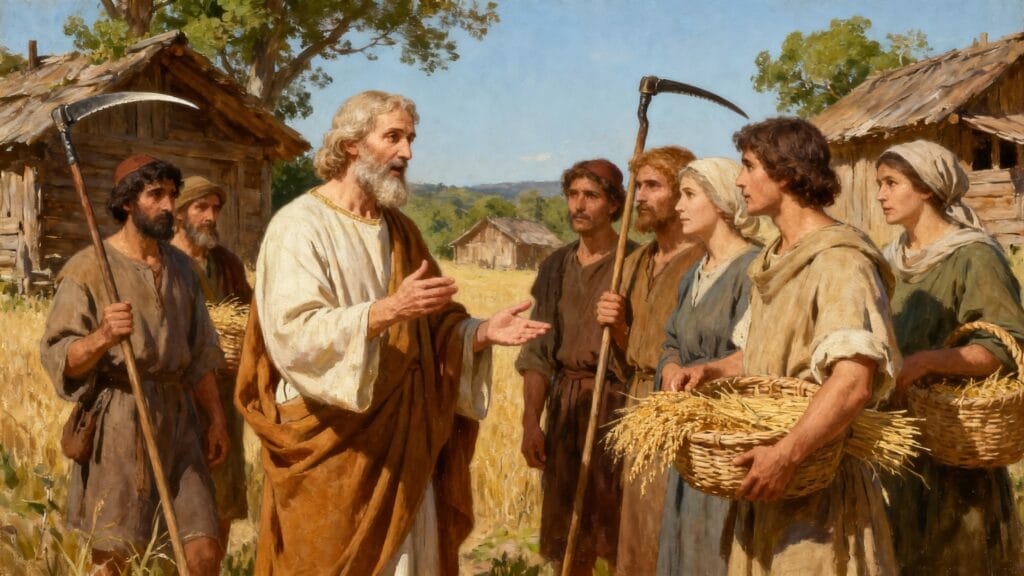
So, the next time you hear this phrase, don't think of a judge, but of a brother, Paul, reaching out to you, weary from his own work as a tentmaker, and saying to you affectionately: «My friend, don't get agitated. Don't lose yourself in the clouds or distractions. Take your rightful share of reality. Work. Do it 'in peace'. That's where you'll find your dignity, that's where you'll serve your brothers, and that's where, in the bread earned and shared, you'll find the Lord.‘
Some guidelines
- Reading : Reread the parallel passage in 1 Thessalonians 4:11-12: «Make it your goal to live quietly, to mind your own business, to work with your hands, as we commanded you.»
- Discernment: Identifying a "sterile agitation" (periergia) in your life (gossip, a addiction to social media, an anxiety) and contrast it with "real work" (ergon) concrete (a service, a specific task, a time of silent prayer).
- Justice : During your next act of charity, ask yourself: how can this donation be a lever for the dignity and the responsibility of the person being helped, and not just assistance?
- Awareness : To perform a manual task (cooking, gardening, cleaning, DIY) mindfully, experiencing it not as a chore, but as an act of order and pacification of the soul.
- Training: To learn more, read some passages from the encyclical. Laborem Exercens of John Paul II, which offers a magnificent synthesis of the Christian theology of work.
References
- Primary biblical texts:
- 2 Thessalonians, chapter 3
- 1 Thessalonians, chapter 4
- Genesis, chapters 2 and 3
- Acts of the Apostles, Chapters 17 and 18
- 1 Corinthians, chapter 9
- Tradition and Magisterium:
- Saint Benedict of Nursia, The Rule of Saint Benedict, (Chapter 48: "Daily manual labor").
- John Paul II, Encyclical Letter Laborem Exercens (1981).
- Theological and spiritual works:
- Marie-Dominique Chenu, OP, Towards a theology of work, Seuil. (A classic on the Christian view of work).
- Jacques Philippe, Peace interior, Published by Éditions des Béatitudes. (An excellent modern reflection on the struggle against inner turmoil).