

- Ezekiel 18: Your past does not determine your future before God
- The movement of the text: open your eyes, turn around, live
- The weight of the past is not inevitable.
- The stability achieved is a dangerous illusion
- What God truly sees: the present moment that turns towards him
- Practical implications for everyday life
- Echoes in tradition
- Lectio divina
- Meditation prompts
- Current challenges
- Conclusion
- Practices
- References
- ✝ Biblical references
A reading from the book of the prophet Ezekiel
25You say, «The way of the Lord is not right?» Listen then, house of Israel: Is it my way that is not right? Are not your ways not right? 26When a righteous person turns away from their righteousness and commits iniquity, and dies because of it, it is because of the iniquity they have committed that they die. 27And if the wicked man turns from the wickedness he has practiced and acts according to justice and righteousness, he will save his soul. 28If he opens his eyes and turns away from all the transgressions he has committed, he will certainly live and he will not die.
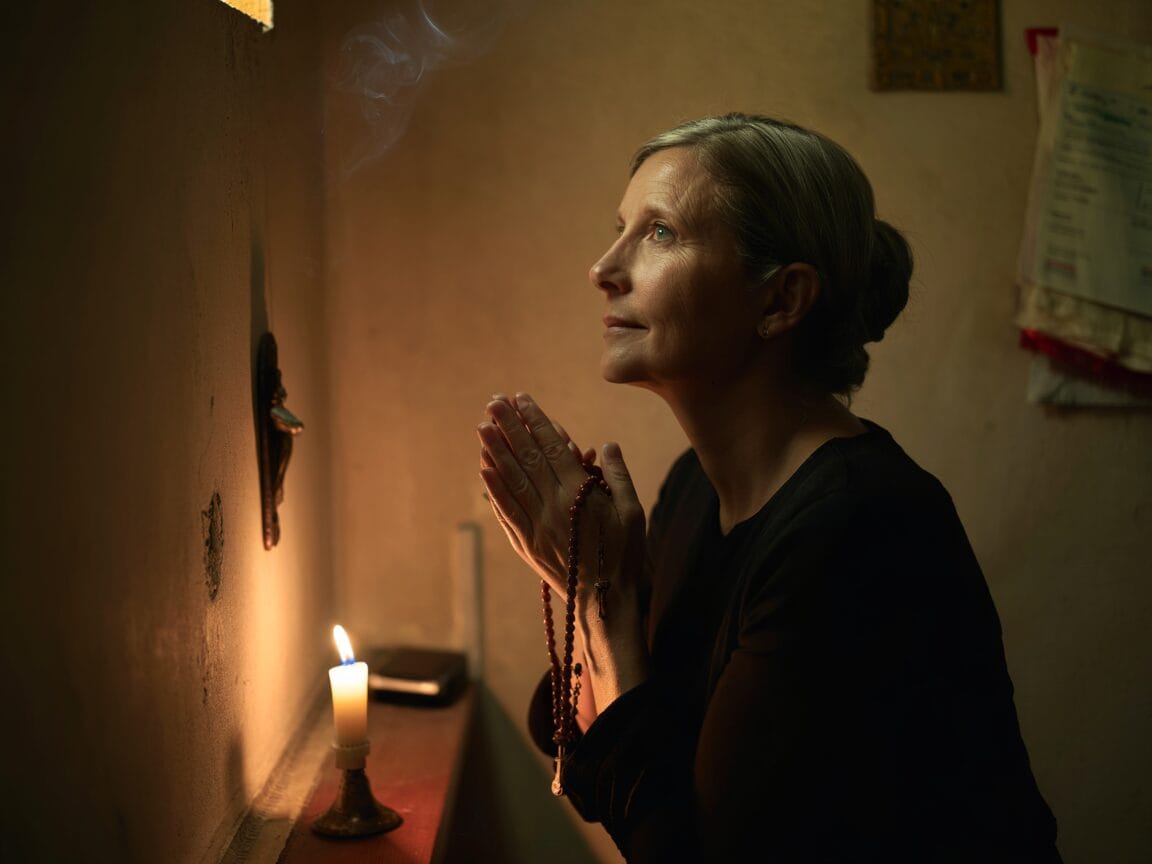
There is a man who has done evil all his life. He knows it, his neighbors know it, and he himself no longer deludes himself about what he has become. And yet one morning, something gives way within him. He opens his eyes—not just his eyelids, but his whole gaze upon the crooked things he has built. He turns away. He changes course, as one abandons a path one knows to be a dead end.
Around him, people murmur: «Too late. What he did, he did. Justice can’t erase it with a simple U-turn.» But God speaks, and he refutes this countdown logic. He doesn’t ask for a clean slate. He asks for a present turned toward good. «He will live,» he says, without any further conditions, without any punishment to serve beforehand. And conversely, he warns the righteous man entrenched in his righteousness as if it were an acquired right: no one is immune to their own failings, no one lives off the gains of a virtuous past.
This text overturns an accounting that we all keep, in secret, about ourselves and others.
Ezekiel 18: Your past does not determine your future before God
Ezekiel speaks from Babylon, in exile, around 593-571 BCE. His people have just experienced total collapse: Jerusalem destroyed, the Temple razed, the elite forcibly deported hundreds of kilometers from their homes. In this context of catastrophe, a phrase circulates among the exiles as a ready-made explanation for their misfortune: "The fathers have eaten sour grapes, and the children's teeth are set on edge"—in other words, we are paying for the sins of our ancestors. It is a fatalistic saying, almost a slogan of collective resignation.

Ezekiel directly confronts this idea in the entirety of chapter 18, of which our passage forms the powerful conclusion. He does not deny that evil has real and sometimes transgenerational consequences in human history. But he refuses to let this logic become a theological prison—the idea that each person's fate is predetermined, inherited, imposed from the outside, without any connection to their own present choices.
The people, for their part, turn the accusation back on God himself: «The Lord’s way is not right.» In other words: this God who punishes indiscriminately is unjust. Ezekiel recounts this complaint with astonishing candor—the biblical text doesn't shy away from quoting the people's revolt against their God verbatim.
It is within this tension that God responds, through the prophet. And his response is a complete reversal of expectations. It is not the past that determines someone's fate, he says, but the current direction of their life. The wicked who turn away will live. The righteous who stray will die. No moral capital is acquired forever; no sin is an irreversible sentence.
It is essential to understand that this message is addressed to a people brought to their knees, tempted by despair or sterile accusation. It tells them: your future is not sealed by your past, nor by that of your ancestors. Every day, the door remains open. This is a message of crisis that rejects fatalism, both the kind that burdens others and the kind that excuses our own inaction.
The Hebrew word used for "to turn away," shuv, is the same one that gives us the notion of teshuvah, return, conversion in the most concrete sense: literally, to turn around. It is not a feeling of regret. It is a movement, a physical step in another direction.
The movement of the text: open your eyes, turn around, live
This text actually tells a single story, repeated in two opposing forms: we believe our destiny is fixed — then we discover that it is not.
The pattern is easy to follow. First, an accusation: God is unjust. Then, an example contrary to what the people expected: the righteous person who falls into evil cannot invoke their virtuous past to save themselves. Then the opposite example, the one we are concerned with: the wicked person who turns to good is not held prisoner by their evil past. Finally, the keystone: "He opened his eyes and turned away from his sins. He will certainly live."«
This little verb, "to open one's eyes," deserves our attention. Before a change in behavior, there is a change in perspective. A person doesn't simply alter their behavior out of calculation or fear of consequences—something within them finally sees what they were doing, and this new vision makes turning back possible. We never truly turn away from what we haven't first seen directly.

Why does this still matter today, thousands of years later? Because we all carry within us, somewhere deep down, a secret theology of fixed reckoning. We judge others by their past—"it's always been like that"—and we sometimes judge ourselves in the same way, with a severity that forbids any fresh start. This text cracks that prison. It doesn't say the past doesn't exist. It says the past doesn't have the final say on who we are becoming.
And there's a dangerous downside to this good news: the stability gained doesn't work both ways. The righteous person who rests on their past actions, who ceases to be vigilant, can fall. This is a statement that disturbs both sides—those who despair of ever getting back on their feet, and those who believe themselves safe because they have always been upright.
This text already foreshadows, without fully realizing it yet, what the Gospel will later reveal in full light: that God does not judge man by his past, but by what he is now turning towards. The good thief on the cross, converted at the last hour, will be the most moving illustration of this—a man whose entire life was wicked, and who "opens his eyes" in a single final moment.
The weight of the past is not inevitable.
We often live as if our history condemns us or guarantees us something. Let's take a simple example: a man has lied to his family for years about his finances, out of shame, fear, or ingrained habit. One day, he decides to tell everything. His first thought, often, isn't "I'll finally be free" but "It's too late, the damage is done, I might as well keep lying since I'm a liar anyway." This is precisely the logic that Ezekiel dismantles.
The text makes a radical assertion: it is not the sum of our past actions that defines us, but the direction in which we walk today. This does not mean that the concrete consequences of lying disappear—rebuilding trust takes time, and the damage is real. But before God, the person who confesses is no longer "the liar." They are the one who has opened their eyes.
This logic directly opposes the paralyzing guilt that says, "What I did is too serious to change anything now." Ezekiel responds: no, it changes everything, precisely because it begins now. The past weighs heavily, but it doesn't lock anything in place.
There is immense liberation in this for anyone carrying an old wrong like an immutable burden—an addiction that has passed but was never truly acknowledged, a rift caused by pride, a neglect of a child who has grown up. The text says: the reckoning is never over as long as you live. There is always the possibility of turning back.
The stability achieved is a dangerous illusion
The other side of this text is less comfortable, and that's precisely why it deserves to be confronted. "If a righteous person turns from their righteousness, commits evil, and dies in that state, it is because of their evil that they will die." No amount of virtue can protect someone from their own present failings.
Consider someone who has led an honest professional life for thirty years, respected by all, and who, late in life, gives in to a minor dishonesty, justifying it by all that they have "deserved" before. "I've been upright all my life, I can afford this." This is precisely the trap Ezekiel denounces. Uprightness is not a bank account that can be withdrawn without consequence. It is lived in the present, day after day, or it erodes.
This truth also applies to ordinary spiritual life. One can pray faithfully for decades and gradually allow prayer to become an empty routine, without ever realizing it, because one believes oneself protected by one's long-standing faith. The biblical text rejects this false security. It calls for constant vigilance, not out of scrupulous anxiety, but out of realism: we are beings in motion, never definitively settled.
There is a profound humility to be drawn from this passage: no one, regardless of their past, is immune to their own downfall — and no one, regardless of their past, is trapped in their own downfall.
What God truly sees: the present moment that turns towards him
At the heart of this text lies a statement about the very nature of God. «Is it my conduct that is wrong?» he asks, almost wounded by the accusation. The people imagined a God who kept records of accumulated sins, automatically handing out sentences. Ezekiel reveals a God who looks at the heart as it turns, not at the archived file.
This profoundly changes our understanding of divine judgment. It is not the cold reading of an account book. It is the recognition of what someone is becoming, at the very moment we observe them. «Certainly, he will live»—this certainty is not arbitrary; it is the logical consequence of a God who takes human freedom and the real movement of every existence seriously.
Therein lies a divine lesson for how we see others. We tend to fix people in what they have been—"he's always been like that," "I know him, he'll never change." This text invites us to see them more like God: to look for the present movement in others rather than past statistics.

Practical implications for everyday life
In family life, this text encourages us never to confine a loved one to their past. A child who has lied once is not "a liar" forever; a spouse who has hurt someone can truly change, and refusing this on principle is to contradict what God himself refuses to do.
In professional life, he reminds us that no amount of long-standing virtue can replace daily vigilance — integrity is renewed every day, not once and for all.
In the personal spiritual life, it offers a way out to anyone who feels condemned by their past sins: the sacrament of reconciliation, in the Catholic tradition, applies this logic very concretely — sins are not listed to make them weigh more heavily, eyes are opened to turn away, and absolution proclaims the same certainty as Ezekiel: "he will live".
In a broader societal perspective, this text opposes any culture of permanent erasure, where a past wrong, even acknowledged and resolved, would condemn someone without hope of redemption. This does not preclude restorative justice—but it rejects the final verdict.
Echoes in tradition
John Chrysostom
In his *Homilies on Genesis*, homily XIX, John Chrysostom comments at length on divine mercy, which never judges a person by their past sins but by their present repentance. He explicitly draws on the logic of Ezekiel 18 to exhort his listeners never to despair of their own conversion, regardless of the gravity of their past lives. He emphasizes that God rejoices more in the return of a sinner than in the quiet perseverance of a righteous person who has never strayed—an argument he derives directly from the logic of our passage.
Augustine of Hippo
In his *Confessions*, Book VIII, Augustine recounts his own experience of Ezekiel's about-turn: years of deliberate drifting, then a precise moment when his eyes are opened, in the garden of Milan, under the fig tree. He does not present his conversion as the magical erasure of his disordered past, but as a radical change of direction that renders this past ineffective in shaping his future—precisely the logic of Ezekiel's text, experienced in concrete terms.
Thomas Aquinas
In the *Summa Theologica*, when dealing with penance, Thomas Aquinas relies on Ezekiel 18 to establish that authentic conversion erases the eternal punishment attached to sin, even if temporal consequences may remain — a valuable distinction which helps to understand why the text does not cancel the concrete damage of the evil committed while affirming the real possibility of salvation.
Contemporary liturgical resonance This text is proclaimed on Wednesday of the twenty-fifth week of Ordinary Time in the lectionary for weekday Mass, and it profoundly permeates the Lenten liturgy, where the Church emphasizes this same dynamic each year: opening our eyes, turning away, and being reborn. The rite of communal reconciliation, widely celebrated during this period, concretely embodies the logic of this prophetic text.
Lectio divina
«He opened his eyes and turned away from his sins. He will certainly live.» Ezekiel 18:28
There's an old sin within you that you carry like an irrevocable sentence. Ezekiel isn't asking you to forget what happened. He's asking if you've truly opened your eyes to it, or if you continue to look away so you don't have to change course. What direction is your life taking, right now, today? Are you still judging yourself based on a past that God has already stopped looking at?
Lord, you don't look at my record, you look at my face turned toward you this morning. Grant me the grace to see what I still refuse to see within myself. Teach me not to settle into my own righteousness as if it were a given. Lift me from the weight of a past I drag around needlessly. Make me someone who turns to you each day, regardless of the times I have fallen. Give me the certainty you offer to those who return: I shall live.
A man who had been motionless for years silently took a single step towards the light.
Meditation prompts
Take a moment of silence and ask yourself this simple question: what old mistake do you continue to carry as if it defined you forever? Name it internally, without judging yourself.
Next, ask yourself the opposite: on what moral assumption are you perhaps relying too comfortably, relaxing your vigilance in the present moment?
Finish with a concrete action: write on a piece of paper a phrase that you repeat to yourself too often about your own past — "I am like this", "it's too late" — then cross it out, physically, like a visible U-turn.
Current challenges
Our era is experiencing a strange tension surrounding this text. On the one hand, a culture of second chances seems to be celebrated everywhere—there's much talk of resilience, bouncing back, and personal transformation. On the other hand, these same societies often practice an implacable digital memory: nothing is ever truly erased, every past mistake can resurface and condemn definitively, without any possibility of demonstrating real change.
Ezekiel speaks directly to this contradiction. He asserts that a genuine change of direction must be recognized as real, not perpetually suspected or denied. This does not mean being naive about repeat offenses or forgetting the victims—but it does mean rejecting the very principle that a past wrong condemns someone eternally, regardless of their subsequent actions.
The text also challenges our temptation toward fatalistic identity politics—the idea that "I am the way I am, it will never change," which often serves as a convenient excuse for never truly questioning ourselves. Ezekiel dismantles this excuse at its root: no one is a prisoner of who they have been.
Conclusion
This text is not an abstract lesson on divine justice. It is an outstretched hand to anyone who believes themselves condemned by their past, and a warning to anyone who believes themselves safe because of their past achievements. The question it poses is not "What have you done?" but "Where do you turn now?"«
No one is too far gone to turn back. No one is too settled to stop watching. It is a harsh and gentle saying at the same time — harsh because it rejects all acquired comfort, gentle because it rejects all definitive despair.
Practices
Name an old fault that you still carry as a sentence, and entrust it concretely in the sacrament of reconciliation — not to magically erase it, but to truly experience the U-turn.
Reread your week each evening, looking not for your mistakes to list, but for the general direction of your choices: what are you turning towards right now?
Resist the urge to trap a loved one in their past — choose a specific person and consciously decide to look at them according to what they are becoming.
If you feel spiritually established, ask yourself one unsettling question each week: where might I be letting my guard down without realizing it?
Read Ezekiel 18 in its entirety this week, not just the six verses of the liturgy, to grasp the magnitude of the reversal that God is proposing to his people.
Pray every day this week with the phrase "open my eyes", thinking specifically of a concrete area of your life where you feel a resistance to seeing clearly.
References
Antiquity and the Fathers (1st–5th centuries)
- John Chrysostom, *Homilies on Genesis*, homily XIX — meditation on divine mercy which prioritizes present repentance over past sins, relying on the logic of Ezekiel 18 to encourage conversion at any age of life.
- Augustine of Hippo, *Confessions*, Book VIII — personal account of the inner about-turn under the fig tree of Milan, a lived illustration of the dynamic «open your eyes, turn away, live» described by the prophet.
Late Fathers and the Middle Ages (5th–15th centuries)
- Thomas Aquinas, *Summa Theologica*, IIIa, question on penance — analysis of authentic conversion as the erasure of the eternal punishment of sin despite the possible persistence of temporal consequences, in direct connection with Ezekiel 18.
✝ Biblical references
1 passage · 1 book
I will give you a new heart and put a new spirit in you. (Ezekiel 36:26)
Apocalyptic visions, oracles of judgment, and the promise of the restoration of Israel.
→ Explore the Ezekiel Codex- Buffalo: When living stones stand firm against the hammer of spreadsheets
- Florida: Two Catholic governors, two paths in the face of death
- Mercy or impunity? What the Spina case reveals about the fractures in the Church of France
- Florida, a laboratory for a "culture of death": when a Catholic governor defies his bishops

🗺 Map
 IN
 IN
 IN
 IN
 IN
Recommended reading
The historic English translation by the English Dominicans, presented here in a complete and navigable digital edition with a table of contents. A free or nearly free resource for anyone seeking the full text of the Summa without the expense of a scholarly edition. Ideal as a complement to Kreeft's anthology for a deeper exploration of the text itself.
View on Amazon →
The best entry point into Thomistic thought in English: Kreeft selects the essential philosophical passages from the Summa Theologica and accompanies them with notes that clarify every technical difficulty. Originally intended for students, this book remains the standard reference for anyone who wants to read Thomas himself rather than a summary. A must for any serious English-speaking reader.
View on Amazon →
The definitive English translation of the Confessions, hailed by critics as the most readable and faithful available in modern English. Henry Chadwick, Oxford's eminent patrologist, adds notes of great historical and theological richness. The quintessential Oxford World's Classics edition for discovering this masterpiece in English.
View on Amazon →
A biography that breaks with the traditional narrative by examining the Confessions themselves as a literary construct rather than a simple testimony. O'Donnell, a renowned scholar who produced the definitive critical edition of the Confessions, offers a more political and ambiguous portrait of the Bishop of Hippo. A stimulating and erudite counterpoint to classic biographies.
View on Amazon →
Considered by Thomists like Gilson and Maritain as one of the finest introductions ever written to Thomas Aquinas, this 1933 biography combines erudition with a flamboyant style. Chesterton portrays an intellectual giant with humor and depth, without ever sacrificing rigor. A lively text that inspires the reader to discover the Summa Theologica itself.
View on Amazon →
Considered the definitive scholarly biography in English, this study traces with rare erudition the entirety of Chrysostom's life, from his asceticism in Antioch to his exile and death in Armenia. Kelly, a leading Oxford patrologist, paints a nuanced portrait of an upright yet tragic man, whose own weaknesses precipitated his downfall. A demanding work, but…
View on Amazon →
A definitive introduction in English, written by two of today's leading Chrysostom scholars, which situates the preacher in his concrete role as deacon, priest, and then bishop in service to his people. The book offers vivid and faithful translations of selected sermons and letters, allowing the reader to hear the saint's voice directly. An essential resource for…
View on Amazon →
A classic of popular Thomistic thought, designed to make the substance of the Summa Theologica accessible to ordinary believers without scholastic jargon. Organized in a question-and-answer format like a catechism, this book has been the gentlest gateway to Thomas's thought for a century. Perfect for a non-academic audience who nevertheless wish to grasp the heart of…
View on Amazon →
Edited by the current director of the Institute of Christian Sources, this collection brings together nine studies that profoundly renew our understanding of Chrysostom's exegesis, from its technical terminology to its use of biblical figures such as Cain and Paul in Athens. It draws upon the 38,000 biblical references that Chrysostom left in his work, the most extensive of all…
View on Amazon →
The definitive international biography of Augustine, hailed for over fifty years as an essential classic. Peter Brown traces with rare erudition the life of a man shaped by the encounter of two worlds: the end of Antiquity and the dawn of Christianity. A lengthy epilogue takes into account the discovery of previously unpublished letters and sermons that have shed new light on his life…
View on Amazon →
The definitive Dominican translation, published by Cerf, which has trained generations of seminarians and French-speaking students. This first volume covers the existence of God and how creatures know Him, the foundation of the entire Thomistic edifice. A classic purchase for anyone who wants the authoritative French print version, rather than the complete Kindle edition.
View on Amazon →
A masterful biography by one of France's foremost specialists in Roman Africa, a renowned archaeologist and Latinist. Lancel presents Augustine in all his complexity, from the man torn apart by his youthful passions to the bishop who became the intellectual touchstone of Latin Christianity. A dense and rigorous work, admired for the subtlety of its human portrait as much as for its historical mastery.
View on Amazon →
This dialogue is John Chrysostom's most widely read and admired work on the dignity and formidable demands of the priestly ministry. For fifteen centuries, it has been an essential reference for the formation of clerics, from Saint Jerome to Vatican II. This bilingual Greek-French edition, based on the finest manuscripts and compiled by the renowned patrologist Anne-Marie Malingrey, offers…
View on Amazon →
The masterpiece of Thomas Aquinas, available in its entirety in a single digital volume at a modest price. A comprehensive synthesis of faith and reason, organized into questions and articles, which shaped all subsequent Catholic theology. Ideal for anyone who wants to own the complete text without investing in an expensive scholarly edition.
View on Amazon →
The only readily available comprehensive French biography for discovering the entirety of Chrysostom's life, from his childhood in Antioch to his death in exile. Brändle recounts, without embellishment or caricature, his journey as a hermit, preacher, and then bishop in conflict with imperial power, in language accessible to the non-specialist reader. An excellent starting point before delving into…
View on Amazon →
This recent and accessible handbook succeeds the now out-of-print major introductions (Quasten, Sister Gabriel Peters) by combining scholarly rigor with pedagogical clarity for any reader curious about the first eight centuries of the Church. Chrysostom is presented within the broader context of the Greek and Latin Fathers, allowing the reader to appreciate his unique place among his contemporaries. A library of…
View on Amazon →
An unconventional biography, written by the master of paradox, that engages as much with the modern reader as with the 13th century. Chesterton blends history, philosophy, and cultural criticism to offer a vivid and ever-evolving portrait of Aquinas. A true intellectual delight, available in a very affordable Kindle edition.
View on Amazon →
A bilingual Latin-Italian edition that allows you to verify each Thomistic formula in its original language while following a faithful translation. Despite the doubled text, its compact format is designed for sustained study rather than simple consultation. A good compromise between philological rigor and a reasonable price for the Prima Pars.
View on Amazon →
The biography that Maritain and Pegis considered the best ever written on Thomas, presented here in a beautiful Italian translation. Chesterton paints a witty and insightful portrait of the great saint of the Catholic Church, from his rebellious youth to his teaching in Paris. A text accessible to all non-specialist readers, believers or not.
View on Amazon →
A Thomist Dominican here condenses the entire structure of the Summa Theologica into a short and clear volume, without ever betraying the rigor of the original text. Designed for the general Italian public who wish to grasp the overall coherence of the work before venturing into the complete text, it is an excellent entry point before scholarly reading.
View on Amazon →
Chesterton, grappling with the challenge of summarizing such a giant, nevertheless delivers one of the most accomplished studies ever devoted to the great scholastic doctor. The text blends erudition and humor, retracing in eight chapters the life of a man nicknamed "the Ox" for his imposing stature as much as for his deceptive silence. A lively read, much appreciated by readers…
View on Amazon →
Josef Pieper, one of the greatest German Thomists of the 20th century, recounts here, in just a few pages, the life and work of Aquinas with remarkable clarity. This small book is recognized as an ideal introduction to Thomism in German, neither simplistic nor dry, written by someone who dedicated his life to keeping Thomistic thought alive. A classic reference…
View on Amazon →
Die full text summa theologiae in einer preisgünstigen digitalen Ausgabe. Thomas entfaltet hier ein System, das Glauben und Vernunft seiner Zeit systematisch aufeinander bezieht und bis heute die katholische Theologie prägt. A solid Möglichkeit, sich das Hauptwerk ohne hohe Anschaffungskosten anzueignen.
View on Amazon →