












Gospel of Jesus Christ according to Saint Luke
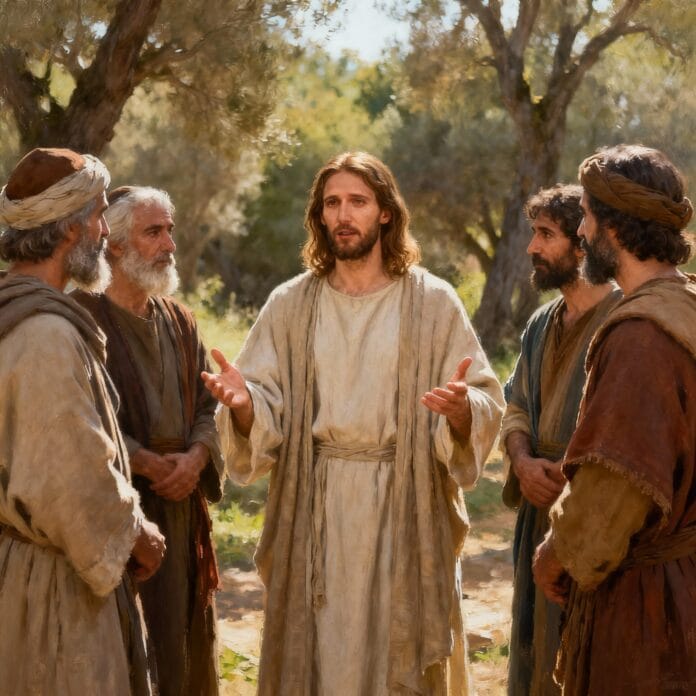
At that time, Jesus said to his disciples:
«But I tell you, use the deceptive riches to make friends for yourselves, so that when they fail, they may receive you into the eternal dwellings.
He who is trustworthy in small matters is trustworthy in big matters. He who is dishonest in small matters is dishonest in big matters.
If you have not been trustworthy with deceptive wealth, who will entrust you with true wealth? And if you have not been trustworthy with what belongs to others, who will give you what is your own?
No servant can serve two masters: either he will hate the one and love the other, or he will be devoted to the one and despise the other. You cannot serve God and money at the same time.»
When the Pharisees, who were lovers of money, heard all this, they mocked Jesus. He said to them, «You are those who justify yourselves in the eyes of men, but God knows your hearts. What men value is an abomination in God’s sight.»
Serving God rather than money: rediscovering true wealth
How trust in small things shapes our capacity to receive true good
Each passes through our hands Fragile Goods Day money, power, influence, reputation. Yet, the Gospel reminds us that divine trust is earned in loyalty to the humblest things. This article explores the parable of the dishonest manager (Luke 16:9-15) to discern a luminous call: to learn to handle money with a free heart, in order to become worthy of "true good," that which cannot be bought. This discernment is addressed to every disciple active in the world.
- To situate the Gospel passage and its spiritual use
- Analyzing the paradox of "dishonest money"«
- To develop three axes: loyalty, freedom, spiritual friendship
- Explore the practical applications in everyday life
- Connecting the teachings of Christ to tradition
- To offer a prayer, a practice, an examination of conscience
Context: a lesson on fidelity in earthly possessions
The episode of Luke 16 is part of a set of parables where Jesus explains the proper use of wealth, immediately following the example of the unfaithful manager. This passage is addressed first to the disciples, then, by contrast, to the Pharisees, "lovers of money," who ridicule his message. The contrast is striking: between earthly economics, governed by immediate self-interest, and divine economics, founded on trust and the righteousness of the heart.
The expression "dishonest money" does not condemn money itself, but the system it represents: the money of an unequal world, marked by corruption and human vanity. Jesus does not ask us to flee from this money, but to make it an instrument of charity and lasting friendship. Paradoxically, it is precisely in this management of imperfect goods that God assesses our capacity to receive what is imperishable: grace. peace, communion with him.
The "friends" mentioned are not accomplices, but rather those relationships of solidarity and love that open the doors to "eternal dwellings." Money then becomes a test of trust: what do we do with what we only partially possess? Are we faithful, just, transparent? This discernment sheds light on modern economic structures, where the temptation of dual service—to God and money—remains strong.
This context invites us to read this passage as a deliberate juxtaposition: Jesus confronts two incompatible logics. The divided heart becomes incapable of receiving the "true good." God desires stewards who are clear-sighted, free, and trusting, capable of transforming the small into the great, the temporal into the eternal.
Analysis: Trust, a measure of the Kingdom
The central theme of this text is the gradualness of trust. Jesus connects three levels: responsibility in small things, integrity in managing money, and the capacity to receive spiritual treasure. The criterion of faithfulness is not the quantity possessed, but the rightness of intention.
The term "trustworthy" (pistos in Greek) evokes faith itself: to be reliable, constant, true. God reveals himself as a master seeking trustworthy servants. The disciple, in turn, becomes a mirror of this God reliable. In this symmetry, money is merely a training ground; it shapes the heart for increasingly profound missions.
Dishonest money is therefore less a thing than a ethical test. Its seductive power exposes our priorities. The way we use it reveals what we seek: security, recognition, or communion. Jesus denounces the Pharisees not for their material comfort, but for their duplicity: they play the role of the righteous without revealing their hearts.
This parable establishes a realistic pedagogy: God begins by entrusting to us what belongs to others, what is external (time, talents(wealth), before giving us what is truly ours – participation in his life. By omitting loyalty By using material means we distort this process; by embracing it, we open ourselves to the coherence of the Kingdom.
Loyalty in the little things
It is often in ordinary decisions that our true relationship with God is played out. Honestly keeping track of our finances, paying our employees a fair wage, not giving in to deceit—all of this is spiritual. Holiness is not outside the world: it is rooted in the precision of a daily act performed with integrity.
Let's take the example of a small family business. The owner chooses to pay his suppliers even when deadlines are tight. This choice doesn't yield immediate returns, but it creates a culture of reliability. Spiritually, it demonstrates inner unity: serving God, not money.
This ordinary faithfulness forges an inner muscle: that of truth. From an evangelical perspective, those who are faithful in little receive more, for God measures depth, not size. Loyalty learns constancy; constancy becomes confidence; confidence opens the way to grace.
Freedom versus money
«You cannot serve both God and money.» That says it all. To serve implies obedience, dependence, and identification with a logic. But money imposes its own: calculation, profit, power. To serve God is to adopt a different system of values: selflessness, altruism, and trust.
Living this inner freedom doesn't mean despising wealth, but rather putting it into perspective. The economy of the Kingdom doesn't forbid possessing, but rather allowing oneself to be possessed. One can live in abundance while remaining poor in spirit. This requires constant discernment: with every financial decision, ask yourself, "Does this act bind me or does it liberate me?"«
Friendship as a true good
Jesus links the use of money to building lasting friendships. These relationships, based on giving, contribute to true good. In a fragmented society where wealth isolates, this teaching has regained a burning relevance: money becomes a sign of communion when it is used to serve others.
One can imagine a modern Christian leader funding charitable projects, not to improve their image, but to build a network of fraternity. These "friends" carry a share of eternity, for they embody the relationship that God establishes with humankind. Spiritual friendship, in patristic theology, is the best measure of charity real.
Practical applications: living out economic virtue on a daily basis
Three spheres can accommodate this parabola:
- Personal life : to make every expense an implicit prayer. To ask oneself: "Does this purchase bring my heart of God or myself?»
- Professional life : putting financial decisions at the service of the common good. Transparent management becomes an act of faith.
- Community life : to encourage circuits of generosity – mutual aid, microcredit, hidden donations – as concrete signs of the Kingdom.
These commitments unleash a new joy: the coherence between economics and faith. Where calculation once reigned, generosity reinvents value.
Tradition and spiritual significance: the economy of grace
The Church Fathers interpreted this passage as a parable of salvation. Saint Ambrose saw in the wise manager the one who learns to transform worldly goods into spiritual merits. Saint Augustine spoke of the conversion of the heart through almsgiving. The true economy is that of grace: God becomes poor to enrich us (2 Corinthians 8:9).
Monastic tradition pursued this intuition: the management of common goods became an exercise inhumilityWorking, sharing, giving—these are all ways to master money without being corrupted by it. The Benedictine or Franciscan rules remain schools of inner freedom.
Theologically, this parable connects two mysteries: Providence and Responsibility. God entrusts the world's goods to us to test our capacity to use them as a passage to the Kingdom. God's absolute power does not crush human prudence; it transfigures it.
Practice exercise: discernment in five steps
- Look at his possessions : to draw up an honest inventory of what one owns, without judgment.
- Naming one's attachments : identify what is worrying or addictive.
- Demand freedom : pray for a detached heart, capable of gratitude.
- Transforming a use : choose an expense to redirect towards service or sharing.
- Read again every night : ask God how he would like us to use his money tomorrow.
Each step builds inner openness. This exercise, repeated, relaxes the soul and makes it open to true goodness.
Contemporary challenges: between performance and the truth of the heart
Our era glorifies financial success as a measure of personal worth. Money becomes a universal language, sometimes the only one understood. How can we remain faithful to the Gospel in this context? Not by rejecting the world, but by... re-enchantment of the relationship with wealth.
The challenges are numerous:
- The temptation of economic hypocrisy: displaying ethical values without living them.
- The anxiety of insecurity: wanting to secure the future at the expense of trust in God.
- The ethics of Christian businesses: how to combine profitability and spiritual fidelity.
The answers require nuance: developing economic models where profit becomes a means, not an end; teaching a culture of transparency; placing the human dignity at the center of decision-making. Being trustworthy is no longer just a matter of religion: it is a moral and civilizational imperative.
Prayer: offering oneself in trust
Lord Jesus,
You who made yourself poor to enrich us with your love,
free our hearts from the fear that clings to money.
Teach us loyalty little things,
the courage of integrity,
And joy to share what we have received.
Make our hands instruments of trust.,
From our choices, seeds of eternity,
and our work a service to the Kingdom.
That we know how to serve you alone,
you, the true Good,
source of all wealth and all peace.
Amen.
Conclusion: regaining dignity and trust
Christ's words trace a path of transformation: from possession to communion. The disciple becomes a steward of divine trust. Faithful in the smallest things, he learns to receive what cannot be bought. True good is a free heart.
To put into practice
- Reread Luke 16 at the beginning of each month before making any financial decisions.
- To reserve a portion of one's income for an anonymous donation.
- Cultivate a form of joyful austerity when shopping.
- Keep a "loyalty journal" to note the small acts of righteousness in everyday life.
- Pray before every money transfer or important signature.
- Learn to say no to an unfair or unclear offer.
- Teaching the evangelical simplicity to the youngest.
References
- Gospel according to Saint Luke 16:9-15.
- Second Epistle to the Corinthians 8, 9.
- Saint Ambrose, De Officiis Ministrorum.
- Saint Augustine, Sermon on Almsgiving.
- Rule of Saint Benedict, chapters 31-33.
- Francis of Assisi, Admonitions.
- John Paul II, Centesimus Annus.
- Benedict XVI, Caritas in Veritate.