












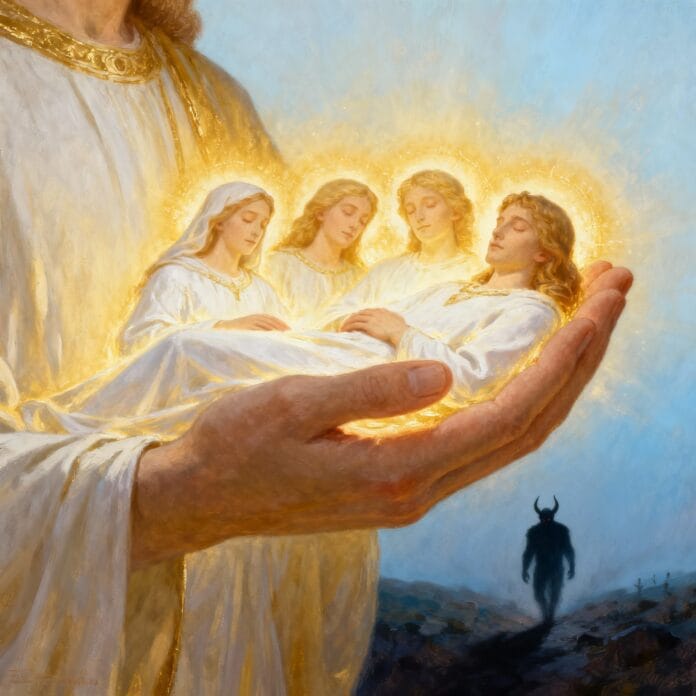
Reading from the Book of Wisdom
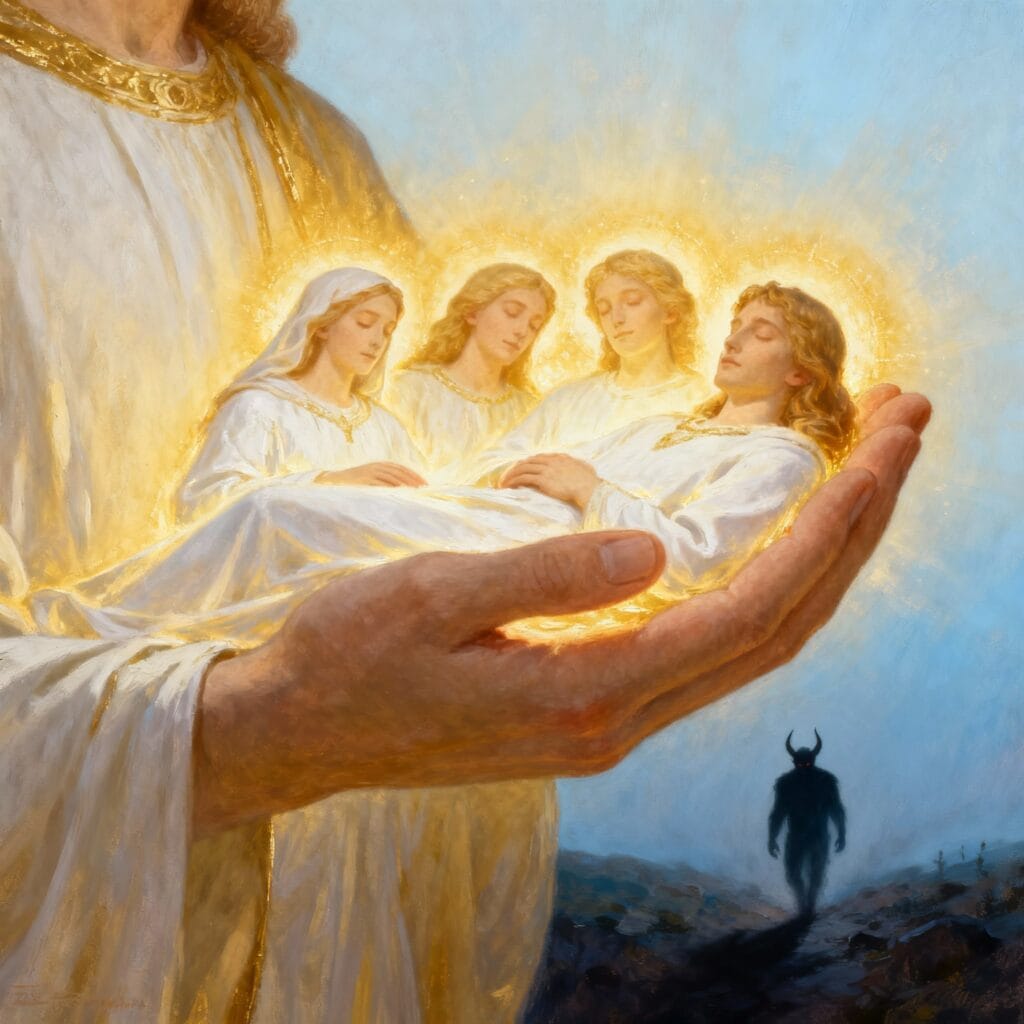
God created man for immortality; he made him in the image of his own nature. It is through the devil's envy that death entered the world; those who side with him experience its consequences.
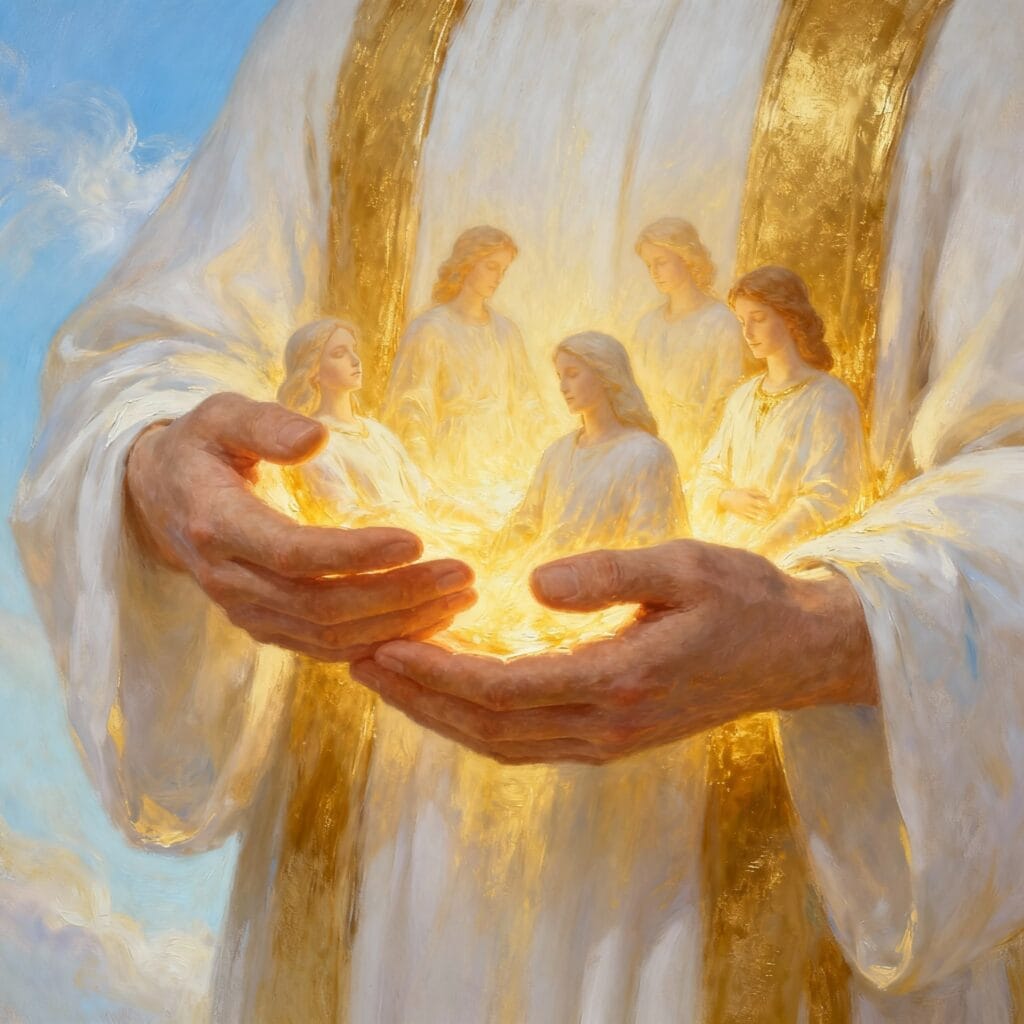
But the souls of the righteous are in the hand of God; no torment befalls them. In the eyes of the fool they seemed to die; their passing was perceived as misfortune, and their departure as annihilation: but they are at peace.
In the eyes of men, they suffered punishment, but the hope of immortality filled them. After light trials, great rewards await them, for God tested them and found them worthy of him. Like gold in the crucible, he refined them; like a perfect sacrifice, he accepts them.
On the day of his visitation, they will shine forth: like sparks that run through stubble, they will soar. They will judge the nations, they will exercise their power over the peoples, and the Lord will reign over them forever.
Those who trust in him will understand the truth; those who are faithful to him will remain with him in love. For his friends, grace and tenderness: he will visit his chosen ones.
Finding peace in the hand of God
Understanding the promise of incorruptibility and eternal life in Wisdom 2–3, to transform our view of death and daily faith.
THE Book of Wisdom This invites a shift in perspective: what appears to be destruction is in reality a passage. This text, often read at Christian funerals, affirms the quiet strength of the righteous, held by God's hand. This article offers a theological and spiritual reading of the passage "In the eyes of the fool, they seemed to have died," in order to help every believer reconcile faith with the mystery of death and live in it. peace of the promise
- The context and scope of Book of Wisdom.
- A reversal of perspective on death: wisdom versus vanity.
- Three key areas for understanding peace promise.
- Practical applications in human and spiritual life.
- The echoes of Christian tradition and their relevance today.
- A path for meditation to inhabit the promise.
- Contemporary challenges in our relationship with death.
- A prayer to rekindle faith in eternal life.
- A conclusion geared towards active hope.
The Book of Wisdom: A text that goes against the grain
Probably written in Alexandria, around the 1st century BC, the Book of Wisdom seeks to show that true human splendor lies not in power or knowledge, but in loyalty to God. The Hellenistic context weighs heavily: Greek thought values visible heroes, political triumphs, tangible successes. The Jewish people, a minority without influence, are often despised. It is in this tension that this paradoxical declaration arises: «"In the eyes of the fool, they appeared to be dead; but they are in peace. »
The text expresses a reversal of perspective. Death, the ultimate symbol of human defeat, here becomes the site of divine revelation. This reversal operates at the heart of biblical faith. Man is created "for incorruptibility," not for death. But the devil's jealousy introduces the rupture. Death is therefore not natural to the divine plan: it is a consequence of spiritual disorder, but it does not exhaust God's final word.
This passage is often read in the liturgy for the dead. It does not deny suffering; it transcends it. It does not deny death; it illuminates it. It does not promise consoling magic, but a tenacious hope: that of a God who welcomes the righteous, tested like gold in the crucible. This trial purifies, elevates, and makes one worthy of God. Peace What is at stake is therefore not the absence of pain, but rest in confidence.
The liturgy places this text as a key to the resurrection, preparing the Christian understanding of Christ, the victor over death. If man is created for incorruptibility, then the death of the righteous is but a passage to his fullness. It becomes the gateway to the Kingdom.
The reversed perspective: wisdom versus illusion
The central idea of the passage contrasts two worldviews: that of the "fool" and that of the believer. The fool judges by appearances. He takes for reality what is seen: death, loss, silence. The believer, on the other hand, sees behind the scenes of God: where the world perceives the end, he sees fulfillment.
This shift in perspective requires a conversion of heart. Biblical wisdom is not cold knowledge; it is a living relationship. It teaches us to read reality from God's point of view. For the fool, death is absurd; for the wise, it becomes revelation. This contrast echoes the Gospel paradox: «Blessed the poor in spirit.".
The "souls of the righteous" are not a mythological category: they are all those who remain faithful despite hardship. Their peace comes from their union with God, not from their immunity to evil. This passage introduces a theology of faith tested. God "tests like gold in a crucible," not to destroy, but to glorify.
In short, true death is that which separates us from God, not the death of the body. True life is communion, even beyond pain. Biblical faith reverses the human perspective: apparent failure becomes invisible fruitfulness.
Creation for incorruptibility
The opening of the text states it clearly: God created man "for incorruptibility." This sentence is crucial. It grounds all Christian hope on kindness original of the divine plan. Man is not destined to perish; he carries within him the image of God, therefore an eternal vocation.
This truth contradicts fatalism. In a world marked by the fear of the end, where death imposes its law of despair, faith affirms another horizon: imbued with God, humankind remains drawn toward Him. This is the theological root of all Christian anthropology.
But this text immediately adds that the devil's jealousy brought about death. In other words, corruption is not inherent in the nature of God or in that of humankind. It arises from misguided freedom, from the breaking of the bond. It wounds without nullifying the promise. This is why hope does not vanish even in sin or suffering.
This statement already contains an intuition of the resurrection. Man, created to live, cannot be definitively destroyed. Death becomes a temporary accident on an eternal journey. This certainty changes our way of living: it motivates courage., loyalty, tenderness towards all human existence.
The paradoxical judgment of death
The second part of the passage unfolds an almost dramatic scene: in the eyes of men, the righteous appear punished. Their death seems a defeat. But this human judgment is refuted by God. The apparent loss becomes an inner victory.
This dialectic of "appearance" and "profound truth" runs throughout Revelation. This theme connects the Beatitudes What the world considers misfortune, God blesses. Here, the text reveals that death itself can become a place of grace. The hope of immortality "filled them." In other words, they already sensed, in their ordeal, the victory to come.
The image of gold in the crucible illustrates this paradox: suffering purifies. Not everything that burns destroys, but refines. Suffering, therefore, only has meaning if it opens us to divine light. This is the meaning of a merciful judgment: God does not condemn hardship, but draws out its hidden beauty.
In a Christian reading, this verse foreshadows the crucified Christ. In the eyes of the foolish, Jesus is dead, crushed. But for the believer, he is alive, welcomed, glorified. The righteous of Book of Wisdom announces the Righteous One par excellence.
The peace of the elected officials and their mission
The passage concludes by presenting the reward: the righteous "will judge the nations" and "the Lord will reign over them forever." This apocalyptic vision is not one of vengeance, but of restoration. Peace which they enjoy is contagious. It becomes a light on the world.
In the Christian faith, this promise is expanded: peace The righteous becomes the vocation of all the baptized. To live "in the hand of God" is not to await death, but to radiate life here below. This peace comes from loyalty, trust, selflessness.
The image of "sparks flying across the straw" conveys the fruitfulness of the witnesses. Their faith spreads, warms, and illuminates. In a fragmented world, this image retains all its power. peace True is not inertia, but radiation.
Living the promise today
- In family life Accepting the death of a loved one as a transition does not erase the pain, but opens the memory to gratitude. Mourning becomes prayer.
- In personal life : to reread each ordeal as a purification, not as a failure. To ask: what does this pain refine within me?
- In community life : to encourage solidarity in the face of collective suffering — wars, migrations, loneliness — by drawing inspiration from peace righteous people.
- In professional life : choose loyalty to conscience rather than success at all costs. Wisdom rejects the short-sighted view of the fool.
- In ecclesial life : to accompany those who doubt, reminding them that faith does not promise the absence of trials, but the presence of God at its heart.
Thus the text invites us to transform fear into confidence, loss into offering, apparent immobility into silent fecundity.
Hope through the centuries
This passage permeates the entire Christian theology of death and of the resurrection. The Church Fathers, from Saint Irenaeus to Augustine, saw in this the implicit announcement of Christ's victory. The incorruptibility evoked here is not a material return, but participation in the mystery of the Risen Christ.
The liturgies for the dead make this a cornerstone: they do not celebrate the end of a life, but its transformation into love. Saint Gregory of Nyssa said that "the death of the righteous becomes birth into eternal light.".
In the mystical tradition, this promised peace joins peace from the hearts of those who surrender themselves fully to God. The saints, whether martyrs or contemplatives, have borne witness to this inexplicable serenity in the face of death. This text, read each year in the liturgy, recalls the constancy of love divine: God welcomes what he has purified.
Theologically, the "hand of God" is an expression of Providence. In the Bible, the hand signifies active power, protection, loyalty. To be "in God's hand" is to exist in a space of ultimate security.
Meditation prompt: dwelling in the peace of the righteous
- Sit in silence, breathe slowly and repeat silently: In your hand, Lord, I stand.
- To reread a painful memory or a loss, not to revive it but to place it in that divine hand.
- To ask for the grace to see beyond appearances: where I perceive the end, may I be given to perceive the passage.
- Contemplating the image of the crucible: what burns in my life may only be a purifying fire.
- End with a thanksgiving: You are my peace, Lord, even when I do not understand.
This simple practice aligns the soul with biblical wisdom. It cultivates a mindful, slow, and confident gaze—an antidote to the modern fear of death.
Current challenges in our relationship with death
Our era represses death. We silence it, we medicalize it, we push it out of sight. Contemporary folly believes it has surpassed God by eliminating the boundary of mystery. Yet fear has not disappeared. It has shifted to the anguish of the loss of meaning.
In response to this, the message of Book of Wisdom remains prophetic. He reminds us that peace It does not come from control, but from trust. Modernity fears powerlessness; biblical wisdom makes it a springboard to faith.
Another challenge lies in the temptation of collective despair: catastrophism, ecological crisis, war. This text offers spiritual resistance: if God created humankind for incorruptibility, then human history is not doomed to ruin. Faith becomes an act of active hope, not a celestial escape.
Finally, secularization has silenced death. The current Christian mission is to restore voice and meaning to this passing. To bear witness to peace The right thing to do is to remind wounded hearts that all is not lost, even when everything seems to be falling apart.
Prayer: In the hand of your love
Lord of life, you who created man for incorruptibility,
You know the fear and trembling of our final hours.
When our eyes close to the light of the world,
Open within us the light of your presence.
You who have tested your righteous ones like gold in the fire,
purifies our hearts of everything that hinders trust.
Help us understand the truth that only your gaze can grasp:
Nothing that is surrendered to you is lost.
Welcome our departed into your peace,
and enable us to already live in this peace,
within the struggles of each day.
May your love shine forth through our weaknesses,
like a spark on straw, quick and alive.
Grant us to remain in your hand,
until the dawn of the Kingdom,
where everything will be light, consolation, and endless joy.
Amen.
Conclusion: Hope that transforms
The passage of Book of Wisdom does not provide an intellectual answer to the mystery of death: it offers guidance for the heart. To the fool who judges by appearances, God offers the vision of peace. This vision, passed down through the centuries, invites a conversion: to move from despair to confident rest.
Believing that the souls of the righteous are in God's hands is more than an idea; it's a way of life, a way of seeing the world, a way of navigating suffering. Where modern society sees the end, faith sees the continuity of relationship. Where fear seeks closure, God opens.
Experiencing this peace begins here, in every act of trust. It is already being in God's hands.
To practice
- Reread the passage from Wisdom each evening as a personal promise.
- Praying for a deceased person, entrusting their peace to God.
- Listening to a grieving person without trying to explain: simply remaining present.
- Choose a concrete act of hope each day in the face of discouragement.
- Meditate on the small daily "deaths" as passages towards more light.
- Keep a gratitude journal to track the signs of peace received despite the ordeal.
- To participate in a liturgy for the deceased and to make an act of faith in eternal life.
References
- Book of Wisdom 2, 23 – 3, 9.
- Saint Augustine, The City of God, book XIII.
- Saint Irenaeus, Against heresies, IV, 20.
- Gregory of Nyssa, On the resurrection.
- Catechism of the Catholic Church, §§ 366-1019.
- Benedict XVI, Spe Salvi.
- Funeral liturgy, readings and prayers.
- John Paul II, General Audience of November 25, 1998 on Christian Hope.