












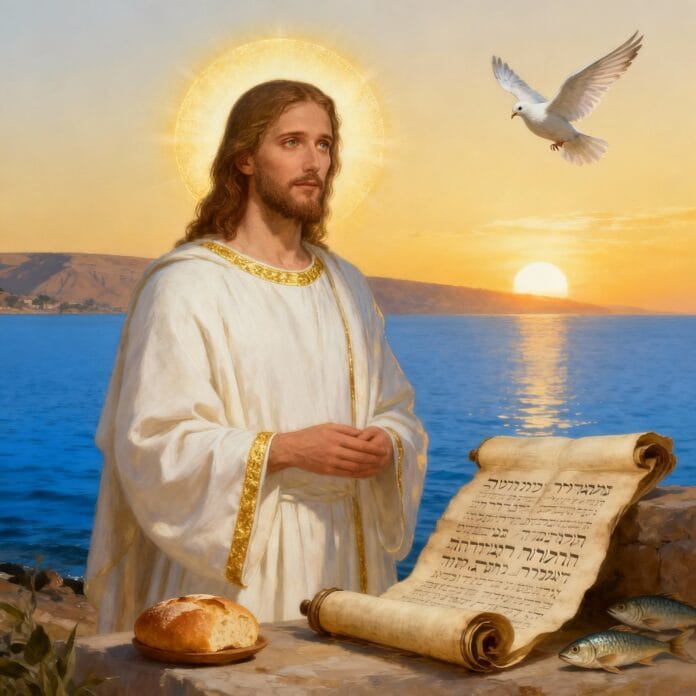
THE APOSTLE ST. JOHN
1° His name. — A very beautiful name, and quite significant in its original form. Yôchanan ( יוחבן, abbreviation for יתותבן, Yehochanan) is indeed translated as "God has shown grace" (cf. commentary St. Matthew, 3, 1). After the Forerunner, no one bore it better than the beloved apostle. It was then quite widespread among the Jews. In the genealogy of Our Lord Jesus Christ according to St. Luke (Luke 3:27), the Greek text reproduces almost the Hebrew pronunciation: Ἰωανάν. From the Hellenized form Ἰωάννης came the Latin "Joannes" (originally Johannes, the letter h corresponding to the Hebrew ח (aspirated ch) from which we made "John" (via Jehan).
2° His family. — The apostle St. John was a Galilean by origin, like all the members of the group of twelve apostles, except for the traitor Judas. His family resided on the shores of the Sea of Galilee in the NW; probably in Bethsaida, the homeland of St. Peter, St. Andrew and St. Philip (cf. John 144. This is deduced from the fact that James and John were associates of Peter and Andrew (Luke 5:9). See, regarding the situation at Bethsaida, the Gospel according to St. Matthew, 11:21. Do not confuse this locality with Bethsaida-Julias, located northeast of the lake (cf. commentary on St. Mark 6:9). The date of St. John's birth is unknown, but it is generally accepted that he was the youngest of the apostles, and that Jesus himself was a few years older than him.
Although a simple fisherman, his father Zebedee (Hebrew: זבךיח, Zebadiah (in Greek: ὁ Ζεβεδαίος, cf. 1 Chronicles 8:15. This name means "gift of the Lord") appears to have enjoyed a certain degree of comfort; for he owned several boats, and his business was prosperous enough to allow him to employ several day laborers (cf. Mark 1:20 and our commentary). This is all the Gospel tells us about him. The mother of St. John is better known: her name was Salome (Schelomith ,(Shelomyit, the peaceful one), and the Synoptic Gospels repeatedly mention her devotion to the sacred person of the Savior. Combining the passages Luke 8:3 and Mark 15:40-41, we see that she was one of the holy women who accompanied and served the divine Master according to their means. She was faithful even to the cross (Matthew 27:56 and parallels), even to the tomb (Mark 16:1). (It is without sufficient reason that many exegetes have made Salome a sister of the Blessed Virgin. See our commentary on John 19:25.) As for St. James the Greater, the very famous brother of St. John, everything leads us to believe that he was the elder of the two: such is the general impression that emerges from the Gospel narrative, where he is almost always mentioned first.
An episode from the evening of Holy Thursday, John 18:15-16, which shows that St. John had free access to Caiaphas's palace and was even "known to the Pontiff," has led various critics to suggest that St. John belonged to the priestly family. The note by St. Polycarp, Bishop of Ephesus in the second century, according to which John, in his old age, wore on his forehead ἱερεὺς τὸ πέταλον (cf. Eusebius, Ecclesiastical History 3, 31; 5, 24), that is, the gold plate that served as an ornament for the Jewish high priests (cf. Exodus 28:32; 29:6; 39:30; Leviticus 8:9), has sometimes been interpreted in this way. But this conjecture seems implausible (however, the use of "the holy golden blade" does create some difficulty). Several commentators on Eusebius give a metaphorical interpretation to the words of St. Polycarp. He simply wanted to express, they say, the noble majesty of the holy old man. This conjecture lacks plausibility, given the simplicity of the ancient language: it is a real event that St. Polycarp intended to relate. Compare St. Epiphanius, Haer 29, 4; 78, 14, which recounts a similar thing about St. James the Less (πέταλον ἐπὶ τῆς ϰεφαλῆς ἐφόρεσε). Probably, the gold plate on St. John's forehead marked his authority as apostle over all the churches of Asia).
3° His vocation— John was first a disciple of the Forerunner, Saint John the Baptist, before becoming a disciple of the Messiah. The first time we encounter him, he is at his side in Bethabara, on the banks of the Jordan (John 1, 28; see the commentary). The Forerunner, seeing Jesus pass by at some distance, exclaimed: “Behold the Lamb of God!” He who was to be the beloved apostle was the first, with St. Andrew, to translate this significant statement into action, and immediately he attached himself to the person of the Savior (John 1, 35 et seq.).
For a few months, the Gospel narrative shows us John living with his new Master, along with Peter, James, Philip, and Nathanael: they travel together from Bethabara to Cana in Galilee, from Cana to Capernaum, from Capernaum to Jerusalem to celebrate Passover, from Jerusalem to Judea, then to Samaria, and back to Galilee. These were blessed times when the divine friendship of Our Lord Jesus Christ for the young Galilean fisherman was being formed. He let no detail of it be lost (cf. John 1, 43-4, 54).
Separated for a time, the apostolic group whose members had gathered for the first time on the banks of the Jordan soon reformed. Following a great miracle (Luke 5:3-11, cf. Matthew 4:18ff.; Mark 1:16ff.), Jesus definitively called Peter and Andrew, James and John to the role of disciples. Having abandoned their fishing nets and their father, the sons of Zebedee happily embraced the Son of God. Soon they were chosen, and among the first, for the noble but perilous mission of apostles (cf. Luke 6:12-16, and parallels). In the lists of the group of twelve apostles, St. John is sometimes mentioned in second place, Act 1, 13, sometimes in the third, Mark. 3, 17, sometimes in the fourth, Matthew 10, 3 and Luke 6, 14.
4° His life with Jesus— John soon became counted, along with St. Peter and his brother St. James, among those disciples of the Savior whom an ancient writer so aptly called "the closest of the intimate" (ἐϰλεϰτῶν ἐϰλεϰτότεροι). As such, they witnessed, to the exclusion of the other apostles, several remarkable events in the life of Christ: notably, at the resurrection of Jairus' daughter, Mark 5:37 and parallels, at the Transfiguration, Matthew 17:1 and parallels, at the agony in Gethsemane, Matthew 26:37 and parallels. John was also one of the four to whom Jesus deigned to reveal the signs of the destruction of Jerusalem and the end of the world (cf. Mark 13:3). The conjecture of St. Ambrose, St. Gregory the Great, Bede the Venerable, etc., according to which the young man mentioned by St. Mark 14:51-52 was no different from St. John, is universally abandoned. See our commentary on this passage. On the morning of Holy Thursday, he was entrusted, along with St. Peter, with the preparations for the Last Supper (Luke 22:9).
But what an ineffable privilege was reserved for him at that farewell meal! He himself recounts it in one of those simple lines, as profound as his soul, which abound in the fourth Gospel: «One of the disciples, the one whom Jesus loved, was reclining on Jesus’ heart” (John 13:23). “The one whom Jesus loved”—that was his true name, by which he referred to himself on various occasions with an admirable mixture of modesty and pride. How much is contained in that single phrase! “Human friendships had been famous; but never had the marvelous tenderness of a divine friendship been seen. God had this inclination to lean toward a man and love him as if he were his equal. Accustomed to living for all eternity in the unity of the Father and the Holy Spirit, he asked the earth for the company of a soul that would be the outpouring and image of his own. See the incomparable sermon of Bossuet, Works, (Versailles edition, vol. 16, p. 552 et seq.). And this soul was that of St. John.
But how he knew how to love in return! The current period of his life abounds with facts that prove this most conclusively. Why, like a new Elijah, would he want to call down fire from heaven on inhospitable Samaritans, if not because he could not bear an insult to his Master? (cf. Luke 9:54ff.) Why did he once prevent a stranger from casting out demons in the name of Jesus, if not because he was holy and jealous for the glory of the Savior? (Mark 9:38, cf. Luke 9:45) Why the nickname "son of thunder," Boanerges (on the etymology and meaning of this word, see Mark 3:17 and our commentary), which Our Lord gave him jointly with his brother, if not to mark his loving, though sometimes immoderate, zeal? Gold is not purified of all impurities in an instant: thus, even towards the end of Jesus' public life, we see James and John joining their prayers with those of their mother to obtain the first and second place at the side of the triumphant Messiah; but they clearly show that they were not guided in this by vulgar selfishness, when, asked if they were ready to share the bitter cup of the Master's sufferings, they respond with their generous "We can," dictated by love (cf. Matthew 20:20, and parallel passages).
If John fled like the other apostles at the time of the arrest of Our Lord Jesus Christ, it was only for a few moments; for soon we see him courageously accompanying the divine victim to the palace of the high priest, where no one was to be unaware of his title of disciple (John 18:15-16). The next day, he stood fearlessly by the cross among the executioners. He found the most magnificent reward at Calvary when the dying Jesus entrusted to him the care of his Mother (John 19:25-27; see the commentary).
On Easter morning, the beloved apostle's own account tells us in what picturesque circumstances he first ran with St. Peter to the empty tomb, and how promptly he believed in the resurrection of Our Lord (cf. John 20:2 ff.). Finally, when the risen divine One appeared near the Sea of Galilee to some of his disciples (John 21:1 ff.), St. John was the first to recognize him, for love is vigilant and infallible in these matters (See, on all these facts, reflections as delicate as they are interesting in Baunard, The Apostle St. John, p. 1-164).
5° St. John after the Ascension. — He first remained for some time in Jerusalem, like all the other apostles. The Book of Acts, in two consecutive chapters (chapters 3 and 4), recounts at length glorious episodes in which he took part alongside St. Peter, and especially the courage he displayed the day after Pentecost in the face of the Sanhedrin (see Fouard, St. Peter and the early years of Christianity, Paris, 1886, p. 25 et seq.). A little later, again with St. Peter, to whom he was united by the bonds of a deep affection (antiquity did not fail to point out this interesting fact. “St. Peter tenderly loved (σφόδρα ἐφίλει) St. John, and this friendship is evident throughout the Gospel and also in the Acts of the ApostlesSt. John Chrysostom, Hom. 88 in Jean See also St. Augustine, In Jean tract. 124), he went to Samaria to complete the work of evangelization begun by the deacon St. Philip (Acts 8, 14 ff.).
About three years later, St. Paul, having come to Jerusalem for the first time since his conversion, found only St. Peter and St. James the Less among the members of the group of twelve apostles (Galatians 1:18): St. John was temporarily absent. But, after an interval of another ten years, when the apostle to the Gentiles made his third journey to the Jewish capital, on the occasion of the Council, he had joy to meet St. John there, whom he mentions among the "pillars" of the Church (Galatians 2(2 ff.; cf. Acts 15). Apart from one other detail, which will be discussed later (in connection with the exile on Patmos), this is all that the writings of the New Testament tell us about the beloved disciple. But tradition picks up the thread of this precious life and continues it. As for the main events, its testimony leaves nothing to be desired in terms of antiquity, clarity, and unanimity.
At a time that is difficult to pinpoint with absolute certainty, but which is generally agreed not to be before the year 67 AD (that is, at the time of the martyrdom of St. Peter and St. Paul; and also, around the time when the Romans began to threaten Judea and Jerusalem), St. John came to settle in Ephesus (Türkiye), in the heart of Proconsular Asia. Two main reasons must have prompted this change of residence: firstly, the vitality of the Christianity in this noble land; on the other hand, the dangerous heresies that were beginning to germinate there (cf. Simeon Metaphr., Vita Joannis, c. 2). John therefore wanted to use his apostolic authority either to preserve or to crown the glorious edifice built by St. Paul (on the origins of the Church in Ephesus and Asia, see Acts 18:19-20:38; 1 Corinthians 16:8-9); and his powerful influence contributed no small thing to giving the churches of Asia the astonishing vitality they retained throughout the second century (According to a tradition mentioned by St. Augustine (cf. Quæst. evang.( ., 2, 39), and traces of which are found in the superscriptions of some New Testament manuscripts, the second letter of St. John is said to have been addressed to the Parthians; this would imply, according to some critics, a prior sojourn among that people. On this controversial question, see Tillemont, Memoirs to serve as a history of the Church., vol. 1, p. 336. In fact, it is unlikely that St. John evangelized the Parthians).
Here are some of the most interesting texts on this subject. — 1° St. Irenaeus, originally from Asia Minor, Bishop of Lyon in 178, and martyred in that city in 202, provides us with information of exceptional value. First, in his famous work Against Heresies. «All the elders,” he said, “who met in Asia with John, the disciple of the Lord, testify that he passed these things on to them, for he lived with them until the time of Trajan. And some of them saw not only John, but also other apostles (Against Heresies 2, 22, 5, cf. Eusebius, Ecclesiastical History 3, 23, -3. … The church of Ephesus, founded by Paul, and in which John remained until the time of Trajan, is also a true witness to the tradition of the apostles» (Against Heresies 3, 3, 4, ap. Eus. lc. 3, 23, 4). In his letter to Florinus, his childhood friend who had been seduced by the Gnostics, St. Irenaeus is no less explicit: “These are not the teachings handed down to you by the elders who came before us and lived with the apostles; for I saw you, when I was still a child, in Lower Asia, with Polycarp… And I could still show you the place where he sat when he taught, and when he recounted his relationship with John and with the others who had seen the Lord, and how he spoke of what he had heard from them about the Lord, about his miracles, and about his teaching” (Eusebius, 11:5, 20:2-4). Finally, we have this other testimony, from the great bishop of Lyon, in the letter he wrote to pope Victor, on the occasion of the famous dispute concerning Easter: "When the blessed Polycarp visited Rome in the time of Anicetus (around the year 160), minor disagreements arose on a few points, peace was quickly concluded. And they did not even argue about the main issue. For Anicetus could not dissuade Polycarp from celebrating the 14th of Nisan (as Passover, in the Jewish manner), since he had always celebrated it with John, the disciple of the Lord, and the other apostles with whom he had lived. And for his part, Polycarp could not persuade Anicetus to observe that same day, Anicetus replying that he must maintain the custom he had received from his predecessors. Things being thus, they gave each other communion,… and they parted in peace” (ap. Eusebius). Ecclesiastical History, 5, 24, 16). — 2° Apollonius, a valiant opponent of the Montanists, who lived in Asia Minor around 180, recounts in a fragment preserved by Eusebius (lc, 5, 28) "that a dead man had been raised from the dead at Ephesus by St. John." — 3° Polycrates, Bishop of Ephesus in 190, and drawing on the rich traditions of his family, seven members of which had held the episcopal see of Ephesus before him, wrote in turn to pope Victor in the following terms: "We celebrate the true day (the 14th of Nisan)... For some great lights have been extinguished in Asia and will rise again there on the day of the Lord...: Philip, one of the twelve apostles, and John who rested on the bosom of the Lord" (ap. Eusebius). Ecclesiastical History, 5, 24, cf. 3, 31, 3))». — 4° To these testimonies, all the more striking as they relate to Asia Minor and Ephesus, we can add another, which is no less ancient. It is that of Clement of Alexandria (around 190), who expresses himself thus in his treatise Quis dives salvetur, § 42 (cf. Eusebius, l. c.( ., 3, 24): «At Ephesus, John visited the surrounding regions to establish bishops and organize the churches.» There is no need to dwell on this further or cite the identical, but more recent, statements of Origen, Tertullian, St. Jerome, etc. (A geographical testimony, which is quite valuable, is that contained in the name of the Turkish village.) Ayâ salouk, located near the ruins of ancient Ephesus. In this name, it is easy to recognize a corruption of the Greek words ἀγίος θεολόγος. Now, the "holy theologian" is none other than St. John, so designated by the Council of Ephesus).
St. John could not have been in Ephesus for very long when he was arrested by order of the Emperor Domitian and taken to Rome to suffer martyrdom. Tertullian was the first to preserve the memory of this event, so well commented on by Bossuet (Panegyric of St. John, first part). "How happy is the Roman Church, in which the apostles spread all doctrine with their blood, where Peter received a death like that of the Lord, where Paul was crowned by beheading like St. John the Baptist, where the apostle John suffered nothing when he was plunged into boiling oil."De præscript. 36). St. Jerome, relying on Tertullian's account, says with some additional details, "That, sent to Rome in a barrel of boiling oil, he came out purer and more vigorous than when he had gone in." (Controlled by Jovinian. 1, 26, cf. In Matthew. 20, 23; Orig. In Matthew. Hom, 12; Eusebius Ecclesiastical History 10, 17, 18; St. Augustine of Hippo Sermo 226).
The Church celebrates on May 6 the anniversary of the martyrdom of St. John (see the Roman Martyrology...on the same day. The scene having taken place "In front of the Latin gate", hence the name given to the festival of May 6th).
The powerless persecutor thought he could take revenge by exiling to the rock of Patmos the apostle whose life he had been unable to save. But Our Lord Jesus Christ awaited his beloved disciple there to share the most intimate communications with him: it was indeed during the exile on Patmos that St. John composed the Apocalypse (Revelation 1:9: “I, John, your brother… was on the island called Patmos on account of the word of God and the testimony of Jesus.” See Drach, Apocalypse of St. John, pp. 15-16. «Patmos resembles all the islands of the Archipelago: azure sea, clear air, serene sky, jagged rocks, barely covered at times with a light down of greenery. The aspect is bare and sterile,» Renan, The Antichrist, p. 376. The island essentially consists of three clusters of rocks joined by narrow isthmuses. Although the date of this banishment has been given differently (St. Epiphanius, Hær. 51, 33, speaks of the reign of Claudius, Theophylact of the reign of Nero. St. Irenaeus, Against Heresies 5, 30, 3, St. Jerome, De viris illustr. 9, Sulpicius Severus, Sacred History. 2, 31, Eusebius, Ecclesiastical History 3, 18 and 20, 23, agree in placing the exile of St. John under Domitian), nothing is more certain than the fact itself, which is related by very ancient and very trustworthy authors, such as St. Irenaeus, Clement of Alexandria (Quis dives salvetur, § 42, cf. Eus. 3, 13), Origen (Comm. in Matth. 20, 12) and Eusebius. The latter formally says: ΰατέχει λόγος, to mark something sure and certain.
The exile of St. John ended after the death of Domitian, when Nerva, his successor, granted freedom to all those who had been unjustly banished by the tyrant (cf. Eusebius). Ecclesiastical History 3, 20, and the fragment from the Chronicle of George Hamartolos (9th century), published by Nolte in the Theolog. Quartalschrift of Tübingen, 1862). The apostle then returned to Ephesus, as indicated by the most authentic sources (Eusebius, Ecclesiastical History 3, 23: ὁ τῦν παρʹ ἡμῖν ἀρχαίων παραδίδωσι λόγος, and he refers by name to S. Irenaeus and Clement of Alexandria), and he continued his valiant ministry there.
We know only a very small number of specific details about the last years of the disciple of love; but they are in perfect harmony with the rest of his life. It will suffice to summarize them briefly, for they would be found in every book if they were not in every memory. First, there is the anecdote concerning that dearly beloved disciple whom John had entrusted to a neighboring bishop during an absence necessitated by the needs of the churches in Asia. Upon his return, the apostle was saddened to learn that the young man, insufficiently supervised, had been led into all sorts of debauchery by corrupt friends and had ended up becoming a leader of brigands. Without hesitation, despite his advanced age, St. John ran in pursuit of this lost sheep, and he was fortunate enough to bring him back to the fold (Clem. Alex. Quis dives salvetur, § 41, cf. Eusebius, Ecclesiastical History, 3, 23, and Baunard, The Apostle St. John, pp. 510-514. "Christian antiquity," says Mr. Baunard, "has bequeathed to us few pages of simpler eloquence and more pathetic beauty.".
The episode of the partridge, as told by Cassian (Collat. (24, 21): We see the great apostle, during his rare hours of rest, playing with a small, tame partridge. A young hunter, who was very eager to see the Saint, having one day surprised him in the midst of his recreation, was greatly scandalized. St. John asked him gently, "What is that object you are holding in your hand?" "A bow," replied the hunter. "Why then is it not strung?" The young man answered, "Because if it were always strung, it would lose its flexibility and become useless." "Then do not be shocked," replied the old man, "by these brief moments of rest which prevent my spirit from losing all its strength.".
On the contrary, it is the son of thunder who is revealed anew in these lines of St. Irenaeus (Against Heresies 3, 3, 4, cf. Eusebius Ecclesiastical History 3, 28). There are men who heard Polycarp recount that John, having entered a bathhouse in Ephesus and having seen Cerinthus inside, abruptly left without bathing, saying: "Let us go out, lest the house collapse, since Cerinthus, the enemy of truth, is there." ("No one," say the rabbis, "treaty Kitzur Sch'lah, (f. 10, 2, should not cross a ford or any other dangerous place in the company of an apostate or a perverse Jew, for fear of being enveloped in the same ruin as him). Compare the analogous trait of St. Polycarp, meeting Marcion in a street and exclaiming, when the heretic wanted to make himself known to him: "Yes, I know you, firstborn of Satan!".
The miracle of the poisoned cup, which the apostle emptied without suffering any harm, has sometimes been linked to the island of Patmos and recounted in different ways (St. Augustine of Hippo). Soliloq. ; S. Isid. Hisp. Of life and death Sanct., 73; Fabricius, Cod. Apocr. N. T. (t. 2, p. 575). Christian iconography has made the memory of it imperishable, for "it is in memory of this fact that the apostle is represented holding in his hand a cup from which a serpent escapes" (Baunard, St. John, p. 458. According to some, things happened to the letter; according to others, the serpent that leaps out is a simple figure of the poison that has become harmless).
The last episode, which we owe to St. Jerome (In Galatians 6, 10), is the most beautiful of all. «The blessed John remained in Ephesus until extreme old age. And it was supported by his disciples that he went with difficulty to the church. Unable to preach as before, he could say nothing other than: «My little children, love one another.» Finally, the brothers who came to worship the Lord grew weary of hearing him repeat the same words, and said to him: «Master, why do you always say the same thing?» He answered them with this memorable phrase: ‘Because it is the Lord’s precept. And if we do only that, it is enough.’ (Lessing treated this subject in literary form in his Testament of Johannes).
6° The death of St. John. Such, according to the most authentic sources, was the life of the beloved disciple. He died peacefully in Ephesus, during the reign of Trajan (98-117) (cf. St. Irenaeus, Against Heresies, 2, 39; 3, 3; Eusebius). Ecclesiastical History 3, 23), and they buried him in that city which he had loved so much: οὗτος ἐν Έφέσῳ ϰεϰοίμηται, says S. Polycrates (Ap. Euseb. lc. 3, 31; 5, 24). The later account of George Hamartolos (this writer lived in the 9th century) is devoid of historical value. The fragment of his Chronicle, published recently by Dr. Nolte, according to which St. John was put to death by the Jews, is also devoid of historical value. The same is true of the strange rumors that circulated for quite some time concerning the miraculous prolongation of his life in the tomb ("It is reported that the earth began to spew forth, and as if to boil, and that this became its exhalation." St. Augustine of Hippo) Leaflet. 124 in Jean cf. D. Calmet, Dissertation on the death of St. John. See other legendary tales in Zahn, Acta Johannis, Erlangen, 1880; Fabricius, Codex Apocryph. NT. t. 2, p. 531 et seq.).
We do not know exactly how old St. John was at the time of his death; but the ancient ecclesiastical authors are almost unanimous in affirming that he lived nearly one hundred years (one hundred years and seven months, according to the Chronicon paschale, Bonn edition, p. 470; one hundred and twenty years, according to Suidas, sv Ίωάννης).
7° The biography of St. John and the rationalists. — We must here undertake a thankless task, which will become even more arduous in the following paragraph: namely, to demonstrate the obvious and to answer the vain subtleties of rationalism. Take any jury and pose this simple question to them, after having developed the traditional arguments that we have merely abridged: Did the Apostle St. John truly reside in Patmos, in Ephesus? They will answer without hesitation: "yes." Nevertheless, a number of critics declare the evidence insufficient, and they deny that St. John stayed in these two places (Lützelberger (Die kirchl. Tradition über den Apostel Johannes und seine Schriften, Leipzig, 1840), Keim (The Story of Jesus of Nazareth, t. 1, p. 161 et seq.), Wittichen (Der geschicht: Charakter des Evang. Johannes, Elberfeld 1868, p. 107 ff.), Holtzmann (under the word "Johannes der Presbyter" in the Bibellexicon by Schenkel, t. 3, p. 352 et seq.), Ziegler (Irenaeus, Bishop of Lyon, Berlin 1871) and Scholten (Der Apost. Johannes in Kleinasien(translated from the Dutch by Spiegel, Berlin 1877) were the principal advocates of this strange system. They do not hide their aim: if it is demonstrated that tradition is erroneous on this two points, it will be easy to overturn it when it claims that John composed the Apocalypse on the island of Patmos, the fourth gospel in the city of Ephesus.
Their reasoning is of two kinds: some negative, others positive. They abuse it excessively.’argument of silence Such weak evidence, especially after we heard from such important, ancient, and numerous witnesses. Keim would like that the Acts of the Apostles would have mentioned St. John's stay in Ephesus. "With such logic," replies Leuschen, "one could prove that Paul did not die at that time," since the Acts do not say so. "As if the book of Acts," adds Mr. Godet, "were a biography of the apostles, and as if it did not end before the time when John could have lived in Asia."Commentary on the Gospel of St. John, vol. 1, p. 56 of the 2nd edition. Mr. Godet rightly criticizes the conduct of the rationalist school, saying that it is "critical arrogance"). But how to explain the silence of St. Ignatius in his Letter to the Ephesians (chapter 12), that of St. Polycarp in his letter to the Philippines (Chapter 3)? Both speak of St. Paul, yet remain silent on St. John. Again, the answer is easy. St. Ignatius had passed through Ephesus to suffer martyrdom in Rome, like the apostle to the Gentiles before him (Acts 20:17 ff.); he therefore had a special reason to mention this fact. Moreover, the Philippians had been St. Paul's beloved disciples: another special reason to remind them of him. And these two particular motives did not exist with regard to St. John. Indeed, "it is not with such proofs that John's sojourn on Patmos and in Asia will be erased from history." (Keil, How. über das Evang. Johannes, p. 7).
Their positive arguments are also only valuable because of the boldness with which they are presented. Here are the two main ones. Firstly, S. Epiphanius, as mentioned above (page 7, note 4), places the exile of Patmos under the reign of Claudius (Έν χρονόις Κλαυδίου Καίσαρος. Haer. 51, 12), that is, between the years 41-54, which is impossible. Nothing could be truer, and no one would think of defending St. Epiphanius on this point. But, because a single witness, one of the least important, makes a minor error about a secondary element, are we entitled to conclude that the main fact, attested to by all the other witnesses, is thereby nullified? Besides, it is clear that St. Epiphanius's inaccuracy concerns only the name of the emperor then reigning; for he says in the preceding line that St. John composed his Gospel upon returning from Patmos, at the age of ninety. Now, the Savior's favorite was not yet forty years old during the reign of Claudius.
Secondly, St. Irenaeus, whose very formal assertions we have read, was supposedly misled by his own recollections, confusing the priest John with the apostle of the same name, and thus leading the whole tradition astray. Dr. Keim, who discovered this new argument, is so proud of it that he proposes it, and we quote his own words, "with all the pathos inspired by the certainty of victory," for he is sure that such proof suffices "to put an end to the Ephesian illusions."The Story of Jesus of Nazareth, (t. 1, p. 161 et seq.). Can one conceive of it? St. Irenaeus mistaken on a similar matter, at such a short distance, and confusing one of the most glorious apostles with an obscure priest? And St. Polycrates, and his other contemporaries whose testimonies we have cited, being the plaything of the same illusion? An error of this kind is impossible, inadmissible; Keim's audacious assertion, coming after an interval of seventeen centuries, also earned him, even within his own camp, and all the more so from believing exegetes, ripostes of perfectly excusable vehemence (Beyschlag: "This is rhetoric masquerading as criticism." Luthardt: "This hypothesis descends into insanity." Farrar: "It is the very intemperance of negation... This attempt is a resounding failure." Etc.). And neither Strauss, nor Baur, nor Hilgenfeld, nor Mr. Renan (The Gospels and the Second Christian Generation, (Paris 1877, p. 412), nor the most advanced and undisciplined proponents of the Tübingen school, such as Schwegler, Zeller, and Volkmar (which is saying something), wished to associate their names with a system devoid of all support and scholarship. Moreover, learned historians now admit that the very existence of Prester John, this "nebulous priest," as they call him, is highly problematic, and they are inclined to identify him with the apostle himself. At least, the following fragment from Papias, preserved by Eusebius (Ecclesiastical History 3, 39. It is useful to recall that Papias had been a friend of St. Polycarp and probably a disciple of St. John (cf. Eus. 5, 33, 4), which proves that, if the nπρεσϐύτερος Ἰωάννης really existed, it was known, even in those remote times, that his personality could be clearly distinguished from that of the apostle St. John. «I will not fail to add to my explanations all that I have… retained from the Ancients (παρὰ τῶν πρεσβυτέρων), guaranteeing you its truth.” For I did not take pleasure, like the majority, in those who tell many things, but in those who teach true things… If sometimes one of those who had accompanied the elders came to me, I would inquire about the words of the elders: What did Andrew, or Peter, or Philip, or Thomas, or James, or John, or Matthew, or any other disciple of the Lord say? Then I would ask what Aristion and John the priest, the disciples of the Lord, were saying. (Note the antithesis between the past tense: τὶ εἶπεν what he said, and the present tense: ἃ λέγουσιν, what they say ; It truly seems to contrast two different eras. Furthermore, the first time, John is associated solely with apostles; the second, with a little-known disciple. Those who support this identification claim that the use of the past tense refers to the writings of the Apostle St. John, while the present tense alludes to communications that Papias supposedly received personally from the beloved disciple; for I did not presume that what is drawn from books could be as useful to me as what comes from the living and enduring word.»
Thus, the theory of Lützelberger and Keim falls apart in every way, and nothing remains better attested than the stay of St. John either at Patmos or at Ephesus; and, "unless one rejects wholesale all the testimonies subsequent to the first century, one must regard it as an indisputable fact" (Stanley, Sermons on the Apostolic Age, p. 287, cf. Davidson, An Introduction to the Study of the N. T., vol. 2, p. 324).
8° The character of St. John. — We must limit ourselves to a few brief points; moreover, better than anyone, St. John himself has drawn his portrait in the Gospel he bequeathed to us (see § 5: «John continues to live. He gives us his image to contemplate perpetually in the Church, through his golden writings, which he left behind as a precious treasure for the erudition of all ages.» «Vivit interea Johannes, suamque perpetuo in Ecclesia imaginem contemplandam exhibet scriptis aureis, quae tanquam pretiosissima cimelia in omnium post se ætatum eruditionem reliquit.» Lampe, Prolegomena. in Joh. lib. l, cap. 7 § l).
The Savior's favorite was eminently gifted, and above all possessed those qualities that always and everywhere attract affection. His nature was ideal, exquisitely delicate; his loving heart gave itself without ever taking it back and remained devoted until death.
Jean was fundamentally gentle and calm, yet without that certain feminine quality that painters have too often attributed to him (Even Ary Scheffer, in his well-known and justly celebrated painting, cf. Tholuck, sv John the Apostle, in Kitto, Cyclopædia of Biblical Literature) ; for on occasion, as various episodes of his life have revealed to us (see above pages 3 and 6), he knew how to manifest the energy of a virile, ardent, courageous soul, which did not want to sacrifice any of the rights of his adored Master, and which feared no danger.
He was perfectly modest. He plays only a very minor role in his own narration, speaking of himself only in the third person (cf. John 1, 35 and following; 13, 13-26; 18, 15-16, etc.), and quoting only three of his sayings (All three very short: 1, 38, "Rabbi, where are you staying?"; 13, 25, "Lord, who is it?"; 21, 7 "it is the Lord").
His keen intelligence shines through in all his writings; and if the Pharisees, in an official circumstance (Acts 4, 13), treated him jointly with St. Peter as "illiterate" and "imbecile", these words only expressed on their lips the lack of a rabbinical education (even Plato would have been an "imbecile" according to Pharisaic principles, not having followed the courses of the rabbis, the only scholars certified by the Judaism of that time).
The virginal purity of St. John is one of the most striking and attractive features of his nature; it has been noted and praised a thousand times since the earliest centuries. "There are those who think, and they are not contemptible commentators on the holy word," wrote Tertullian (From Monogam. c. 7). that John was loved more than others by Jesus because he did not marry, and that he remained chaste from his early childhood. », St. Augustine (Leaflet. 124 in Jean 8, cf. De bono conjug. 21). «John, whom the faith of Christ found a virgin, remained ever a virgin, and that is why he was loved more than the others by Jesus, and why he rested on the heart of Jesus. And so that in a few words I may contain and teach several things about the privilege of John, that is to say, his virginity, I will say: by the Lord a virgin, a virgin mother is entrusted to a virgin disciple.« (St. Jerome, Control Jovin. 1, 26, cf. Ad Princip. ep. 127, 5; etc.). Hence the beautiful names of παρθένος (virgin) or παρθένιος (virginal), by which people liked to designate, according the Apocalypse, 14, 4, this angelic apostle (See other numerous quotations in Zahn, Acta Johannis, p. 208 et seq., cf. also Fabricius, Codex apocr. (vol. 2, p. 585 ff.). But, as is generally agreed, what characterizes St. John above all is the astonishing depth, the great receptivity (a barbarous but expressive word, which we allow ourselves to use after others) of his soul. Peter was eminently a man of action, while John, in the manner of Married (cf. Luke 10:39 ff.), was immersed in a wonderful recollection (St. Augustine notes this difference in an interesting parallel between the two apostles, cf. Tract. 124 in Jean, 21). «Jean is the tranquility of contemplation resting in silence near the object it adores, and a prelude to the calm joys of eternity (Baunard, The Apostle St. John, p. 167). » Look at him, in Domenichino's magnificent painting, his eyes, mind and heart raised to heaven: it is indeed him, living much more inside than outside, in the intensity of thought and love.
THE AUTHENTICITY OF THE FOURTH GOSPEL
(We have addressed the issue of integrity in the commentary. The discussion focuses on the three passages: 5, 4; 8, 1-11; 21).
Is the fourth Gospel truly the work of the apostle whose life and character we have just described in a few pages? This question, so simple in itself and so easily answered, has become, thanks to rationalists, one of the most complicated and serious among those that the exegete encounters over the past century. A veritable «battlefield of the New Testament,» as has been aptly described (Plummer, The Gospel according to S. John. Cambridge, 1881, p. 16). And this is understandable, because it is around the person of Our Lord Jesus Christ that the struggle between believers and unbelievers is engaged, and the gospel according to St. John has a vital importance in making us know the God-Man, the Word incarnate.
Let us judge by a bibliographical detail the tenacity of the struggle. Dr. CE Luthardt, in one of the best works ever written to defend the authenticity of the fourth gospel (Der Johanneische Ursprung des vierten Evangeliums untersucht. (Leipzig, 1874), attempted to compile a list of the more or less substantial works published before his own (from 1792 to 1874; in German, English, French, Dutch, and Latin) on this same subject. Although incomplete, his list comprises no fewer than thirteen octavo pages and lists as many as two hundred and eighty-five authors. (We ourselves had, successively, on our desk, in composing these few pages, more than one hundred and ten volumes, pamphlets, or journal articles mentioned by Dr. Luthardt, and several others besides. We would, in turn, need to compose a rather large volume if we wished to treat this subject with all the developments it entails; but that is not the case here. At least we will ensure that our summary is substantial and thorough.).
We will study successively: extrinsic proofs, intrinsic proofs and the fallacies of rationalists.
1. EXTRINSIC EVIDENCE
As the reader has understood, these are the testimonies of tradition in favor of the fourth gospel. This is the strongest of all arguments; it suffices on its own, and we shall see that the opponents of its authenticity will be unable to raise any serious counter-arguments.
Two preliminary observations. 1. As we will explain later (in § 4), the Gospel according to St. John did not appear until towards the end of the first century AD. The narratives of the three Synoptic Gospels, considerably older, were therefore widespread when it was given to the faithful, and they had formed the core of the Gospel tradition. Furthermore, being more abstract, more intimate, and less episodic in both content and form, the work of St. John was less amenable to quotations and borrowings, especially in a literary era whose practices differed greatly from those of today. For this twofold reason, it would be natural a priori that the fourth Gospel had not been quoted with such profusion as the first three. 2. Among the quotations from ancient ecclesiastical writers, we must make a rather limited selection and present the texts without discussion. But let it be remembered, when reading them, that we could have filled more than twenty pages with them (quite complete indications can be found in Lücke, Commentar über das Evangelium des Johannes, vol. 1, pp. 41-83 of the 3rd edition; in Westcott, A General Survey of the History of the Canon of the N. T., 2nd ed., London, 1866; and in J. Langen, General description of the instructions in the N. T..(Fribourg, 1868), and learned critics have studied them one by one, either to prove their authenticity, to study their meaning, or to answer the detailed objections that rationalists raised about them. Indeed, it was foot by foot, so to speak, that this sacred ground was defended against the relentless and repeated incursions of the enemy.
And now, let us place ourselves at the confluence of the second and third centuries. There is no need to go back any further, for even the most ardent opponents of the Gospel of John admit that from that time onward its authenticity was universally accepted: the Christian literature of the third century, and even more so of the fourth, abounds in such clear and unequivocal testimonies that there can be no doubt whatsoever about the Church's faith on the point at hand. It is easy to demonstrate that this faith rested on a tradition almost as ancient as the work of St. John. Between the years 185 and 220, we see that, on the one hand, in all the ecclesiastical provinces—in Gaul, Carthage, Asia Minor, and Egypt—and on the other hand, in the heterodox camp, our Gospel is uniformly treated as canonical and attributed to the Apostle St. John.
HAS. The Orthodox tradition. — The historian Eusebius is much more recent than the date indicated (this «father of ecclesiastical history,» as he is rightly called, died around 340); but his authority is nonetheless of immense value, for he possessed extraordinary knowledge of those distant times. He had read everything, consulted everything; he quotes numerous fragments of writings that have since disappeared, and he presents the results of his reading with admirable fidelity. Now, except for one minor disagreement (see below the discussion concerning the Alogi), he found nothing to point out against the authenticity of the Gospel according to St. John. It is an ὁμολογούμενον, that is to say, a universally accepted book. Therefore, "it must be admitted in the first place because it is known in all the Churches that are under heaven (Ecclesiastical History, 3, 24)”. And yet, Eusebius does not hesitate, on occasion, to note the hesitations that had arisen here and there concerning certain biblical writings, for example, those of Dionysius of Alexandria concerning the Apocalypse.
Origen, whose famous catecheses date back to the early years of the third century, places the Gospel of St. John among the four "which alone are received without dispute in the Church of God which is under heaven" (Ap. Euseb. Ecclesiastical History 6, 25). This is absolutely incomprehensible if this book had only been composed around the year 450; for then, how could it have acquired such authority so quickly?
Before Origen spoke in this way in Alexandria, Tertullian (born around 150, died around 240) spoke in Carthage in similar terms, which also assume that St. John was everywhere recognized as the author of the gospel that bears his name: «We establish first that the instruction manual of the gospel has the apostles as its authors. It was composed by them to fulfill the mission, received from the Lord, of promulgating the word of God. By the apostolic fathers, too, not only them, but with the apostles and after the apostles… It was the apostles Matthew and John who sowed the faith. The apostolic fathers Luke and Mark planted it.»Adv. Marcion, 4, 2)». And the numerous quotations that Tertullian gives from the fourth gospel prove that this is indeed the book that we still read today.
Let us return to Alexandria. Clement, Origen's teacher, who directed the learned school of that city around 190, who had traveled through Greece, Italy, the SyriaPalestine, searching everywhere for ancient traditions, formally opposes to the various apocryphal gospels then circulating "the four that have been handed down to us" (Stromata, 3, : ἐν τοῖς παραδεδομένοις ἡμῖν τέταρσιν εύαγγελίοις); and among these four authentic biographies of the Savior, he most explicitly points out that of the beloved disciple. «John received the first three Gospels, and noting that they contained the outward facts of the Lord’s life, under the influence of prominent men of the church he wrote a spiritual Gospel» (Extract from the Hypotyposes, cited by Eusebius, Ecclesiastical History, 6, 14). In addition, Clement of Alexandria does not fail to add that he obtained his information from the "ancients who went back to the beginning" (Παράδοσις τῶν ἀνέϰαθεν πρεσϐυτέρων. Ibid.), and in particular of his master S. Pantène, died in 189 (Ap. Euseb., Ecclesiastical History, 6, 13).
But, at the same time, our principal witness is St. Irenaeus, that other man of science (it is indeed remarkable that the first four witnesses cited are learned theologians), who by origin belongs to Asia Minor, where he spent his childhood (he was born around 125 or 130), and by maturity to Gaul, where he exercised his functions as priest and bishop for many years. In his work Against Heresies, published during the reign of Commodus, therefore between the years 180 and 192, it quotes the Gospel according to St. John more than sixty times, and it very clearly attributes its composition to the beloved disciple. St. Matthew wrote the first part of the τετράμορφον εὐαγγέλιον (that is, the "Gospel with four faces", by allusion to the prophecy of Ezekiel, 1, cf. Against Heresies 3, 11, 8), St. Mark the second, St. Luke the third; "then John, the disciple of the Lord, who leaned on his breast, also proclaimed his gospel while he was living in Ephesus in Asia." (Against Heresies 3, 1, l, cf. Eusebius Ecclesiastical History 5, 8. And note also that St. Irenaeus constantly relies on ecclesiastical tradition, in whose name he speaks and by no means in his own name (For example, Against Heresies 3, 3, 4: "Through the succession which comes from the apostles in the church, through tradition, the teaching of the truth has come down to us." cf. 4, 33, 8.
And we can go back much further than Origen, Tertullian, Clement of Alexandria, or St. Irenaeus. The simple letters, short treatises, and fragmentary writings that make up the Christian literature of the first two-thirds of the second century allow us to verify the assertions we have just heard and to see their perfect truth (cf. Early Christian writings, Paris, 2016, Gallimard editions Bibliothèque de La Pléiade N° 617).
Let us first mention, at opposite ends of the Church, in the West and the East, two translations of the entire Bible, both of which contain the fourth Gospel as we read it today and attribute it to the Apostle St. John. We are referring to the’Itala Latin and of the Peschito Syriac, both of which existed well before the end of the second century. «Our people still use it,» wrote Tertullian concerning the Itala (Adv. Prax. 5). As for the Peschito, it is likely that it simply succeeded another, even older, Syriac version. Certainly, the original text must have existed for quite some time when these translations were composed.
In the "Muratoria fragment," which has preserved for us a precious list of the books included in the canon of Holy Scripture during the second half of the second century, we read the following lines: "Concerning the fourth of the Gospels, Saint John said, according to his disciples, to his fellow disciples and bishops who were urging him to write: 'Fast with me today for three days, and we will tell each other what has been revealed to each of us.' That same night it was revealed to Andrew that, with everyone agreeing, John would describe all these things in his name…. Is it any wonder, then, that in his letters he always specifies that he speaks in his own name: what we have seen with our own eyes, what we have heard with our own ears, what our hands have touched, this is what we write (cf. 1 John 11). Therefore, we believe in him not only as the one who saw the Lord, who heard his preaching, but also as the one who wrote down all the wonders of the Lord in order.”
Around the year 177, the churches of Lyon and Vienne addressed an admirable letter to those of Asia and Phrygia, in which they recounted the persecutions that Marcus Aurelius had inflicted upon them (Eusebius preserved it, inserting it into his Ecclesiastical History 5, 1, 2. It is possible that it had St. Irenaeus as its author, as has often been conjectured). Now this letter borrows two quotations from the fourth Gospel. “Having the Paraclete within him,” it says of one of the martyrs, cf. John 1426. And elsewhere: “This was to fulfill what our Lord had said, ‘The time will come when whoever kills you will think he is offering a service to God.’” Cf. John 16:2. This second passage is extremely striking (The rationalist Scholten readily admits that the formula τὸ ὑπὸ τοῦ ΰυρίου ἡμῶν εἰρημένον introduces the passage from St. John as an integral part of the Bible).
Around the same time, Theophilus of Antioch also quoted, even more categorically, a text from the Gospel of St. John. Writing to his friend Autolycus, he pointed out the first words of the prologue in these terms: John 11: "This is what the holy writings and all men animated by the Spirit teach us, among whom John says: In the beginning (Ad Autolyc. 2, 22)… » Moreover, we know from St. Jerome that Theophilus had brought together the four canonical Gospels in the form of a Concordance (De viris illustr. c. 25: "Comprising in one book the words of the four gospels").
We have already seen above that St. Polycrates, Bishop of Ephesus, another contemporary of St. Irenaeus, mentions St. John as "the one who had rested on the breast of the Lord." Now this is a real, albeit indirect, quotation from the fourth Gospel (Ap. Euseb. Ecclesiastical History 5.24: cf. John 13,25): Hilgenfeld was obliged to recognize this.
Athenagoras, in the apology he addressed in 176 to the emperor Marcus Aurelius, paraphrases and combines the words of St. John relating to the divine Logos: "The Son of God is the Word of the Father… All things were made through him" ( Leg. 10, cf. John 1, 1, 3).
From Melito, another apologist of this period, we possess only a few fragments: one of them undoubtedly presupposes knowledge of the fourth Gospel. «Jesus, being both God and perfect man, proved his divinity by his miracles in the three years following his baptism, and his humanity in the thirty years preceding it» (Ap. Otto, Corpus apologet. t. 9, p. 415). Now it is only through the narration of St. John that Melito was able to thus evaluate the true duration of the public ministry of Our Lord Jesus Christ.
Apollinaris, Bishop of Hierapolis, composed, around the year 170, a work concerning the celebration of Passover. Alluding to the divergence of opinion that already existed among exegetes regarding the day on which the Savior ate the Passover lamb, he asserts that the Gospels cannot be in disagreement with one another, and it is quite clear to anyone familiar with the matter that the words στασιάζειν τὰ εὐαγγέλια refer to the Synoptic Gospels on the one hand, and to St. John on the other. Apollinaris further designates Jesus Christ by this periphrasis, which obviously recalls the fourth Gospel (John 19:34): «He whose sacred side was pierced, and from whose side water and blood was poured out.».
A few years earlier (around 160), Tatian composed his famous Diatessaron, which combined our four canonical Gospels and began with these words from St. John: "In the beginning was the Word." In his Discourse to the Greeks, he quotes several other texts from the beloved disciple. "Follow the one God, through whom all things were made and without him nothing was made" (Orat. c. Graec. 19, cf. John 1, 3). "This, then, is what is said here: Darkness cannot overcome the light" (cf. John 1, 5).
Tatian had as his teacher St. Justin Martyr, who lived in the middle of the second century. Despite their objections and after resounding debates, the rationalists (among others Hilgenfeld and Keim) concluded: «We find the first trace of the Gospel of John,” said Hilgenfeld, Introduction in the N. T., p. 734, among the Orthodox, and, although in an isolated and subordinate manner, among Justin Martyr.» And Keim: «It is easy to prove that the Martyr had before his eyes a whole series of passages from St. John,», History of Jesus, (t. 1, p. 138) were forced to acknowledge that this Father testifies to the authenticity of the Gospel according to St. John. The following passages are indeed manifest borrowings. «The Word (ὁ λόγος) who was with God when in the beginning he created all things through him.». Apolog., 2, 6, cf. John 13. "The first power after God... is the Son, the Word, who, having been made but in a certain way, became man." Apolog.1, 45, cf. John 114. “Jesus is called the only begotten son of the Father.” Dialogue with Tryphon c. 105, cf. John 118. “And (John the Baptist) cried out: I am not the Christ, but the voice of one who cries out.” Dial, c. 88, cf. John 1, 21-23. “The Jews were rightly reproached, both by the prophetic spirit and by Christ himself, for not knowing the Father or the Son.” Apolog., 1, 63, cf. John 8, 19 and 16, 3. «Christ said: Unless you are born again, you will not enter the kingdom of heaven. Now, it is evident that it is impossible that once born one can return to his mother’s womb.». Apolog., 1, 61, cf. John 3, 3-4. And ten other similar passages.
The letter to Diognetus, perhaps earlier than St. Justin, also contains various fragments which can only be echoes of the fourth gospel. For example: "God loved men, to whom he sent his only son" (c. 10, cf. John 3, 16). « Christians are not of the world (ἐϰ τοῦ ϰόσμου)” (c. 6, cf. John 15:19). Let us go back further, ever closer to the first century. Here we arrive at the Apostolic Fathers, whose testimonies have even greater value for us. Between the years 160 and 100, we also find clear evidence of the belief in the apostolic origin of our Gospel.
Papias, whom St. Irenaeus (Adv. Hæres. 5, 33, 4) presents him as a listener of St. John, as a friend of St. Polycarp, would he be silent on the gospel of his master, as our adversaries claim? (Regarding the exaggerated importance that rationalists attach to the testimony of Papias, see the’Gospel according to St. Matthew. Introduction. §2. Authenticity of the first Gospel, and the’Gospel. (according to St. Mark, Intro. §2. Authenticity of the Second Gospel)? Certainly not; for, as Eusebius explicitly states (Ecclesiastical History 3, 40, 19), “he quoted (as an integral part of the Bible) the first letter of St. John.” Now it is accepted today that this letter is inseparable from the fourth gospel. Various details of Papias’ Λογίων ΰυριαϰῶν ἐξηγήσεις, notably the expression αὐτὴ ἡ ἀλήθεια (“the truth itself”) to designate Our Lord Jesus Christ (cf. John 1, 14, 17; 14, 6), are definite reminiscences of St. John. Finally, although relatively late (it belongs at least to the 9th century), the following inscription, discovered in a manuscript of the VaticanThis passage is of paramount importance to our topic: “The Gospel of Saint John was promulgated and given to the churches during Saint John’s lifetime, as Papias, named Hierapolitanus, a dear disciple of John, recounts in his last five books. He wrote the Gospel at John’s dictation. When the heretic Marcion was rejected by him because he taught things contrary to the Gospel, he was also rejected by Saint John.” Tradition, therefore, considered it impossible that Papias could not have been familiar with the principal work of his beloved disciple.
Besides Papias, St. Irenaeus mentions the "elders" of the ecclesiastical province of Asia Minor (Against Heresies 5, 36, 2), who also belonged to the second generation of Christians. He even quotes several of their sayings; now, one of them is taken verbatim from St. John: "For this reason, they taught that the Lord had said: There are many rooms in my Father's house" (Ἐν τοῖς τοὒ πατρὸς μου μονὰς εἶναι πολλάς cf. John 14, 2).
St. Polycarp, because of his personal relationship with St. John (see the text of St. Irenaeus cited above), is another crucial witness for us. Indeed, in his own words, he «had been associated with the apostles in Asia, and placed at the head of the Church of Smyrna by those who had been eyewitnesses and ministers of the Lord» (Eusebius, Ecclesiastical History 3, 36, cf. Irenaeus, Against Heresies 3, 3, 4). Martyred at the age of eighty-six (cf. Acta Polycarpi, c. 9), around 155 or 156, he lived in Asia for most of the time the Apostle St. John spent there: he was thus like a living link between the first two generations. This detail is crucial to the question we are addressing: there was no interruption between St. John and us; the tradition is absolutely certain. Nevertheless, St. Polycarp does not mention our Gospel directly, but, like Papias, he shows equivalently that he knew it, since he quotes the letter that was, so to speak, its introduction and dedication. “Whoever,” he says in his letter to the Philippines (Ad Philip. 7. St. Irenaeus reports this letter, Against Heresies 3, 3, 4), does not confess that Jesus Christ came in the flesh, is not from God, is an antichrist.” Compare 1 John 4, 3.
If the testimony of St. John's immediate disciples were not enough, we have further proof. The Shepherd of Hermas, whose appearance is commonly placed between the years 140 and 150 (Dr. Zahn places it much earlier). The Hermaphrodite(1868, pp. 467-476), has several points of contact, either with the First Letter of St. John or with the Gospel. Jesus is called there "the gate of God, the only entrance that leads to the Lord" (Similitude 9:12, cf. John 10:7; 14:6). The passages John 14, 21; 15, 10; 17, 8, are likewise represented there; moreover, Mr. Keim acknowledges that "the shepherd's terminology often recalls the fourth gospel" (Gesch. Jesu von Nazara, (Vol. 1, p. 143).
The letters of St. Ignatius of Antioch, which certainly date from the first half of the second century, and perhaps from the year 110, also attest that at that time the fourth gospel already existed (see the important work of Zahn, Ignatius of Antioch, 1873; Godet, Commentary on the Gospel of St. John(Vol. 1, pp. 276-281 of the 2nd edition). The translation to the Romans, chapter 7, contains the following passage: “The living water, speaking within me, said: Come to the Father. I do not take pleasure in the food of corruption, nor in the pleasures of this life; I want the bread of God, the heavenly bread, the bread of life, which is the flesh of Jesus Christ. I want the drink of God, his blood, which is incorruptible love and eternal life.” Do we not have here a twofold reminiscence? John 4:14: “The water that I will give you will become in you a spring of water welling up to eternal life.” John 656: “I am the bread of life that came down from heaven; my flesh is truly food and my blood truly drink.” The letter to the Philadelphians, chapter 7, expresses itself in these terms: “The spirit does not go astray, for it is from God. It knows where it comes from and where it is going, and it condemns hidden things.” The allusion to John 38:20 and 16:8, isn't it transparent? Compare again. John 10:9 and these other lines from the same letter: "(Jesus is) the gate of the Father, through which enter Abraham, Isaac, Jacob, the apostles, the prophets, the Church." In short, Hilgenfeld, who is not easily convinced on such matters, admits that "the entire theology of Ignatius' letters rests on the Gospel of John" (quoted by Godet, lc., (p. 280)
Can the same be said of St. Barnabas's letter, composed around the year 96? Yes, according to the best judges and even according to some of our opponents (among others Keim and Holtzmann), so striking are the parallels at times. Thus, in chapter 12, 5, the author seems to have borrowed only from St. John 3:14-15 the comparison he establishes between the bronze serpent and the crucifixion of Jesus. The very characteristic expressions ἐλθεῖν ἐν σαρϰί, φανεροῦσθαι ἐν σαρϰί (5, 6, 10, 11; 6, 7, 9, 14); φανεροῦν ἐαυτόν (5, 6), ζωοποιεῖν (6, 17; 7, 2; 12, 5, 7) ζήσεσθαι εἰς τὸν αἰῶνα (8, 5; 11, 10, 11), etc., are entirely reminiscent of the style of the fourth gospel (Schanz, l. c., p.6; Luthardt, l. c., p. 75 et seq.).
Finally, we can rely on the letter addressed to the Corinthians by the pope St. Clement, at the very time when the Gospel according to St. John was published. It contains phrases that can only be explained by a very close relationship between the two writings. For example, the words ἀληθινὸς ΰαὶ μόνος θέος (43, 6, cf. John 17, 3) (Several authors (Luthardt, Godet, etc.) still cite the passage John 21, 24 and 25 as proof of authenticity; but wrongly, in our opinion, since it more probably comes from St. John himself. See the commentary. The title of the Gospel, which goes back a very long way, is a better guarantee).
Thus, nothing is clearer, nothing is more explicit than the testimony of the ancient Church concerning the author of the fourth Gospel. Multiple voices, succeeding one another at frequent intervals, and going back to the time when this sublime work was composed, pronounce the name of the Apostle St. John or presume to do so. Either this argument is infallible, or the translation is a meaningless word (cf. Freppel, The Apostolic Fathers, Paris, 1859, p. 416 et seq.).
B. The heterodox tradition This also confirms, as with the other Gospels (see the Gospel according to St. Matthew, §.2 Authenticity of the First Gospel; the Gospel according to St. Luke, §.2 Authenticity of the Third Gospel), the result we have obtained. It is divided here into three branches, according to whether it represents Judaizing circles, Gnostic circles, or the pagan circle. Heretics and pagans came to the Gospel according to St. John seeking a supposed basis for their attacks or their various errors.
In the Testament of the Twelve Patriarchs, which is obviously prior to the year 135, we find several expressions which are certainly borrowed from our Gospel: φῶς τοῦ ϰόσμου, τὸ πνεῦμα τῆς ἀληθείας, μονογενής, θεὸς ἐν σαρϰί, ὁ ἀμνὸς τοῦ θεοῦ, πηγὴ εἰς ζωὴν πάσης σαρϰός. THE Clementine Homilies quote complete fragments, independently of the more rapid allusions, which number fifteen. «The True Prophet himself said: I am the gate of life: whoever enters through me enters into life… My sheep hear my voice» (Hom. Clem3, 52, cf. John 10. 3, 9, 27). “To those who questioned him, and asked him, ‘Was it this man who sinned, or his parents, that he was born blind?’ Our Lord answered, ‘Neither this man nor his parents sinned, but this happened so that the power of God might be manifested through him.’” This important excerpt from the story of the man born blind (John 9:1-3) was only discovered in 1853 by Dressel in a manuscript of the VaticanHe extracted this precious admission from Hilgenfeld: "The Gospel of John is used without scruple even by the adversaries of the divinity of Christ, such as Pseudo-Clement, the author of the Clementines" (quoted by Godet, l. c.(p. 249).
Let us turn to the followers of Gnosticism. They too, during the first part of the second century, made almost constant use of the Gospel according to St. John. This was the case for the Ophites, whom the author of the Philosophumena identifies as the oldest Gnostic sect. They notably quoted this passage: «The Savior said: If you knew who it is that is making this request of you, you yourself would have addressed him, and he would have given you living water to drink» (Philos. 5, 9). Who does not recognize here John 4:10, 14 (compare also Philos5.12 and John 3, 17, etc.)? This is the case for the famous Basilides, who died, according to St. Jerome (De viris illustrib., c. 21.) around the year 131. In his Gospel commentaries, of which the Philosophumena They have likewise preserved some passages for us, we read: "Here is what is said in the Gospels: It was the true light that enlightens every man (Philos. 7, 22, cf. John 1, 9)… Let each thing have its own time; this is what the Savior sufficiently declares in these words: My hour has not yet come” (Philos. 7, 27, cf. John 2, 4). This is the case for the no less famous Valentinus, and for his disciples Ptolemy, Heracleon, and Theodotus, who, when they tried to distort the work of the beloved disciple to make it favorable to their doctrines, scarcely imagined that they would one day be among the best defenders of its authenticity. St. Irenaeus wrote a very fine passage on this subject (Against Heresies, 3.11.7): «The authority of the Gospels is so firmly established that even the heretics themselves bear witness to it. And everyone strives to confirm their doctrine with quotations from these same Gospels. The fact that Valentinus’s disciples make extensive use of the texts of Saint John demonstrates their spiritual kinship…» (Their syzygies or pairs of aeons. See the commentary on 1.1) «When those who contradict us use the Gospels, they are only bearing witness to us.» (Tertullian, From the script., (c. 38, makes a similar observation regarding Valentinus's use of the Gospels). The few fragments of Valentinus's writings that St. Hippolytus has preserved for us perfectly confirm St. Irenaeus's statement, use it extensively. «He said: All the prophets and the law spoke according to the demiurge, the foolish God; therefore the Savior says: All those who came before me are thieves and robbers» (Philosoph. 6, 35, cf. John 10:8). The appellation "prince of this world," which refers to the devil several times in the fourth Gospel, was also used by Valentinus (Philos. 6, 33, cf. John 14, 30, etc). As for Ptolemy, we have even more expressive testimonies from him: for, on the one hand, he announces that Jesus himself (and he cites this name) spoke of the ἀρχή, of the μονογένης ΰαὶ θεός (Ap. Iren. Against Heresies 1, 8, 5); on the other hand, in a letter that St. Epiphanius has preserved for us (Hæres. (p. 33), he expressly states: «The apostle declares that the creation of the world belongs to the Savior, since all things were made through him and nothing was made without him.» And this is a literal quotation from John 1:3. The ascending gradation continues for Theodotus, since we find up to twenty-six passages from the Gospel according to John mentioned in the fragments of his works that Clement of Alexandria transmitted to us. And it continues to progress for Heracleon, who composed a complete commentary on our Gospel (around 150 or 160 AD. Origen refuted it point by point).
We also have, rather strangely, the testimony of a pagan in favor of the fourth gospel. In his book entitled Ὁ ἀληθὴς λόγος (“The True Word”), which appeared around 175, Celsus proposes to “sacrifice Christians by their own sword,” as he ironically puts it, that is, to overthrow their religion by means of the writings they claim to be inspired (see F. Vigouroux, Holy Scriptures and Rationalist Criticism, vol. 1, p. 139 ff., and Origen's refutation, Contra Celsum). He frequently quotes the four Gospel narratives, noting, sometimes quite wittily, their apparent contradictions, and he mentions many details of the Gospel according to St. John, in particular the changing of water into wine at the wedding in Cana, the blood that flowed from the side of Our Lord Jesus Christ on the cross, the doctrine of the Logos.
Now let us summarize. What does the Christian or directly anti-Christian literature of the second century consist of? A few letters, apologetic writings, and a number of treatises. Now, it so happens that all these works, although most have come down to us only in fragments, each testify in its own way that St. John is truly the author of the gospel that bears his name. This is our extrinsic proof. As has rightly been said, (MF Sadler, The Gospel according to S. John, London 1883, p. 25) "there is not a book composed by a pagan author which can claim, in favor of its authenticity, the fifth part of the proofs which we allege for the gospel according to St John".
And yet, spots were found in this sun; and they were gradually magnified to such an extreme degree that it was claimed they obscured all the rays of light. Here are the facts. 1. Marcion, who came to Rome around the year 140 and was one of the first great heretics, rejected the fourth gospel. 2. St. Irenaeus mentions a sect that also refused to accept it: «Others, because they are deprived of the gift of the Holy Spirit, which in the last days will, according to the Father’s good pleasure, be poured out on all humankind, do not accept the prophecy found in the Gospel of John, namely, that the Lord promises to send the Paraclete. They therefore reject both the gospel and the prophetic Spirit.»Against Heresies 3, 11, 9) 3rd St. Epiphanius (Hær. 51, 3, cf. Philastrius, Hær. 60) reports on his side that another sect, which he gives the name of Alogi (ἂλογοι) (literally: "those who are without Logos"), because they did not admit the doctrine of the Word; or else, the "fools", which would be an insulting nickname), attributed the composition of our gospel to Cerinthus.
These three facts, according to rationalists, would counterbalance the entire mass of evidence we have just read! In truth, we will first reply to them with Mr. Schanz (Comment, (p. 10), "it is almost comical not to find, in these testimonies emanating from distinguished ecclesiastical writers, the smallest thing that has the value of a historical document, while the contradiction of the Alogi, those unknown heretics, of whom St. Epiphanius wrote in his own words: ὀλίγον μὲν τῆ δυνάμει." ("Small in potential"), is transformed into a first-rate historical testimony. But let us go into some details.
Marcion indeed wanted no other gospel than the one he had composed himself by mutilating St. Luke; but he was familiar with the other biographies of Our Lord "published under the name of the apostles and also of apostolic men" (Tertullian, Adv. Marc. 4, 3), and he had expressly recognized first the authenticity of the work of St. John, as Tertullian further told him: "If you had not rejected the writings contrary to your system, the Gospel of John would be there to confound you."De carne Christi, (c. 3) And why had he suddenly removed them from his canon? Based on a dogmatic prejudice, because they did not fit with the religious system he had invented. Therefore, his conduct is rather an argument in favor of our thesis, and many of our opponents are already abandoning the use of it.
No more than Marcion did the obscure heretics of whom St. Irenaeus speaks dispute that St. John was the author of the fourth Gospel; they too rejected his work because it contradicted their errors concerning the Paraclete. Is this not yet further proof in our favor? As for the Alogi, it is true that they are an exception, but in a completely insignificant way. Or rather, can we not say that they confirm the rule? Indeed, 1) Cerinthus being a contemporary of the apostle St. John, attributing the composition of the fourth Gospel to him was to acknowledge its great antiquity. 2) The Alogi do not base their denial on historical or critical grounds, the only ones that have any value in such a case; but, since the prologue of St. John seemed to them to support Cerinthus's errors, they began to suppose that this heretic was personally its author. 3° If the ancient ecclesiastical writers were faithful in pointing out the slightest contradictions directed against the fourth gospel, all the more reason they would have pointed out serious doubts, if any had existed in their time.
2° INTRINSIC EVIDENCE.
But for us, there is a demonstration no less victorious: «it is that which we draw, not from without, but from within. This portrait of a unique being drawn by a unique painter; these details so precise that they point to the eyewitness; this signature of St. John, so modest, but all the more striking for it; this spirit, this heart, this genius of St. John exhaling throughout these pages a certain fragrance of truth that dispels doubt; on the other hand, this figure of Jesus Christ, so lofty, so sublime, so pure, so alive, so human, which could only have been observed by a witness possessing the spirit, the heart, the sincerity, the tenderness of St. John…: this is another indubitable proof of the authenticity of the fourth Gospel» (Bougaud, Jesus Christ pp. 106-107 of the 4th edition. JM. Bougaud says: "this is the supreme proof"; which would be inaccurate, because the intrinsic argument is inferior to the testimony of tradition).
What answer, then, does the fourth Gospel itself give to honest researchers, free from all dogmatic prejudice, who question its authenticity? Here again, unfortunately, we can only provide summary indications and a meager abridged version of the proof. But the studious reader will easily find documents to supplement our findings (Bacuez, Vigouroux, Bible manual, (Vol. 3, pp. 161-166 of the 4th edition). Intrinsic evidence is found primarily in a thorough reading of the Gospel according to St. John. St. John does not name himself directly, just as St. Matthew, St. Mark, and St. Luke did not name themselves before him. However, we can conclude from the whole and the details of his narrative: 1) that he was Jewish; 2) that he was from Palestine; 3) that he had been an eyewitness to most of the events recorded in his account; 4) that he belonged to the group of the twelve apostles; 5) that he was none other than John, son of Zebedee. These are concentric circles that lead us gradually, but irresistibly and surely, to the desired conclusion. The circle of possible authors will narrow as we approach the central point: the final conclusion will be entirely inevitable (this kind of increase does not apply in the same way to other drafts; indeed, what the Synoptic Gospels The suggestions we make regarding their authors do not go beyond mere presumptions. Here, we arrive at a moral certainty through these converging lines of evidence.
But allow us one further preliminary reflection. Those who claim that the fourth Gospel was composed in the second century under the name of St. John have failed to see how ill-suited the circumstances of time and place were to such a deception. A forger who had tried to fabricate such a work at that time would have encountered insurmountable difficulties and would have promptly and unfailingly betrayed himself. Indeed, the state of Palestine around the time of Our Lord Jesus Christ (from 1 to 50 AD) is unique in all of history and extremely complex. The three great civilizations of the ancient world mingle and combine there in a strange way: Jewish civilization, which was that of the mass of inhabitants; Roman civilization, or that of the conquerors and masters of the land; Greek civilization, which had penetrated quite deeply into certain regions and classes, either through philosophical ideas or language. These three elements sometimes remained strictly isolated, sometimes intertwined in the smallest details of political, social, and religious life. For example, the census in Palestine was conducted partly according to Roman ordinances and partly according to Jewish customs (see Luke 2:3 and our commentary). Regarding a characteristic specific to St. John, the crurifragium, In verse 19, 31, M. Renan was forced to say: «The Jewish and Roman interpretations of this verse are accurate.» Only a Jew contemporary with Our Lord could therefore recognize himself amidst such minute details and present them without making blunder after blunder; for a pagan writer, even one of that era living in Palestine, it was a true impossibility, given that the Jews lived proudly apart, and that the pagans, for their part, showed the greatest disdain for Israelite customs. All the more so would it have been an insoluble problem for a pagan of the second century, when Jerusalem was destroyed, the Jewish nation dispersed, and the former state of affairs completely vanished. Today, archaeological studies, so rightly valued, would allow us to reconstruct the situation of a region at a given date to some extent; but they were then completely relegated to obscurity. «How could you expect,» we might say after each detail, “that Hellenistic sectarians from Ephesus could have found this?” (E. Renan, Life of Jesus, (p. 452)?
1° The author of the fourth gospel was Jewish.— There can be no doubt about this, for the style alone would suffice to convince us. The language is outwardly Greek, and even a purer Greek than that of the apocalypse (St. John had been able to learn Greek in Galilee during his childhood, and his long stay in Ephesus had enabled him to speak the language fluently. The letter of St. James gives us a fairly accurate idea of the Greek that was spoken among the Jews of Palestine); But the general tone, the spirit that animates the expressions, the sentence structure (parallelism is frequent in the fourth Gospel. See §6), and a significant portion of the vocabulary—all this is Jewish and Hebrew, as the best modern and contemporary scholars affirm ("He spoke Greek less than the other evangelists. His text abounds in Hebrew phrases. Hence, knowledge of the Hebrew language is no less necessary than that of the Greek language to determine the meaning of his sentences." Tolet, in his commentary on the sacrosanct Gospel of John, p. 1. "The author's Greek language bears the most evident and marked traces of a perfect Hebrew, who... even under the Greek garb he learned to wear, still breathes all the breath of his mother tongue." Ewald, The Johannine Writings, 1861, vol. 1, p. 44 et seq., cf. Credner, Introduction to the New Testament., vol. 1, p. 209, and Luthardt, The Johanneische Evangelium, vol. 1, pp. 48-59 of the 2nd edition. Keim himself, Gesch. Jesu con Nazara, t. 1, p. 116, recognizes this "remarkable mixture" of Greek and Hebrew). Few or none of those particles that abound in ordinary Greek; no periods, although they were so dear to Greek writers, but sentences simply aligned according to what has been called the order paratactic. However, actual Hebraisms are not extremely frequent (the most frequent consist of the use of ἴδε, ἰδού (1, 29, 36, 48; 3, 26; 4, 35; 5, 14, etc.), and of the formula ἀμὴν ἀμὴν λέγω (1, 52; 3, 3; 5, 11, 19, 24, 25; 6, 26, 32, etc.), and in the association of the noun υἱός with a noun that expresses a general idea, in order to characterize a person; for example, υἱοὶ φωτός, «filii lucis», 12, 36; υἱὸς ἀπωλείας, «son of perdition», 17, 12); but no Greek could have written like this.
The general form of our Gospel leads us to the same conclusion. While not directly addressed to the Jews, like that of St. Matthew, it treats the issues from a distinctly Israelite perspective. Thus, Palestine is the land of Christ, and the Hebrews constitute his special nation (1:11); the temple is the palace of the theocratic king (2:16); salvation comes from the Jews (4:22); Holy Scripture has perpetual value (10:35); Moses wrote about Our Lord Jesus Christ (1:45; 5:46); Abraham saw "his day" (8:56). Moreover, and this is far more significant, the narrative of the Fourth Gospel is consistently grounded in the Old Testament as its natural foundation; it springs from it as a shoot springs from its root. The author draws his main images and comparisons from the sacred books of Israel: the woman giving birth, 16, 21 (cf. Isaiah 21, 3; Hosea 13, 13), the good and the bad shepherd, 10, 1 et seq., (cf. Jeremiah 2, 8; Ezekiel 34, 7; Zechariah 11, 5), the living water, 4, 10 (cf. Isaiah 41, 18), etc. Various biblical incidents are for him types of the Messiah: among others those concerning the bronze serpent, 3:14, the manna, 6:32, the Passover lamb, 19:36. In the manner of St. Matthew (cf. commentary Mth. 1:23), he cites various prophecies of the Old Testament as finding their fulfillment in Jesus Christ, and he also uses the formula: "so that the Scripture might be fulfilled," cf. 13:18; 17:12; 19:24, 28, 36, 37; 20:9. No one but a Jew could go into such detail.
Our evangelist is no less thoroughly familiar with the civil and religious customs of the Jews contemporary with Our Lord Jesus Christ. Everything is instructive in this respect: see what he says about criminal law, 8:17 and 18, about wedding feasts, 2:6, about burial, 11:44; 19:40 about legal impurities, 18:28, about purifications and ablutions, 1:25; 2:6; 3:22, 23:25; 4:2; 11:55; 19:31, about circumcision and the Sabbath, 5:1; 7, 22-23, of the excommunication, 9, 22. He knows perfectly well from what time work has been underway on the reconstruction of the Temple in Jerusalem, 2, 20. He mentions most of the Jewish festivals: Passover, 2, 13, 23; 6, 4; 13, 1; 18, 26; the Feast of Tabernacles, 7, 2; the Dedication, 10, 22, etc. Not only does he name them, but he groups his entire narrative around them, and he shows through details that their ceremonies, their history, their meaning are very clear to him. For example, the Encenia are celebrated in winter, 10, 22; an eighth day has been added to the Dedication, which is the most solemn day of the festival, 7, 37, etc. A writer from a pagan background would certainly not have emphasized things of this kind.
The same reflection applies, finally, to the ideas and sentiments prevalent among the Jews at that time. Elijah is the object of universal expectation (1:21); there is a very strong national hatred between Israel and the Samaritans (4:9, 20, 22; 8:48); it is improper for a scholar to converse publicly with a woman (4:27); rabbinical schools are held in high esteem (7:15); the proud Pharisees have utter contempt for the illiterate people (7:49 ff.) (the portrait of the Pharisees is admirably drawn in the fourth Gospel); there is debate about the causal relationships that may exist between sin and temporal evils (9:2). Above all, with what freshness and perfect knowledge of his subject the author points out the popular traditions, true or false, concerning the Messiah. See 1, 19-28, 45-49, 51; 4, 25; 6, 14, 15; 7, 26, 27, 31, 40-42, 52; 12, 13, 34; 19, 15, 21, etc; And all this flows naturally, in each chapter.
2° The author of the fourth gospel was a Jew originally from Palestine. — We have two main pieces of evidence: his topographical knowledge and his quotations from the Old Testament.
For a time, it was fashionable in the rationalist camp to emphasize the supposed inaccuracies of the fourth Gospel with regard to topography. But our opponents have abandoned this argument, because the evidence of the facts compels them to do so. "We remain silent," says Keim (The Story of Jesus of Nazareth, (vol. 1, p. 133), on this subject of historical and geographical errors that are usually pointed out. This is all the less believable given that the author demonstrates a passable knowledge of the country.» Yes, certainly, a very «passable» knowledge, both of the region as a whole and of the capital. Localities, large and small, are characterized throughout the narrative by meticulous, picturesque notes that are of great interest to the reader without ever seeming affected. A foreign forger would have been careful not to insert these various details, which could have compromised him, or at least would have considered them useless. Our evangelist knows that there are two villages called Bethany, one located beyond the Jordan (1:28), the other fifteen stades from Jerusalem (11:18); He mentions Bethsaida as the homeland not only of Peter and Andrew, but also of Philip, 1:44. The detail concerning Nazareth is no less naive than precise, 1:46: «Can anything good come out of Nazareth?» Cana is in Galilee, 2:1; 21:2; Aenon is near Salim, and there is plenty of water there, 3:23; Ephrem, Jesus' last retreat, is near the desert, 11:54. Sychar is a city in Samaria, built in the fertile plain that stretches at the foot of Mount Gerizim: precious memories from the time of the patriarchs are attached to this locality, especially Jacob's field and well (the depth of the well, noted by travelers, is specifically mentioned, 4:11), 4:5, 6:20 ("Only a Jew from Palestine who often passed through the entrance to the valley of Shechem could have written this," says M. Renan). The plateau overlooking the northeastern shore of the Sea of Galilee is covered with grass in the spring, 6:10. The narrator knows everything about this beautiful lake perfectly: he judges distances, 6:19; He is well aware that one can travel on foot or by boat from Bethsaida-Julias to Capernaum, 6:22-24 (see also 21:6-11). And it is of such a writer that it has been dared to be said: "The region does not seem very familiar to the author" (M. Réville, cf. Nicolas, Critical studies, p. 198).
His accuracy is no less remarkable concerning Jerusalem, and here the precision is all the more noteworthy since the holy city had been destroyed quite a few years before the composition of the fourth Gospel. Not far from the Gate of Bethesda was the Pool of Bethesda, with its five porticoes (5:2). Jesus, at a specific moment, preached in the part of the temple called the "Gazophylacium" (8:20); on another occasion, he was standing under Solomon's Portico when a large crowd eagerly surrounded him (10:23). Other interesting details concern the Kidron Valley (18:1, 28), Gabbatha (19:13), Calvary (19:17 and 20), the garden where Jesus was buried (19:41-42), etc. Obviously the author lived and travelled in the country, he mingled with the people, he saw everything with his own eyes: he is a Palestinian Jew.
The method he adopts for making the biblical quotations mentioned above leads us to the same result. An Israelite of the "Dispersion" (Διασπορά, cf. John 7:35. This was the name given to Jews dispersed throughout the world, outside of Palestine), as they were then called, would have quoted the Old Testament from the Septuagint version, which had been specifically composed for Greek-speaking Jews: our evangelist borrows nothing from the Septuagint and translates directly from the Hebrew himself. It has been calculated that he inserts fourteen passages from the Bible into his narrative. Seven of these quotations are his own (2:17, cf. Psalm 58:10; 12:14, 15, cf. Zechariah 9:9; 12:38, cf. Isaiah 53, 1; 12, 40, cf. Isaiah 6, 10; 19, 24, cf. Psalm 21, 18; 19, 36, cf. Exodus 12, 46; 19, 37, cf. Zechariah 12, 10); five are made by Our Lord Jesus Christ himself (6, 45, cf. Isaiah 54, 13; 7, 38, see the commentary; 10, 34, cf. Psalm 71, 6; 13, 18, cf. Psalm 40, 10; 15, 25, cf. Ps. 35, 19), one by St. John the Baptist (1, 23, cf. Isaiah 40, 3), one by the Galileans (6, 31, cf. Psalm 77, 24). Now, none of them agrees with the Septuagint, when the latter differs from the Hebrew; three of them, on the contrary (6, 45; 13, 18; 19, 37), are in harmony with the Hebrew while the original text is in disagreement with the Alexandrian translation (here are the facts. 6. 45, S. John has this quotation from Isaiah, 54, 13: Καὶ ἔσονται πάντες διδαϰτοὶ θεοῦ The Septuagint translating: Καὶ (θήσω) πάντας τοὺς υἱούς σου. διδαϰτους θεοῦ, making these words depend on verse 12, which does not occur in the Hebrew text. — John 13, 18, we read: Ὁ τρώγων μου τὸν ᾄρτον ἐπῆρεν ἐπʹ ἐμὲ τὴν πτέρναν αὐτοῦ, which is consistent with the Hebrew. The Septuagint modified the original text slightly: Ὁ ἐσθίων ᾄρτους μου ἐμεγάλυνεν ἐπʹ ἐμὲ πτερνισμόν. But the passage John 19:37 is the most significant of the three: Ὂψοντι εἰς ὂν ἐξεϰέντησαν (ךקרו ). The Septuagint missed the true meaning: Ἐπιϐλέψονται πρὸς με ἀνθʹ ὧν ϰατωρχήσαντο.)
3° The author of the fourth gospel was an eyewitness to most of the events he recounts.— We have direct proof and several indirect proofs. The direct proof consists of three passages where the writer states explicitly that he witnessed what he recounts. 1° John 114: “And the Word became flesh and dwelt among us, and we have beheld (ἐθεασάμεθα) (very strong expression: see the commentary) his glory.” A comparison with the beginning of the First Letter of St. John (1 John 11-3) is done here of its own accord: “That which was from the beginning, which we have seen with our eyes, which we have looked upon and our hands have touched, concerning the Word of life—and the life was manifested, and we have seen it, and bear witness to it, and proclaim unto you the eternal life which was with the Father, and was manifested unto us—that which we have seen and heard we proclaim unto you.” 2. John 19:34-35: “One of the soldiers pierced his side with a spear, and at once blood and water flowed out. And he who saw it has testified, and his testimony is true” (what to think of Baur and Keim, according to whom these passages would be a purely spiritual vision?). 3. John 21:24: “This disciple testifies to these things, and he wrote them down.” And we know that his testimony is true” (see the commentary. These lines are probably still from St. John himself; others regard them as added by the “elders” of Ephesus. It does not matter for the proof they provide us here).
Indirect evidence also demonstrates to us in the most evident way that if any writing bears the stamp of an eyewitness, it is certainly the work of St. John. This evidence consists of the vivid and often autobiographical nature of the narrative, and the precise mention of the circumstances of time and number.
We will have occasion to reiterate this point when examining the character of the fourth Gospel (see § 5): nothing is more vivid, more picturesque than its narratives. Everything is depicted from reality; the characters move before our eyes because they first moved before the narrator's. Art and imagination could not arrange things with such a blend of truth and simplicity. One must have personally witnessed the scenes to recount them in this way; moreover, the writer frequently cites his own experience. John 211: “Jesus revealed his glory, and his disciples believed in him.” 2:22: “When he was raised from the dead, his disciples remembered that he had said this, and they believed.” 20:8: “The other disciple, who had reached the tomb first, also went in; he saw and believed.” And twenty other similar details. What perfect accuracy in the descriptions! One sees, from a simple reading, that the smallest details had somehow been photographed in the author's memory. This is striking not only for the episodes considered as a whole—the choice of the first disciples, 1:38-51; the merchants driven from the temple, 2:13-17; the conversation with the Samaritan woman, 4:4 ff.; the woman caught in adultery, 8:1-11; the healing of the man born blind, 9:6-7; the washing of the feet, 13:4, 5:12; the arrest of Jesus, 18:1-13; the details of the Passion, 18 and 19; the visit to the Holy Sepulchre, 20:3-8—but also, and especially, for the smallest details, which attest at every moment to the eyewitness. John the Baptist glances at Jesus passing by at some distance, 1:35; Jesus, hearing that he is being followed, turns around, 1:38; when Married He pours the precious perfume on the Savior's feet, the house is filled with a pleasant smell, 12, 3; it is dark night when Judas leaves the upper room, 13, 30; Jesus interrupts his discourse after the Last Supper to give the signal to leave: Rise, let us go from here, 14, 31. Let these indications suffice, for the commentary will usually note them faithfully.
Similarly, a significant portion of the fourth Gospel would need to be copied to fully highlight all the temporal and numerical details that punctuate the narrative and lend it such clarity and precision. As for time, the chronological order, followed with utmost precision, proves that the biography of Our Lord remained present, in its historical and real form, in the mind of the sacred writer. The eras, the days, even the hours emerge from the narrative and give it depth. These are the Jewish festivals, which we have already discussed. It is, at a given time, a series of specific days (see 1, 29, 35, 43; 2, 1; 4, 40, 43; 6, 22; 7, 14, 37; 11, 6, 17, 39; 12, 1, 12; 19, 31; 20, 1, 26, etc.). It is, on a given day, the tenth hour, 1, 40, the sixth hour, 4, 6, the seventh hour, 4, 52, around the sixth hour, 19, 14, very early in the morning, 18, 28; 20, 1; 21, 4, in the evening, 6, 16; 20, 19, at night, 3, 2, etc. The author was there, for he knows everything. Nothing is more remarkable than his precise knowledge of numbers, whether for people or things: two disciples, 1, 35; six amphorae, 21, 6; five husbands, 4, 18; thirty-five years of illness, 5, 5; five loaves and two small fish, 6, 9; twenty-five stadia, 6, 19; three hundred denarii, 12, 5; one hundred pounds, 19, 39; two hundred cubits, 21, 8; one hundred and fifty-three fish, 21, 11. And note that these details appear everywhere, without any attempt at manipulation, incidentally and quite naturally. No, even the most refined forger would not have been capable of such a result.
4° The author was one of the twelve apostles.. — He knows too well both the inner circle of Our Lord Jesus Christ and Jesus himself, not to have been personally one of the Twelve. In this two respects, the fourth Gospel provides us with a greater number of specific details than the other three combined.
Regarding the disciples, our evangelist reveals their most secret thoughts, even thoughts that sometimes surprise us, and which no writer of fiction would have attributed to them. See 2:11, 17, 22; 4:27; 6:19, 60; 12:16; 18:22, 28; 20:9; 21:12. It is easy to see that he was close to several of them (Andrew, Philip, Nathanael, especially Simon Peter, chapters 1 and 21). Early on, he uncovered the ignoble feelings of the traitor (cf. 6:70, 71; 11:6; 13:2, 27). It can indicate the places of their retreats (18, 2; 20, 19), the words they exchanged in private either among themselves or with their Master (4, 31, 33; 9, 2; 11, 8, 12, 16; 16, 17, 29, etc.).
In relation to Jesus, what a rich treasure trove of personal memories he had gradually accumulated. And all these memories prove that he himself had lived for a long time in Jesus' immediate circle. He must have been associated with the Savior from the very beginning on the banks of the Jordan (1:19 ff.), accompanied him to the wedding at Cana, then to Jerusalem, and then to Judea and Samaria (2:4). He was with Jesus and the other apostles at the multiplication of the loaves and the discourse that followed. He read in the sacred heart of Jesus the sentiments that moved him (11:33, 38; 13:21), the motives that prompted his actions (2:24, 25; 4:1, 3; 5:6; 6:6, 15; 7:1; 13:1, 3, 11; 16:19; 18:4; 19:28). Everywhere, he is seen as the disciple, the privileged apostle. Moreover, only a man vested with apostolic authority could, toward the end of the first century, when the tradition concerning the life of Jesus had been formed with the Synoptic Gospels as its foundation, publish a new biography, so different from the older ones on several points and even sometimes seeming to contradict them.
5° The author is none other than the apostle St. John.. — Here, the circle closes, and we arrive at a nearly complete certainty. First, the Synoptic Gospels tell us that among his apostles, Jesus had three friends more favored than the others: St. Peter, St. James the Greater, and St. John. Now, St. James was martyred in the year 44 (cf. Acts 12:2): he cannot be considered the author of the fourth Gospel. Nor could St. Peter have written such a work; for, on the one hand, he too received the crown of martyrdom before the time of its publication, and, on the other hand, the style and manner of our evangelist differ entirely from that of St. Peter as a man and as a writer (see the letters of St. Peter). John alone remains; and indeed, he was the sole survivor of the entire group of twelve apostles when the Gospel that bears his name appeared.
Secondly, there is a very close resemblance between the calm, delicate, tender, and contemplative soul of St. John and the character of the Gospel we are studying (see below, § 5). The stylistic similarity between this writing and the first letter of the beloved disciple is no less striking.
Thirdly, the author of our Gospel, who so carefully distinguishes between places and people to avoid any possibility of confusion (the two Canaanites, the two Bethanies, Jude and Judas, etc.), completely omits one of the most important distinctions, noted twenty times by the Synoptic Gospels: that concerning John the Baptist and John, son of Zebedee. For him, the Forerunner is John, without further specification; this is because he himself is the other John, and, by not naming himself, he considers confusion impossible.
Finally, is not this very silence that he maintains about himself, about his brother and his mother, while so readily naming the other apostles (St. Andrew four times, St. Philip twice, Nathanael and St. Thomas five times each, St. Jude once, Judas Iscariot eight times, St. Peter up to thirty-three times) another key to the mystery? His modesty prevented him from speaking of himself except under the veil of anonymity (the account of St. John is indeed completely "subjective," as has rightly been said; the earlier narratives, on the contrary, are "objective" and clearly linked to the personality of their authors); but he thereby betrayed the secret he wanted to keep silent. .
Are we not now entitled to conclude that the intrinsic evidence combines most forcefully with external testimony to demonstrate that the fourth Gospel is truly the work of the Apostle St. John? «If, in the absence of historical information, one were to discover, based on mere probabilities, the author of this Gospel among the apostles or disciples of Jesus, scholars would quickly settle on St. John, so clearly are the character of this apostle and the circumstances of his life revealed in this book» (De Valroger, Historical and critical introduction to the books of the New Testament, (Vol. 2, p. 92.).
3° THE RATIONALISTS AND THEIR SOPHISMS.
On this point as well, we must limit ourselves to brief and summary indications. The aim of our commentaries is indeed to explain, not to refute; or rather, we hope to have often indirectly overturned the false theories of our adversaries by establishing the true meaning of the texts, following in the footsteps of our great masters, the Fathers and Doctors. Moreover, a complete refutation, which would follow the error step by step through all its twists and turns, would require an entire volume (witness Mr. Godet, who had to devote a whole volume of 366 pages to his introduction to the fourth Gospel because he wanted to respond to most of the rationalist arguments; and even then, it necessarily remained incomplete. His responses are, moreover, those of a scholar and a man of faith, although certain Protestant theories do surface here and there).
First, a word about the history of the issue. Between the Alogi mentioned above and the end of the 17th century, no doubt, no attack to report. Many heresies followed one another, each denying the most sacred dogmas; but the Gospel according to St. John received traditional respect on all sides. The English deist Edward Evanson was the first to claim that this sublime work had been composed in the second century by a converted Platonist (The dissonance of the four generally received Evangelists and the evidence of their respective authenticity examined, Ipswich, 1792). Two excellent replies silenced Evanson, and England was for a long time freed from this painful controversy (cf. Priestley, Letters to a young man, 1793; Simpson, An Essay on the authenticity of the N. Test, 1793).
But the negation soon passed into Germany, where numerous pamphlets, as bold as they were unscientific, made it resound in the most varied forms: Vogel, with a playful and light tone (Der Evangelist Johannes und seine Ausleger vor dem jüngsten Gericht, 1781), and the sentimental Herder (Von Gottes Sohn, the World Heiland, (Riga 1777) alone deserve special mention in this insignificant crowd. There were immediately learned refutations, among others those of the Catholic professor L. Hug and the Protestant doctor Eichhorn, in their Introductions to the New Testament, frequently reprinted (Hug's first edition appeared in 1808, Eichhorn's in 1810). A reaction arose, and the opponents were silenced in Germany as previously in England.
About ten years later, the famous Probabilia by CG Bretschneider, audacious under a modest title (here is the full title: Probabilia de evangelii et epistolarum Joannis apostoli indole et origin eruditorum judiciis modest subject. (Leipzig 1820), reignited a debate that had been hoped to be over forever. This work was far more serious than any that had appeared until then, and in essence, it has remained the arsenal from which all subsequent enemies of the Fourth Gospel have sought weapons. Bretschneider skillfully places St. John in perpetual opposition to the Synoptic Gospels, he accuses the author of our Gospel of numerous errors in history and geography, he claims that he could have been neither an eyewitness, nor a Jew, nor an apostle: he was, he says, a Christian from a pagan background, who lived at the beginning of the second century. Great harm was done. However, there were also, and immediately, such solid refutations ("The Christian heart was at issue," said Dr. Lücke eloquently, who then composed his fine commentary in response to Bretschneider. And when the Christian heart is attacked, it knows how to defend admirably what it loves. See J. van Oosterzee, Das Johannes‑evangelium, vier Vortræge, (1867), which Bretschneider himself openly backed down after a year; he asserted, with varying degrees of sincerity, that his conduct had aimed to make the truth more evident by provoking a thoroughly serious examination of the question. From that moment on, a new period of calm ensued. A contrary current soon emerged, thanks to Lücke and Schleiermacher, who gave undue prominence to St. John at the expense of the Synoptic Gospels (it is worth noting that such misguided reactions do not occur in the Catholic Church, guided by the infallible Magisterium).
But then, in 1835, the struggle erupted violently once again, provoked by the infamous Dr. F. Strauss and his Life of Jesus (Das Leben Jesu kritisch bearbeitet, Tübingen 1835-1836). If almost everything in the Gospel narratives is "myth," their authors are naturally forgers: Strauss did not deign to elaborate further on this latter point. Around the same time, Lützelberger began to deny, as we have seen, the possibility of St. John's sojourn in Ephesus, thereby, he thought, overturning the entire tradition concerning the author of the fourth Gospel. Strauss's three principal disciples, F. Baur (Ueber die Composition und den Character des Johann. Evangeliums, in the Theolog. Iahrbücher, 1844. Bishop Haneberg, Comment, p. 20, regards Baur as being "undoubtedly the most important of the opponents of the Gospel according to St. John"), Zeller (Theolog. Iahrbücher, 1845 and 1847) and Schwegler (Montanism, 1841, and Theolog. Iahrbücher, 1842), agreed, despite very significant differences in argumentation, to reject the composition of the work known as the Work of St. John in the second half of the 2nd century. Similarly, Hilgenfeld (Das Evangelium and die Briefe Johannis, 1849 ; Der Passastreit und das Evangel. John. in the Theolog. Iahrbücher 1849; more recently, Introduction to the New Testament, Leipzig 1873) and Volkmar (in various journal articles and pamphlets), whose motives, however, were quite different. These multiple attacks were met with renewed valiant response: the most prominent champions of authenticity at that time were Dr. Thiersch (Versuch zur Herstellung des histor. Standpoints for the Kritik of the neutest. Schriften, 1845 ; Einige Worte über dis Aechtkeit der neutest. Schriten, 1846), Ebrard (Das Evangelium Johannis and die neueste Hypothese über seine Entstehung, 1845), Bleek (Beitræge zur Evangelien‑Kritik, 1846) and Luthardt (Das Evangelium Johannis nach seiner Eigentümlichkeit geschildert, 1852).
A relative peace reigned until Mr. Keim opened the final stage of this sad struggle. In the introduction to his erudite but error-ridden work, which quickly earned him a European reputation (The Story of Jesus of Nazareth, (1867-1872), he employed the most radical means to strip St. John of his title as author of the fourth Gospel: the entire tradition had been distorted and did not deserve the slightest credence (see above Keim's allegations concerning St. John's stay in Ephesus). However, he was forced, by the very existence of the testimonies, to push back the composition to the early years of the second century. The debate then resumed in England, where Davidson (Introduction to the study o the N. Test., London 1868, vol. 2) and the anonymous author of the book entitled Supernatural Religion (the first edition appeared in London in 1874; a sixth had already become necessary by 1875) sided with the opponents of its authenticity. Among the numerous refutations prompted by this resurgence of attacks, we will cite those of Abbé Deramey (Defense of the Fourth Gospel, Paris 1868), by the venerable and tireless Dr. Luthardt (Das Johanneische Ursprung des vierten Evangeliums, Leipzig 1874), by ME Leuschner (Das Evangelium Johannis und seine neuesten Widersacher, (Halle 1873), and M.W. Beyschlag. More than once, these works have forced the "critics," as they proudly call themselves, to recant and return to the traditional view. At other times, they have compelled them to resort to compromises by which they reluctantly admitted their defeat. Thus, in the thirteenth edition of his Life of Jesus (Paris 1867), M. Renan came to recognize that our Gospel had been written in Ephesus, based on the account of the Apostle St. John, perhaps even dictated by him. M. Michel Nicolas (Critical Studies on the Bible: New Testament, 1862), Weizsæcker, Schenkel, and several others have reached similar conclusions.
Let us turn to some minor objections and see what their value is. But, if this were the place, it would be interesting to highlight, on the one hand, the perpetual contradictions in which rationalists become entangled regarding the Gospel according to St. John (cf. JP Lange, The Gospel according to John, p. 21 of the 3rd edition. Some reject the fourth Gospel as too idealistic, others as too realistic. According to some, it was composed by a Samaritan; according to others, it is the work of the Church itself. Some believe that the Valentinian errors were based on the doctrine of St. John; others, on the contrary, see these errors as the source from which the forger drew. Etc. "This is how criticism... annihilates itself in the most striking way"), on the other hand their displays of authority and "the tone of haughty assurance" they affect (Dr. Scholten wrote in one of his most recent works, Der Apostel Johannes in Kleinasien, p. 89: «That the fourth gospel could not have come from the apostle John is a result of historical criticism, which is recognized with ever-increasing unanimity by all those whose eyes are not clouded by any dogmatic prejudice.» (We have already read above no less pedantic assertions from Dr. Keim.) These are proofs that they are aware of their extreme weakness.
We are presented with objections of two categories: the first, very numerous, of an intrinsic nature; the second, two at most, of an external nature.
1° The objections drawn from the book itself. — Obviously, we will only point out the main ones. The first, which is found most frequently and in very varied forms, consists of the supposed contradiction that is said to manifest itself incessantly between the narrative of St. John and the three accounts of the Synoptic Gospels. «The best-attested facts and speeches of the early Gospels are separated or combined, diminished or augmented in the most arbitrary way. Instead of Galilee, it is Samaria and Jerusalem; it is a whirlwind of festive journeys, instead of peaceful missions; two years of teaching instead of one, a Christian philosopher and theologian instead of the independent national Baptist, a believing mother instead of a doubting one, a single favorite disciple instead of three privileged ones, riddles about wisdom instead of popular preaching, the rejection of the (Mosaic) Law instead of its preservation, retreats instead of the fierce battles of the end times, the washing of feet instead of the Last Supper, calm and triumph instead of anguish, a Roman cohort instead of Jewish henchmen, an imperial tribunal instead of the Sanhedrin, a kingdom of truth preached to Pilate instead of Messianism; in short, who could name all the divergences?» We borrow this summary from Keim, which is quite well presented (History of Jesus, (Vol. 1, p. 45). Everything would therefore differ: the facts, the doctrine, the discourses, the overall portrait. Consequently, if the Gospels of St. Matthew, St. Mark, and St. Luke are authentic, the work of St. John falls by the same token. — We provide a detailed response in our General Introduction to the Holy Gospels, where the relationship between the Synoptic Gospels and St. John is thoroughly examined. We will now answer that if differences exist, they are strangely exaggerated by our opponents, and that they are easily explained by the different genres and purposes of the sacred writers (see below, §3 and §4); moreover, the resemblance is even more striking, and we readily recognize in both accounts the same Jesus, the same Christ, the same Son of God. How many details in words and deeds in the Synoptic Gospels seem to be borrowed from St. John (cf. Matt. 2:15; 3:3, 17; 11:19, 26-30; 16:16; 26:64; 28:1, 8; Mark 1:2; 2:28; 12:35; 13:26; 16:19; Luke 1:16-17; 2:11, etc.), and conversely, how many details in the fourth Gospel recall those of the first three (cf. 2:14; 5:19; 6:3, etc.). We have repeatedly emphasized this point in our previous commentaries, and likewise in this volume (see a good, detailed refutation of these supposed antilogies in G.K. Mayer, Die Æchtheit des Evang. nach Johannes, 298-455, cf. Westcott, St. John's Gospel, p. 78 ff. On the discourses of Our Lord Jesus Christ in St. John, see § 5, and Corluy, Commentarius in Evangelium S. Joannis(pp. 15-16 of the 2nd ed.). As for theological ideas, it is impossible to prove that the slightest feature dates only from the second century and is inconsistent with the rest of the Gospel preaching. The rationalists' assertions on this subject are entirely arbitrary and without any real basis. We will explain in the commentary from whom St. John borrowed the doctrine of the divine Logos. A second intrinsic objection is drawn from the marked difference, whether in form or substance, that exists between the Apocalypse and the fourth gospel. We are assured that one or the other of these writings is certainly inauthentic. Here again, we will reply that the discrepancies have been greatly exaggerated in the interest of the cause being supported, and that they can be easily explained. The Apocalypse is written in a less pure Greek, which is easily understood if one considers that it is considerably older, and that St. John subsequently had time to increase his knowledge of the Greek language during his extended stay in Ephesus. As for the content, the ideas differ because the genre also differs: can a prophetic book and a historical work therefore reproduce the same theories identically? But despite this, and Baur himself acknowledged it (see Schanz, Comment, (p. 13), the overall and detailed coincidences between the two sacred texts are truly striking. On both sides, the "saturated" language of the Old Testament; on both sides, Jesus Christ, the central figure: around him, a dual movement, that of love and that of hate; on both sides, the same richness and depth of thought. Nothing precludes them from having one and the same author (cf. Westcott, l. c., p. 84 et seq.; Drach, The Apocalypse, Paris 1883, pp. 10 and 11).
But St. John could not have composed a gospel in which he personally presents himself in such an immodest manner, in which he manifests, in particular, "a feeling of jealous rivalry" toward St. Peter (Weizsæcker, Baur, Hilgenfeld, M. Renan). The latter adds, to reinforce the argument based on a related fact, "our author's particular hatred for Judas of Kerioth." "What childishness!" we will exclaim with one commentator. How can one read the texts when one deduces such diametrically opposed conclusions from them? St. John lacks modesty. But if he was so eager to appear, why the veil of anonymity and this delicate, impersonal way of presenting himself? He calls himself, it is true, "the disciple whom Jesus loved"; did not gratitude oblige him to do so? It is also likely that he had been preparing for this early on. in the Church to designate him by this beautiful name. St. John was offended by the preponderant role that the Synoptics attribute to St. Peter. But then, why did he contribute as much as they did to exalting this role? Let us examine the passages 1, 41, 42; 6, 68; 13, 6, 24; 18, 10; 20, 2, 6-8; 21, 2, 3, 7; 2, 15-22, and we will see if the writer who recorded such lines in his narrative could have felt the slightest "feeling of jealous rivalry" towards the prince of the apostles (Mr. Godet rightly wonders if it is permissible to "twist the meaning" of a narrative in this way).
Less ridiculous, the objection, based on what is called the author's anti-Judaism, is likewise devoid of any support. What has been said above about the relationship of the fourth gospel with the Old Testament suffices to demonstrate this ("If I wanted to cite all the passages where one encounters ideas, ways of seeing, figurative expressions, symbols from the Old Testament, I would have to copy half the gospel," Luthardt rightly says, Comment(t. 1, p. 131). If he constantly refers to the leaders of the theocracy as "Jews" (οἱ Ἰουδαῖοι), in an apparently hostile sense, he is merely conforming to the reality of the situation, and it is certainly not he who initiates the fight. Obviously the Christianity had broken with Judaism, but not in the sense emphasized by the rationalists. The commentary on some of the incriminating texts (8, 17; 10, 34; 15, 25) will convince the reader that the supposed other traces of antinomianism scattered, we are told, throughout the narrative, are nothing less than anti-Judaism and antinomianism (see Müller, De nonnullis doctrinæ gnosticæ vestigiis quœ in quarlo evangelio inesse feruntur dissertatio, Freiburg im Breisgau 1883, p. 17 et seq. Baur and his disciples conclude from Galatians 2, 9, and from the book of Acts, that St. John was a very active Judaizer).
Finally, a text riddled with geographical and historical errors could not have been written by the Apostle St. John. We have already seen what we must consider on this point. Only one detail deserves special mention: Caiaphas is named "high priest that year" twice, 11:49, 51; 18:13, whereas, according to Jewish law, high priests always held their office until their death. But the commentary on these passages will also reveal the astonishing accuracy of such an expression.
2° The difficulties of the external order therefore remain.. — We hardly dare mention the first, so humiliating does it seem to those who propose it. The fourth gospel, in the eyes of the rationalist school, is not sufficiently accredited by tradition; the ancient witnesses did not speak in its favor explicitly enough. We know, from the first part of this paragraph, where we stand on this matter. Men who live eighteen hundred years after the publication of a work question, with regard to its authenticity, the testimony of other men who lived around the time it appeared. These latter men deserve our trust more (see the development of this proof in Sadler, The Gospel according to St. John, (pp. 11, 17 and 18).
At least our opponents keep in reserve, like an anchor of last hope, the proof provided to them by the conduct of the Quartodecimans. Here is the summary of the objection. In the famous struggle which took place in the second century concerning the precise day on which the Christian Passover should be celebrated, the bishops of Asia Minor, in particular St. Polycarp and St. Polycrates, relied on the apostle St. John to always solemnize the 14th of Nisan, in the manner of the Jews (cf. Eusebius). Church History., 5, 24, 16, and the texts cited above). Now, according to the fourth Gospel (John 13:1; 18:28; 19:14), Jesus himself celebrated Passover in an early manner, that is, before the 14th of Nisan. It follows that this Gospel cannot have the Apostle St. John as its author, since it contradicts the tradition which was based precisely on the practices of the privileged disciple (see Bretschneider, Probabilia, p. 109 et seq.; Baur, Critical investigations, p. 354 et seq.; Hilgenfeld, The Passastreit of the Old Church, 1860). But, a false hypothesis, we will first reply; for, as we increasingly admit with the vast majority of exegetes (see comm. under Mth.26,17-19, The Gospel. Mark 14:12-25 ; Luke(22:7-30, and the present commentary on chapters 13 and 18), Our Lord Jesus Christ, in terms of the date as in all other matters, conformed in every respect to the Jewish customs concerning the celebration of Passover. And, impossible (at least in our opinion), even if it were to become certain that Jesus anticipated the Jewish Passover, the argument of our opponents would still be flawed, as Dr. Schürer—a rationalist, no less—has demonstrated. Indeed, the Passover controversy was not at all about this point: When did Jesus Christ celebrate Passover? But about this one: Christians Should they keep the same day for this holiday as the Jews, or change their calendar?
In conclusion. In light of the irrefutable proof provided by tradition, in light of the powerful proof we can find in the very work of St. John, rationalists can only offer sophisms, which, far from refuting these two arguments in any way, actually enhance their admirable force. ("Those who, since this question began to be discussed, have been truly informed about it, have never been able to have, or have never had, a moment of doubt. As the attacks against St. John became more violent, the truth, during the first ten or twelve years, was increasingly firmly established, error was driven into the most hidden corners, and at this moment the facts before us are such that no one, unless knowingly choosing error and rejecting truth, can have the audacity to claim that the fourth Gospel is not the work of the Apostle John." This is Dr. Ewald, also a rationalist, who wrote these lines some time ago on the occasion of Mr. Renan's Life of Jesus, Goellinge Geleherte Anzeigen, August 1883).
THE OCCASION, THE SOURCES, THE PURPOSE OF THE FOURTH GOSPEL
L. The opportunity. — A tradition no less ancient than it is enduring affirms that St. John composed his Gospel at the urgent and repeated request of either the priests or the faithful of Asia Minor. «At the request of his disciples, his fellow disciples (according to some authors, this word would designate those of Jesus« immediate disciples who were still living), and his bishops, St. John said: »Fast together for me for three days, beginning today, and whatever is revealed to each one, each one shall tell to all.» That very night, it was revealed to the apostle Andrew that, since all acknowledged that John’s testimony was true (John 21–24), he would write everything in his name.” Thus wrote, as early as the end of the second century, the author of the Muratori fragment (although several events, notably the intervention of St. Andrew, seem legendary, the main testimony remains). Clement of Alexandria, around the same time, provides us with similar information, although more concise: προτραπέντα ὑπὸ τῶν γνωρίμων (Ap. Euseb. Ecclesiastical History 6, 14). St. Victorinus of Pettau, in Pannonia, martyred in the year 303, expressed himself in these terms: «As Valentinus, Cerinthus, and Ebion, and others of the school of Satan were spreading their heresies in the inhabited world, they all went to John and forced him to give a written testimony himself.» (Migne, Patrol. græca, t. 5, col. 333). The testimonies of Eusebius (Ecclesiastical History, 3,24) and St. Jerome are identical. "John," says the author Illustrious Men, (c. 9, ) was compelled to write by almost all the bishops of Asia and delegations from several churches.” Nothing could be more natural, moreover, than such a request at such a time. The beloved disciple had reached the limits of human life, and it was then a time of crisis, because of the nascent heresies: the bishops and Christians Those from Asia rightly thought that it would be extremely useful for the Church to possess, in a book that would not die, the divine narratives that St. John had so often set forth to them orally.
This gives a new authority to the fourth Gospel. "It therefore summarizes the collective testimony of an entire group of the Savior's disciples and apostles, with Saint John at their head. This explains the conclusion of the book (John 21:24), which is a kind of formal acknowledgment: This disciple is the one who testifies to these things, and who wrote this; and we know that his testimony is true.. Here we have, so to speak, the confirmatory signature of the companions of Saint John» (De Valroger, Historical and critical introduction to the books of the New Testament., t. 2, p. 101 et seq.).
2. The sources. — The loving heart of the favorite apostle, his memory in which all that he had seen and heard« de Verbo vitæ » (1 John 1,1) had been indelibly engraved; such were the principal sources of this unique book, marked with the seal of such admirable originality. Time, which erases our best memories with its wing, on the contrary rejuvenated those of St. John (“Nothing had perished in him of the story of his Master. It had penetrated his faithful soul to such depth that it could no longer leave. If the greater a memory is, if above all, the dearer it is, the more it is engraved and lives in the heart that has received it, what must not have been the memory of Jesus Christ in the soul of St. John.”
However, this does not exclude, the authors readily admit, some actual documents, for example, ἀπομνημονεύματα similar to those used by St. Luke (Luke 1:1-4) to compose his narrative.
Finally, for various details, St. John was able to draw upon personal information. During the years he spent in the holy city after Pentecost, nothing was easier than questioning Nicodemus, Mary Magdalene, and other disciples. Above all, how often, during his intimate conversations with the Mother of Jesus, who had become his own mother, did he not have to revisit the actions and words of Him who constantly occupied their thoughts? (We were pleased to see that Protestant commentators, including Messrs. Watkins, The Gospel according to S. John, p. 23, and JP Lange, The Gospel according to John, p. 24 of the 3rd edition, unhesitatingly associate the Blessed Virgin with the work of St. John). Hence, even for the discourses of Our Lord, this very sure wording, although after so many years.
3. The goal. This is the most important and one of the most interesting points concerning the composition of the Gospel according to St. John. At first glance, the information from the ancient ecclesiastical writers seems to differ from one another in a notable way, which has caused some hesitation among the commentators: We will see, however, that everything can be reconciled, by distinguishing, as several believing exegetes do, between the main purpose and the secondary intentions of the evangelist; tradition and the gospel will be our surest guides.
1° The direct and main goal that St. John set for himself in composing his gospel was dogmatic, Christological. He took care to warn us of this himself towards the end of his account: «Jesus performed many other miracles in the presence of his disciples, which are not written in this book.
But these were written so that you may believe that Jesus is the Christ, the Son of God, and that by believing you may have life in his name» (John 20:30-31, cf. 19:35). The other tendencies are secondary and subordinate to this one, which truly sets the tone for the entire narrative and runs through the whole book like a golden thread, connecting its various parts.
Several Church Fathers spoke very clearly in this sense. Origen: “None of the evangelists manifested the divinity of Jesus as John did, presenting him to us saying: ‘I am the Way, the Truth, and the Life,’” the Resurrection, the Gate, the Good Shepherd." (cf. John 1, 6: οὐδεὶς γὰρ ἐϰείνων ἀϰράτως ἐφανέρωσεν αὐτοῦ τὴν θεότητα ὡς Ίωάννης ϰτλ).
St. Jerome (Proæm. in Matth.): «He was compelled to write with greater reverence about the divinity of the Savior, and to reveal the Word of God without temerity, but with a fortunate boldness.» Saint Augustine: «These three evangelists (the Synoptic Gospels) primarily recounted what the Son did temporally through his human flesh. But Saint John aimed above all to describe the divinity of the Lord, by which he is equal to the Father. And it is this divinity that he first took care to relate, as far as he deemed it necessary to do so.» The Agreement of the Evangelists 1:4. Latin title: De consensu evangelist. Epiphanius. «By speaking last, but rising above the others, John defines once and for all the things that preceded the incarnation, for it is spiritual things that were spoken by him, for the most part, whereas the things relating to the flesh had already been well reported by the others (the Synoptic Gospels = Matthew, Mark, Luke). This is why he begins this spiritual narrative with this gift which, being without any beginning, comes to us from the Father.»Hœr., 51, 19).
But, in the absence of external indications, the text itself would be, in this respect, a very reliable guarantee for us. The whole and the details of the narrative constantly converge toward this goal, which is both theoretical and practical: to demonstrate that Jesus is the Christ, the Son of God (note the force of the articles in the Greek text, ὁ χρίστος, ὁ υἱὸς τοῦ θεοῦ) (that is to say, to prove either the messianic character or the divinity of Jesus), and through this demonstration produce faith in all hearts, so that all may attain eternal life, salvation. These two propositions—Jesus, Son of God, and life in his name—are evident throughout the Gospel. This is, moreover, the essential basis of the Christianityand also its perfect summary. Assuredly, the other evangelists had proposed a similar goal, but not in such a direct, formal, and energetic way; none of them is a "theologian" like St. John.
The episodes and speeches that together form the fourth Gospel were wonderfully chosen in the sense we have just indicated. The facts are not the most important thing for the author, but he insists preferably on the theory that emerges from them, and this theory always comes down to saying: Blessed are those who believe in Jesus, Messiah, Son of God. Woe to those who remain unbelieving. From the prologue, 1:1-18, which is like the grand portico of our Gospel, Jesus appears to us in the guise of the Word, the Only Begotten Son of God the Father: John the Baptist is his Forerunner and his witness (cf. John 1, 6-8, 15, 19-34). His first disciples already greeted him by his true titles: "Rabbi, you are the Son of God, you are the King of Israel" (John 1, 49, cf. verse 45). The temple is the house of his Father (John 2, 16). To the ignorant as well as the learned, to the humble Samaritan woman as well as to the just Nicodemus, he openly reveals his dignity (John 3, 13 ff.; 4, 10, 26). But we cannot mention all the isolated details here (see also 7, 30, 34; 8, 20, 59; 10, 39; 18, 6, 36; 20, 28). Go through chapters 5, 7, 8, 11 (the resurrection of Lazarus), 14-16 (the farewell discourse), 17 (the priestly prayer), and you will find some very significant ones for the thesis of St. John. It is also with his lofty goal in mind that our evangelist inserts the dogmatic discourses of Our Lord Jesus Christ rather than his moral discourses and his parablesIt is for the same reason that he calls miracles of his Master of the signs (“Book of Signs”, βιϐλίον τῶν σημείων: this name was given to the fourth gospel); for they admirably manifest his divinity, his character as Messiah, and consequently excite faith in his person (cf. 2, 11; 11, 41-42; etc.).
No, however, as has been claimed, that the Gospel according to St. John is "in truth a theological treatise, just as much as the Letter to the Hebrews » (E. Reuss, Johannine theology, (p. 12). Ultimately, it remains a narrative, just like the volumes of St. Matthew, St. Mark, and St. Luke: the historical method is in no way compromised by the dogmatic intention (On the main purpose of the evangelist St. John, see also Baunard, The Apostle St. John, (ch. 17).
2. Besides this predominant and general intention, valid for all places and all times, St. John sets himself other secondary goals, notably a polemical one. A tradition that goes back to St. Irenaeus explicitly mentions the Gnostics among the adversaries he had in mind and whom he wanted to refute indirectly. Here are the very words of the great Bishop of Lyon: «Announcing this faith, John, the disciple, who wanted, through the proclamation of the gospel, to refute the one who, disseminated by Cerinthus, brought error to men, and even earlier, by those who call themselves Nicolaitans, thus began the gospel.»Against Heresies 3, 11, 1). Irrefutable testimony, coming from such a reliable source. Tertullian (Of The Prescription, c. 33), St. Epiphanius (Hær. 69, 23), St. Jerome informs us in the same direction. «John,” says the latter (Illustrious Men(c.9, Proem in Matthew) wrote the gospel against Cerinthus and other heretics, rebelling especially against the dogmas of the Ebionites, who taught that Christ did not exist before MarriedThis is why he was, as it were, forced to proclaim his divine nativity.” Indeed, Gnosticism had appeared some time before in Asia Minor when St. John settled in Ephesus. St. Paul had already had to fight against the first seeds of this error, which he viewed with genuine dread (cf. Acts 20:28 and 29; 1 Timothy 4:1-11, etc.). It had developed rapidly, and it was necessary to strike it with a decisive blow. One need only read the following lines from St. Irenaeus to understand that passages 1:1-18; 14:20-31, and other similar texts are directed against Gnosticism:
«"A certain Cerinthus taught in Asia that the world had not been made by the first God,
but by a virtue that is very separate from Him, and very far removed from the principality that is above the universes, and which ignores the God who is above all. He teaches that Jesus was not born of a virgin, since that seems impossible, but that he was the son of Joseph and of MarriedLike all other men, but far more than them, he excelled in prudence, wisdom, and justice in the eyes of men. And, after his baptism, Christ, in the form of a dove, descended into him from the principality that is above all. And it was then that he began to proclaim the unknown Father, and that he brought the virtues to perfection. In the end, Christ made revelations concerning Jesus, that it was Jesus who died and was resurrected, but that Christ remained impassible, as a spiritual being.”Against Heresies 1, 26). But the thesis of St. John, Jesus is the Christ, son of God, overturns all these absurd theories (cf. De Valroger, Introduction vol. 2, p. 102 et seq.).
It has also been thought, and not without reason, that St. John's indirect polemic targets, on the one hand, the "Joannites," as they have been called, and on the other, the Docetists. The former were disciples of the Forerunner who, long after his death and after the manifestation of Our Lord Jesus Christ, had maintained an exaggerated cult for their master, even regarding him as the Messiah (The Clement. Recognitions, (1:54, explicitly state this). The Book of Acts (18:14-15; 19:1 ff.) attests to the presence of a number of them in Asia during the lifetime of St. Paul. There were undoubtedly still some at the end of the first century, and it is natural to suppose that our evangelist wanted to set them straight, by emphasizing either the secondary role of John the Baptist or the brilliant testimonies that the Forerunner had given to Jesus Christ (cf. 1:6 ff., 15:19-34; 3:26 ff.). Grotius, however, went much too far in this direction. See his Præfatio ad Joan(where he asserts that this is the dominant idea of the fourth Gospel). As for the Docetists, so called because they regarded the Incarnation of the Word as a mere appearance (δοϰέσις) without external reality, it is possible that the following details were tacitly directed against them: 1:14, “The Word became flesh”; 19:34 and 35, “One of the soldiers pierced his side with a spear, and at once blood and water flowed out. The one who saw this has testified to it.” 20:23, “He showed them his hands and his side.” (cf. verse 27.) See also 1 John 1, 1 ; 4, 2-3 ; 5, 6.
Dr. Aberle of Tübingen attributes to St. John the direct intention of attacking Judaism, which was then rising from its ashes in Jamnia.
While several rationalist writers, including Credner (Introduction in the N. Test. p. 213 et seq.) and M. Reuss (Geschichte der heil. Schriften N. Test, p. 219. See also the Johannine Theology, (p. 34 ff.), categorically denied that there could be any connection whatsoever between the composition of the fourth gospel and contemporary heresies; other critics, of varying degrees (see Davidson, Introduction(Vol. 1, p. 331), regarded this book as an apologetic work of a universal character: according to them, it would not have concerned any of the errors of the time, but it would have addressed them all at once by describing the truth ChristianityThis sentiment is incompatible with the very formal texts of the tradition that have been cited above.
3° Besides the polemical tendency which they themselves have spoken of, the Fathers also attribute to St. John the aim of completing the three narratives preceding his own. «When John saw that, in the other gospels, the things which pertain to the body (we will explain this expression by outlining the character of the fourth gospel) had been transmitted, he wrote, under the divine inspiration of the Holy Spirit, a spiritual gospel, after having been urged to do so by his close associates,» says Clement of Alexandria (Ap. Euseb. Ecclesiastical History 6, 14). Similarly, St. Ephrem: «Realizing that the words of those who had written on the genealogy and human nature of the Lord had provoked diverse opinions, he wrote that he was not only a man, but that the Word existed from the very beginning (from the principle).”Gospel. Concord. Exposition, Concordance of the Gospels Moesinger, p. 286). This is also the opinion of St. Epiphanius (Hær. (51, 12, cf. 69, 23): «Since Luke had enumerated the generations from the most ancient to the most recent, since he implied that the divine Word had descended from heaven, and since at the same time, to draw the blind from their error, he presented the mystery of the flesh assumed by Him, the heretics did not want to follow him that far. This is why the Holy Spirit prompted John to write a gospel.» But the language of Eusebius and St. Jerome is even clearer. «When St. John read the volumes of Matthew, Mark, and Luke, he approved the text of the story and confirmed that what they had said was true. But,” he protested, “the story they recount took place during only one year, the year in which Jesus suffered, after the imprisonment of St. John the Baptist.” Leaving aside what was reported by the three Synoptic Gospels, he recounted what happened before the imprisonment of Saint John the Baptist.De Viris illustrib, (c. 9, St. Jerome, however, makes a mistake when he says that the Synoptic Gospels only recount one year of Jesus' life). And Eusebius (Ecclesiastical History 3, 24): «When the three Gospels were brought to Saint John in the presence of a large crowd, he approved them and confirmed their veracity by his testimony. The only thing missing, according to him, were the actions that Christ had performed at the very beginning of his preaching. It is therefore said that it was at the request of his friends that he wrote in his book about the time passed over in silence by the first evangelists, and about the things that the Lord accomplished during that time, as he himself indicates when he specifies: «This is the beginning of the signs of Jesus.» How could anyone deny a fact so well and so long attested (Mr. Reuss in particular, in his rather discourteous language towards those who think differently from him, cf. Johannine Theology, (p. 34), and moreover, so likely in himself? Is it possible that St. John was unfamiliar with the Synoptic Gospels? Even knowing them, could he not have completed their work? Let us reiterate that this was only a secondary, indirect purpose (Theodore of Mopsuestia wrongly claimed it was the principal purpose, but it was nonetheless one of St. John's intentions). This explains why he omits many incidents, even those that directly led to his point; for example, the voice of baptism (Matthew 3:16ff.), the forced confessions of the demoniacs (Mark 1:24; Luke 7:28, the Transfiguration (Matthew 17:1ff.), etc.: these things were sufficiently known from earlier accounts. This also explains why he relates so many entirely new details. Here and there, moreover, very visible allusions appear to the Synoptic Gospels' narratives, in the form of brief notes, which would be obscure to anyone who did not have the other Gospels at hand. See 3:24, for the imprisonment of the Forerunner; 6:70, for the election of the apostles; 18:13, concerning Anna, the former pontiff, etc. Finally, the chronology, generally so clear in St. John, is also one of the points on which it seems evident that the fourth Gospel completes the preceding ones. «Four Easters, several other feasts of the religious year, each clearly indicated in its place, mark the historian's path, assigning their dates to the principal events in the life of the divine Master. All the synchronisms that have been made of the Gospel have started from these points illuminated by St. John» (Baunard, The Apostle St. John, p. 357. See our Synopsis evangelica, Paris 1882).
4° Instead of the very elevated, wise and legitimate motives that tradition attributes to St. John for the composition of his incomparable work, the rationalists suggest strange ones.
According to Strauss and the "Anonymous Saxon," the author of the fourth Gospel intended to indirectly criticize St. Peter and portray the apostle John in a favorable light. We have seen what to make of this theory.
Baur, on the contrary, makes our evangelist a peacemaker. The Church had until then been divided into two enemy camps, Montanism and Gnosticism; to bring these hostile parties together, by leading them to uniformly accept the theory of the Logos, that is the true "tendency", which is entirely towards conciliation, towards mediation.
For Hilgenfeld, it was about restoring the honor of Paulinism, that is to say Christian liberalism, and to completely overturn Judaizing doctrines and practices.
And so it goes with the others, for where to stop on such a beautiful path? By demonstrating the authenticity of the Gospel according to St. John, we have refuted in advance these various systems; for they all assume a late composition, between 125 and 175.
And don't they fight each other, so as to leave us completely in control of the situation?
TIME AND PLACE OF COMPOSITION
1. The question of time is generally easy to resolve, but difficult when a precise date needs to be set.
1° All of antiquity accepts that the Gospel of St. John appeared after the Synoptic Gospels. «John the last of all,» says Clement of Alexandria (Ap. Euseb, Ecclesiastical History 6, 14). «John was the last,» we read in St. Ephrem (Evangelical Concordance Exposition, ed. Mœsinger, p. 286). And we saw in the preceding paragraph that this is also the opinion of St. Irenaeus (so important in all these matters), of St. Epiphanius, of Eusebius of Caesarea, of St. Jerome («John was the last of all to write the Gospel,« writes St. Jerome, De viris illustr(c. 9). St. Victorinus of Pettau and St. Epiphanius add that St. John only published his gospel after the Apocalypse Or, St. Victorinus places the appearance of the Apocalypse during the reign of Domitian, as do St. Irenaeus, Tertullian, Clement of Alexandria, and others (Domitian reigned from 81 to 96). This shows how deliberately Semler erred when he placed our Gospel first in terms of chronology (Semler's followers, it is true, went to the opposite extreme from their master, pushing back the publication of the fourth Gospel to the middle or end of the second century).
A careful examination of the work perfectly confirms the assertions of the ancient authors. At every turn, in fact, some detail proves to us that the events recounted had long since fallen into the realm of the past. Here, it is the translation of very simple Hebrew words (Rabbi, rabbouni, 1, 39 ; 20, 16 ; Messias, 1, 42; 4, 25); these are secondary notes, from which it is evident, on the one hand, that Judaism [through the near unanimity of the Sanhedrin] has shown itself entirely rebellious to grace and has lost its first chances of salvation (cf. 1, 11; 3, 19, etc.); on the other hand, that the Jewish nation perished as a people and that its capital was destroyed (the use of the imperfect tense is remarkable in passages 11:18; 18:1; 19:41 (although the use of the present tense (ἔστι) in another text, 5:1, somewhat diminishes the value of this argument). Regarding 11:51-52, Mr. Westcott very rightly said: "There is no doubt that when the evangelist wrote these words, he was reading the fulfillment of Caiaphas's unconscious prophecy in the present state of the Christian Church" (St. John's Gospel, p. 36, cf. John 10:16). In short, the writer's style presupposes an elderly man, of deep experience, who, in recounting, casts his gaze back on events which he remembers perfectly, but from which a long interval separates him.
2. To determine the precise year, there is a wide variety of opinions. Dr. Reithmayr (Introduction, (p. 421) goes back to 70, but wrongly, since it is generally accepted that the Gospel according to St. John appeared only a considerable time after the martyrdom of St. Peter (this is deduced from passage 21:19 ff., which also assumes that Our Lord's prophecy concerning the two apostles St. Peter and St. John had long since been fulfilled), therefore after the year 67. As we have said, the rationalists go to the other extreme: Baur and Scholten, between 160 and 170; Volkmar, in 155; Zeller and Schwegler, in 150; Lützelberger, Hilgenfeld, Thomas, from 130 to 140; Keim, around 130; Schenkel, M. Renan, from 110 to 115. It seems likely to us, and this is the system that appears to garner the most support among believing exegetes (St. Thomas of Aquinas, Baronius, Drs. Hug, A. Maier, Tholuck, Langen, Schegg, Aberle, Poelzl, etc.), that the fourth gospel did not appear until the very last years of the first century. We even readily adopt the reign of Nerva (96-98), based on the following quotation, which is ancient although falsely attributed to St. Augustine (Pseudo-Augustine). Preface in John cf. S. Epiph. Hær. 51, 12): «John surpasses all other Gospel writers in the depth of his understanding of divine mysteries, he who preached the word of God for sixty-five years, from the time of the Lord’s ascension until the last day of Domitian, without relying on a written text. But, when Domitian was killed, and with Nerva’s permission returned from his exile to Ephesus, he was forced by the bishops of Asia to write against the heretics, on the divinity of Christ co-eternal with the Father.» (Here are some further dates accepted by authors: Alford, between 70 and 85; W. Meyer, around 80; Macdonald, around 85; Bisping, M. Godet, between 80 and 90; M. Westcott, from 90 to 100).
2. Regarding the question of location, the most authoritative Fathers, including St. Irenaeus, St. Polycrates, Clement of Alexandria, Origen, Eusebius of Caesarea, and St. Jerome, declare themselves in favor of Ephesus. We have already quoted their texts; let it suffice to repeat the words of St. Irenaeus: «John, the disciple of the Lord, the one who had rested on his breast, in turn proclaimed the Gospel while he was living in Ephesus, in Asia.».
However, the false Hippolytus (De duodecim apostolis, Migne, Patrol. græc, t. 10, col. 952, cf. Zahn, Acta Johannis, p. 43), the superscription of the Syriac version, and later Suidas, Theophylact, and Euthymius, regarded the island of Patmos as the cradle of the fourth Gospel. But this sentiment undoubtedly stems from a confusion with the Book of Revelation; in any case, it cannot prevail against the very important testimony of St. Irenaeus. The Easter Chronicle (Edit. Dindorf, Bonn 1832, p. 11) assures that the original manuscript of St. John was long kept in Ephesus, where it was held in great honor.
The Synopsis falsely attributed to S. Athanase (Opera, (ed. Bened. t. 3, p. 202) combines the two opinions; according to her, the gospel was written on Patmos but published only in Ephesus. Dr. Hug and Father Patrizi accepted this hypothesis without sufficient reason (L. Hug, Introduction, vol. 2, pp. 226-227; Patrizi, From the Gospels, lib. 1 p. 110).
THE CHARACTER OF THE GOSPEL ACCORDING TO ST. JOHN
Here is yet another extremely rich and interesting subject, which could receive almost indefinite development. But we must still confine ourselves to a dry nomenclature (see the charming pages in Bougaud, Jesus Christ, Part 1, Chapter 3, and in Baunard, The Apostle St. John, chapter 15).
«Surely there is no one,» said Tholuck in introducing his commentary, “who reads the Gospel of St. John without receiving the impression that it breathes a spirit which is not found in any other book” (Comment. on the Gospel. Johann.(p. 19 of the 5th edition). Ewald, so exceptionally gifted at appreciating fine literary works, sums up in this simple line what he thought of the fourth gospel: "It is such a wonderfully perfect piece of writing."Die Johanneische Scripten übersetzt und erklaert, vol. 1, p. 43. Claudius's saying is famous: "Since my childhood, I have read the Bible with great pleasure; but it is above all St. John that I read with the most charm. There is something in him so admirable, so lofty, so sweet, that one can never tire of it. It always seems to me, when I read him, that I see him at the Last Supper, leaning on his Master's breast, and that his angel holds the light for me" (quoted by the Zeitschrift für kirchl. Wissenschaft und kirchl. Leben, 1882, p. 508).
Dr. J.-P. Lange gives us, in a few words, almost a complete anthology: “The fourth gospel has been both much praised and vehemently attacked as the gospel of Jesus himself. It is the spiritual gospel, said Clement of Alexandria; it is a mixture of paganism, Judaism, and…” Christianity“It is the first of the Gospels, a unique and perfect book,” said Luther; “it is a worthless and useless product for our time,” replied the Lutheran Vogel. “It is the heart of Christ,” said Ernesti; “it is a muddled mystical writing, a dilution, a nebula,” replied other authors. “It is the least authoritative of the Gospels, a decidedly bastard work, mixed with skepticism,” cried the rationalists of the 19th century, “while, since the time of St. Irenaeus, it remains for all the sons of the Holy Spirit the crown of the apostolic Gospels.”The Gospel, according to Johannes, 3rd ed., p. 19).
A veritable golden gospel, printed in England in gold lettering in the medieval style (The Golden Gospel, being The Gospel according to S. John, printed in letters of Gold. London, 1885, one flight. in-4°).
But let us try to clarify the character of the Gospel according to St. John further, by going into some details and considering it from its main aspects.
1° As mentioned above, it is first and foremost the’Gospel of the Son of God : a term he repeats up to thirty times. It is, therefore, a metaphysical gospel, the gospel of the theologian, the gospel of the idea. Everything in it is so profound, so full, so sublime, so radiant, without neglecting, however, the simple and popular element. A quick glance at chapters 1, 3, 5, 6, 7, 8, 10, 14, 15, 16, 17, is enough to recall all the theological grandeur they contain. «What a mountain that is!” exclaimed St. Augustine (In Jean (Tract. 1), what an elevation this genius possesses! See John, who surpasses all earthly peaks, all ethereal spaces, the entire realm of the stars, then even the celestial choirs themselves and the legion of angels. What do you say to him about heaven and earth? They are merely creatures. What do you say to him about what heaven and earth contain? Creatures again. Even what are spiritual beings doing here? These beings are the work of God, not God himself.».
2. This is the gospel of the heart, composed, as one can easily see, by the beloved disciple, who knew how to return love for love. "Almost everything is about charity"Let him who has ears to hear, hear. This reading will be like oil that feeds his flame," said St. Augustine (Praef. in lettre ad Parth.The word "love" is used there more than forty times, and everything is marked with the seal of heavenly love. Hence these lines from Origen: "The Gospel of St. John is like the flower of the Gospels (In Greek: τῶν εὐαγγελίων ἀπαρχήν, just as the evangelists are ἡ ἀπαρχή of the Bible). He alone could penetrate to this depth, whose head rested on the breast of Jesus, and to whom Jesus gave Married for mother. This close friend of Jesus and of Married, this disciple, treated by the Master as another self, was alone capable of the thoughts and feelings summarized in this book"... Let us therefore not be surprised, when reading it, if it speaks to us so directly to the heart, if it breathes so much sweetness, if it fills us with joy and peace, like the conversation of a tenderly loved friend.
3° It is the gospel of the eyewitness, And this, too, characterizes it in a special way. St. Matthew, like St. John, had the good fortune to witness everything with his own eyes; but he showed us little of this in his narrative. We have seen, on the contrary, what an intimate and subjective quality this same circumstance imparts to the fourth Gospel. Not only does the story that St. John recount stand, as it were, fully alive before his memories; but one immediately perceives that it has invaded, penetrated his entire soul, that it has become his very life. Hence the frequent use of the verbs θεωρεῖν, θεᾶσθαι, ἑωραϰέναι. Hence these dramatic details that one encounters at every turn; for example: 1, 4, 9, 11, 13, 18, 19, 20, 21, etc. See where the life of Jesus Christ on earth begins for him: at the moment when he personally came into contact with the divine Master, cf. 1, 19-51.
4° This is, more than the work of the Synoptic Gospels, a fragmentary gospel. Gaps abound on all sides; after a very detailed account of an event, a great void suddenly opens; the narrative breaks off almost as often as it moves forward. As in the Gospel according to St. Mark, there is nothing about the childhood and hidden life of Jesus; at the end, nothing about the Ascension. If, as we believe, the words "One Jewish festival" (see 5:1 and the commentary) refer to Passover, chapters 2-5 will summarize two whole years (2:13, the first Passover; 5:1, the second; 6:4, the third: thus, a two-year interval). In reality, of the three and a half years that the Savior's public life lasted, St. John's account barely reaches thirty distinct days. Moreover, he himself takes care, by general formulas which come back from time to time, to warn us that he is surprisingly shortening, or rather that he is suppressing entire periods, cf. 2, 23; 3, 2; 4, 43; 6, 2; 7, 1; 20, 30; 21, 25, etc.
5. And yet, it is the’gospel of perfect unity. It was truly written in one continuous flow. To divide the Synoptic narratives, one must resort to fictitious plans: here, the structure is very pronounced and consistently followed (see § 7). Jewish festivals mark the journey. The speeches are linked to the miracles, of which they provide a brilliant commentary: far from slowing the progress, they accelerate it, for they are like the dialogue of this great drama, and they accentuate its movement. It is around the divine person of Our Lord Jesus Christ that all the details are admirably grouped: this is the true center of unity.
6. Let us say further: gospel of twofold progress ; despite Keim, who claimed to find in the work of St. John only a "lead-like monotony" (The Story of Jesus of Nazareth, vol. 1, p. 117. Hilgenfeld, on the contrary, admits this twofold progression, Evangel, (p. 325). There is the progress of faith and unbelief; or, which amounts to the same thing, the progress of love and the progress of hatred. This gradation appears from the prologue (indeed, we see the struggle between good and evil, light and darkness, life and death, faith and unbelief taking shape there), and it continues throughout, right up to the conclusion of the Gospel. A few points will suffice to highlight it. First, «St. John saw better than anyone else the mystery of the hatred under which his Master succumbed. He does not merely recount, like the Synoptic Gospels, its final explosion. He perceives its first seeds, with what intuition! He follows its terrible developments, with what clarity! He predicts, he depicts its fatal outcome» (Bougaud, Jesus Christ(p. 114 of the 4th edition). Here, in the first chapter, is the Sanhedrin viewing the ministry of John the Baptist with suspicion; in chapter 2, Jesus himself, after his anger in the temple, becomes the object of the hierarchs' malevolence; the beginning of chapter 4 shows us the Pharisees openly jealous of his influence; in the fifth, their hatred erupts; in the seventh, the Jews take an official and direct step to seize him; in the eighth, they try to stone him; in the ninth, they excommunicate his followers; in the tenth, another attempt to put him to death; in the eleventh, following the resurrection The Sanhedrin decrees that Lazarus should be put to death; the triumphant entry of Jesus into Jerusalem brings about the denouement (see Godet, Comment(Vol. 1, pp. 102 and 103, cf. as separate passages, 1, 10, 11; 3, 32; 5, 16, 18; 7, 1, 19, 30, 32, 44; 8, 20, 40, 59; 11, 31, 39; 11, 8, 53, 57). Faith and love follow an identical upward trajectory, no less easy to observe, either in general for the mass of the Savior's followers, or in particular within the group of intimate disciples and even in individual cases. We have noted the following passages in this regard: 1, 12, 41, 45, 49; 2, 11, 22; 3, 2, 23; 4, 4, 39, 41, 42, 53; 6, 14, 69; 7, 31; 8, 30; 9, 17; 10, 42; 11, 27, 45; 12, 11, 42; 16, 30; 19, 38, 39; 20, 8, 28, etc. "This, then, is the Gospel of St. John." It consists, so to speak, of only two large paintings: the painting of Jesus among the Jews, and that of Jesus among his friends.” Bougaud, lc., (p. 113).
7. More specifically, it is the spiritual Gospel. The author himself is entirely celestial, ideal, transfigured; likewise his work: it fully shares in his beautiful titles of eagle, angel, and virgin. “In the four Gospels, or rather in the four books of a single Gospel, Saint John the Apostle is not without reason, because of his spiritual intelligence, compared to an eagle. He raised his preaching much higher and made it more sublime than the other three. And in his elevation, he wished to raise our hearts as well.” Saint Augustine (Treatise 36 on Saint John). And again (The Agreement of the Gospels, 1,4): «He ascends much higher than the other three, so that the others appear to you, in a certain way, to remain on earth with Christ the man, but he passes through the cloud that covers the whole earth, and reaches the empyrean heaven, where with the sharp and keen point of the mind, one sees, in the beginning, with God, the Word God through whom all things were made.» Compare these words of Clement of Alexandria, ap. Eusebius. Ecclesiastical History 6, 14: «Putting on the wings of the eagle, hastening to the heights, he spoke of the Word of God.» «The evangelist was a virgin,» wrote St. Ambrose, “and I am not surprised that, better than all others, he was able to express the divine mysteries, he before whom the sanctuary of heavenly secrets was thus always open” (quoted by Baunard)., The Apostle St. John, p. 366). "The hand of an angel wrote it," said Herder following St. Augustine ("He began to be an angel.". Tract. 3 in Joan). Spiritual gospel: the epithet is from Clement of Alexandria, πνευματιϰὸν εὐαγγέλιον (Ap. Euseb. Ecclesiastical History (6, 14), and it seemed so apt, so characteristic, that it has been repeated tirelessly ever since, to emphasize its value. It contains the briefest, but also the most beautiful, eulogy of the fourth Gospel. Let us, in turn, try to develop it.
1. The other Gospels contained mostly τὰ σωματιϰά (an untranslatable word in French; "Things relating to the body of Christ," says the Latin paraphrase) of Christ,« says Clement of Alexandria in the same passage, to explain his thought. They were therefore primarily external biographies, which viewed Our Lord Jesus Christ primarily through his outward appearance. With St. John, we descend into the very depths of the soul of the God-Man; we study Christ in his innermost nature. »The heavenly element that forms the background of the first three Gospel narratives is the familiar atmosphere of the fourth Gospel.».
2. Here, speeches and words outweigh deeds in scope; and these words possess an elevation and sublimity that is only equaled at rare intervals in the Synoptic Gospels (we will quote, in the’General Introduction to the Holy Gospels, (the main points of reference). The more one rereads them, the more riches one discovers. Each word evokes divine harmonies in the soul, which resonate vividly and sweetly. Undoubtedly, at first glance, they possess a certain abstract, sententious quality that makes them more difficult to grasp; but how rewarding the mind and heart are when, through reflection, one has forged a path through these depths. Obviously, they are often mere summaries; this is evident in Jesus' conversation with Nicodemus (chapter 3), which, in its present form, would have barely lasted three minutes. But these summaries are faithful: they truly contain the essence and core of the Savior's thoughts, and even his principal expressions. Was it then so difficult for St. John to preserve in his deepest soul some discourses, remarkable in content and form, uttered by his beloved Master, and to which his meditations or sermons constantly returned? Let us then allow the rationalists to be scandalized, and to say, for example with Mr. Renan: "These are pieces of theology and rhetoric, without any analogy with the discourses of Jesus in the Synoptic Gospels, and to which historical reality should be no more attributed than to the discourses that Plato puts in the mouth of his master at the moment of his death" (Life of Jesus, p. 520. Elsewhere he says: «A choice must be made: if Jesus spoke as Matthew claims, he could not have spoken as John claims.» The perfect aptness that reigns throughout, the admirable nuances that Jesus’ words take on according to the character of his interlocutors (what a difference in the way he speaks to Nicodemus and the Samaritan woman, to the crowd and the hierarchs, to his friends and his enemies!), these small historical details woven here and there into the discourse (cf. 1:28; 4:9; 5:18; 7:37; 10:22-23; 14:31, etc.), all this proves the authenticity (See Davidson, Introduction, t. 2, p. 300 et seq. ; Bucket, Comment, vol. 1, pp. 163-200). Moreover, here again our opponents take care to refute one another. Thus, Mr. Reuss does not admit that the discourses of Jesus according to St. John "are invented with regard to their deepest content" (Geschichte der heil. Schriften des NT., pp. 219 and 220); and, according to Keim (Gesch. Jesu von Nazara, (t. 1, p. 207), in the fourth gospel we encounter "profound words of Jesus, a language clothed in the richest images; alongside this, a masterful dialectical precision, and testimonies of Jesus sometimes tender, sometimes spiritual, sometimes lofty, sublime.".
3. A spiritual gospel in its mystical and symbolic aspects. We see that the sacred writer never focuses on external incidents as mere incidents, but constantly considers their significance for the history of salvation. Thus, interesting remarks frequently emerge from his contemplative soul, such as these: “Go, and wash in the Pool of Siloam (a name which means sent),” 9:7 (see the commentary); “Now he (Caiaphas) did not say this of his own accord, but being high priest that year, he prophesied that Jesus would die for the nation,” 11:51; “Judas took the morsel and hurried out. It was night,” 13:30; etc. For St. John miracles They themselves are "signs", types. And he alone has preserved for us the touching allegories of the sheepfold, the Good Shepherd and the vine (see also what has been said about the quotations from the Old Testament by St. John).
4. The characters, few in number but so varied, who move within the narratives of St. John, also contribute to this spiritual character. Although perfectly true and real, they all possess an ideal touch, a mysterious transparency. This would be a most interesting subject of study. Contemplate them. Married, the mother of Our Lord Jesus Christ, the beloved disciple, St. John the Baptist, St. Peter, St. Andrew, St. Philip, Nathanael, Nicodemus, the Samaritan woman, the man born blind, Lazarus, Martha and MarriedSt. Thomas; in another sense, Judas, Caiaphas, Pilate: what exquisite portraits! And yet, sometimes, barely two words are spoken, barely a gesture is noted. The same goes for the groups, friendly or hostile (Jesus' brothers, the people, the priests, the Pharisees, the disciples), that the evangelist often introduces into his narrative: everything is ideally depicted, though with the most perfect resemblance.
5. Finally, the divine figure of the Savior is reflected in the fourth gospel «as in the purest water,» serving as the center for all the others. It emerges more and more as the narrative progresses: every word and every detail reveals it, so beautiful, so loving, so «spiritual» everywhere.
THE STYLE OF THE FOURTH GOSPEL
Like St. Mark, St. Luke and almost all the authors of the New Testament, St. John wrote in the ΰοινὴ γλῶσσα τῶν Έλλήνων. There has never been the slightest doubt about this.
His Greek is even quite pure, at least as far as the use of words is concerned; but, as has been said previously, the mold is entirely Hebrew, and it is only through a great exaggeration that St. Dionysius of Alexandria could appreciate it in these terms: «The Gospel and the First Letter of John were written not only without error, with regard to grammar and vocabulary, but with supreme elegance, both in the words and in the arguments, and in the whole composition of the work. The evangelist was endowed with these two gifts: the art of writing and knowledge.» (Ap. Euseb, Ecclesiastical History 7, 25). Let one read successively, in the Greek text, a page of the fourth gospel, and a page of Demosthenes or Thucydides, and one will be struck by the difference.
The style of St. John is indeed very simple. Instead of the long, flowing sentences so beloved by the Greeks, there are short phrases strung together without any particular artistry, following one another in what has been called the "paratactic" style. 1:1-2: "In the beginning was the Word, and the Word was with God, and the Word was God. He was with God." 1:10: "He was in the world, and the world was made through him, yet the world did not recognize him." 4:6: "Jacob's well was there, and Jesus, tired from his journey, stood by the well. It was the sixth hour." Etc.
But this "simplicity," rightly praised by Erasmus (Paraphrase. in Jean Praetatio), produces the greatest effect without seeking it, for it encompasses a depth of thought that one soon feels is inexhaustible. No affectation, no pathos; everything is simple and commonplace, as in life; but everywhere at the same time, subtlety, variety, progression, barely suggested details that form a picture in the mind of the thoughtful reader. No art, and astonishing power. With this, much sweetness. "From time to time, in a low and restrained voice, like a father speaking at home to his beloved sons." (Flaccius Illyricus, Clavis Scripturae, Basel 1618, p. 528 et seq.).
But let us study some particularities of either words or constructions.
1. Peculiarities of Words. — More perhaps than any other writer, St. John has his favorite expressions, which recur constantly in his writing. And this, too, produces a striking effect. Here are the principal ones: ἀλήθεια (truth), twenty-five times; ἀληθής (true), fifteen times; ἀμαρτία (sin), sixteen times; the formula ἀμήν ἀμήν, twenty-five times; γινώσϰειν (to know), fifty-five times; δόξα (glory), twenty times; ἔργον (work), twenty-seven times; ζωή (life), thirty-six times; ζῆν (to live), sixteen times; θεωρεῖν (to contemplate), thirty-three times (only twice in St. Matthew, six in St. Mark, seven in St. Luke); ϰρίμα (judgment), eleven times; ϰρίνειν (to judge), nineteen times; ϰόσμος (world), seventy-eight times; λαμβάνειν (to take), forty-four times; μαρτυρεῖν (to bear witness), thirty-three times; μαρτυρία (testimony), fourteen times; ὄνομα (name), twenty-five times; πιστεύειν (believe), ninety-eight times; σημεῖον (sign), seventeen times; φῶς (light), twenty-three times. The noun πρόβατον (sheep) appears fourteen times in a row in chapter 10; ΰόσμος (world), up to eighteen times in chapter 17. We should also note the following expressions: ἔρχεισθαι (to come), to mark the incarnation of the Word (3, 2, 19, 31; 6, 14; 7, 28; 8, 42; 12, 46; 16, 28, 30; 18, 37); ὁ πέμψας με, to represent his divine mission (7, 38; 8, 26, 29; 9, 4, 12, 49, etc.); ἀποστέλλω (I send), in a similar sense (3, 17; 5, 38; 6, 29, 57; 10, 36; 20, 21).
There are a certain number of words that St. John is alone in using among the evangelists; in particular: ἀντλεῖν, ἀποσυνάγωγος, ἀρνίον, γλωσσόϰομον, ϰλῆμα, σϰέλος, σϰηνοῦν, τίτλος, ὑδρία, ψωμίον, etc. Mr. Westcott says he counted as many as sixty-five (Introduction, p. 264, note 2). On the other hand, we are surprised to see that other expressions, very common elsewhere, are totally absent from his gospel; for example, δύναμις, ἐπιτιμᾶν, εὐαγγέλιον, παραβολή, πίστις, σοφία, etc.
2. Peculiarities of Construction. — It is difficult to conceive of Greek without particles; and yet the style of St. John is extraordinarily restrained in this respect. In chapter 15, we noted in the commentary twenty consecutive verses where not a single particle is found. They are especially absent in the most moving passages. 11:34 and 35: “And he said, ‘Where have you laid him?’ They said to him, ‘Lord, come and see.’ Jesus wept” (see the Greek text), cf. 1:3, 6, 8; 2:17; 4:7, 10, etc. Δέ (“autem”) and ΰαὶ (“and”) are almost sufficient for St. John; it is true that he makes extensive use of these terms. The following passage is characteristic: Μετὰ ταῦτα ϰατέβη, … ϰαὶ ἐγγύς ἦν τὸ πάσχα…, ϰαὶ ἀνέβη…, ϰαὶ εὗρεν, ϰαὶ ποιήσας… ἐξέβαλεν, ϰαὶ εἶπεν (John 2, 12-16, cf. 3, 1, 2, 14, 22, 23, 35, 36; 5, 27; 8, 21, 49; 17, l, etc.).
The use of οὖν («ergo») and ἵνα («ita ut») is also a characteristic of the fourth Gospel. The adverb οὖν is remarkably frequent. Read in the Greek text the second half of chapter 19: οὖν appears in verses 20, 21, 23, 24 (twice), 26, 29, 30, 32, 38, 40, 42. See also 2:22; 3:25, 29; 4:1, 6, 46; 6:5; 7:25, 28ff.; 8:12, 21ff., 31, 38; 10:7; 11:31ff. 12, 1, 3, 9, 17, 21, etc. As for ἵνα, the special use our evangelist makes of it remarkably highlights God's providential designs, even in the smallest circumstances (this is also, moreover, the result produced by the repetition of οὖν). See, among other passages: 1:27; 4:34; 5:23; 6:29, 40, 50; 9:2, 3; 10:10; 11:42; 14:16; 16:7; 18:9; 19:24, 28, 36. Unfortunately, it is sometimes impossible to reproduce in a translation the full force of this so that.
S. John also readily uses the particle ὡς («ut» of the historical narration for «cum», when), and the comparison formula ϰαθὼς… οὕτως («sicut… ita»), cf. 3, 14; 5, 19, 21, 23, 26, 30; 6, 3l, 58; 7, 38: 8, 28; 10, 15; 12, 36, 50; 13, 15, 34; 14, 31; 15, 4, 9, 10, 12; 17, 1, 11, 14, 16, etc.
The pronouns are often repeated emphatically, especially ἐϰεῖνος and οὗσος. See 6:71; 7:4, 7; 9:33, etc. Quite often, St. John inserts them into his sentences to emphasize the subject when a parenthetical clause has been inserted between it and the verb. 7:18: «He who seeks the glory of him who sent him is truthful.» Similar examples can be found in passages 1:18, 33; 3:32; 5:11, 37, 38; 6:116; 10:1, 25; 12:48; 14:21, 26; 15:5, 26, etc.
There are other repetitions favored by our evangelist, which he uses to produce the most striking effect. The same word appears three or four times in quick succession, and the idea expressed thus inevitably penetrates the reader's mind. 1:1: "In the beginning was the Word, and the Word was with God, and the Word was God." 11:33: "When Jesus saw her weeping, and the Jews who had come with her also weeping, he was deeply troubled in spirit." 5:31-32: "If then I testify about myself, my testimony is not true. There is another who testifies about me, and I know that his testimony about me is true," cf. 1:10; 5:46-47; 15:4ff.; 17:25.
From time to time the same thought, initially expressed in positive terms, is reiterated in a negative form. 1:3: «All things were made through him, and without him was not anything made that was made.» 1:20: «And he confessed, and did not deny.» 7:18: «He is true, and there is no unrighteousness in him.» 10:28: «I give them eternal life, and they shall never perish.» And fifty similar examples (cf. 1:48; 3:18; 5:23; 8:29; 11:25, 26; 12:48; 14:6, 23, 24; 15:29, etc.).
The transitional formulas in the dialogue passages, so frequent and so concise, impart a great deal of life to the discourse: they constantly draw the reader back to the characters who are the focus of the scene. 4, 9, 11, 15, 19, 25: "The woman said to him"; 4, 7, 10, 13, 16, 17, 21, 26: "Jesus said to him," cf. 8, 49 ff.; 10, 23 ff.: "Jesus said, the Jews said." Sometimes formulas of this kind are emphatically repeated, as in Book of Job (cf. Job 4:1; 6:1, and at the beginning of almost all the speeches). 1:25: “They questioned him and told him.” 7:28: “He cried out in the temple, teaching and saying,” cf. 1:15, 32; 8:12; 12:14, etc. The phrase ἀπεϰρίθη ϰαὶ εἶπεν appears as many as thirty-four times in our Gospel. While it may seem meticulous at first glance, in reality it draws the reader's attention and lends considerable solemnity to the narrative.
When quoting words, St. John frequently uses the direct form, even though the so-called "oblique" form would be more natural. 7:40-41: "Therefore, when the crowd heard his words, some said, 'This is truly the Prophet.' Others said, 'He is the Christ.'" cf. 1:19-27; 8:22; 9:3ff.; 21:20, etc. These are essentially Hebraisms.
The same observation applies to parallelism, examples of which are not uncommon in the fourth Gospel. See 7:6; 8:14, 23, 35, 38; 16:16, 28. The commentary has highlighted the most remarkable cases.
Let us conclude that «all this gives the style an even more extraordinary character, since, in St. John, the expression sprang immediately from thought and flowed into the discourse just as it had been born in the mind… All this combined gives St. John’s expression and exposition an extraordinary impetus and charm. The ordinary reader is captivated, and the scholar feels the need to study this gospel more thoroughly.” (De Valroger, Historical and critical introduction to the books of the New Testament, (Vol. 2, p. 128 et seq.).
PLAN AND DIVISION
We have already touched upon, for all these questions are interconnected, the unity of plan presented in the fourth Gospel, and the remarkable progress found within it. This subject has been extensively studied in recent times, and the interesting monographs it has inspired have only served to further illuminate the excellence and beauty of St. John's work.
Since the bases adopted for the sharing were not always the same, the divisions naturally varied greatly for some time.
Some authors have taken as their principle the combined geography and chronology (that is to say, the journeys that Jesus Christ made to Jerusalem on the occasion of the festivals). This is how Bengel, in his famous Gnomom, distinguishes an initial week (1:19–2:11), a final week (12:1–20:31), and, between these two weeks, three periods beginning with the first Passover (2:12), Pentecost (5:1) (according to Bengel's system. On this feast, see the commentary), and the Feast of Tabernacles (7:1). Olshausen has something similar: 1. Chapters 1–6, from the prelude to the Feast of Tabernacles; 2. Chapters 7–11, from the Feast of Tabernacles to Jesus' journey to Jerusalem for the last Passover; 3. Chapters 12–17, Our Lord's final stay in Jerusalem; 4. Chapters 18–21, the Passion and the Resurrection— These systems have rightly been criticized for being too external and lacking real support.
Other exegetes have sought in the fourth gospel an essential idea, the development of which could serve as a serious basis for the organization. For De Wette (Evangelium und Briefe des Johannes, 4th ed., 1852) and Lücke (Comment über das Evangel. Johannes, (3rd ed.), the δόξα or "glory" of Our Lord Jesus Christ would be this central idea. Dr. Schweizer (The Gospel of St. John, (1851) prefers the notion of combat, and from this point of view he distinguishes three parts: the announcement of the struggle, chapters 1-6; the explosion of the struggle, chapters 7-10; the solution, chapters 13-21. But who cannot see how incomplete these "ideas" are? They completely neglect elements of the greatest importance for understanding the fourth Gospel: faith, and unbelief. We will say nothing of Baur ("He has Hegelianized the gospel, and sought, through his analysis, to remove its historical character.» Keppler, Die Composition des Johannesevang, p. 8), and of his followers, whose idealist systems are fabricated from scratch, and have nothing in common with the true plan of the evangelist.
If we wish to arrive at a division that is not arbitrary, we must, as is commonly accepted, produce a judicious blend of ideas and facts, associating the outward course of events with the inner development of thoughts. In this respect, there are three principal factors in the work of St. John: the manifestations of Our Lord Jesus Christ, along with the faith and unbelief they encounter. We should also note that the author himself, through important formulations, has established in two places "dividing lines" that cannot be ignored. These are passages 12:37-50 and 20:30. Finally, let us add to this the logical separation that exists between verses 18 and 19 of chapter 1.
[The division into chapters was invented around the year 1226 by Monsignor Stephen Langton, Archbishop of Canterbury and Grand Chancellor of the University of Paris.
The division into verses was invented by Father Santes Pagnino (d. 1541). These divisions were adopted by the Catholic printer Robert Estienne in 1530, and subsequently by all printers, including Protestant ones. Therefore, these divisions should not be given any importance, as they are not divinely inspired. In the oldest manuscripts of the Bible, the text is written in capital letters, and the words are joined together without punctuation, numbered verses, or chapter divisions.
That being said, we have at the beginning of the text a Prologue, 1, 1-18, which corresponds at the end to an Epilogue, 21, 1-26. Between this introduction and this conclusion unfolds the main body of the volume, 1, 19-20, 30. The prologue, so sublime, deals with the Logos, his divine attributes, and his role before and after the Incarnation. The Epilogue recounts an important appearance of the resurrected Jesus.
The lengthy formula mentioned above, 12:37-50, divides the remaining narrative into two parts. We thus obtain a first part, 1:19–12:50, which presents the public life of Our Lord Jesus Christ from the perspective of St. John, and a second part, which relates the details of the Passion and the resurrection, 13, 1 – 20, 30.
Let us revisit this division in some detail, to show the role played by the three factors mentioned above.
In the first part, 1:19–12:50, Jesus gradually, but very openly, reveals his messianic character and his divinity, both through his words and his deeds. Two groups form around him: the group of friends, the believers, and the group of unbelievers, the enemies. The narrative progression is very clearly marked. 1. Jesus is introduced onto the Gospel scene by John the Baptist, his Forerunner, of whom we hear several testimonies; then, he himself begins to reveal himself directly to his first disciples (1:19–2:11). 2. Another subdivision (2:12–4:54) shows us the divine Master on a larger scale: he manifests himself in Jerusalem, in Judea, in Samaria, and in Galilee. 3. In the preceding periods, the seeds of faith and unbelief had already appeared; But faith prevailed. Suddenly the conflict erupts, and it becomes threatening to Jesus from the very first day. In chapters 5-12, the narrator admirably describes its vicissitudes: crisis in Jerusalem, 5; crisis in Galilee, 6; the struggle becomes increasingly violent in the Jewish capital, 7-10; the resurrection The death of Lazarus and the triumphant entry of the Savior into Jerusalem bring about the long-foreseen catastrophe, 11-12.
In the second part, 13:1–20:30, the manifestation of Our Lord Jesus Christ continues and is perfected. It lasts only a few days in terms of time, but the events and discourses are decisive, of the utmost gravity. The dual current of faith and unbelief, of love and hatred, is more visible than ever; ultimately, however, Jesus wins a complete triumph over his adversaries. 1. In private, Our Lord completes the revelation of his nature and his role to his dearest disciples, 13–17. 2. Account of his passion and death, 18–19. 3. His glorious resurrection, 20.
These, we believe, are truly the main outlines drawn by the author himself, based on both the content and the form of the fourth Gospel, and this is the most generally accepted division. Moreover, this same division is found in almost all commentators who admit three or four sections instead of two; for the principal breaks are so clearly marked that it is hardly possible to replace them with other separations.
According to Baumgarten-Crusius, there are four parts: 1-4, the work of Christ; 5-12, his struggles; 13-19, his moral victory; 20-21, his complete glory. Mr. Godet suggests as many as five: "Faith is born, 1-4; unbelief dominates, 5-12; faith reaches its relative perfection, 13-17; unbelief is consummated, 18-19; faith reaches its perfection, 20-21" (Commentary on the Gospel according to St. John, 2nd ed., vol. 2, p. 12). Critics who adopt more than two major divisions usually stop at three (Ewald declares himself in favor of "five steps forward" (1, 1-2, 11; 2, 12 – 4, 54; 5, 1 – 6, 14; 6, 15 – 11, 46; 11, 47 – 20, 31). He omits chapter 21. JP Lange has up to nine sections, including the prologue and epilogue). For example, Dr. Bisping (1-12, Jesus in his public activity and in his struggle with the world; 13-17, Jesus in the intimate circle of the apostles; 18-21, Jesus suffering and resurrected), Dr. Luthardt (1-4, Jesus Son of God; 5-7, Jesus and the Jews; 8-21, Jesus and his own) ("In the first part, he says, the threads are laid, in the second the knot is formed; the untying takes place in the third.". Das Johann. Evangel., ( , vol. 1, p. 212), Mr. Keppler (The Composition of the Johannesevangs., p. 13) (the beginning, 1-4; the progress, 5-12; the conclusion, 13-21); Mr. Franke (Loc. cit.(1-6, Jesus is brought into the world; 7-12, he fights against the world; 13-21, he leaves the world). These various plans seem to us more or less artificial.
COMMENTATORS ON THE GOSPEL ACCORDING TO ST. JOHN
It was natural, after all we have said in this Preface, that the fourth Gospel should attract a greater number of commentators than the Synoptic Gospels. Here, apart from the specialized works mentioned above or which will be mentioned later, are the best commentaries written on St. John.
1. In the time of the Church Fathers. — To counter the perfidious exegesis of the Gnostic Heracleon, Origen composed his Commentarii in evangelium secundum Joannem (Opera, edition of Rue, vol. 4; Migne, vol. 14), divided into thirty-two volumes, but of which only volumes 1, 2, 6, 10, 13, 19, 20, 28, 32, and some fragments of volumes 4 and 5 remain. Ten of them were already lost in Eusebius's time (Hist. Eccles., 4, 24). There are rich ideas and all the qualities of Origen, but also all his faults.
St. John Chrysostom left us eighty-eight Homiliæ in evangelium Joannispreached at Antioch From 388 to 398 (Volume 8 of the Montfaucon edition). They are admirably written, eloquent, vigorous, and above all emphasize the literal meaning.
There Catena Patrum in evangelium Joannis, published by Corderius (Antwerp, 1630) contains valuable fragments of the commentaries of Theodore of Mopsuestia (cf. Migne, Patrol. grœca, t. 66 col. 727-786), Apollinaris of Laodicea, Ammonius of Heraclea, etc.
S. Cyril of Alexandria also has an excellent Commentarius in Joannis evangelium (Migne, Patrol. gr. (t. 73 and 74), more literal than the ordinary works of the school to which it belongs.
THE Tractatus 124 in evangelium Joannis The sermons of St. Augustine, preached in 416 by the great bishop of Hippo, are a masterpiece, where theological genius and oratorical art are perpetually manifested, although the exegetical tact is less perfect (Migne, Opera, t. 3, p. 2, col. 1379-1976).
We have in Greek hexameters a Paraphrasis S. Evangelii sec. Joannem composed in the first half of the fifth century by Nonnus of Panoply. It is very useful for understanding certain details (Migne, Patrol. gr., t. 43).
Bede of Venerable, Theophylact and Euthymius Zigabenus commented on St. John according to the principles that had already served as the basis for their interpretation of the Synoptics.
2° In the Middle Ages (at that time, people often liked to preach on the Gospel according to St. John). — Abbot Rupert of Deutz, «generally a good author,» in Maldonat’s words, is the author of a pious and interesting explanation of the fourth Gospel, divided into fourteen books (In evangelium Joannis commentariorum libri 14, Migne, Patrol. lat. (t. 169). It was he who wrote these beautiful words, which one cannot meditate on too much before beginning the study of St. John: "All attachments to carnal affections must be removed from the eyes of those who, in the school of Christ, study the holy letters, so that they may follow this eagle; so that with the help of purity of heart, they may, by the point of the spirit, contemplate the brightness of the eternal Sun.".
We have from Albert the Great a Postilla in evangelium Joannis evangelistœ, and by S. Thomas Aquinas, an Expositio in evangelium Joannis (Opera, Venice edition, vol. 14) where the sacred text is vigorously analyzed, but explained in a much less successful way.
3. Modern and contemporary times. — To the works of Maldonat, Cornelius a Lapide, Luc de Bruges, the two Jansenius brothers, Noël Alexandra, D. Calmet, Bisping, etc., already mentioned in connection with the Synoptic Gospels, We have a number of excellent comments to add.
Canon Cl. Guillaud: Narrations in evangelium Johannis. Paris, 1550.
Cardinal Tolet: In sacrosanctum Joannis evangelium commentarii. Cologne, 1589. A lot of science, but some parts are a bit long-winded.
The Jesuit Ribera: Commentarius in Johannis evangelium. Lyon, 1613.
Klee: Comment über das Evangelium nach Johannes. Fribourg, 1843-1845. Incomplete.
Fr. X. Patrizi: In Joannem commentarium. Rome, 1857. Somewhat concise.
Messmer: Erklærung des Johannes evangeliums. Innspruck, 1860.
Corluy: Commentarius in evangelium S. Joannis. Ghent (we quote from the second edition, published in 1880). Excellent exegetical and dogmatic manual.
Haneberg-Schegg: Evangelium nach Johannes, übersetzt und erklært. Munich, 1878-1880. One of the best Catholic commentaries, begun by the Bishop of Speyer, completed and published after his death by Professor Schegg.
Pœlzl: Kurzgefasster Commentar zum Evangelium des Johannes. Graz, 1882-1884. Good manual.
P. Schanz: Commentar über das Evangelium des heiligen Johannes. Tubinguen, 1884-1885. The best Catholic commentary on the Gospel according to St. John; but too much German scholarship, which often makes it difficult to read.
To complete this list, we must add some information regarding Protestant and rationalist commentators on the fourth gospel. We will mention only the most famous. FA Lampe: Commentarius analytico ‑exegeticus tam litteralis quam realis evangelii Joannis. Amsterdam, 1724. A work often cited by Protestant exegetes. It is complete, but scattered. F. Lücke: Commentar über das Evangelium des Johannes. First edition in 1820, third edition in 1840. Good, but a bit long.
Hilgenfeld: Das Evangelium and die Briefe Johannis, nach ihrem Lehrbegriff dargestellt. Halle, 1849. Fundamentally rationalist.
A. Tholuck: Commentary on the Evangelium of the Johannes. Hamburg, 1827. Concise and good; often reprinted.
HAW Mayer: Kristisch. Exegetisches Handbuch über das Evangelium des Johannes. Gœttingue, 1832 (6th ed. in 1880). Excellent from a philological point of view; but numerous concessions to the negative school.
O. Baumgarten-Crusius; ; Theolog. Auslegung der Johann. Schriften. Jena, 1844-1845. Rationalist tendencies; the Fathers are often cited.
CE Luthardt: The Johannine Evangelium nach seiner Eigenthümlichkeit geschildert und erkloert. Nuremberg 1852, second edition in 1875. Delicate and distinguished.
H. Ewald: Die Johanneischen Schriften übersetzt und erklært. Gœttingue 1861-1862. On the one hand, Ewald's ingenious and novel ideas; on the other hand, his arbitrary, rationalist assessments.
EW Hengstenberg: Das Evangelium des heilig. Johannes erlæutert. Berlin, 1861-1863. Good and devout, but diffuse.
L. Bæumlein: Commentar über das Evangelium des Johannes. Stuttgart, 1863. Simple manual, incomplete.
F. Godet: Commentary on the Gospel of St. John. Neuchâtel, 1864. 2nd ed. in 1876. One of the best Protestant commentaries.
Scholten: The Gospel to John, 1867. Scholten is an ultra-rationalist.
E. Reuss: Johannine theology. Paris, 1870. Also very rationalist tendencies; often great exegetical finesse, which makes one regret such a poor use of a fine talent.
L. Abbott: An illustrated Commentary on the Gospel according to St. John. London, 1879. Good manual.
W. Milligan and W. Moulton: A Popular Commentary on the Gospel of St. John. Edinburgh, 1880.
F. Westcott: St. John's Gospel (part of the Speaker's CommentaryLondon, 1880. Excellent commentary; profound exegetical knowledge.
A. Plummer: The Gospel according to St. John, with Notes and Introduction (part of the Cambridge Bible for Schools). London, 1881. Good abridgment of Mr. Westcott's work.
HW Walkins: The Gospel according to St. John (part of The Commentary for SchoolsLondon, 1881. Another good manual.
CF Keil: Commentar über das Evangelium des Johannes, Leipzig, 1881. Mr. Keil is one of the best exegetes of the 19th century. He is a believer, sound, and summarizes most of the previous commentaries.
MF Sadler: The Gospel according to St. John, with Notes critical and practical, London, 1883. Quite a good manual.
J. Wichelhaus: The Gospel of John, Halle, 1884. Often interesting notes, published by Dr. Zahn after the author's death. The Divine Word (verses 1-18). – The Forerunner bears witness to Jesus Christ before the delegates of the Sanhedrin of Saint John the Baptist, before his own disciples (verses 29-34). – The first disciples of Jesus (verses 35-51).