












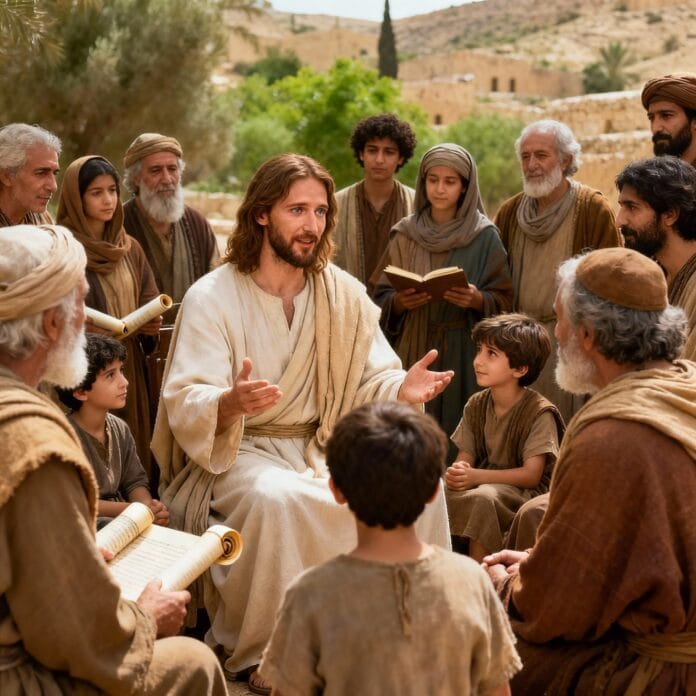
BIOGRAPHICAL NOTE ON ST. LUC
Luke, in Latin Lucas, in Greek Λουϰᾶς, is the abbreviated form of Zucianus (Λουϰιανός), or of Lucilius (Λουϰιλιός), or more probably of Lucanus (Λουϰανός): several ancient Itala manuscripts (especially Cod. Vercell., Vindobon., Cottonian., of Evangel. libri tres, l, 62.) indeed entitle the third Gospel "Evangelium secundum LUCANUM" (Abbreviations of this kind were very common among the Greeks and Romans; for example Zenas for Zenodorus, Demas for Demetrius, Artemas for Artemidorus, Cleopas for Cleopater, Hermas for Hermagoras; Alexas for Alexander, etc.).
This name appears three times in the writings of the New Testament, Colossians 4:14; Philemon 24; 2 Timothy 4:11, and always, according to the unanimous testimony of antiquity, to designate the third of the Synoptic Evangelists. But it is wrong for various ancient and modern authors to have tried to identify St. Luke with the two figures named "Lucius" mentioned in the Book of Acts, 13:1 ("But this Luke, too, they consider to be the same as the one who wrote the Gospel, because names are sometimes written as they are written in their country of origin, or sometimes as they are written in Greek or Latin." Origen, Commentary on the Epistles of Rome 16:21. Campanius, Annal. ad ann. 58, no. 57), and in the letter to the Romans, 16, 21.
We possess patristic information of the greatest value concerning the homeland and origin of St. Luke.
The historian Eusebius and St. Jerome agree that he was born in Antioch, capital of the Syria. Λουϰᾶςτὸ γένος τῶν ἀπʹ Ἀντιοχείας, said the first, Ecclesiastical History. 3, 4. Likewise S. Jerome: «Tertius (Evangelista) Lucas…, natione Syrus, Antiochensis,» Proem. in Matth. (cf. St. John Chrysostom, Hom. in Matth. 1; Tillemont, Ecclesiastic memoirs. 2 p 60.) This tradition, although it has sometimes been attacked, is certainly worth the conjectures of Greswell and other Protestants, who attribute without the slightest appearance of reason to the cities of Troas or Philippi the honor of having given birth to our evangelist.
St. Luke, by birth, did not belong to Judaism, but to the pagan world. This is very clear from the Letter to the Colossians, 4, 10 ff., where St. Paul, after mentioning three of his friends and collaborators, Aristarchus, Mark, and Jesus the Just, taking care to add that they were Jews by origin (“who were circumcised,” verse 11), names three others, Epaphras, Luke, and Demas, without any similar indication, which suggests that the latter were born of pagan parents. The Hebraisms found in several places in the writings of St. Luke prove nothing against this conclusion, for they are easily explained by the Jewish sources from which the author of the third Gospel and the Acts of the Apostles must sometimes have drawn. — Of the four evangelists, St. Luke is therefore the only one who came from a pagan background. It is quite possible, however, according to a belief that was already widespread in the time of St. Jerome (Quæst. in Genèse c. 46), that he affiliated himself with the Jewish religion by becoming a proselyte (See Matthew 23:15 and the commentary), before converting to ChristianityThis explains his perfect knowledge of Israelite customs.
St. Paul tells us that St. Luke practiced medicine. Colossians 4:14: Luc, the beloved doctor, greets you. And confirmation of this fact is found not only in the numerous statements of early ecclesiastical writers, but even in the pages of the third Gospel and the Book of Acts. Technical terms there repeatedly betray the physician. For example, in Acts 4:38, the author takes care to say that St. Peter's mother-in-law was ill with a high fever, πυρετῷ μεγάλῳ, an expression found precisely in Galen. In Acts 13:11, he designates blindness with a rare word, ἀχλύς, also used by Galen. Elsewhere, in Luke 22:44, etc., he mentions pathological phenomena that the other evangelists had passed over in silence. These details are certainly significant.
Based on this fact, and relying on the one hand on the fact that the names of slaves were frequently abbreviated to -as, like that of St. Luke, and on the other hand on the fact that, among the Greeks and in Rome, doctors were often of servile condition (cf. Suetonius, In Caio, c. 8; Senec., Of profit. (3, 24; Quintilian, 7, 2, no. 26), various exegetes have claimed that our evangelist was a freed slave. But nothing in the Bible or in tradition justifies this hypothesis.
Was St. Luke a painter as well as a doctor? This was the belief of St. Thomas Aquinas (Sum, 3a, q. 25, a. 3), as well as that of Simon Metaphrastes in the middle of the tenth century (Vita Luc, c. v1.). Nicephorus (14th century) is therefore not the first, as is often repeated, to mention this opinion (Hist. eccl. 2, 43; ἄϰρως τὴν ζωγράφου τέχνην ἐξεπιστάμενος. According to this author, St. Luke painted portraits of Our Lord Jesus Christ, the Virgin Mary, and the principal Apostles). Whatever the authenticity of the paintings attributed to him, it is certain, and the commentary will demonstrate this at every turn, that St. Luke had the soul of an artist, and that he excelled in descriptions of all kinds, especially in psychological portraits (Bougaud, Jesus Christ, 2nd ed. pp. 87, 88, 93).
At what time and under what circumstances did St. Luke become a Christian? Tradition is almost silent on this question, which can therefore only be answered with more or less risky conjectures. However, since St. Luke was from Antioch, it seems likely that he learned about and adopted the religion of Jesus in that city, which so early possessed a flourishing Christian community, largely composed of pagan elements (cf. Acts 11:19-30). Tertullian even suggests, adv. Marcion, 4, 2, states that St. Luke was converted by the Apostle to the Gentiles himself ("Luke, not an apostle, but an apostolic. Not a master, but a disciple. Inferior, therefore, to the master. And certainly all the more so as he is a follower of the later apostle, St. Paul, without a doubt." This would explain very well their close relationship, which we will soon discuss.«
St. Epiphanius, Against Heresies 51, 6, and other authors following him, make St. Luke one of the seventy-two disciples. Some of the proponents of this opinion argue, in justification, that the third evangelist alone recounted the sending out of the seventy-two, the instructions Jesus gave them, their labors, and their return (Luke 10:1 ff.). But St. Luke refuted them in advance, from the very beginning of his Gospel (1:1), by implicitly stating that he was not an eyewitness to the events he describes. Moreover, "Tertullian states as a constant fact that St. Luke was not a disciple of Jesus Christ… The same Tertullian and St. Irenaeus (Book 1, chapter 20) simply call him an Apostolic Man" (Calmet, Literal commentary on all the books of the Old and New Testaments [26 volumes, also called "The Calmet Bible"]«, (t. 20, p. 182, Preface on St. Luke.). The Muratorian canon states just as clearly that St. Luke "never saw the Lord in the flesh."»
The feeling that our evangelist was one of the two disciples of Emmaus (Luke 24:13 ff. See Theophilacte, Comm. hl) does not rest on more solid foundations.
But now St. Luke becomes his own biographer for a considerable part of his life. Without naming himself, and yet in such a clear way that it is impossible to misunderstand (cf. St. Irenaeus, Against Heresies 3, 14. See the commentaries on the Book of Acts, in the passages indicated below), he recounts in brief the evangelical ministry that he had the joy of exercising in the company of St. Paul for several years. «The dear physician,» leaving Troas with the Apostle to the Gentiles, at the time when the latter was preparing to cross into Europe for the first time, accompanied him as far as Philippi, in Macedonia, Acts 16:10-17. According to St. Jerome, De viris ill. c. 7, the disciple who accompanied Tite In Corinth, to collect alms from the faithful in the name of St. Paul (2 Corinthians 8:18 ff.), we find him none other than St. Luke. Later, in Acts 20:5 ff., we find him in that same city with his illustrious master: they cross the Hellespont again, but in the opposite direction, to return to Troas, from where they travel together to Jerusalem, passing through Miletus, Tyre, and Caesarea. (Ibid. 20:13–21:17). Everything betrays the eyewitness in this account, full of interesting details. It was during this time that St. Paul was arrested in Jerusalem and imprisoned for a long time in Caesarea. When the great Apostle, after his appeal to Caesar, was taken to Rome with other prisoners, his faithful St. Luke followed him and shared in his shipwreck, which has given us one of the most vivid and instructive narratives in the New Testament. Cf. Acts 27:1-28:16.
A few years later, during his second Roman captivity, St. Paul himself shows us St. Luke at his side, as a friend whose attachment nothing can shake: "Luke is alone with me." 2 Timothy 4:11 (For the chronology of this part of St. Luke's story, see Drach, Epistles of St. Paul, pp. 72 and 73.).
What became of the evangelist after the glorious death of his master? Reliable sources abandon us here, and we can only speak from traditions that are almost always uncertain and fluctuating, when they are not directly contradictory. He is at least portrayed as a tireless missionary who carried his message to many lands, even as far as Gaul, according to the testimony of St. Epiphanius (Against Heresies l. 51, 11.) the name and doctrine of the Lord Jesus. Achaea, however, seems to have been the principal place of his work (cf. St. Greg. of Naz. Orat. 33, 11; Carm. 12 de veris S. Script. libris. See D. Calmet, Preface on St. Luke. (p. 183). He died a martyr (in Greece, hanged from an olive tree, according to Nicephorus, Ecclesiastical History. 2, 43; in Bithynia, according to St. Isidore, De ortu et de obitu Patrum, (c. 92), at a fairly advanced age (seventy-four or eighty-one years old, according to different traditions. See Nicephorus and St. Isidore, 1c), probably during the last quarter of the first Christian century. Sedulius (Argument in Luc. Collect. Nov. Vol. 9, p. 177.) expressly states that he had preserved, like St. Paul, perpetual virginity. In 357, the twentieth year of Constantius' reign, his precious remains were solemnly transported to Constantinople (cf. St. Jerome, De vir. Illustr., c. 7; St. John Damascene ap. Spicil. rom. ed. May, t. 4. p. 352.). It is by virtue of a legendary tradition that his tomb is shown today among the ruins of Ephesus.
The Church celebrates his feast day on October 18 (See the Roman Martyrology on the same day).
AUTHENTICITY OF THE THIRD GOSPEL
The authenticity of the third gospel is no less certain than that of the first two biographies of Our Lord Jesus Christ ("Nothing very serious," these are the words of Mr. Renan, "opposes us to considering Luke as the author of the Gospel attributed to him. Luke did not have enough fame for his name to be exploited in order to give authority to a book."« The GospelsParis 1877, p. 252. Even formulated thus, the admission still has its price. We have numerous testimonies to demonstrate this, dating back to apostolic times (we are leaving aside intrinsic proofs, whose probative force seems questionable to us). We could say that the authenticity of the Book of Acts, whose existence has been established elsewhere (see the commentary, Preface, § 1) by the most plausible arguments, is a sure guarantee of that of our Gospel, the author of both writings being the same, and affirming in formal terms, Act 1, 1, that he only composed the second to complete the first. But, for the moment, we only want to appeal to tradition itself.
I. Direct testimonies, that is, those which explicitly name St. Luke as the author of the third Gospel, do not, it is true, extend beyond the second century. However, it must be noted "that they are not the expression of the individual feelings of the writers in whose works they are found, but that they appear incidentally, as the expression of the ancient, uninterrupted, and uncontested conviction of the entire Church. These writers express the fact as something that no one is unaware of. They would not have thought to state it if a special circumstance had not called them to do so. By this ecclesiastical character, at once universal and hereditary, these testimonies, even though they date only from the second century, thus allow us to ascertain the conviction of the first. What reigned then, in fact, was not individual criticism, but tradition (Godet, Commentary on the Gospel of Luke, 2nd ed. t. l, p. 32). » The silence of Papias, which rationalists like to cite against us, therefore does not deprive St. Luke of any of his authorship rights (the reader will recall that Papias expressly attributes the composition of the first and second Gospels to St. Matthew and St. Mark. See our comments. It is also known that we possess only rare fragments of Papias's works.).
The first formal testimony is that of S. Irénée. It is extremely clear and precise: Λουϰᾶς δὲ ὁ ἀϰόλουθος Παύλου τὸ ὑπʹ ἐϰείνου ϰηρυσσόμενον εὐαγγέλιον ἐν βιϐλίῳ ϰατέθετο. Against Heresies 3, 1; cf. 14, 1. Moreover, the great bishop of Lyon cites the third gospel more than eighty times.
At the same time (late second century), the Muratorian Canon (See on this important piece the P. de Valroger, Historical and critical introduction to the books of the New Testament., (t. l, p. 76 et seq.) promulgated, in his curious Latin, the authenticity of the Gospel according to St. Luke as follows: «The third Gospel, that according to Luke. This Luke, a physician, after the Ascension of Christ, as St. Paul received him as someone who wanted to learn to be just, wrote in his own name and according to his own opinion. He had not, however, seen the Lord in the flesh. But he was still able to accomplish his undertaking. And it was from the nativity of John that he began to write. Latin: Lucas iste medicus post ascensum Christi, cum eo (eum) Paulus quasi ut juris studiosum secundum assumpsisset, numine (nomine) suo et opinione concriset (conscripsit); Dominum tamen nec ipse vidit in carne, et idem, prout assequi potuit, ita et ab nativitate Joannis incipet (incipit) dicere. »
Tertullian is no less explicit: «In short, if it appears that nothing is truer than what came before, that nothing is more ancient than what has been from the beginning, and that what has been from the beginning comes from the apostles, it also appears that what has been held as sacrosanct by the churches of the apostles was transmitted by the apostles. I say that not only in them, but in all the churches which are united to them by communion in the same mysteries, this gospel of Luke appears at the very beginning of the edition. We can therefore place our complete trust in it» (Adv. Marcion. 4, 5.). Latin: «In summa, si observation id verius quod prius, id prius quod ab initio, quod ab apostolis, pariter utique constabit, id esse ab apostolis traditum, quod apud ecclesias apostolorum fuerit sacrosanctum… Dico itaque apud illas, nec jam solum apostolicas, sed apud universas, quæ illis de societate sacramenti confœderantur, id evangelium Lucæ ab initio editionis stare, quod eum maxime tuemur. »
As we can see, as we said above, we are not only hearing here the private opinion of a great doctor, but the belief of the entire ancient Church.
Origen, as quoted by Eusebius, Ecclesiastical History. 6, 25, expresses himself thus on the third gospel: Καὶ τρίτον τὸ ϰατὰ Λουϰᾶν, τὸ ὑπὸ Παύλου (cf. Clem. Alex., Strom. 1, 21.).
Eusebius himself does not hesitate to admit this gospel among the ὁμολογούμενα, that is, among the sacred books universally recognized as authentic in the early Church. Cf. Ecclesiastical History 3, 4.
St. Jerome, finally, since it is pointless to go back further than the fourth century, writes in his treatise De viris illustr., c. 7: “Luke, a doctor at AntiochAs his writings indicate, he was well-versed in the Greek language. He was a disciple of Paul and his companion on all his journeys. He wrote a gospel.
We can also regard as direct witnesses to the greatest value the ancient Latin (Itala and Vulgate), Syriac, Egyptian, etc. translations, which entitle the third gospel "According to Luke."«
2. Indirect testimonies are perhaps even more important, either because they go back much further, or because we receive them from the mouths of heretical writers as well as from those of orthodox authors, or finally because they prove to us that the third gospel has always been what it is today.
1. Orthodox Writers. — St. Justin, whose numerous quotations have been so valuable to us in establishing the authenticity of the first Gospel, will be of no less help here. Let us first gather some significant admissions from rationalist exegetes. «Justin’s knowledge of the Gospel of Luke,” says Zeller, “is demonstrated by a series of texts, some of which are undoubtedly, and others in all likelihood, borrowings from this work (Apostleship History, p. 26.). » « Besides Matthew and Mark…, Justin also uses the Gospel of Luke, » writes Hilgenfeld (The Kanon, p. 25. cf., by the same author, das Evangel. Justin's, pp. 101 ff.). And Volkmar: "Justin knows our three Synoptic Gospels, and extracts almost all of them (Ursprung unserer Evangelien, p. 91. cf. Semisch, die Denkwürdigkeiten Justin's, pp. 134 et seq.).» Some comparisons will justify these statements.
Dialogc. 100: "The Virgin MarriedWhen the angel Gabriel announced to her that the Spirit of the Lord would come upon her and that the power of the Most High would overshadow her, and that consequently the holy being born of her would be the Son of God, she replied: “Let it be done to me according to your word.” (See also Apol. 1. 33.) cf. Luke 1:26-30.
Dialog. c. 78: “The first census having then been taken in Judea under Cyrinus, (Joseph) had come from Nazareth, where he lived, to Bethlehem, where we find him now, to be registered. He belonged to the tribe of Judah, which inhabited that region.” cf. Luke 2:2.
Dialog. c. c103: «In the memoirs composed, as I have said, by the Apostles and their disciples, it is related that sweat flowed in drops (from Jesus), while he prayed and said: May this cup, if it is possible, pass from me!» cf. Luke 22:44.
Dialog. c. 105: «Deathing on the cross, he said: My Father, into your hands I commit my soul.» cf. Luke 23:46.
Bring them closer in a similar way Dial. 51 of Luke. 16, 16; Apol. 1, 16 and Dial. 101 of Luke 18, 19; Apol. 1, 19 of Luke. 20, 34; Apol. 1, 66 of Luke. 22, 19, etc.
The letter from the Churches of Lyon and Vienne (Ap. Euseb. Ecclesiastical History. 5, l), written in the year 177, clearly quotes Luke 1:5 and 6.
In that of St. Clement of Rome, c. 13, Volkmar himself recognizes a text from St. Luke, 6, 31, 36-38 (Maier, Einleit., (p. 117, mentions some other less certain quotations from apostolic writers.).
2. Heterodox writers — Cerdon accepted the authority of the third gospel, as we learn from an ancient book attributed to Tertullian: “Cerdon only received theGospel of Saint Luke, but not in full.” “Solum evangelium Lucæ, nec tamen totum, recipit (Cerdo)” (Pseudo-Tertull. De præscript. hær. c. 51).
In the Philosophoumena, 6, 35 and 7, 26, we see Basilides and the Valentinians quoting our gospel (1, 15), proof that they accepted its authenticity (cf. also St. Irenaeus, Against Heresies 1, 8, 4, and Luke 2, 29, 36). Heracleon comments on several passages (3, 17; 12, 8, 9, ap. Clem. Al, following the Stromata); Theodotus argues on various other texts (Theodoti Ecloge, (c. 5, 14, 85). Similarly the Clementine Homilies, as can be seen by comparing the following passages: Hom. 12, 35, 19, 2 and Luke 10, 18; Hom. 9, 22 and Luke 10, 20; Hom. 3, 30 and Luke 9, 5; Hom. 17, 5 and Luke 18, 6-8. etc.
But of all the heretical testimonies supporting the authenticity of the third gospel, the most important and famous is that of the Gnostic Marcion (circa 138 AD). Desiring to eliminate from the Christianity Any element that recalled Judaism, this heretic cut and drastically removed from the writings of the New Testament, retaining only a few letters of St. Paul and the Gospel according to St. Luke, not without having subjected them to considerable changes and modifications to adapt them to his system. We have several Fathers as witnesses to this fact, who gave it great publicity through their energetic denunciations. “And in addition to this,” says St. Irenaeus, “taking what is according to the Gospel of Luke, and removing everything written about the generation of the Lord, and much concerning the doctrine of the Lord’s sermons, he persuades his disciples to be more truthful than the apostles of Christ, even though he transmits to them only a part of his Gospel (Against Heresies 1, 27, 2.). » Tertullian wrote similarly: «Marcion seems to have chosen Luke (Contr. Marcion, 4, 2.).» cf. Orig. Cont. Celsum 2, 27; St. Epiphanius, Against Heresies 42, 11; Theodoret, Haeret. Fab. 1, 24 (One will find in Thilo, Cod. apocryph. N. T., pp. 401-486, and in Volkmar, das Evangel. Marcion's, pp. 150-174, considerable fragments of the Gospel of Marcion, collected through the writings of the Fathers).
What follows from this treatment inflicted by Marcion on the account of St. Luke, in such a way as to form what the famous Gnostic proudly called "the Gospel of Christ"? The obvious conclusion is that the third Gospel pre-existed Marcion, that it was received into the Church as early as the first half of the second century. — But the rationalists have claimed quite the opposite (at the end of the 18th century Semler and Eichhorn, in the 19th century Schwegler, Baur, Ritschl (das Evangel. Marcions u. das kanonische Evangel. des Lucas, Tubing. 1846), etc.). Taking as their basis the fact we have pointed out, they dared to maintain, despite the very clear interpretation given by the most ancient and learned Fathers, that, far from deriving its origin from the third canonical Gospel, Marcion's arbitrary composition is much older than the work attributed to St. Luke, the latter being in reality only a late reworking of the former. Such assertions would scarcely merit a reply. Providence, however, allowed other nationalists to become ardent defenders of the truth on this point, and to expose the secret maneuvers of their rivals: "This opinion," writes Hilgenfeld (The Evangelist, p. 27.), misunderstood the true tendency of the Marcionite gospel, in order to attribute to the canonical text THE MOST RECENT POSSIBLE DATE. » « We can admit as demonstrated and generally accepted, » says Zeller similarly, « not only that Marcion used an older gospel, but also that he reworked it, modified it, often abridged it, and that this older gospel was none other than… our St. Luke (Apostleship History, lc Volkmar, das Evangel. Marcion's, Leipzig 1852, develops the same thesis in detail. Yielding to these reasons, Ritschl was forced to retract his statement (Theolog. Jahrb., 1851, pp. 528 ff.). See also, on this question of the relationship between St. Luke and Marcion, Hahn, Heim, Marcion, his doctrine and his gospel, Strasbourg 1862; Mgr Meignan, The Gospels and Criticism in the 19th Century, Bar-le-Duc 1864, pp. 317 et seq.).» The question is therefore now settled, and Marcion becomes, albeit against his will, a guarantor of the authenticity of the third gospel.
Finally, let us add that the pagan Celsus (cf. Origen, Against Celsus, 2, 32) knows the exegetical difficulties which arise from the genealogies of Our Lord Jesus Christ, proof that the Gospel according to St. Luke existed in his time.
The first two chapters, which recount the story of the Holy Childhood of Jesus, have sometimes been considered apocryphal. This opinion had no serious basis.
THE SOURCES OF ST. LUKE
1. St. Luke, as we saw in the biographical note that opens this volume, had a long and close relationship with the Apostle to the Gentiles. "A priori," we might expect to find in his Gospel some reflections of St. Paul's doctrine and style. But now, thanks to tradition and critical scholarship, our conjectures on this point will be transformed into complete certainty.
Λουϰᾶς δὲ, we read in S. Irenaeus (Against Heresies 3, 1. cf. 14, l), ἀϰόλουθου ἐν βιϐλίῳ ϰατέθετο. Origen says similarly: ϰαί τὸ τρίτον τὸ ϰατὰ Λουϰᾶν τὸ ὑπὸ Παύλου ἐπαινούμενον εὐαγγέλιον (Ap. Euseb. Ecclesiastical History. 6, 25). Tertullian (Contr. Marcion. 4, 2), after calling Saint Paul the "master" and "illuminator" of Luke, adds: "For they are accustomed to attributing to Paul what Luke wrote. It is reasonable, in fact, to think that what the disciples propagated came from the masters" (Ibid, 4, 5). The author of the Synopsis S. Scripturæ falsely attributed to S. Athanasius (P. 155), also writes that τὸ ϰατὰ Λουϰᾶν εὐαγγέλιον ὑπηγορεύθη μὲν ὑπὸ Παύλου ἀπόστολου, συνέγραφη δὲ ϰαί ἐξέδοθη ὑπὸ Λουϰᾶ. Finally, several Fathers assert that, according to the teaching of various exegetes who lived in their time, St. Paul intended to refer directly to the third Gospel every time he uses the expression "My Gospel" in his Letters (For example, Romans 2:16; 16:25; 2 Timothy 2:8). Φασὶ δὲ ὡς ἄρα τοῦ ϰατʹ αὐτὸν (Λουϰᾶν) εὐαγγελίου μνημονεύειν ὁ Παῦλος εἴωθεν, ὕπηνίϰα ὡς περὶ ἰδίου τινος εὐαγγελίου γράφων ἔλεγε, Κατὰ τὸ εὐαγγελίον μου. Eusebius, Ecclesiastical History. 3, 4. «Some even believe that every time Saint Paul writes «according to my gospel» in his letters, he is referring to the Gospel of Saint Luke.» St. Jerome, De viris illustr. c. 7 (cf. St. John Chrysostom. Hom. 1 in Act. Apost.; Orig. Hom. 1 in Luc.).
We should certainly not take these various passages too literally: St. Luke himself would disagree (see 1:1 ff.). However, it is very clear from their totality that St. Paul played a significant role in the composition of the third Gospel. His influence becomes quite palpable if we move from tradition to an examination of several facts that have long attracted the attention of exegetes and critics.
First fact. St. Paul included in his first Letter to the Corinthians, 11:23 ff., the account of the institution of the divine Eucharist Now, the parallel narrative of Luke 22:19 ff., on the one hand, differs from that of the other two Synoptic Gospels (cf. Matthew 26:26 ff., and Mark 14:22 ff.), and on the other hand, coincides almost verbatim with that of St. Paul. This coincidence is certainly not accidental (cf. also, on the one hand, Luke 10:7; 1 Timothy 5:18; on the other, Matthew 10:11).
Second point. We notice, in the writings of the great Apostle and in the Gospel according to St. Luke, a great number of common ideas. Like his master, the evangelist emphasizes at every turn the universal character of the religion of Christ; he speaks of justification by faith, of the activity of divine grace in the remission of sins, etc. See in particular the following passages: 1:28, 30, 68 ff.; 2:31 and 32; 4:25 ff.; 7:36 ff.; 9:56; 11:13; 14:16 ff.; 17:3 ff., 11 ff.; 18:9 ff., etc. (See also what we will say below about the purpose and character of the third Gospel, §§ 4 and 5).
Third point. Often, the resemblance exists not only between thoughts: it even extends to expressions. We could, in the manner of Davidson (Introduction, t. 2, pp. 12 et seq.), fill entire pages with expressions common to S. Paul and S. Luke. It will suffice to cite a few, chosen from those which were only used by these two sacred writers: Ἄδηλος, Luke. 11, 44 and 1 Corinthians 14, 8; αἰφνίδιος, Luke. 21, 34 and 1 Thessalonians 5, 3; αἰχμαλωτίζειν, Luke. 9, 54 and 2 Corinthians 10, 5; ἀλλʹ οὐδέ, frequently on both sides; ἀναλῶσαι, Luke 1:54 and Galatians 5:15, 2 Thessalonians 2:8; ἀνταπόδομα, Luke 14:12 and Romans 11, 9; ἀπολύτρωσις, Luke. 21, 18 and often in S. Paul; ἀροτριᾶν, Luke. 17, 7 and 1 Corinthians 9, 10; ἐϰδιώϰειν, Luke. 11, 49 and 1 Thessalonians 2, 15; ἐπιμελεῖσθαι, Luke. and 1 Timothy 3, 5; ϰατάγειν, Luke. 5, 11, Acts. and Romans 10, 6; ϰυριεύειν, Luke, 22, 25 and Romans 6, 9; ὀπτασία, Luke, Acts and 2 Corinthians 12, 1; πανουργία, Luke. 20, 23 and 2 Corinthians 4, 2, 11, 3; ὑπωπιάζειν, Luke. 18, 5 and 1 Corinthians 9, 27, etc. cf. also Luke. 4, 22 and Colossians 4, 6; Luke. 4, 36 and 1 Corinthians 2, 4; Luke. 6, 36 and 2 Corinthians 1, 3; Luke. 6, 48 and 1 Corinthians 310; Luke 8:15 and Colossians 1Luke 10:11; Luke 10:8 and 1 Corinthians 10:27; Luke 11:36 and Ephesians 5:13; Luke 11:41 and Tite 1, 15, etc. As we can see, "the evangelist's mind was thoroughly imbued with the views and phraseology of St. Paul" (Davidson, l. c., p. 19.).» Thus, even the most skeptical critics admit that it is impossible to ignore the affinity that exists between the Gospel according to St. Luke and the letters of St. Paul (See Gilly, A Concise Introduction to Holy Scripture, vol. 3, p. 221. It is true that some of them, for example the Anonymous Saxon (cf. the excellent work by M. Vigouroux, *The Bible and Modern Discoveries*, vol. 1, p. 21 ff. of the 2nd ed.) and the Tübingen school (ibid., p. 79 ff.), concluded from this that our Gospel is "a text of tendency" intended to effect a reconciliation between the Paulinism and the Petrinism ; but we have seen elsewhere (Commentary on St. Matthew) the case to be made with such assertions.).
2. Like St. Peter (see the Gospel according to St. Mark, pp. 11 and 12), St. Paul also has, in a certain way, his own Gospel. Nevertheless, while he undoubtedly exerted an influence on the writing of St. Luke, he did not exert it exclusively. Tradition is again very explicit on this point. St. Irenaeus. Against Heresies 3.10.1 calls St. Luke the disciple and follower of Paul (cf. 3.14.1 and 2). St. Jerome says of him, based on earlier testimonies, that he had not only learned the Gospel from the mouth of the Apostle St. Paul, "but also from the other apostles." (De viris illustr. lc). Following Eusebius (Hist. eccl. 3, 4), Λουϰᾶς… τὰ πλεῖστα συγγεγονὼς τῷ Παύλῳ, ϰαὶ τοῖς λοιποῖς δὲ οὐ παρέργως τῶν ἀποστόλων ὡμιληϰὼς, ἧς ἀπὸ τούτων προσέϰτήσατο ψυχῶν θεραπευτιϰῆς, ἐν δυσιν ἡμῖν ὑποδείγματα θεοπνεύστοις ϰαταλέλοιπε βιϐλίοις .
But St. Luke himself is even more affirmative in his Prologue, 1, 1 ff.: "« 1Many have undertaken to write the history of the events that have taken place among us, 2 in accordance with what was handed down to us by those who from the beginning were eyewitnesses and ministers of the word, 3 I too have resolved, after diligently striving to understand everything precisely from the beginning, to write you a continuous account of it, excellent Théophile, 4 so that you may recognize the certainty of the teachings you have received.» (See the Commentary.).
Since the evangelist St. Luke did not have the privilege of witnessing firsthand the divine events he wished to recount, he thus reveals to his readers the sources he consulted to obtain truly authentic material. First and foremost, he turned to eyewitnesses of the life of Jesus (St. Paul was not one), and he collected from their lips the traditions they had faithfully preserved. Now, «if we look among the Apostles to see which men could have provided him with information, history will show us first St. Barnabas, founder of the Church of Antioch… then St. Peter, with whom St. Luke certainly became acquainted in Antioch… then St. James of Jerusalem, brother of the Lord, with whom our evangelist entered into a relationship (Acts 21:18), and who, being a member of the Holy Family, could give him the most reliable information concerning the early days of the life of Our Lord Jesus Christ.» » (From Valroger, Historical and critical introduction to the books of the New Testament., vol. 2, p. 77 ff. Petrus Cantor (towards the end of the 12th century) already believed that St. Luke had gathered from the Blessed Virgin Mary herself most of the details that fill the first two chapters of his Gospel. This opinion is very plausible; it has also been adopted even by Protestant exegetes, cf. among others Grotius, Annotat. in Luc. 2, 5). In the less intimate, it is true, but larger circle of disciples, it was even easier for St. Luke to gather valuable information about the Savior's ministry. His long journeys, his stays in Jerusalem, in Antioch, in Caesarea of Palestine, in Greece, in Rome, had to put him in contact with a hundred trustworthy people, who taught him about Our Lord Jesus Christ the details that he alone preserved for us.
Oral tradition, then, was the principal source from which he drew. But he also had at his disposal the written documents he mentions in his Prologue. These were, as we would say today, more or less substantial "Essays," some perhaps dealing with the entire life of Jesus, others, most undoubtedly, with fragmentary accounts of this or that part of his public ministry, for example, his speeches, his miracles, still others with his childhood, his Passion, etc. St. Luke drew from a work of this kind his genealogy of Jesus (3:23 ff.), probably also the "Benedictus," the "Magnificat," the "Nunc dimittis," if not the entire account of the early years of the Forerunner and of Jesus. — Did he also make use of the Gospels of St. Matthew and St. Mark, composed, in all likelihood, before his own? Critics have expressed conflicting opinions on this issue, which has been the subject of intense debate. Further discussion can be found in our General Introduction to the Gospels. http://jesusmarie.free.fr/bible_fillion_intro_evangiles.pdf the elements of this controversy, which forms only an accessory part in the vast discussion concerning the reciprocal relationships of the three synoptic books.
Various German rationalists have arbitrarily attempted to reconstruct, in detail, the sources St. Luke used to compose the Gospel that bears his name. Schleiermacher considered himself perceptive enough to distinguish in the third Gospel four series of documents predating St. Luke, compiled and stitched together by the narrator. Koestlin, for his part, identifies sources of Jewish origin and others of Samaritan origin. There is nothing sound in this exaggerated criticism (See Maier, 111, p. 106, note 2).
DESTINATION AND PURPOSE OF THE THIRD GOSPEL
Here again, the author himself provides us with valuable information. We therefore need not dwell at length on these two points, thanks to the Prologue which we have quoted in large part above.
LA new and even unique feature in Gospel literature, the biography of Our Lord Jesus Christ according to St. Luke begins with a dedication: Ἔδοξε ϰάμοὶ… σοι γράψαι, ϰράτιστε Θεόφιλε, 1, 3. In the commentary, we will outline the principal opinions that have formed since antiquity concerning this mysterious figure, to whom the third Gospel is dedicated. Suffice it to say for now that he must have been a man of some importance, a pagan by origin and converted to Christianity. ChristianitySt. Luke, conforming to a custom then in vogue in the Roman Empire, took him, according to the established expression, as his "protector or defender of the book." But, although he addresses himself directly to Theophilus, this does not mean that he actually wrote only for him. A book of this kind had not been composed for such a limited audience. Through the intermediary of his illustrious friend, the evangelist thus presented his work, as the Fathers had already affirmed, either in a more specific way to the Greek Churches ("Luke, therefore, who, among all the evangelists, was the most versed in the Greek language, who was also a physician, and who wrote a gospel in Greek." St. Jerome, Letter 20, to Damascus. Μάρϰος δʹ Ἰταλίν ἔγραψε θαύματα Χριστοῦ, Λουϰᾶς Αχαΐδι. S. Greg. Naz. Carmen de veris: S. Script. Bookshelf, 12, 31. Id. Carm. 22, 5, 1.), that is, to all converts from paganism (Orig. ap. Euseb. Ecclesiastical History. 3, 4: τοῖς ἀπὸ τῶν ἐθνῶν), or even in general to all Christians (St. John Chrysostom, Hom. in Matth. 1: ὁ δὲ Λουϰᾶς ᾅτε ϰοινῆ πᾶσι διαλεγόμε νος). A careful examination of the third Gospel corroborates these traditional accounts and shows that St. Luke, unlike St. Matthew, did not have in mind readers who were, at least for the most part, Jewish. Indeed, many of his explanations would have been completely useless to Jews, while they were indispensable to Gentiles. For example, 4:31, « He went down to Capernaum, a town in Galilee »8:26, «Then they landed in the land of the Gerasenes, which is opposite Galilee.»; 21:37, « During the day, Jesus taught in the temple, and he would leave it to spend the night on the mountain called Olivet.»" ; 22, 1, "« The Feast of Unleavened Bread, which is called Passover »; 23, 51, « He was from Arimathea, a city in Judea. »"; 24, 13, "on the way to a village called Emmaus, sixty stades from Jerusalem", etc. cf. 2, 1 and 3, 1, where the evangelist designates by the reign and by the name of two Roman emperors the date of the birth of Jesus and of the ministry of St. John the Baptist.
2. The purpose of the third Gospel is no less clear than its destination. It is first and foremost a historical purpose. To compose a biography of the Savior more complete and better coordinated than all those that had appeared until then (cf. 1:1-3), and consequently to provide his readers with a new means of strengthening their faith ("so that you may know the certainty of the teachings you have received," 1:4), such was the twofold purpose that St. Luke set for himself.
This is what the historian Eusebius expresses very well (Ecclesiastical History. 3, 24.): Ὁ δὲ Λουϰᾶς ἀρχόμενος ϰαὶ αὐτὸς τοῦ ϰατʹ αὐτὸν συγγράμματος τὴν αἰτίαν προύθηϰε, δἰ ἣν πεποίηται τὴν σύνταξιν· δηλῶν, ὡς ᾄρα πολλῶν ϰαὶ ᾄλλων προπετέστερον ἐπιτετηδευϰότων διήγησιν ποιήσασθαι ὧν αὐτὸς πεπληροφορητο λόγων, ἀναγϰαίως ἀπαλλάτων ἡμᾶς περὶ τοὺς ᾄλλους ἀμφηρίστου ὑπολήψεως, τὸν ἀφ λόγον, ὧν αὐτὸς ἱϰανῶς τὴν ἀλήθειαν ϰατειλήφει, ἐϰ τῆς ᾅμα Παύλω συνουσίας τε ϰαὶ διατριϐῆς ϰαὶ τῆς τῶν λοιπῶν ἀποστόλων ὁμιλίας ὠφελημένος, διὰ τοῦ ἰδίου παρέδωϰεν εὐαγγελίου. During the apostolic era, the speeches and actions of Our Lord. Jesus Christ formed the basis of Christian teaching; the catechesis of the first preachers was entirely based on the life of the Master. By writing in turn an abridgment of this divine life, St. Luke thus contributed eminently to the dissemination of the ChristianityCenturies after their first appearance, its inspired pages still help to strengthen Christian convictions in people's hearts. It is only in this sense that they have a dogmatic purpose.
THE CHARACTER OF THE GOSPEL ACCORDING TO ST. LUKE
1As we indicated above, when discussing the similarities between the third Gospel and the letters of St. Paul, what is most striking when studying the work of St. Luke as an evangelist is its universality. The limits of the Christianity They are as vast as the world. Jesus appears there as the Savior of all people without exception, even pagans. No distinction is made, with regard to salvation, between Jews and pagans, Greeks and barbarians, the righteous and the fishermen It would seem rather that if, according to St. Luke, there is any privilege from this point of view, it is that of the pagans, the barbarians and the fishermen who enjoy it (we certainly do not mean to say that the other Gospel accounts do not teach the same doctrine, but we are trying to highlight the specific and characteristic aspect of the third Gospel. (See Bougaud, Jesus Christ, 2nd ed., pp. 89 ff.).
Let us cite a few examples in support of this theory. St. Luke, 3:23 ff., in giving his readers the genealogy of Jesus, does not only trace the lineage back to Abraham, as St. Matthew did; from one line to the next, he goes all the way to the father of all humanity: “son of Adam, son of God.” At the birth of the Redeemer, the angelsAfter first announcing this great event to Jewish pastors, they hasten to point out its happy consequences for all men: to men of goodwill, 2:14 (cf. 2:1 ff., where Jesus is shown to us as a subject of Caesar, as a citizen of the Roman Empire). Forty days later, it is the mouth of a son of Jacob that utters these sublime words: «a light to dispel the darkness of the Gentiles and the glory of your people Israel» (2:32). At the beginning of his public ministry, Jesus himself, in reference to a passage from Isaiah, clearly reminds his compatriots that, from the days of Elijah and Elisha, Gentiles had received divine blessings in preference to the Israelites (cf. 4:25-27). Elsewhere (9:52-56, 17:11-16), we see him extending his blessings even to the cursed Samaritans. The parable of the banquet, 14, 16-24, likewise announces that the pagans will have a share in the messianic salvation.
Through how many similar details does St. Luke not highlight the Good Shepherd's predilection for the poorest and most lost souls? Suffice it to mention those of the sinful woman (7:37 ff.) and the prodigal son (15:11 ff.) as two of the most famous examples ("There is scarcely an anecdote, a parable in Luke that does not breathe this spirit of mercy and appeal to sinners… The Gospel of Luke is preeminently the Gospel of forgiveness." E. Renan, The Gospels, p. 266 ff.). It is true that Renan immediately adds: "All distortions are good enough for him (St. Luke!) to make each Gospel story a story of rehabilitated sinners." On whose side do the "distortions" really lie?.
While constantly highlighting God's benevolent disposition not only towards Jews but also towards Gentiles and sinners, St. Luke omits details that might have offended converts from paganism, or at least were of less interest to them (Davidson, Introduction, (Vol. 2, p. 44 et seq.).
2. We will better indicate the character of the third gospel by showing how St. Luke drew the portrait of Jesus.
True to his promise, he gave the Church the most complete of all biographies of the divine Master ("It has been calculated that a third of Luke's text is found neither in Mark nor in Matthew." E. Renan, the Gospels, p. 266. cf. Bougaud, Jesus Christ, 2nd ed., p. 92 ff.; St. Irenaeus, 3, 14). Taking the mystery of the Incarnation as his starting point, he leads the reader to the Ascension of Jesus, through all the principal events that constitute our redemption. Without him, we would have known only a very imperfect way about the childhood and hidden life of Our Lord: thanks to the details that fill his first two chapters, we can form a true idea of this important period. His description of the public life abounds in new details, which fill many gaps. A considerable passage, 9, 51 – 18, 14, belongs almost entirely to him: he is likewise the only one to recount the episodes of Nazareth, 4, 16 ff., and of Zacchaeus, 19, 2-10. During this period of Jesus' life, there are as many as twelve parables:
1° The two debtors, 7, 40-43; ;
2° the Good Samaritan, 10, 30-37 ;
3° the two friends, 11, 5-10; ;
4° the rich fool, 12, 16-21; ;
5° the barren fig tree, 13, 6-9; ;
6. The lost and found drachma, 15, 8-10; 7. The prodigal son, 15, 11-32; ;
8° the unfaithful steward, 16, 1-8;
9° the rich man and Lazarus, 16, 19-31; ;
10° the unjust judge, 18, 1-8; ;
11° The Pharisee and the Publican, 18, 9-14; ;
12° the mines, 19, 11-27)
and five miracles:
1° The first miraculous catch of fish, 5, 5-9;
2° the resurrection of the widow's son, 7, 11-17; 3° the healing of a disabled woman, 13, 11-17; 4° the healing of a dropsical man, 14, 1-6;
5° the ten lepers, 17, 12-19) which are not found outside the third gospel.
His account of the Passion is no less rich in highly valuable details, such as the sweat of blood and the appearance of the comforting angel in Gethsemane (22:43-44), the interrogation at Herod's court (23:6-12), Jesus' words to the holy women (23:27-31), and the episode of the good thief (23:39-43) (cf. also 22:61: "The Lord turned and looked at Peter"; 23:34, etc.). These numerous details demonstrate that St. Luke's research was not in vain. We will point out many more in the commentary.
However, he omitted several remarkable incidents, reported by the first two synoptic Gospels: for example, the healing of the Canaanite woman's daughter, Jesus walking on water, the second multiplication of the loaves, the cursing of the fig tree, and various other miracles (Here are his principal omissions: Matt. 14:22-16:12 (cf. Mark 6:45-8:26); Matt. 19:2-12; 20:1-16, 20-28 (cf. Mark 10:35-15); Matt. 26:6-13 (cf. Mark 14:3-9); Matt. 17:23-26, etc.).
The image of Jesus that emerges from St. Luke's Gospel has a very special character. It is not that of the Messiah promised to the Jews, as in St. Matthew; it is not that of the Son of God, as in St. Mark and St. John: it is that of the Son of Man, living among us, like one of us. The opening pages of the third Gospel are very significant in this respect, for they show us, through a series of rapid gradations, the human development of Jesus. First ϰαρπὸς τῆς ϰοιλίας («the fruit of your womb»), 1:42, the Savior successively becomes βρέφος («the newborn»), 2:16, then παιδίον («the little child»), 2:27, then παῖς: («child»), 2:40, and finally ἀνήρ, perfect man, 3:22. Although hypostatically united to the Divinity, this son of man is poor, he humbles himself, he kneels at every moment to pray (Cf. 3:21; 9:29; 11:1; 22:32, etc.) («Like a true The pontiff (Jesus) offered prayers, for in the Gospels, especially in Luke's, we read that he prayed. – St. Anselm, In letter to Hebr. (chapter 5), he suffers, and we even see him weep (19, 41). But, on the other hand, he is the most lovable of men's children: we said so in the first part of this paragraph, mercy Overflowing from his sacred heart, he takes pity on all suffering, physical or moral, he soothes all wounds. Such is the Jesus of St. Luke.
3. Let us add a few more points worth noting concerning the character of the third gospel.
1. It has sometimes been called "the Gospel of contrasts." It begins with a contrast, the doubts of Zechariah juxtaposed with the faith of MarriedSoon after, in 2:34, he shows us Jesus as an occasion of ruin for some, as a cause of salvation for others. Later, in the abridged version of the Sermon on the Mount, he places the curses alongside the beatitudes. The proud Simon and the humble sinner, Martha and MarriedThe good poor man and the bad rich man, the Pharisee and the tax collector, the two thieves: these are some other striking contrasts in the third gospel.
2° The role given to women is also a characteristic detail of this admirable work. In no other Gospel version is the Blessed Virgin discussed at such length. St. Elizabeth, Anna the prophetess, the widow of Nain, Mary Magdalene and her companions (8:2-3), the sisters of Lazarus, the "daughters of Jerusalem" (23:28), and many others, appear in turn in St. Luke's narrative as living proofs of the interest Jesus had in this part of humanity, so humiliated and mistreated at the time.
3. St. Luke is the poet, the hymnographer of the New Testament. He alone has preserved for us four sublime canticles, the Magnificat of Married, the Benedictus of Zacharias, the Nunc dimittis of the old man Simeon, finally the Gloria in excelsis sung by the angels— He is also the evangelist as psychologist. He intersperses his narrative with delicate and profound reflections, which shed great light on the events to which they are linked. cf. 2:50-51; 3:15; 6:11; 7:25, 30, 39; 16:14; 20:20; 22:3; 23:12, etc.
4. In essence, the composition of St. Luke certainly surpasses those of St. Matthew and St. Mark in beauty. It delights the mind and heart, and powerfully contributes to making Our Lord Jesus Christ known. St. Mark, however, surpasses St. Luke in the picturesque and dramatic nature of his narratives; this does not prevent the third Gospel from containing a wealth of graphic details, for example 3:21-22; 4:1; 7:14; 9:29, etc.
LANGUAGE AND STYLE OF THE THIRD GOSPEL
St. Luke composed his gospel in Greek; there has never been the slightest doubt about that.
Antiquity already judged his style very favorably. "The Gospel of Luke is the most literary of the Gospels… Luke… shows a true intelligence of composition. His book is a beautiful, well-structured narrative,… combining the emotion of drama with the serenity of idyll." Latin: "Evangelistam Lucam," wrote St. Jerome (Commentary on Isaiah 6, 9. cf. De viris illustr., lc, Letter 20 to Damascus), tradunt veteres Ecclesiœ tractatores…magis Græcas litteras scisse quam Hebræas. Unde sermo ejus, tam in Evangelio quam in Actibus Apostolorum…, comptior est et sæcularem redolet eloquentiam» (E. Renan, The Gospels, p. 282 et seq.: "Our ignorance is such today that there are perhaps literary figures who will be astonished to learn that St. Luke is a very great writer." Chateaubriand, Genius of Christianity, (Book 5, Chapter 2). Indeed, none of the other evangelists equals him in this respect. His diction is easy, generally pure, sometimes even exquisitely elegant. The prologue in particular is entirely classical.
But details and examples will better highlight St. Luke's literary culture. A sign of the utmost importance when it comes to demonstrating knowledge of a language, our evangelist employs a considerable number of expressions. He alone uses more Greek words than St. Matthew, St. Mark, and St. John combined. Compound words, which so delicately convey the varied nuances of thought, appear constantly in his writing. He has a predilection for those in which the prepositions ἐπὶ and διὰ enter (eg διαϐαλλειν, διαγινώσϰειν, διαγρηγορεῖν, διάδοχος, διαϰούειν, διαμάχεσθαι, διαπορεῖν, διασπείρειν, ἐπιϐιϐάζειν, ἐπιβουλὴ, ἐπιγίνεσθαι, ἐπιδεῖν, ἐπίεναι, έπιϰουρία, ἐπιρίνειν, ἐπιμελῶς). His sentences are for the most part well formed (what difference, for example, between the heavy sentence of S. Mark, 12, 38 et seq., βλέπετε ἀπὸ τῶν γραμματέων τῶν θελόντων ἐν στολαῖς περιπατεῖν ϰαὶ ἀσπασμοὺς ἐν ταῖς ἀγοραῖς, and that of S. Luke, 20, 46, προσε he varies them with ease. The most complicated constructions are not an embarrassment for him.
He takes care to avoid overly Hebrew expressions or ideas that might have presented obscurity to his readers. This is how he uses ἐπιστάτης instead of ῥαϐϐί (six times), ναὶ, ἀληθῶς or ἐπʹ ἀληθείας instead of ἀμήν (However, we encounter this seven times adverb in the third Gospel; but S. Matthew used it thirty times, S. Mark fourteen times), νομιϰοί instead of γραμματεῖς (six times), ἄπτειν λύχνον instead of ϰαίειν λύχνον, φόρος instead of ϰῆνσος, etc. He calls the lake of Gennesaret λίμνη and not θάλασσα. Sometimes, however, especially in the first two chapters, as previously mentioned, a few Hebraisms have crept into his sentences. The main ones are: 1° ἐγένετο ἐν τῷ…, 'ויהיב (twenty-three times, only twice in St. Mark, never in St. Matthew); ;
2° ἐγένετο ὡς,
ױהיכ'; 3° οἶϰος in the sense of "family" in the manner of בית; and
4° the name of Ὕψιστος (עליזן), applied to God (five times, only once in St. Mark); ;
5° ἀπὸ τοῦ νῦν, כוצתה (four times, never in the other gospels);
6° προσέθετο πέμψαι 20, 11, 12
(See Davidson, Introduction, (p. 57).
Among the most remarkable constructional features of the third Gospel, we can point out the following: 1° The participle in the neuter form, accompanied by the article, to replace a noun; e.g.: 4:16, ϰατὰ τὸ εἰωθος αὐτῷ; 8:34, ἰδόντες τὸ γεγεννημένον; 22:22; 24:14, etc. 2° The auxiliary verb "to be" constructed with the participle, instead of the verb in the "tempus finitum" [perfect tense] Cf. 4:31; 5:10; 6:12; 7:8, etc. (Forty-eight times.) 3° The article τὸ placed before an interrogative sentence, vg: 1, 63, ἐνένευον δὲ τῷ πατρί αὐτοῦ, τὸ τί ἄν θέλοι ϰαλεῖσθαι αὐτόν ; 7, 11; 9, 46, etc. 4° The infinitive preceded by the article in the genitive case, to mark a result or a design; Cf. 2, 27; 5, 7; 21, 22, etc. (In all, twenty-seven times: only once in S. Mark, six in S. Matthew.) 5° The frequent use of certain verbs in the participle, to give more life and color to the story; for example, ἀναστάς (seventeen times), στραφείς (seven times), πεσών, etc. 6° εἰπεῖν πρός (sixty-seven times) (Only once in the first Gospel.), λαλεῖν πρὸς (four times), λέγειν πρὸς (ten times).
Here are now some of the expressions specific to the author of the third gospel, or which at least recur most often in his story (We will find the almost complete list in Davidson, lc, pp. 58-67: Κύριος instead of Ἰνσοῦς (fourteen times), σωτέρ and σωτηρία, χάρις (eight times), εὐαγγελίζομαι (ten times), ὑποστρέφω (twenty-one times), ὑπάρχω (seven times), ᾅπας (twenty times), πλῆθος (eight times), ἐνώπιον (twenty-two times, never in the first two gospels), ἀτενίζω, ᾄτοπος, βουλή, βρέφος, δεόμαι, δοχή, ἐφιστάναι, ἐξαίφνης, θάμϐος, θεμέλιον, ϰλάσις, λεῖος, ὀνόματι, ὀδυνᾶσθαι, ὁμοθυμαδόν, ὁμιλεῖν, οιϰόνομος, παιδεύω, παύω, πλέω, πλὴν, παραχρῆμα, πράσσω, σιγάω, σϰιρτάω, τυρϐάζομαι, χήρα, etc.
S. Luke uses some Greekized Latin words; ἀσσάριον, 12, 6; δηνάριον, 7, 41; λεγέων, 8, 30; μόδιον, 11, 33; σουδάριον, 19, 20.
TIME AND PLACE OF COMPOSITION
In the absence of certain information on these two points, we can at least offer probable conjectures.
1. The Book of Acts, as is generally accepted, was written around the year 63 (See Gilly, A Concise Introduction, General and Specific to Holy Scripture, t. 3, p. 256; P. de Valroger, Historical introduction. and criticism., vol. 2, p. 158.). However, from its first lines, this book announces itself as a sequel and a complement to the third Gospel (1, 1: Τὸν μὲν πρῶτον λόγον ἔποιησάμην περὶ πάντων, ᾦ Θεόφιλε, ᾧν ἡρξατο ὁ Ἰησοῦς ποιεῖν τε ϰαὶ διδάσϰειν πρῶτον (λόγον certainly refers to the Gospel according to St. Luke). The author indicates by this that he had already composed the biography of Our Lord Jesus Christ some time before he began to write the history of the Christianity The year 60 AD is therefore the approximate date of the Gospel according to St. Luke. This is the date adopted by most exegetes, based on reasoning similar to that which we have just presented. It is true that various Greek manuscripts and authors expressly mention the fifteenth year following the Ascension as the year in which St. Luke published the first of his writings (Μετά ιέ χρόνους τῆς τοῦ Σωτῆρος ἡμῶν ἀναλήψεως. Theophylact and Euthymius); but these figures appear to be quite exaggerated (See de Valroger, 1c, p. 86). The exaggeration is even worse on the part of the critics, almost all rationalists, who push back the composition of our Gospel to a more or less advanced period of the second century (Volkmar, the year 100; Hilgenfeld, from 100 to 110; Davidson, around the year 115; Baur, in 130, etc.). Indeed, from the arguments by which we demonstrated above (§ 2) the authenticity of the third Gospel, it follows that such an opinion is entirely untenable from a historical point of view (here are a few other particular opinions on the date of the Gospel according to St. Luke: Alford, from 50 to 58; Messrs. Vilmain and Gilly, 53; Bisping and Olshausen, 64; Maier, between 67 and 70; von Burger, around 70; Credner, de Wette, Bleek, Reuss, etc., after 70; Holtzmann, between 70 and 80; Keim, in 90). These variations show that there is necessarily something subjective in establishing dates of this kind when tradition has not spoken clearly. Ernest Renan shows that he is not familiar with all the authors when he writes: "Everyone agrees that the book is later than the year 70. The Gospels, pp. 252 and 253. He adds, however: "But on the other hand, it cannot be much later than this year.".
2. St. Jerome, in the Preface to his commentary on St. Matthew, speaking of the Gospel according to St. Luke, says that it was composed in Achaia and Boeotia. St. Gregory of Nazianzus also places the origin of the third Gospel in Achaia. But the ancient Syrian version known as Peshito states, on the contrary, in a title, that St. Luke published and preached his Gospel in Alexandria the Great. Unsure which of these two contradictory accounts to trust, exegetes have complicated the matter by suggesting other origins for the Gospel of Luke, such as Ephesus (Koestlin. This opinion is completely implausible), Rome (Ewald, Keim, Olshausen, Maier, Bisping, etc.), and Caesarea in Palestine (Bertholdt, Kuinœl, Humphrey, Ayre, Thiersch, Thomson, etc.). Lardner, Hilgenfeld, and Wordsworth, however, come closer to Jerome's view when they place Luke's writing in Greece and in Macedonia. Rome or Caesarea would be very suitable from a historical point of view, since St. Luke had ample time to compose his Gospel during the enforced leisure afforded him by St. Paul's long captivity in those two cities (cf. Acts 23:33; 24:27; 28:14 ff., and the commentaries). But the authority of St. Jerome impresses us, and we do not believe there are sufficient grounds to reject his testimony.
PLAN AND DIVISION
1. St. Luke's plan is entirely contained in these lines of the Prologue, 1:3: "I too have decided, having carefully studied all things from the beginning, to write for you an orderly account." ᾌνωθεν and ϰατεξῆς are the most important words in this statement. Our evangelist thus wanted to go back as far as possible in the history of Jesus; on the other hand, he intended to coordinate the events as best he could according to their natural and chronological sequence. He faithfully kept his promise. First of all, no one, not even St. Matthew, begins as far back as he does concerning the human life of Our Lord Jesus Christ. Beginning his account with the birth of the Savior did not seem sufficient to him; he therefore first presented the astonishing mystery of the Incarnation. But, as if that were not enough, he placed before this divine episode the annunciation made to Zechariah and the nativity of the Forerunner.
Secondly, St. Luke, more than any other evangelist, is attentive to dates and the historical order of events. Most often, in his lucid pages, the incidents follow one another in the very manner in which they occurred: artificial connections are rarer than in the other two Synoptic Gospels. Sometimes he clearly establishes the periods, e.g., 1:5; 2:1, 2, 42; 2:23; 9:28, etc., even occasionally resorting to synchronism to better indicate them (cf. 3:1 and 2); at other times, he links the various incidents together with transitional formulas that demonstrate their real connection (cf. 4:14, 16, 31, 38, 42, 44; 5:1, 12, 17, 27; 6:1, 6, 12). 7, 1, 11; 8, 1, etc. This does not mean, however, that he always strictly adhered to chronological order: the commentary and Evangelical Harmony placed following our General Introduction to the Gospels show exceptions in this respect: but these cases are few, and do not prevent the plan of St. Luke from being on the whole very regular.
The chronological accuracy of our sacred writer is further manifested with a rather striking character by the care he takes to surround the conversations of the Lord Jesus with the secondary circumstances which had served as their setting (See especially 9, 51 — 18, 14).
2The Gospel according to St. Luke has been divided in many ways, by means of more or less ingenious, that is to say, more or less artificial, combinations. Behrmann divides it into four sections: the preliminary story, 1:5–4:13; the ministry of Jesus in Galilee, 4:14–9:50; the account of the final journey to Jerusalem, 9:51–18:30; and the Passion. the Resurrection and the Ascension, 18, 31-24, 53. Davidson (Introduction, (p. 25) admits five divisions: 1° the childhood of John the Baptist and Jesus, 1 and 2; 2° the preliminaries of Jesus' public ministry, 3:1-4:13; 3° the public life in Galilee, 4:14-9:50; 4° what is sometimes called "gnomology," with the entry into Jerusalem, 9:51-21:38; 5° the final incidents up to the Ascension, 22-24. More commonly, although with different nuances, it is limited to three parts, corresponding to the hidden life, the public life, and the suffering and resurrected life of Our Lord Jesus Christ (M. Gilly, Introductory summary, lc: 1, 1-4, 13; 4, 14-21, 38; 22-24. Mr. Langen: 1 and 2; 3-21; 22-24. Dr. van Oosterzee: 1 and 2; 3, 1-19, 27; 19, 28-24, 53). This will also be our division, the details of which will be found below.
COMMENTS
St. Ambrose composed a complete commentary on the third Gospel, which can be ranked among his best exegetical works (Expositio Evangelii secundum Lucam libris decem comprehensa. French translation published in the collection Christian Sources, (published by Éditions du Cerf, Paris, France). The holy Doctor belongs, as is known, to the allegorical and mystical school: often he only indicates the literal meaning, in order to elaborate on his favorite subjects. St. Jerome criticizes him for playing too much on words.
Origen had previously written five books of commentaries on St. Luke; only a very small number of fragments survive (Ap. Migne, Patrologia Graeca, vol. 13, col. 1901 ff.). On the other hand, thirty-nine of the "Doctor Adamantinus" remain. Homiliae in Lucam translated by St. Jerome (Ibid.(Col. 1801-1900. The Greek text has been lost).
The explanations of Bede the Venerable (In Lucæ EvangeLium expositio, (ap. Migne, Patrol. lat. t. 92, col. 301 et ss.), of Theophylact (Enarratio in Evang. Lucæ, ap. Migne, Patr. græc., t. 123, col. 691 et seq.), of Euthymlus Zigabenus (Interpretatio Evangelii Lucae, ibid., t. 129, col. 857 et ss.), are, for the third Gospel, what they had been for the two preceding ones, that is to say, full of excellent things despite their brevity.
Nicetas Serron, deacon of the Church of Constantinople, then bishop of Heraclea (11th century), united in a sort of Chain (Συναγωγὴ ἐξηγὴσεων εἰς τὸ ϰατὰ Λουϰᾶν ἀγιον εὐαγγελίον… παρἀ Νιϰῆτα διαϰόνου), recently published by Card. A. Mai (Scriptor. vet. nova Collectio, vol. 9, pp. 626 ff.), a large number of patristic explanations relating to our Gospel. Cordier rendered a similar service to exegetes in the early years of the 17th century (Corderii Catea græcor. Patrum in Lucam, Antwerp 1627).
In modern times, besides the works of Erasmus, Maldonatus, Cornelius Lapide, Cornelius Jansenius, Luke of Bruges, and Noël Alexandre, which encompass the four Gospels, we have to point out, among Catholics, only two special commentaries on St. Luke: that of Stella, published in 1575 and frequently reprinted since, and that of Tolet, which appeared in 1612 (Commentarii in sacrosanctum JCDN Evangelium sec. Lucam).
SYNOPTIC DIVISION OF THE GOSPEL ACCORDING TO ST. LUKE
PROLOGUE. 1, 1-4.
PART ONE
THE HIDDEN LIFE OF OUR LORD JESUS CHRIST. 1-2.
1. — Annunciation of Zechariah and miraculous conception of John the Baptist. 1, 5-25.
2. — The Annunciation of Married and the Incarnation of the Word. 1, 26-38.
3. — The Visitation and the Magnificat. 1, 39-56.
4. — The early years of John the Baptist. 1, 57-80.
1° Nativity of the Forerunner. 1, 57-58.
2. The circumcision of John the Baptist and the Benedictus. 1, 59-79.
3° Education and development of St. John. 1, 80.
5. — Christmas. 2, 1-20.
1. Jesus is born in Bethlehem. 2, 1-7.
2. The first worshippers of Jesus. 2, 8-20.
6. — The Circumcision of Jesus. 2, 21.
7. — The Presentation of Jesus in the Temple and the Purification of Married. 2, 22-38.
1° The two precepts. 2, 22-24.
2° The holy old man Simeon. 2, 25-35.
3° Saint Anne. 2, 36-38.
8. — Hidden Life of Jesus in Nazareth. 2, 39-52.
1° Abridged account of the childhood of Jesus. 2,39 and 40.
2° Jesus among the Doctors. 2, 41-50.
3° From twelve to thirty years old. 2, 51-52.
PART TWO
PUBLIC LIFE OF OUR LORD JESUS CHRIST. 3, 1-19, 28.
1st SECTION. —PERIOD OF TRANSITION AND INAUGURATION: THE PRECURSOR AND THE MESSIAH. 3, 1-4, 13.
1. — Ministry of St. John the Baptist 3, 1-20.
1° The appearance of the Precursor. 3, 1-6.
2. Preaching of John the Baptist. 3:7-18.
3° St. John is put in prison. 3, 19-20.
2. —The preliminaries of the ministry of Our Lord. 3, 21-4, 13.
1. The baptism of Jesus. 3:21-22.
2. The genealogy of Jesus. 3:23-38.
3. The Temptation of Our Lord Jesus Christ. 4:1-13.
2nd SECTION. —MINISTRY OF JESUS IN GALILEE. 4:14-9:50
1. — Jesus' return to Galilee, and a general overview of the beginnings of his ministry. 4, 14-15.
2. — Jesus in Nazareth. 4, 16-30.
3. — Jesus at Capernaum. 4, 31-44.
a. General overview of the Savior's activity in Capernaum. 4, 31-32.
b. Healing of a demoniac. 4, 33-37.
c. Healing of St. Peter's mother-in-law and other sick people. 4, 38-41.
d. Jesus' retreat to the shores of the lake. He evangelizes Galilee. 4:42-44
4. — The miraculous catch of fish and the first disciples of Jesus. 5, 1-11.
5. — Healing of a leper. 5, 12-16.
6. — Healing of a paralytic. 5, 17-26.
7. — The vocation of St. Matthew and related events. 5, 27-39.
8. — The ears of grain and the Sabbath day. 6, 1-5.
9. — Healing of a withered hand. 6, 6-11.
10. — Choice of the Apostles and Sermon on the Mount. 6, 12-49.
a. Jesus chose the twelve Apostles. 6:12-16.
b. Jesus' Sermon on the Mount. 6:17-19.
1) The staging. 6, 17-20a
2) First part of the speech: True happiness. 6, 20b-26.
3) Second part of the discourse: True charity. 6, 27-38.
4) Third part of the discourse: Rules of true wisdom. 6, 39-49.
11. — The Centurion's Servant. 7, 1-10.
12. — Resurrection of the widow's son of Nain. 7, 11-17.
13. — Jesus, John the Baptist, and the present generation. 7, 18-35.
1° The Embassy of the Precursor. 7, 18-23.
2° Speech about the embassy. 7, 24-35.
14. — Simon the Pharisee and the sinful woman. 7, 36-50.
15. — An apostolic journey of Jesus. 8, 1-3.
16. — Two consecutive days of Jesus. 8. 4-56.
1° The parable of the sower and its explanation. 8, 4-15.
2. The need to listen attentively to the divine word. 8, 16-18.
3. The true family of Jesus. 8, 19-21.
4° The storm miraculously calmed. , 8, 22-25.
5° The possessed man of Gadara. 8, 26-39.
6. The woman with the hemorrhage and Jairus' daughter. 8, 40-56.
17. — The dispatch of the Twelve. 9, 1-6.
18. — Herod's opinion concerning Jesus. 9, 7-9.
19. — Return of the Twelve and multiplication of the loaves. 9, 10-17.
20. — Confession of St. Peter and first announcement of the Passion. 9, 18-27.
21. — The Transfiguration. 9, 28-36.
22. — Healing of a paralytic. 9, 37-43.
23. — Second official prediction of the Passion. 9, 44-45.
24. — Lesson inhumility and tolerance. 9, 46-50.
3rd SECTION. — ACCOUNT OF JESUS' LAST JOURNEY TO JERUSALEM. 9, 51-19, 28.
1. — The inhospitable Samaritans. 9, 51-56.
2. — What it takes to follow Jesus. 9, 57-62.
3. — The seventy-two disciples. 10, 1-24.
4. —The parable of the Good Samaritan. 10:25-37.
5. — Martha and Married. 10, 38-42.
6. — Discussion on prayer. 11, 1-13.
7. — The blasphemy of the Pharisees and the sign from heaven. 11, 14-36.
8. — First curse against the Pharisees and the Scribes. 11, 37-54.
9. — Various teachings addressed to the disciples and the people. 12, 1-59.
1. First series of warnings to the disciples. 12:1-12.
2° Strange interruption, and parable of the rich fool. 12, 13-21.
3rd Second series of warnings to the disciples. 12, 22-53.
4. Important lesson for the people. 12, 54-59.
10. — Necessity of penance. 13, 1-9.
1° Two historical facts that prove this necessity. 13, 1-5.
2. Parable of the barren fig tree. 13:6-9.
11. — Healing of a disabled woman. 13, 10-17.
12. — Parables of mustard seed and leaven. 13, 18-21.
13. — The Small Number of the Saved. 13, 22-30.
14. — Herod, that fox. 13, 31-35.
15. — Jesus in the house of a Pharisee on a Sabbath day. 14, 1-24.
1° Cure of a dropsical patient. 14, 1-6.
2. The meal, accompanied by the instructions of the Savior. 14, 7-24.
16. — What it costs to follow Jesus. 14, 25-35.
17. — Mercy of God towards sinners. 14, 1-32.
1st Occasion of the speech. 15, 1-3.
2. The parable of the lost sheep. 15:4-7.
3. The parable of the lost drachma. 15, 8-10.
4° The parable of the Prodigal Son. 15, 11-32.
18. — The proper use of wealth. 16, 1-31.
1° The unfaithful manager. 16, 1-12.
2° The avarice of the Pharisees condemned by the parable of the poor man Lazarus. 16, 14-31.
19. — Four important opinions. 17, 1-10.
20. — Healing of the ten lepers. 17, 11-19.
21. — The coming of the kingdom of God. 17, 20-37.
22.— Parable of the widow and the unjust judge. 18, 1-8.
23. — Parable of the Pharisee and the tax collector. 18, 9-11.
21. — Jesus and the little children. 18, 15-17.
25. — The rich young man. 18, 18-30.
26. — Jesus again foretells his Passion. 18, 31-34.
27. — The blind man of Jericho. 18, 35-43.
28. — Zacchaeus. 19, 1-10.
29. — The parable of the mines. 19, 11-28.
PART THREE
THE SUFFERING AND GLORIOUS LIFE OF JESUS. 19, 29-24, 53.
1. — Solemn entry of the Messiah into his capital. 19, 29-44.
1° Preparations for the triumph. 19, 29-35.
2° The triumphal march. 19, 36-44.
2. — Jesus reigns as Messiah in the temple. 19, 45–21, 4.
1° Expulsion of the sellers. 19, 45 and 46.
2. General description of Jesus' ministry in the temple. 9:47-48.
3° The Sanhedrin and the origin of Jesus' powers. 20, 1-8.
4. Parable of the murderous tenants. 20:9-19.
5° Question relating to taxation. 20, 20-26.
6. The Sadducees were defeated in their turn. 20, 27-40.
7. David and the Messiah. 20, 41-44.
8° Jesus denounces the vices of the scribes. 20, 45-47.
9° The widow's offering. 21, 1-4.
3. — Discourse on the ruin of Jerusalem and the end times. 21, 5-36.
a. Occasion of the speech. 21, 5-7.
b. Prophetic part of the discourse. 21, 8-33.
c. Moral part of the speech. 21, 34-36
4. — An overview of the last days of the Savior. 21, 37-38.
5. — Betrayal of Judas. 22, 1-6.
1° The Sanhedrin seeks a way to assassinate Jesus. 22, 1-2.
2° Judas and the Sanhedrin. 22, 3-6.
6. — The Last Supper. 22, 7-30.
1° Preparations for Passover. 22, 7-13.
2° The two Last Supper. 22, 14-23.
7. — Intimate conversation related to the Last Supper. 22, 24-38.
8. — The agony of Jesus in Gethsemane. 22, 39-46.
9. — The arrest of Jesus. 22, 47-53.
10. — Denial of St. Peter. 22, 54-62.
11. — Jesus insulted by the guards of the Sanhedrin. 22, 63-65.
12. — Jesus before the Sanhedrin. 22, 66-71.
13. — Jesus appears before Pilate and before Herod. 23, 1-25.
1° First phase of the judgment before Pilate. 23, 1-7.
2° Jesus before Herod. 23, 8-12.
3. Second phase of the trial before Pilate. 23:13-25.
14. — The Way of the Cross. 23, 26-32.
15. — Jesus dies on the cross. 23, 33-46.
1° The crucifixion. 23, 33-34.
2° The insulters and the good thief. 23, 35-43.
3. The last moments of Jesus. 22, 44-46.
16. — Testimonies given to the Savior immediately after his death. 23, 47-49.
17. — Burial of Jesus and preparations for his embalming. 23, 50-56.
18. The Resurrection of Jesus and his proofs. 24, 1-43.
1. The holy women find the tomb empty. 24, 1-8.
2. They warn the disciples who refuse to believe. 24:9-11.
3. St. Peter at the tomb. 24, 12.
4° Jesus appears to the disciples on the road to Emmaus. 24, 13-35.
5° Jesus appears to the disciples gathered in the upper room. 24, 36-43.
19. — The last instructions of Jesus. 24, 44-49.
20. — The Ascension of Our Lord Jesus Christ into Heaven. 24, 50-53.