












(Vidal, Saint Paul, his life and his works, Paris, 1863; A. Trognon, Life of Saint Paul, Paris, 1869; C. Fouard, Saint Paul, (2 vols., Paris)
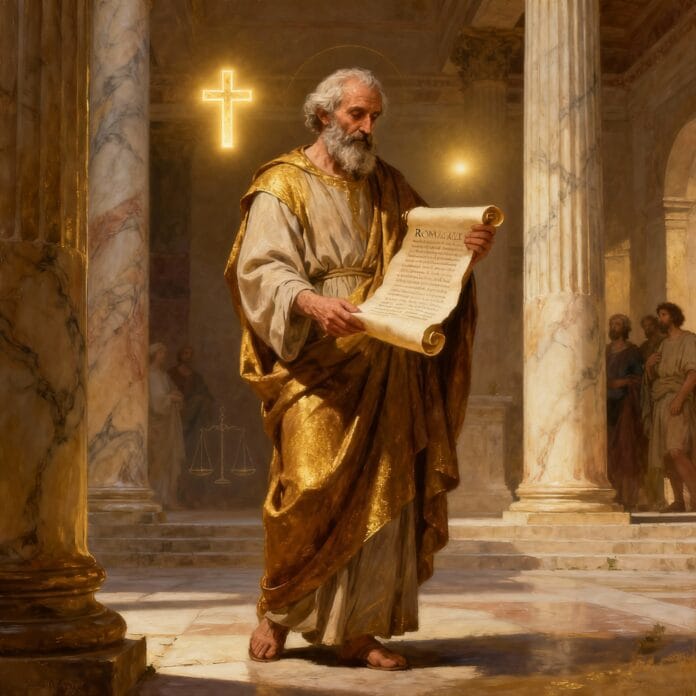
1° The Apostle Saint Paul. — It is useful to first briefly outline the biography of the man whose writings we are going to study at some length. Regarding his dual name of Saul and Paul, the first (Šã´ul) was Hebrew, while the second (Paulus) was Roman, see our commentary on Acts of the Apostles7:58 and 13:9. The apostle himself provides us with some information about his origin and family. He was born in Tarsus (probably around the year 3 AD). This date, and those we will indicate below, are not absolutely certain; they are the ones that seem to us the most reliable. His family belonged to the tribe of Benjamin (Philippians 3:5), and enjoyed citizenship (it cannot be said exactly by what right they possessed this privilege, which rendered Paul very great services during his life as an apostle, cf. Acts of the Apostles 16, 37 ff.; 22, 25-28; 23, 27; 25, 10 ff.). One of its members may have bought it or, perhaps more likely, obtained it as a reward). In religious matters, it strictly followed Pharisaic doctrines and observances (cf. Acts of the Apostles 23, 6).
After his early education in Tarsus (it was perhaps then that the future apostle became acquainted with Greek literature, of which reminiscences can be found in his words and writings, cf. Acts of the Apostles 17, 28; 1 Corinthians 15, 33; Tite 1, 12; see the comments. He also learned his trade as a tentmaker there, which enabled him to earn an honorable living during his evangelical missions, cf. Acts of the Apostles 18, 3; 20, 34; 1 Corinthians 4, 12; 1 Thessalonians 2, 9; 2 Thessalonians 3, 7 and following, etc.), Saul came, still young, to Jerusalem (Acts of the Apostles 26, 4), to pursue his rabbinical studies there, and he had the grace to have the illustrious Gamaliel as his teacher (Acts of the Apostles 22, 3; see notes). It was there that he partly acquired his remarkable knowledge of Holy Scripture and his vigorous dialectical method. At the same time, he himself became increasingly attached to Pharisaic principles, which he had, as it were, imbibed with his mother's milk (see Acts of the Apostles 22, 3b; 26, 5; Galatians 1, 14; Philippians 3, 5). Everything suggests that he only remained in the holy city for a few years, so that he did not have the opportunity to see and know Our Lord Jesus Christ personally. When we find him again in Jerusalem, he is at the forefront of the persecutors of the nascent Church (cf. Acts of the Apostles 7, 58, 60; 8, 3; 9, 1-2; 22, 4; 26, 9-11; 1 Corinthians 15, 9; Galatians 1, 13; Philippians 3, 6a; 1 Timothy 1, 3a).
His miraculous conversion on the road to Damascus, one of the greatest miracles in history Christianity, is recounted up to three times in the Acts of the Apostles (Acts of the Apostles 9:3-19; 22:6-16; 26:12-18. Compare 1 Corinthians 9:1 and 15:8-9; Galatians 1:13-16; 1 Timothy 1:13). According to what we believe to be the most likely view, it took place around the year 34 or 35 AD. Paul was then about thirty years old.
By comparing the passages Galatians 1:17 and Acts of the Apostles In verses 9, 19b-25, we learn that the new convert, after a short stay in Damascus, went to spend three years in Arabia, in the deepest seclusion. He then returned to the capital of the SyriaThere he preached the Christian faith with such zeal and success that the Jews, furious, tried to kill him. It was then that he returned to Jerusalem, where, presented to the apostles by Barnabas, he was able to mingle fraternally with the Christians and resume his preaching. But there again, his former coreligionists laid traps for him, from which he escaped by taking refuge in Tarsus (Acts of the Apostles 9, 26-30). It was in this city that Saint Barnabas went to find him, probably after the year 40, to make him his assistant in the newly founded Church of Antioch, which, thanks to his zealous support, underwent admirable development (Acts of the Apostles 11, 22-26).
His three great apostolic journeys are recounted in detail in the Book of Acts. The first (Acts of the Apostles 13, 1-14, 27) appears to have taken place between the years 46-49; it was followed, around the year 51, by the Council of Jerusalem, in which the Apostle to the Gentiles played a large part (see Acts of the Apostles 15, 1-35 ; Galatians 2, 1-10). The second (Acts of the Apostles 15, 36-18, 22) took place between the years 51 and 54; the third (Acts of the Apostles 18, 23-21, 16), from the year 55 to the year 59.
The Acts of the Apostles also describe in a fairly complete manner the incidents that led to the arrest of Saint Paul in Jerusalem, his imprisonment in Caesarea for two years (59-61), his appeal to Caesar, his shipwreck, and his arrival in Rome in 62 (Acts of the Apostles 21, 17- 28, 29). Then the narrator stops abruptly, and simply notes the duration of the apostle's first Roman captivity (Acts of the Apostles 28, 30-31).
Saint Luke has preserved no details for us about the last three years of Saint Paul's life (64-67 AD). Fortunately, the apostle's pastoral letters and tradition allow us to establish, at least in general terms, the main events. Released at the beginning of 64 AD after successfully pleading his case before Nero, he most likely then went to Spain (Saint Clement). pope, 1 Corinthians 5, Saint Epiphanius, Haer., 27, 6, Saint John Chrysostom, in 2 Timothy Hom., 10, 3, Theodoret, in 2 Timothy, 4, 17, Saint Jerome, in Isaiah(2, 10, and other ancient ecclesiastical writers state this explicitly). He appears to have subsequently evangelized the island of Crete, where he left his disciple Tite to continue his work (cf. Tite 1, 5). From there, he went to visit the churches of Asia Proconsularis and those of Macedonia (see 1 Timothy 1:3); then he returned again, it seems, to Asia (cf. 1 Timothy 3:14). The letter to Titus This is also shown to us, around the same time, in Nicopolis, in Epirus (Tite 3, 12). Later he went to Rome, where he had to endure a second imprisonment (the so-called critical school generally denies the existence of this second Roman captivity of Saint Paul; but it has against it various very explicit testimonies from tradition, see Eusebius, Ecclesiastical History, 2, 22; Saint Jerome, de Vir. illustr., 5 and 12, etc.), during which he wrote his last letter, the second to Timothy. Condemned to death with Saint Peter, he gloriously ended his life with martyrdom in 67.
2° The character of Saint Paul has often been described in eloquent terms by skilled panegyrists. Those who judge the Apostle to the Gentiles in the same way they would judge any other remarkable man unanimously confess that he was one of the greatest minds of all time. Those who believe in his divine mission and his inspiration by the Holy Spirit are amazed and as if astonished when they examine, on the one hand, the gifts he received from on high for the work to which he was destined, and on the other hand, the courageous devotion with which he dedicated himself to this work. But further details can be added. «As humble as the most severe penitent, and yet joyful to the point of shouting with gladness; firm in his convictions, and at the same time wise, reserved on this point like the most prudent man in the world; consummately ecstatic, and notwithstanding active and practical; strong as a hero, and delicate as a virgin; "With his eagle eye, he embraced the entire universe, yet was attentive to the smallest detail; commanding, yet at the service of all; a sublime theologian, yet a humble tentmaker; a Jew filled with love for his people, yet the most formidable enemy of Pharisaism; the most hated and the most popular of the apostles:… he led the magnificent life of a hero whom the world was unable to dominate and subdue, but whom Christ, by a thunderbolt, was able to subject to his divine revelation" (JP Lange, Protestant author). It is because Saint Paul was a true genius that he was able to unite such diverse poles within himself.
3° The letters of Saint Paul and their grouping. It is morally certain that several were lost early on: namely, a first letter to the Corinthians, as can be seen from a comparison between 1 Corinthians 5:9 and 2 Corinthians 10:9; a first letter to the Philippines, according to Philippians 3:1; finally, a letter to the Christians of Laodicea, according to Colossians 4:16. On the apocryphal writings of Saint Paul, see Vigouroux's Biblical Manual, vol. 1. Those that have been preserved for us number fourteen, as tradition teaches, confirmed by the Councils, in particular those of Trent and of Vatican I. These are: the one to the Romans, the first and second to the Corinthians, the ones to the Galatians, the Ephesians, the Philippians, the Colossians, the first and second to the Thessalonians, the first and second to Timothy, the ones to Tite, has Philemon and to the Hebrews. Such has been their canonical order in the Latin Church since Saint AugustineWithout regard to chronology, letters addressed to churches were placed first, and letters to private individuals second. Then, in general terms, consideration was given to either the dignity of the churches and individuals, the importance of the issues addressed, or the length of the letters. However, an exception was made for the Letter to the Hebrews, placed at the end of the collection because its authenticity was initially the subject of some hesitation.
According to the chronological order that seems most plausible to us, the letters of Saint Paul form three very distinct groups, the first comprising two letters; the second, four; and the third, eight. The first group includes the letters to the Thessalonians, composed around the year 52; the second, the letters to the Romans, Corinthians, and Galatians, written between the years 56 and 58; and the third, the letters to the Philippians, Ephesians, Colossians, and... Philemonto the Hebrews, to Timothy, and to Tite, composed of letters 62 to 66 or 67. We will attempt to establish more precisely the date of composition of each letter in the individual introductions. This is a rather difficult problem, moreover, on which the best exegetes, ancient and modern, are far from agreeing.
From the point of view of the subject matter, some of Saint Paul's letters are more specifically doctrinal, for example, the letters to the Romans, the Galatians, the Colossians, and the Hebrews; others are more specifically moral (1 and 2 Corinthians, Philippians, 1 and 2 Thessalonians, etc.). But it should be noted that the moral element is represented to a greater or lesser extent in all the apostle's letters. Among the latter, a separate category is made of the interesting letters that have been called pastoral (1 and 2 Timothy, Tite), because Saint Paul outlines the duties of pastors of souls at greater length there than elsewhere.
4° Their authenticity. — As with the Gospels, we will only address this question here in a general and brief manner. See Valrogern's Introductions to the New Testament; the Bible manual, t. 1, nn. 41-43 , etc. For the letters whose authenticity was most attacked in the 19th century, we will briefly respond, in our small particular Introductions, to the main objections of the critics.
First, there is the extrinsic evidence. Saint Peter was already familiar with the writings of his illustrious colleague in the apostolate (cf. 2 Peter 3:16), although it cannot be said how many letters comprised the collection that the Prince of the Apostles had in his possession. The Apostolic Fathers, immediate successors and often disciples of the apostles, quote and use in their writings, relatively few in number, all the letters of Saint Paul, except for the one to PhilemonOn this point, a truly remarkable fact has been noted: in the very short letter of Saint Polycarp to the Philippians, around the middle of the second century, one finds thirteen texts borrowed verbatim from eight of the letters of Saint Paul (Romans, 1 Corinthians, Galatians, Ephesians, Philippians, 2 Thessalonians, 1 and 2 Timothy); it also contains fairly frequent allusions to other passages from these same letters and to four other letters (2 Corinthians, Colossians, 1 Thessalonians, Hebrews), so that there are only two (Philemon And Tite) which are not represented in this short work. See also Saint Clement pope1 Corinthians 47; Saint Ignatius, ad Philad., 5, and ad Ephes., 12, etc.
A little later, the testimonies become more numerous, more precise, and more official, in a way. The Muratorian Canon (late second century) cites by name all of Paul's letters, except for the one to the Hebrews. Around the same time, Tertullian also cited them all (De Præscript., 37 ; c. Marcion, 4, 5). The Peschito Syriac, which contains them without a single exception, informs us that the entire collection was received, on the same date, by the Church of SyriaOrigen (In Jesus Nave, hom. 8, 1: «Upon arriving, our Lord Jesus Christ… sends his apostle priests, bearing trumpets with which they could play, the magnificent and heavenly doctrine of preaching… (Paul), hurling thunderbolts with the trumpets of his fourteen letters, has overthrown and completely eradicated all the war machines of idolatry and the dogmas of the philosophers.» And Clement of Alexandria also mentions them all as canonical. The same is true of Saint Cyril of Jerusalem (Catech., 10, 18), of Theodoret, and of all subsequent ecclesiastical writers. But Eusebius's testimony has a special value because of the numerous, learned, and judicious investigations that this celebrated historian undertook to ascertain the opinion of the most ancient authors on the authenticity of the Holy Scriptures. "The fourteen letters of Paul are manifestly known to all," he says in formal terms (Ecclesiastical History, 3, 3, 25). He does not fail to point out, with his usual accuracy and frankness, that there were doubts in the Western Church concerning the Letter to the Hebrews ; but he immediately adds that, despite this, it too must be ranked among the ὁμολογούμενα, that is to say, among the writings generally regarded as part of the holy Scriptures.
It is therefore a clearly attested fact that, from the second century onward, it was accepted in all Christian churches that Saint Paul was the author of the fourteen letters that still bear his name today. Even the heretics recognized the authenticity of most of them. "When Marcion went from Pontus to Rome in 142, he carried with him a collection of Saint Paul's letters, which contained all of them except those to Timothy, to Tite and to the Hebrews, whose authenticity he denied, as did Basilides, as Saint Jerome tells us, in letter ad Tite, Prologue.» Bible Manual, t. 1, n. 41, 2a. This work of mutilation was part of the system of the heretics, who eliminated from the New Testament everything that was opposed to their doctrines.
Let us now turn to intrinsic proofs. Bossuet summarizes them very well in these terms (University History(2:28): “The letters of Saint Paul are so vivid, so original, so full of the times, affairs, and movements that were then taking place, and finally of such a marked character, that they would suffice to convince well-formed minds that everything in them is authentic and sincere.” As another exegete says, the writings in question “are not general dissertations, without a specific homeland or purpose. They were prompted by special occasions, composed for specific circumstances and readers, according to the needs of those readers.” All this, therefore, allows for verification. This verification has been carried out, and the remarkable harmony that exists between many details of the letters of Saint Paul and the accounts of the Acts of the Apostles They demonstrate in the most striking way the authenticity of the oldest letters. The letters "abound in biographical details, in intimate outpourings, which, if they did not come from Paul's pen, would be the result of the most refined deception." Such deception is impossible, moreover, for the apostle to the Gentiles is a writer of "inimitable originality." These documents "have certain profoundly marked characteristics that distinguish them from all other literary works."
It was unusual in the 19th century to see the authenticity of such perfectly reliable writings denied. Initially, only the three Pastoral Epistles were rejected. But the Tübingen school went much further, accepting as authentic only the letters to the Romans, Corinthians, and Galatians. Later, even more vehement critics rejected all fourteen letters without exception; but they are few in number and are considered, even within the rationalist camp, to be exaggerated. However, the school quite commonly rejects, along with the Pastoral Epistles, those to the Ephesians, Colossians, Thessalonians, and Hebrews.
5. The language in which the letters of Saint Paul were written was certainly Greek. There is no doubt about this today, even concerning the letters to the Romans and the Hebrews. During the first and second centuries AD, Greek was spoken and understood throughout the Roman Empire, even in Palestine. See the Bible Manual, t. 4, n. 570, 2. However, this is not classical Greek, but the so-called "Hellenistic" idiom, which was then popular almost everywhere for the Jews scattered throughout the Roman Empire, and which the reading of the Septuagint had colored with Hebraisms and special expressions.
Although far from always being punished and perfectly correct (see Saint Jerome, in Gal., 6,1 ; in Ephes., 3, 1 ; to Algas. letter 121, 10. The learned doctor criticizes it for barbarisms; one also finds many inaccuracies and irregularities, Hebraisms, unfinished sentences, long, somewhat complicated periods laden with parentheses, etc. Cf. Origen, in Rom. Præfat. ; Saint Epiphanius, Hær., 64, 29, etc.; the Bible Manual, (t. 4, n. 584), the Greek of Saint Paul, after that of Saint Luke, surpasses that of all the other writers of the New Testament. The use of a considerable vocabulary, and particularly of compound verbs, participles and particles, the frequent paronomasia [a process consisting of using words which present a certain phonetic analogy with another word, but without having the same meaning in a close manner], the generally very Hellenic construction of sentences, prove that the apostle possessed a good command of the Greek language, and that, if he had wanted to take care with his language, he would easily have been irreproachable in this respect.
The number of expressions specific to Saint Paul in his letters, excluding the one to the Hebrews, has been calculated as follows: "96 in the letter to the Romans91 in the first letter to the Corinthians, 92 in the second, 32 in the letter to the Galatians, 38 in the letter to the Ephesians, 34 in the letter to the Colossians, 36 in the letter to the Philippians, 18 in the first letter to the Thessalonians, 7 in the second, 73 in the first letter to Timothy and 44 in the second, 31 in the letter to Titus, 4 in the one at PhilemonIn total, nearly 600 expressions used by Saint Paul alone in the New Testament represent more than a tenth of the approximately 4,700 words that make up the vocabulary of the New Testament.
One of the rationalist authors thus reveals his bias towards denigration: "It is unbelievable that a man who had taken even elementary lessons in grammar and rhetoric could have written this bizarre, incorrect language, so un-Hellenic in style, which is that of the letters of Saint Paul." Other, more honest and serious, proponents of the negative school praised "the apostle's incomparable flexibility in handling Greek expressions" and "the Greek coloring" that is evident throughout.
But, writing amidst many tasks and serious concerns, Saint Paul scarcely had the time, nor the desire, to apply himself to doing so elegantly. He accuses himself, 2 Corinthians 11:6, of being unskillful in his expression (ἰδιώτης τῷ λόγῳ). Moreover, he dictated most of his letters (Cf. Romans 16, 22; 1 Corinthians 16:21; Colossians 4:18; 2 Thessalonians 3, 17, etc. ), and while his secretary wrote a few words, other thoughts flowed into his mind and gave a new twist to the sentence begun.
6° As for the the proper style of Saint Paul, His art and merit have sometimes been unfairly contested, both in ancient times and in the 19th century: notably by Bossuet, in a famous passage from his panegyric of the great apostle; but, more often than not, he is fully and completely recognized. "Everyone is familiar with this style of writing, so often described, sometimes staccato and broken, sometimes sustained, even eloquent to the point of pathos; here moved and passionate, there coldly dialectical; sometimes playful to the point of wordplay, occasionally ironic to the point of sarcasm, always and in all these forms the true, adequate expression of this rich and powerful personality."«
Among the principal qualities of Saint Paul's style, the following should be noted:
its extraordinary energy, which acts powerfully and constantly on the reader; the words of Saint Jerome, ad Pammach. Ep. 48, 13, is well known: “Whenever I read the apostle Paul, I seem to hear not words, but thunder.”; his life, his perpetual freshness and enthusiasm, which correspond to the ardent soul of the writer, but which are even more explained by his apostolic zeal; the pagan Longinus was among the first to praise them. Cf. Saint Augustine, of Christian Doctr.4.7. The frequent use of antithesis (cf. 2 Corinthians 6:8-10, etc.), striking metaphors (cf. 2 Corinthians 11:20; Galatians 5:15, etc.), brief and concrete images (cf. 1 Corinthians 13:1-2, etc.), and questions that abruptly address the reader (cf. Romans 2:21-26; Galatians 4:19, etc.) all contribute significantly to this vitality and warmth. One senses everywhere the skillful orator, who neglects no means to achieve his goal; the "inexhaustible fullness," the astonishing richness of the ideas he expresses. It is true that sometimes Saint Paul, precisely because of this richness, and also because he had to use ancient words to express new ideas, falls into a certain obscurity, which St. Peter had already delicately pointed out to him. See 2 Peter 3:16; along with this, a remarkable variety of sentiments. "The apostle knows how to assert forcefully, to threaten, to speak gently and kindly. He combines firmness with strength." kindness"To blame, praise; to comfort, a grave warning." His style is for everyone, like his heart. The effect produced is all the greater because one senses nowhere the affectation that so often plagues the writings of most men.
7° The external form of Paul's letters is quite similar to the one then used for ordinary letters. It almost always has three parts. The first is the salutation, usually quite brief, but which sometimes becomes solemn and takes on more considerable proportions (cf. Romans 1-6; 1 Corinthians 1:1-3; 2 Corinthians 1:1-2; Galatians 1:1-5; Philippians 1:1-2, etc.). It is omitted only in the Letter to the HebrewsSometimes the apostle uses one of his collaborators known to them to greet those to whom he writes (cf. 1 Corinthians 1:1 (Sosthenes); 2 Corinthians 1:1; Philippians 1:1; Colossians 1, 1 (Timothy); 1 Thessalonians 1:1 and 2 Thessalonians 1:1 (Timothy and Silas)). Instead of ending this greeting with the usual formula, χαίρειν (literally: rejoice; the equivalent of salutem Latins, see Acts of the Apostles 25, 23b and James. 1, 1), he concludes it with an entirely Christian wish: χάρις ϰαὶ εἰρήνη (Vulg.: gratia et pax) in all the letters, except the three pastoral letters, where we read: χάρις, ἔλεος, εἰρήνη (Vulg.: gratia, misericordia, pax). In the letter to TitusA number of manuscripts omit ἔλεος. The greeting is usually followed by a thanksgiving, in which the apostle thanks God for the special favors granted to the recipients of the letter (cf. Romans 1:8 ff.; 1 Corinthians 1:4-9; 2 Corinthians 1:3 ff., etc.). In the letter to the Galatians 1:6-10, it is replaced by a severe rebuke. It is entirely absent, as is the initial greeting, in the Letter to the HebrewsIt is at the same time a delicate and affectionate eulogy, quite capable of winning Paul's attention and making them receptive to his views. Very often, even in this first part, one hears the dominant note of the letter resonate.
Next comes the body of the letter, which obviously forms the main part. Saint Paul develops, with varying degrees of detail depending on the circumstances, the theme he intended to address. Quite frequently, this part is subdivided into two sections: the first is dogmatic and theoretical, the second moral and practical.
The conclusion usually consists of details which are rather personal in nature (Cf. Romans 16, 1-23; 1 Corinthians 16:19-21; Philippians 4, 21-22; 2 Timothy 4, 19-21, etc.), and in an affectionate blessing (Cf. Romans 16, 24-27; 1 Corinthians 16:22-23; Galatians 6:18; Ephesians 6:23-24; 2 Timothy 4:22, etc.).
8° The importance of the writings of Saint Paul is indisputable and uncontested. From the time of the Fathers to the present day, exegetes and theologians of all persuasions have unanimously proclaimed it. They are «an inexhaustible mine and source,» says Saint John Chrysostom, the most celebrated admirer and commentator of the Apostle to the Gentiles (see his treatises). of Verb. Apost., Hom. 3. 1 ; de Laud. Pauli, Hom. 4, etc.). Next Saint Thomas Aquinas ((In Ep. ad Rom., Prolog.), They contain "almost the entire doctrine of theology." According to Cornelius a Lap., we find there (Proœm. de praerogat. Pauli, 3), "the marrow of the Christian law and religion." If the letters of Saint Paul deal admirably with dogma and mystical theology, they are no less able to propose and discuss practical questions, or respond to the difficulties of daily life, which they resolve with remarkable breadth of vision and clarity.
Their themes, as we see, are therefore extremely varied. And yet nothing is more singular than their subject matter, since in reality it constantly returns to the sacred person and divine teachings of Our Lord Jesus Christ, Son of God, Redeemer of all mankind. This is truly the perpetual center of Paul's writings as well as his preaching, the culmination of his thoughts as well as his works. This is above all why his letters are filled with such sublime beauty, and why they do so much good to anyone who studies them with a spirit of faith. After the Holy Gospels, they form the most precious book that the Church possesses.
9° Catholic commentators on the letters of Saint Paul. — We will only mention here those who have explained them all without exception. Comments relating to individual letters will be indicated in the short introductions that precede them.
We will mention, in the early centuries, Saint John Chrysostom, Theodoret, Oecumenius, Theophylact, and Euthymius among the Greeks; Primasius among the Latins (in the 6th century. His explanations are an excellent summary of those of earlier exegetes). In the Middle Ages, Rabanus Maurus, Hugh of Saint Victor, Hugh of Saint-Cher, Nicholas of Lyra, Saint Thomas Aquinas. In modern times, B. Justiniani (In omnes B. Pauli epistolas explanationes, Lyon, 1612), Estius (In omnes D. Pauli et septem catholicas Apostolorum epistolas commentarii, Douai, 1614; work often reprinted; formerly in Mainz, 1858-1860), Cornelius a Lapide (see the Paris edition, 1861, annotated by Abbé Crampon), Bernardin de Picquigny (Triplex expositio epistolarum D. Pauli, Paris 1703; the most recent editions are those of Paris, 1868, and Innsbruck, 1891), Dom Calmet (Literal commentary, etc., Paris, 1707 and following). Abbot Drach (letters of Saint Paul, Paris, 1874).