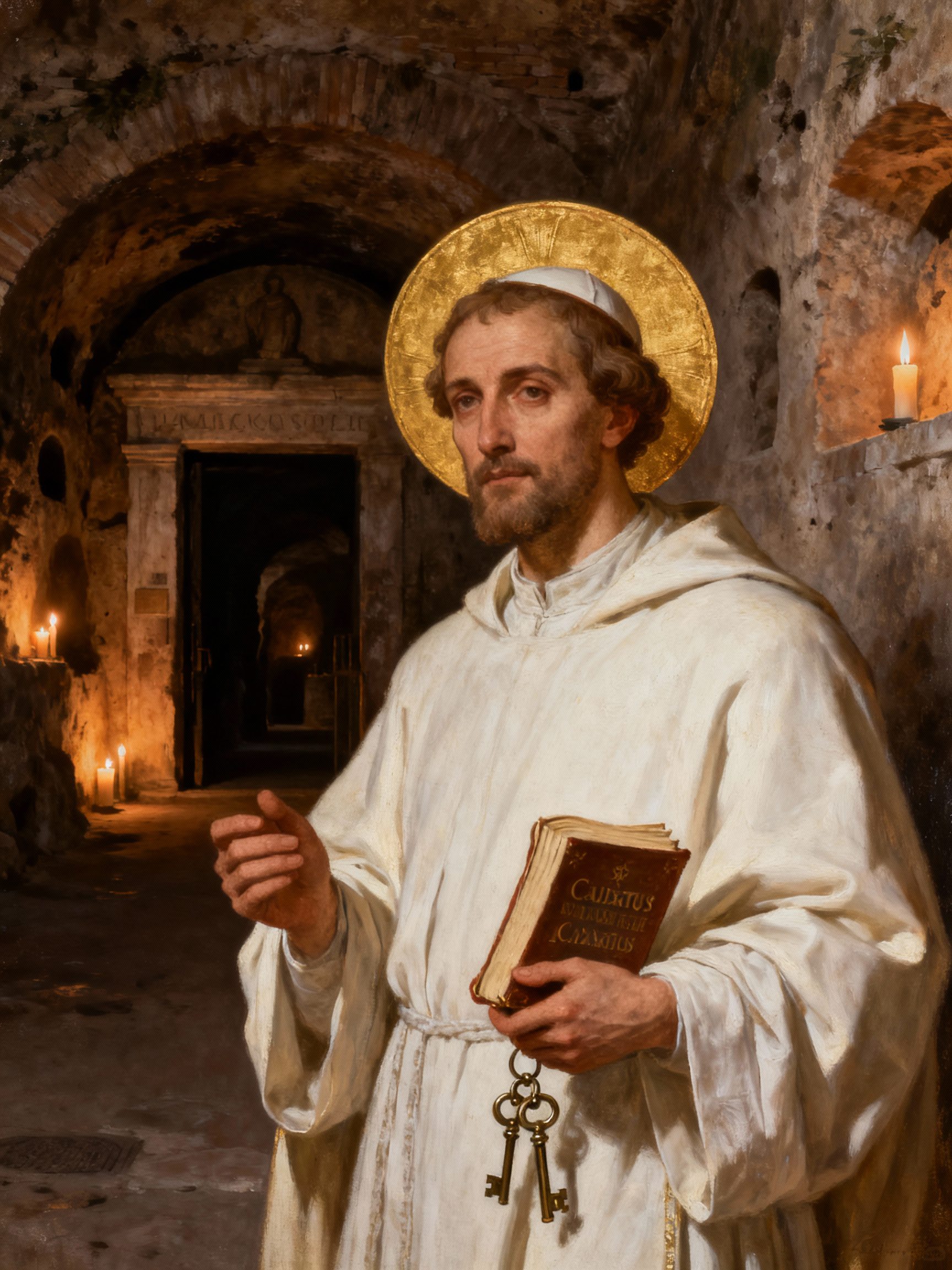


- «"Is your gaze evil because I am good?" — the parable that dislodges our calculations
- Where does this story come from and why does Jesus tell it?
- The paradox of a kindness that is not accountable
- Work, fatigue, and what we believe we have earned
- Comparison, the slow poison of inner life
- The undeserved grace and the dizzying feeling of a God who gives without counting
- What this text changes in concrete terms in our lives
- The patristic, liturgical and martyrological echo of the text
- Lectio divina
- Meditation prompts to allow this text to work within oneself
- What this text says about our era of constant comparison
- Prayer
- Conclusion
- Practices
- References
- ✝ Biblical references
Gospel of Jesus Christ according to Saint Matthew

1«For the kingdom of heaven is like a family owner who went out early in the morning to hire workers for his vineyard. 2Having agreed with the workers on a denarius a day, he sent them to his vineyard. 3He went out around the third hour and saw others standing in the square doing nothing. 4He said to them, “Go also to my vineyard, and I will give you what is right.” 5And they went there. He went out again around the sixth and ninth hour, and did the same thing. 6Finally, going out around the eleventh hour, he found others standing idle, and he said to them, "Why do you stand here all day doing nothing?"" 7They answered him, "Because no one has hired us." He said to them, "You also go into my vineyard.". 8When evening came, the owner of the vineyard said to his foreman: Call the workers and pay their wages, starting with the last and going on to the first. 9Those who came at the eleventh hour received a denarius each. 10Those who came first thought they would receive more, but they each received a denarius. 11Upon receiving him, they murmured against the father of the family., 12saying: These last ones have worked only one hour, and you are giving them as much as we have, who have borne the burden of the day and the heat. 13But the Master, addressing one of them, replied: My friend, I am not doing you an injustice: did you not agree with me for a denarius? 14Take what belongs to you, and go. As for me, I want to give him as much as I give you. 15Am I not allowed to do with my own property as I please? And will your eye be evil because I am good? 16Thus the last will be first, and the first, last, for many are called, but few are chosen.»
Imagine a boss who hires people all day long—at dawn, at noon, at five in the evening—and who, when evening comes, pays everyone the same. No pay scale, no pro-rata. The same wage for one hour of work as for twelve. The first ones hired, furious, do the math: they sweated under the sun, the others barely lifted a stone. But the boss doesn't argue about accounting fairness. He turns the question around: "Are you jealous because I'm generous?" It's not about the wages. It's about how you look at things.
«"Is your gaze evil because I am good?" — the parable that dislodges our calculations
This text is disturbing because it touches on the precise point where we want God to be just as we are — and he is not.
This message is for anyone who has ever compared their own suffering to that of another and felt a silent bitterness as a result. It speaks to the lifelong believer who looks askance at the recent convert. It speaks to the parent, the spouse, the colleague who counts the efforts. What this page offers: the possibility of finally disarming this reflex of comparison that poisons even our joys.
We will begin by placing this parable in its immediate context before delving into its heart: the paradox of a justice that is not a matter of arithmetic. We will then explore three dimensions of existence where this text resonates powerfully—work, comparison, and undeserved grace—and then consider what the Church Fathers, the liturgy, and some modern voices have taken from it. A lectio divina, some practical suggestions, and a prayer will conclude this reflection.
Where does this story come from and why does Jesus tell it?
This parable doesn't appear out of thin air without preamble. Matthew places it right after a pivotal episode: the rich young man has just left, saddened, unable to sell his possessions to follow Jesus, while Peter exclaims, with a touch of legitimate pride: «We have left everything to follow you; what then will there be for us?» (Mt 19:27). Jesus promises thrones, eternal life a hundredfold—then adds this sentence that closes chapter 19 and opens our parable: «Many who are first will be last, and the last first.» The parable of the workers in the vineyard is therefore an answer. An answer to Peter's question, and through him, to the question that everyone asks themselves one day: what will I gain from this? The setting is simple and familiar to all of Jesus' listeners. In Palestine, the vineyard is the very image of Israel—the prophets sang of it (Isaiah 5:1-7), Hosea wept over it. Around September, at harvest time, time is of the essence: the grapes must be picked before the rains, and the landowners hire day laborers in the public square at dawn. These men are neither slaves nor permanent employees: they are poor, landless people who sell their labor day by day. To be unemployed is to have nothing to eat in the evening.


The master goes out five times: at six in the morning, at nine, at noon, at three, at five—almost at the end of the workday, which finishes at six. With the first group, he negotiates a specific wage: a denarius, the average daily wage. With the next group, there's no mention of a specific amount: "I'll give you what's right." To the last group, hired an hour before the end, he doesn't even promise a wage—just: "Go to my vineyard." This progression isn't a literary detail. It prepares for the final shock: when it comes time to pay, the steward starts with the last group. And gives them a whole denarius. The first group, seeing this, expects more. They receive the same amount. Their complaint isn't bad faith: humanly speaking, it's undeniable. And that's precisely where the parable will strike.
The paradox of a kindness that is not accountable
This text rests on a single, dizzying tension: the master has wronged no one, and yet everyone feels a sense of injustice. Let us reread his response to the first worker who protests: «Friend, I am not being unfair to you. Didn’t you agree to pay me a denarius?» He is absolutely right. The contract has been honored to the letter. No promise has been broken. And yet, something within us cries out against the injustice—it is precisely this something that the parable seeks to expose.
You might like...

What we call justice is, most of the time, actually proportionality: the more you give, the more you receive. It's a logic of merit, and it's healthy in many areas—wage labor, for example, needs it to avoid becoming exploitation. But Jesus isn't talking about workers' wages here. He's talking about the kingdom of God. And in the kingdom, this logic collapses, because God doesn't reward merit: he gives a gift. The denarius isn't a wage in the economic sense—it's a sign of eternal life, offered equally to those who have served God all their lives and to those who have converted on their deathbed.
Herein lies the crux of the matter: the master's question, "Is your gaze evil because I am good?", employs a very concrete Greek expression—ophthalmos ponêros, literally "evil eye"—which, in the Semitic world, designated the envious person, the one whose gaze brings misfortune to what they see prospering in others. It is not simply ill humor: it is a gaze that darkens in the face of another's happiness, that transforms the generosity received by another into a personal affront. The first worker has lost nothing. He has merely seen someone else receive what he believed he deserved more—and this sight has spoiled his own penny.
This is where the central lesson lies: God's goodness is never an injustice toward us, but it can become a wound in our hearts—if our joy depends on comparison rather than on the gift received. The master of the vineyard in no way diminishes what he gives to the first. He adds to it, without taking away. And it is this addition offered to others that, paradoxically, impoverishes inwardly those who look askance at it.
Work, fatigue, and what we believe we have earned
The first workers have an argument that no one can take away from them: they have "endured the burden of the day and the heat." It is no small feat, under the Palestinian sun, to work twelve hours in a sloping vineyard. Their fatigue is real, and so is their merit. And it is precisely because their complaint is legitimate that the parable strikes us where it hurts: we all know this kind of weariness, in the literal or spiritual sense.
Let us consider the faithful Christian of forty years, attending Mass every Sunday, serving in the parish, never forgetting evening prayers—who learns that a man, in his hospital bed, converted overnight and received the same promise of paradise. Or, more simply, let us consider the eldest sibling who has always helped, always been sensible, and who watches the younger, carefree child receive the same parental love without ever having tidied their room. This feeling is not malice. It is the logic of merit, ingrained in us since childhood: effort is rewarded, not luck.
But the parable doesn't say that effort doesn't count. It says something else, something more subtle: it says that God's reward isn't proportional to effort because it isn't a reward, but a communion. One cannot earn more of God's love—one can only receive that love at some point in life, sooner or later, with varying degrees of faithfulness over time. The question, therefore, isn't: Have I worked hard enough to deserve heaven? The question becomes: Do I receive this gift as a gift, or as something owed?
There is a profound liberation here for those who identify with the first workers. The weight of the day and the heat was not in vain—it was lived, experienced in the presence of the master, in his vineyard, all day long. Those who worked only an hour did not have this extended presence. Their wages are the same, but their day was not the same. What the first workers had, that the last did not, is the time of the vineyard itself—the master's presence, hour after hour. This is no small thing. It is even, if we look at it this way, a privilege that comparison prevents us from fully appreciating.
Comparison, the slow poison of inner life
The entire narrative revolves around a shift in perspective: that of the first worker who, seeing what the last receives, ceases to see what he himself has received. This is the very mechanism of envy, and it deserves our attention because it hasn't aged a day in two thousand years.
Envy never arises from an objective lack. It arises from comparison. The worker who started early, before seeing the last ones paid, held a penny in his hand—exactly what had been agreed upon, exactly what he expected. He was satisfied. Then he glanced aside. And that glance was enough to transform his satisfaction into resentment, without a single penny changing in his own pocket. This is the tragedy of any life lived in comparison: we no longer measure what we have, we measure the gap with what the other has received.
This dynamic permeates all human existence—professional life, where we discover a colleague's salary and suddenly our own, yesterday satisfactory, becomes an insult. Family life, where we count the attentions given to one another. Even church life, where we can envy the fervor or charisms of a brother, forgetting our own gifts. The philosopher and theologian René Girard extensively explored this dynamic of mimetic desire—desire that does not arise from the object itself but from the desire of the other for that object—and this parable offers an almost perfect illustration of it before its time: the first worker does not desire more money; he desires not to see the other have as much.
The remedy Jesus implicitly offers is not moral, in the sense of requiring an effort of will. It is a shift in perspective. The master doesn't tell the worker, "You're wrong to be sad"—he asks him a question that compels him to turn back to the source: look at me, not your neighbor. "Didn't you agree with me?" The contract was between the worker and the master, never between the worker and the other workers. From the moment a third party is introduced into the relationship with God, the joy of giving becomes a calculation of shares. In this respect, the spiritual life is protected by keeping its eyes fixed on the one who gives, not on what others receive.
The undeserved grace and the dizzying feeling of a God who gives without counting
We must call things by their proper names: what the vineyard owner grants to the last workers is neither a wage based on merit nor a pious handout. It is an excess. He gives them as if they had worked all day, when in fact they have done nothing of the sort—and the Greek text, in referring to the agora where they stood «doing nothing,» argous, emphasizes their forced inactivity, not culpable laziness: they simply hadn't found anyone to hire them. Their situation is not glorious; it is precarious. And it is to this precariousness that the owner responds with disproportionate generosity.
This is what theology calls grace: a gift that precedes and surpasses all merit. Saint Paul expresses it in almost identical terms in the Epistle to the Ephesians: for it is by grace we have been saved, through faith—and this is not from ourselves, it is the gift of God—not by works (cf. Eph 2:8-9). Matthew's parable anticipates this theology without ever using the word grace: it reveals it, it dramatizes it, it makes us feel it in the shock of the last hour, paid for as much as the first.
This dizzying thought is difficult to accept because it reverses our deepest religious instinct: the idea that we earn our salvation through our efforts, our piety, our perseverance. But if salvation were earned, it would no longer be a gift—it would be a wage, and God would become just another employer, perhaps more generous, but subject to the same accounting logic as we are. The good news of this parable is precisely that God escapes this logic. He is not more just than we are in the sense that he calculates better; he is something other than just, in the accounting sense—he is good, and his goodness always transcends calculation.
This doesn't invalidate a lifetime of faithfulness. It transforms it. The first worker discovers, if he's willing to change his perspective, that his long day in the vineyard wasn't a means of buying the denarius, but was already, in itself, a gift—the gift of having been in the vineyard, at the master's side, from morning till night. What the parable reveals, implicitly, is that the true treasure was never the denarius. It was the vineyard itself, and the master's presence.

What this text changes in concrete terms in our lives
In the intimacy of the heart, this parable invites a simple yet daunting examination: on what does my joy depend right now? If it depends on what I possess or what I am in comparison to others, it will remain fragile—always threatened by my neighbor's handout. If it depends on the gift received in itself, independently of what others receive, it becomes stable, almost inviolable.
In our relationships, the text sheds light on our everyday jealousies—between siblings, between colleagues, between friends when one "succeeds" more quickly. It invites us to rejoice sincerely in the good received by others, not out of forced virtue, but because we understand that the good of others does not diminish our own. It is a conversion of perspective far more than an effort of will: seeing God's goodness in others as a reflection of the same love shown to us, and not as a threat.
On a social level, this parable obviously doesn't excuse the need for fair wages—the Church has always defended, since Rerum Novarum, the just wage of the worker, and nothing in this text suggests that an employer can pay arbitrarily. The parable speaks of the kingdom of God, not an economics textbook. But it illuminates a principle that has real social significance: a person's dignity is not measured by their productivity. The last person to arrive, hired an hour before the end, has the same dignity as the first—and this also applies to those whom society judges unproductive, elderly, sick, or nearing the end of their lives.
Within the Church itself, this text serves as an antidote to any hierarchy of spiritual merit between long-standing, devout Christians and recent converts, between those who have always prayed and those who return after years of estrangement. The prodigal son and his elder brother are never far removed from this parable—the same anger, the same denarius received without any possible comparison.
The patristic, liturgical and martyrological echo of the text
Origen, in his Commentary on the Gospel of Matthew, interprets the five hours of the hiring of the workers as the five ages of salvation history—from creation to the coming of Christ—and sees in the laborers of the last hour the pagan nations called late to the faith, yet receiving the same reward as the patriarchs and prophets. This typically allegorical reading gives the text a universal scope: no one, ever, arrives too late in God's plan. John Chrysostom, in his Homilies on the Gospel of Matthew (homily LXIV), insists on a point often neglected: it is not the master who is wrong to pay equally, it is the view of the first workers that is corrupted by the comparison — he comments on the master's final question as a direct invitation to examine where our sadness comes from when another is fulfilled, and he exhorts his listeners never to measure God's gift to others as a loss for oneself. Augustine of Hippo, in his commentary on Psalm 103, takes up this parable to illustrate the equality of the eternal reward between all the saints, regardless of the length of their earthly life — a baptized child who dies and an old man who dies after a whole life of service receive the same eternal life, not through injustice, but because eternal life is not divisible into parts proportional to the time lived. Thomas Aquinas, in the Summa Theologica (IIa-IIae, question 63), precisely distinguishes distributive justice, which presupposes a proportion between merit and reward, and the gratuitous liberality of God, which exceeds all proportion without harming anyone — a valuable philosophical clarification for understanding why the master of the parable can affirm without contradiction that he is not unjust while giving more than what seemed due.


Liturgically, this page is proclaimed on a Sunday in Ordinary Time in Cycle A, associated with Psalm 144, which sings precisely of the Lord's goodness to all — a choice that is not insignificant: the liturgy resolutely places this parable under the sign of universal mercy rather than under that of deserved retribution, immediately directing the assembly towards a reading of grace rather than calculation.
Finally, a contemporary voice: in his commentary on the parables, the biblical scholar Joachim Jeremias emphasizes that Jesus' original audience — Pharisees scandalized by his association with tax collectors and sinners — found in this parable a direct defense of welcoming marginalized people into the kingdom, the last hour representing precisely those whom the religious society of the time judged unworthy of a full reward.
Lectio divina
«Didn’t you agree with me for a denarius?» (Matthew 20:13)
The master doesn't dispute your complaint; he refers you back to what you two agreed upon, nothing more. Does your joy truly need to know what the other receives to be complete? What is it within you that starts measuring itself as soon as something good is given to someone else? Where were you before you were called to the vineyard?
Lord, you called me to your vineyard at the hour you chose, and I thank you for it. Teach me to receive your offering without looking at my neighbor's hand. Heal this gaze within me that darkens before your kindness to another. May I stand before you with open hands, not to demand, but to receive.
The sun sets over the vine, and the same silver coin shines in every outstretched hand.
Meditation prompts to allow this text to work within oneself
To silently revisit a recent moment when one compared one's fate to that of another — and to honestly ask oneself what that comparison changed, if not inner peace.
Choose, this week, a person whose success or happiness has caused some discomfort, however slight — and pray concretely for them, naming their joy rather than measuring it against your own.
To reread one's own life of faith not as a tally of years of faithfulness, but as a long presence in the vineyard — to seek what this presence, in itself, has already given, independently of any final reward.
Faced with remorse linked to a late return — in faith, in a relationship, in a commitment — welcome the promise that the last hour is never disqualified in the eyes of God.
End each evening, for a week, with a simple sentence: today, did I view the kindness received from others as good news, or as a threat?
What this text says about our era of constant comparison
We live in a civilization that has made comparison a way of life. Social media constantly displays the wealth of others—their successes, their travels, their children, their bodies—and the temptation to cast a judgmental glance has never had such an effective tool to feed on. Every scroll is a renewed invitation to leave one's own vineyard to scrutinize that of the neighbor.
This parable, two thousand years old, thus resonates with an almost brutal relevance. It does not condemn legitimate ambition or the desire for progress—but it exposes a precise mechanism: one that makes our inner peace dependent not on what we receive, but on what others receive, more or less. A widespread meritocracy, including in the spiritual life where we sometimes time our own fervor against that of the person sitting next to us, needs to hear this question from the master: Is your gaze evil because I am good?
We must also understand, with nuance, what this text does not say: it does not advocate passivity nor does it minimize the real social injustice of unpaid wages, exploited workers, and the glaring inequalities that so many voices rightly denounce today. The parable speaks of a master who gives more than what is owed, never less. It does not excuse any earthly employer from underpaying anyone. But in the spiritual realm it addresses, it offers a rare antidote to the comparative anxiety of our time: the certainty that God's gaze upon each person is full, complete, never divided proportionally to others.
Prayer
Lord, you constantly come out to meet me, at every hour of my life, even those hours when I thought I had nothing left to offer. You do not consider the hour at which I began to follow you, but the desire that you yourself place in my heart to come to your vineyard.
Teach me to receive your offering without comparing it to my brother's. Too often, my gaze turns away from your open hand to measure what you give beside me — and this measurement poisons the gift I already hold.
Heal this evil gaze within me, this eye that darkens at the sight of another's joy. Grant me the simple joy of one who has been called, whatever the hour, whatever the path taken to reach you.
You who call incessantly — at dawn, at noon, at the last hour of the evening — never cease to come looking for me, even when I remain there, in the square, doing nothing, believing that no one is waiting for me.
Make me a witness to your goodness rather than an accountant of your generosity. May I know how to rejoice, without reservation, in the denarius received by the one who came after me.
And when the evening of my life comes, may I stand before you not with my hand outstretched to claim what is due to me, but with my heart open to receive, like all others, your immeasurable kindness.
Conclusion
There is one way to read this parable that remains external, almost theoretical—a theological lesson on grace. There is another, more challenging way, which requires recognizing oneself in the worker of the first hour, penny in hand, gaze turned toward the neighbor rather than toward the gift received. It is this second reading that the text calls for. Not to work less, nor less faithfully—but to unlearn measuring one's joy by the yardstick of others'. The vineyard remains open, at all hours, for whoever finally accepts to enter it without calculation.
Practices
Before comparing a happy event of a loved one to one's own situation, say inwardly thank you for them, without ulterior motive.
Note, one evening a week, a moment when comparison overshadowed a joy that could have remained whole.
Praying for someone whose success has caused embarrassment, specifically naming their joy.
To reread one's own faith story as a time spent in the vineyard, rather than as an accounting of merits.
To welcome a late return — one's own or that of a loved one — without reservation or hierarchy.
When faced with social media, ask yourself before comparing: am I looking at someone else's contribution, or at my own presence in the vineyard?
References
Antiquity and the Fathers (1st–5th centuries)
- Origen, Commentary on the Gospel of Matthew — allegorical reading of the five hours of hiring as the ages of salvation history, illuminating the universal and timeless call of nations to faith.
- John Chrysostom, Homilies on the Gospel of Matthew, Homily LXIV — analysis of the gaze corrupted by comparison among the first workers, directly linked to the master's final question about the evil eye.
- Augustine of Hippo, Commentary on Psalm 103 — illustration of the equality of eternal life among all the saints, regardless of the length of their earthly life, supported by the parable of the workers.
Late Fathers and the Middle Ages (5th–15th centuries)
- Thomas Aquinas, Summa Theologica, IIa-IIae, question 63 — distinction between distributive justice and God's gratuitous liberality, key to understanding why the master is not unjust in giving more.
Contemporary (20th–21st centuries)
- Joachim Jeremias, The Parables of Jesus — historical contextualization of the parable as a defense of welcoming sinners and marginalized people in the face of Pharisaic indignation.
✝ Biblical references
4 passages · 3 books
Put on the armor of God to stand firm. (Ephesians 6:11)
Mystery of the Church, body of Christ: unity, new life and spiritual battle.
→ Explore the Codex Ephesians- Repairing the Church through peace: the words of Leo XIV in the school of Francis
- A root that sustains you: the Church in Germany facing the temptation of blood and soil
- Newark, Friday evening: when the flags enter the cathedral
- Ethiopia: The peace of Pretoria is broken, and the Church has no right to remain silent.


He has given us a child, a son has been given to us. (Isaiah 9:5)
The great prophet of salvation: judgment, consolation and announcement of the Suffering Servant.
→ Explore the Isaiah Codex- Repairing the Church through peace: the words of Leo XIV in the school of Francis
- The Accra Charter and the Wisdom of Nations: When Africa Refuses to Have the Meaning of Words Dictated to It
- The price of a child: when eighteen billion dollars cannot buy back a soul
- When the gold of the subsoil weighs more heavily than the dignity of the migrant: the words of San Salvador

Behold, I am with you always, to the end of the age. (Matthew 28:20)
The Gospel of the King: Jesus, the new Moses, fulfills the Scriptures for Israel and the nations.
→ Explore the Matthew Codex- Is your gaze evil because I am good? (Mt 20:1-16)
- It is easier for a camel to go through the eye of a needle than for a rich man to enter the kingdom of heaven (Mt 19:23-30)
- If you want to be perfect, go, sell your possessions and give to the poor, and you will have treasure in heaven (Mt 19:16-22)
- It was because of your hardness of heart that Moses allowed you to divorce your wives. But from the beginning it was not so (Mt 19:3-12)
- Why does humility always elude us the moment we think we have it?
- Letting go of what holds us back: the camel, the eye of a needle, and the possibility of freedom
- What love precedes, the law never reaches.
- What we can't let go of: the rich young man and our hidden treasure
- Asterius of Amaseia: Why break off a marriage without flinching?
- Gregory the Great and the penny offered to the newest arrival in the vineyard
- The fire that's burning might not be the one we think it is.
- The heart that doesn't know how to close the door to the misfortune of others
- When God's generosity wounds our sense of justice
- Wanting the top spots — and discovering that Jesus made it something else entirely
- When Africa sits at the Vatican table: Lucy Afandi Esipila and the theology of the periphery that governs
- Why did Leo XIV enter Paris through the Gate of Exiles?
- Wisconsin: The Shrine of Guadalupe, Cardinal Burke's platform for defending the family
- When the Church looks at itself in the mirror of the algorithm: Magnifica Humanitas' revolutionary mea culpa


🗺 Map
 IN
 IN
 IN
 IN
 IN
Recommended reading
Considered by Thomists like Gilson and Maritain as one of the finest introductions ever written to Thomas Aquinas, this 1933 biography combines erudition with a flamboyant style. Chesterton portrays an intellectual giant with humor and depth, without ever sacrificing rigor. A lively text that inspires the reader to discover the Summa Theologica itself.
View on Amazon →
The best entry point into Thomistic thought in English: Kreeft selects the essential philosophical passages from the Summa Theologica and accompanies them with notes that clarify every technical difficulty. Originally intended for students, this book remains the standard reference for anyone who wants to read Thomas himself rather than a summary. A must for any serious English-speaking reader.
View on Amazon →
The definitive English translation of the Confessions, hailed by critics as the most readable and faithful available in modern English. Henry Chadwick, Oxford's eminent patrologist, adds notes of great historical and theological richness. The quintessential Oxford World's Classics edition for discovering this masterpiece in English.
View on Amazon →
Considered the definitive scholarly biography in English, this study traces with rare erudition the entirety of Chrysostom's life, from his asceticism in Antioch to his exile and death in Armenia. Kelly, a leading Oxford patrologist, paints a nuanced portrait of an upright yet tragic man, whose own weaknesses precipitated his downfall. A demanding work, but…
View on Amazon →
A biography that breaks with the traditional narrative by examining the Confessions themselves as a literary construct rather than a simple testimony. O'Donnell, a renowned scholar who produced the definitive critical edition of the Confessions, offers a more political and ambiguous portrait of the Bishop of Hippo. A stimulating and erudite counterpoint to classic biographies.
View on Amazon →
Praised in the preface by Maurice Wiles as doing for Origen what Peter Brown did for Augustine, this work weaves together biography and thought to make Origen come alive and be accessible to a wide English-speaking audience. Trigg traces the theologian's emergence in Alexandria and then Caesarea, while analyzing his exegetical method and his controversial legacy. A key reference…
View on Amazon →
The historic English translation by the English Dominicans, presented here in a complete and navigable digital edition with a table of contents. A free or nearly free resource for anyone seeking the full text of the Summa without the expense of a scholarly edition. Ideal as a complement to Kreeft's anthology for a deeper exploration of the text itself.
View on Amazon →
A definitive introduction in English, written by two of today's leading Chrysostom scholars, which situates the preacher in his concrete role as deacon, priest, and then bishop in service to his people. The book offers vivid and faithful translations of selected sermons and letters, allowing the reader to hear the saint's voice directly. An essential resource for…
View on Amazon →
A masterful biography by one of France's foremost specialists in Roman Africa, a renowned archaeologist and Latinist. Lancel presents Augustine in all his complexity, from the man torn apart by his youthful passions to the bishop who became the intellectual touchstone of Latin Christianity. A dense and rigorous work, admired for the subtlety of its human portrait as much as for its historical mastery.
View on Amazon →
Edited by the current director of the Institute of Christian Sources, this collection brings together nine studies that profoundly renew our understanding of Chrysostom's exegesis, from its technical terminology to its use of biblical figures such as Cain and Paul in Athens. It draws upon the 38,000 biblical references that Chrysostom left in his work, the most extensive of all…
View on Amazon →
The definitive international biography of Augustine, hailed for over fifty years as an essential classic. Peter Brown traces with rare erudition the life of a man shaped by the encounter of two worlds: the end of Antiquity and the dawn of Christianity. A lengthy epilogue takes into account the discovery of previously unpublished letters and sermons that have shed new light on his life…
View on Amazon →
The masterpiece of Thomas Aquinas, available in its entirety in a single digital volume at a modest price. A comprehensive synthesis of faith and reason, organized into questions and articles, which shaped all subsequent Catholic theology. Ideal for anyone who wants to own the complete text without investing in an expensive scholarly edition.
View on Amazon →
A foundational work in the "Ancient Christianity" series published by Beauchesne, this study marked a turning point in Origenist historical criticism by revisiting all available biographical sources, beginning with Eusebius's Ecclesiastical History. Pierre Nautin establishes a rigorous chronology of Origen's life and works, correcting numerous traditional errors. A book of…
View on Amazon →
The definitive Dominican translation, published by Cerf, which has trained generations of seminarians and French-speaking students. This first volume covers the existence of God and how creatures know Him, the foundation of the entire Thomistic edifice. A classic purchase for anyone who wants the authoritative French print version, rather than the complete Kindle edition.
View on Amazon →
This dialogue is John Chrysostom's most widely read and admired work on the dignity and formidable demands of the priestly ministry. For fifteen centuries, it has been an essential reference for the formation of clerics, from Saint Jerome to Vatican II. This bilingual Greek-French edition, based on the finest manuscripts and compiled by the renowned patrologist Anne-Marie Malingrey, offers…
View on Amazon →
A classic of popular Thomistic thought, designed to make the substance of the Summa Theologica accessible to ordinary believers without scholastic jargon. Organized in a question-and-answer format like a catechism, this book has been the gentlest gateway to Thomas's thought for a century. Perfect for a non-academic audience who nevertheless wish to grasp the heart of…
View on Amazon →
Published in 1948 and subsequently reissued by Éditions du Cerf, this classic work by Cardinal Jean Daniélou significantly contributed to the rehabilitation of Origen in the 20th century and remains today the most accessible introduction to his work for a well-read, non-specialist audience. Daniélou traces the Alexandrian theologian's career, his method of biblical interpretation inherited from the typological tradition, and then his…
View on Amazon →
Based on a thesis supervised by Henri-Irénée Marrou, this study is a major reference work in French patristics on Origen's Christology. A renowned Hellenist, Marguerite Harl chronologically examines Origen's writings to highlight the originality of his doctrine of the Son as the pedagogue who reveals the Father. A demanding yet fundamental work for grasping the intellectual coherence of the Alexandrian theologian.
View on Amazon →
This recent and accessible handbook succeeds the now out-of-print major introductions (Quasten, Sister Gabriel Peters) by combining scholarly rigor with pedagogical clarity for any reader curious about the first eight centuries of the Church. Chrysostom is presented within the broader context of the Greek and Latin Fathers, allowing the reader to appreciate his unique place among his contemporaries. A library of…
View on Amazon →
Written by one of the world's foremost Origen scholars of the 20th century, this synthesis remains a key entry point into the thought of the Alexandrian theologian. Henri Crouzel clearly presents Origen's biography, exegetical work, and spiritual theology, while situating his controversial positions within their historical context. A dense yet accessible work, hailed as a definitive reference…
View on Amazon →
The only readily available comprehensive French biography for discovering the entirety of Chrysostom's life, from his childhood in Antioch to his death in exile. Brändle recounts, without embellishment or caricature, his journey as a hermit, preacher, and then bishop in conflict with imperial power, in language accessible to the non-specialist reader. An excellent starting point before delving into…
View on Amazon →
This classic work of the 20th-century patristic revival masterfully rehabilitated Origen's exegesis among contemporary Catholic theologians. Written by one of the greatest theologians of the last century, it shows how Origen's allegorical method foreshadows themes taken up even in Dei Verbum of Vatican II. An essential reference for understanding the interplay between the letter and the spirit of Scripture in…
View on Amazon →
An unconventional biography, written by the master of paradox, that engages as much with the modern reader as with the 13th century. Chesterton blends history, philosophy, and cultural criticism to offer a vivid and ever-evolving portrait of Aquinas. A true intellectual delight, available in a very affordable Kindle edition.
View on Amazon →
A bilingual Latin-Italian edition that allows you to verify each Thomistic formula in its original language while following a faithful translation. Despite the doubled text, its compact format is designed for sustained study rather than simple consultation. A good compromise between philological rigor and a reasonable price for the Prima Pars.
View on Amazon →
The biography that Maritain and Pegis considered the best ever written on Thomas, presented here in a beautiful Italian translation. Chesterton paints a witty and insightful portrait of the great saint of the Catholic Church, from his rebellious youth to his teaching in Paris. A text accessible to all non-specialist readers, believers or not.
View on Amazon →
A Thomist Dominican here condenses the entire structure of the Summa Theologica into a short and clear volume, without ever betraying the rigor of the original text. Designed for the general Italian public who wish to grasp the overall coherence of the work before venturing into the complete text, it is an excellent entry point before scholarly reading.
View on Amazon →
Chesterton, grappling with the challenge of summarizing such a giant, nevertheless delivers one of the most accomplished studies ever devoted to the great scholastic doctor. The text blends erudition and humor, retracing in eight chapters the life of a man nicknamed "the Ox" for his imposing stature as much as for his deceptive silence. A lively read, much appreciated by readers…
View on Amazon →
Die full text summa theologiae in einer preisgünstigen digitalen Ausgabe. Thomas entfaltet hier ein System, das Glauben und Vernunft seiner Zeit systematisch aufeinander bezieht und bis heute die katholische Theologie prägt. A solid Möglichkeit, sich das Hauptwerk ohne hohe Anschaffungskosten anzueignen.
View on Amazon →
Josef Pieper, one of the greatest German Thomists of the 20th century, recounts here, in just a few pages, the life and work of Aquinas with remarkable clarity. This small book is recognized as an ideal introduction to Thomism in German, neither simplistic nor dry, written by someone who dedicated his life to keeping Thomistic thought alive. A classic reference…
View on Amazon →