












Gospel of Jesus Christ according to Saint Luke
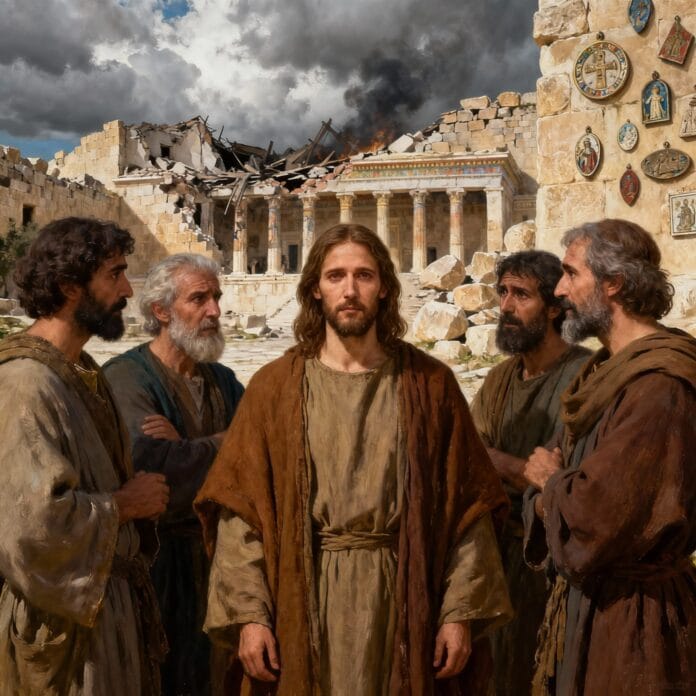
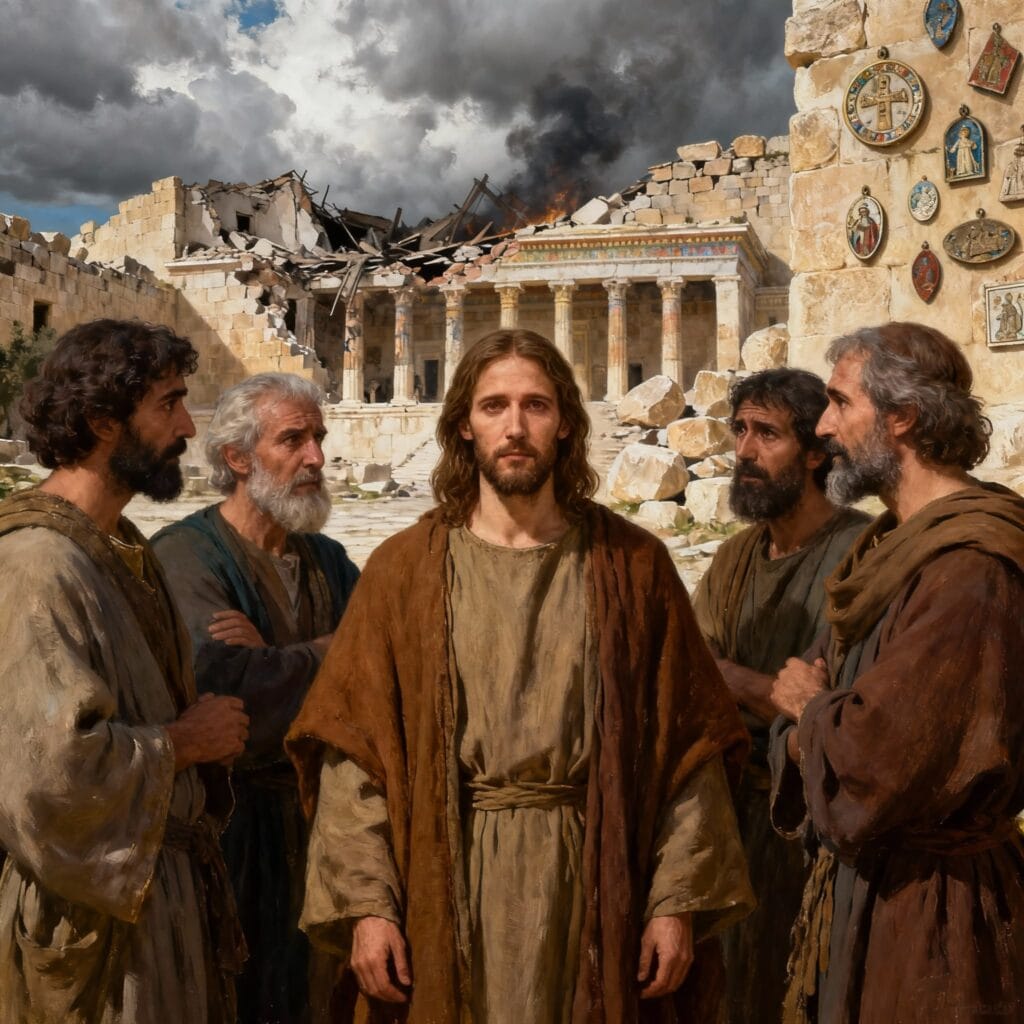
At that time, when some of Jesus' disciples were talking about the Temple, its magnificent stones, and the offerings that adorned it, Jesus said to them:
«"What you admire, the days will come when not one stone will remain upon another: everything will be demolished."»
They asked him, "Teacher, when will this happen? And what will be the sign that it is about to happen?"«
Jesus replied, «Be careful not to be deceived, for many will come claiming to be in my name, saying, «I am he,» or, «The time is near.» Do not follow them! When you hear of conflicts and uprisings, do not be alarmed. These things must happen first, but the end will not come immediately.»
Then Jesus continued: «Nations will fight among themselves, kingdoms will fight against kingdoms. There will be violent earthquakes, and in various places famines and diseases; terrifying events will occur, as well as great signs from heaven.
But before all this, you will be seized and oppressed; you will be dragged before assemblies and into dungeons, you will be brought before sovereigns and rulers, because of my name. This will be your opportunity to bear witness.
Decide within yourselves not to worry about what you will say to justify yourselves. I will grant you words and an intelligence that all your enemies will be unable to contradict or fight.
You will be betrayed even by your parents, your brothers, your family, and your relatives, and they will send some of you to your deaths. You will be hated by everyone because of my name.
Yet, not a single hair of your head will be lost. It is through your endurance that you will save your life.»
Holding on to life when everything falls apart: The power of perseverance according to Luke 21
To understand active endurance (hupomonē) not as passive survival, but as the path to true redemption, guided by the promise of Christ.
This message is addressed to you, who live in a world where the "beautiful stones" of our security seem to be cracking. Wars, personal crises, faltering institutions… fear is a natural response. In this passage, Jesus does not deny the chaos. He looks it in the face and offers us a royal road through it: not by avoiding the storm, but by finding renewed strength within it. This is the path of "perseverance." Together, we will explore how this word, far from being mere "courage," is a divine promise, a gift of Christ's presence that allows us to "hold on to our true lives.".
From the contemplation of human temples to the certainty of divine Redemption.
… through discernment in the face of chaos and false prophets.
… by discovering the ordeal not as an end, but as a place of testimony.
… based on the promise of wisdom given by Christ Himself.
… to finally «acquire» our true life through active and hopeful perseverance.

When the Temple Collapses
The passage of Luke 21, Often called the "eschatological discourse" (discourse on the end times), it opens in a place of great solemnity: the Temple in Jerusalem. The scene is set immediately. Disciples, perhaps dazzled like spiritual tourists, admire "the beautiful stones and the votive offerings." One must imagine the scene. Herod's Temple was one of the architectural marvels of the ancient world, a colossal project that had lasted decades. For a first-century Jew, it was not merely a place of worship; it was the beating heart of national identity, the center of the economy, and the visible symbol of God's covenant with his people. It was the most solid, the most permanent, the most sure to the world.
And it is precisely on this symbol of absolute security that Jesus utters a word of demolition: «As for these things that you see, the days will come when not one stone will be left upon another; all will be thrown down» (v. 6). This is an unprecedented shock. It is not simply an architectural prediction; it is a theological «Temple-quake.» Jesus announces the end of a world, the end of a certain way of understanding the presence of God. If even the Temple can fall, then what can we rely on?
The disciples' reaction is immediate and terribly human: «Teacher, when will these things happen? And what will be the sign that they are about to happen?» (v. 7). They want a calendar. They want a «GPS of the apocalypse »If they can no longer rely on the solidity of stone, they at least want to rely on the predictability of the weather. They seek to regain control through knowledge, to manage their anxiety through understanding.
The Gospel of Luke was probably written After the year 70 AD, that is to say After the actual destruction of the Temple by the Roman armies. Luke's community therefore does not read this as a future prediction, but as an interpretation of a trauma they have experienced. Already lived experience. The question is no longer "will it happen?", but "how to live NOW "What happened?" How can we continue to believe, to hope, to live as disciples, when the most sacred symbol of our faith has been reduced to ashes? It is in this context of post-traumatic stress and uncertainty that Jesus' answer takes on its full meaning. He will not give them a timetable, but a compass for their hearts.
Unmasking the false end of times
Jesus' response is a brilliant maneuver of spiritual redirection. The disciples are focused on the out (the "when," the "signs," the falling stones). Jesus will constantly draw their attention back to the inside (discernment, loyalty, (the testimony). He deconstructs their fear in three steps.
First, he warns them not against chaos, but against the deception. «Beware lest you be led astray» (v. 8). The first danger is not falling stones, but false saviors. «For many will come in my name, saying, ‘I am he,’ or, ‘The time is near.’ Do not follow them!» Jesus downplays the urgency. He tells his disciples to beware of those who claim to have the secret timetable, of those who create panic by shouting, «This is the end!» The first act of perseverance is intellectual and spiritual: rejecting the siren call of fear and the easy solutions offered by gurus.
Next, Jesus «normalizes» historical chaos. «When you hear of wars and uprisings… of great earthquakes… of famines and plagues…» (vv. 9-11). His instruction is radical: «Do not be terrified.» He doesn’t say it’s not serious. He says it’s not not the end yet. «These things must happen first, but the end will not come immediately» (v. 9). Jesus removes the apocalyptic allure of these events. Wars and catastrophes are not the sign of the end; they are the texture of fallen human history. These are the "pains of childbirth," not childbirth itself. He asks us not to be so obsessed with the news that we are paralyzed by fear.
Finally, after defusing the two major fears (spiritual deception and global chaos), Jesus pivots to the real issue for the disciple: «But before all that… (v. 12). Even before this great historical chaos fully unfolds, YOU, My disciples, go and experience a more personal and intimate trial. «They will lay hands on you and persecute you… because of my name.» The real battlefield is not geopolitical, it is theological. The test of faith will not be surviving an earthquake, but remaining faithful to the «name» of Jesus when it comes at a high social, political, and even familial cost. Jesus’ analysis is clear: the problem is not the world which collapses, the problem is whether our faith will hold firm.

The three pillars of perseverance
Jesus does not merely predict hardship; he provides the means to overcome it. "Perseverance" (v. 19) is not a vague sentiment; it rests on three concrete pillars, three divine promises that change everything.
Testimony at the heart of the ordeal
«This will lead you to bear witness» (v. 13). Here is the first great subversion. The trial, the persecution, the arrest… this is not a mere accident. This is not an interruption of the Christian mission. This is the place even of the mission. The opposition is not a failure, it is a opportunity.
Jesus details the locations of this ordeal: «They will hand you over to the synagogues and prisons, and you will be brought before kings and governors» (v. 12). These are the centers of religious (synagogues) and political (kings, governors) power. The disciple, often marginalized, will be dragged into the center of attention, onto the public stage. But the roles are reversed: they think they are judging a criminal, but they are actually going to listen to a witness. The tribunal becomes a lectern. The accused becomes the prosecutor.
We think of the apostle Paul, chained before King Agrippa in the Acts of the Apostles (Acts 26). Paul is not terrified, he is not defensive. He is radiant. He seizes this opportunity to recount his encounter with Christ and to announce the Resurrection. The persecution has given an audience he could never have reached otherwise. This is active perseverance: seeing in crisis not a threat to one's life, but an opportunity for one's mission. Our modern "prisoners" (a conflict at work, an illness, a family crisis) are not obstacles to our spiritual life; they are the very place where we are called to "bear witness.".
The promise of presence: "It is I who will give to you"«
How can one stand firm in such a situation? How can one find the right words when facing a "governor"? The human instinct is to prepare, to rehearse, to anticipate, to "prepare one's defense." Jesus says the opposite, and this is the second pillar: "Therefore, make up your mind that you do not have to worry about your defense." (v. 14).
This instruction is liberating, yet terrifying. It demands total surrender. But it is not a leap into the void, it is a leap into the arms of Christ: «For I will give you words and wisdom which none of your adversaries will be able to resist or oppose» (v. 15). Perseverance is not a Stoic virtue, a «strength of character» that we draw from within ourselves. The Stoic grits his teeth and endures by his own will. The Christian receives the strength to endure.
This promised "wisdom" (sophia) is the assistance of the Holy Spirit (as Luke specifies in 12:11-12). It is not our intelligence, our eloquence, or our rhetoric. It is a word data, a word that comes from elsewhere, and that has divine authority («irresistible»). Christian perseverance is therefore, paradoxically, an act of dependence Radical. It empties us of our pride, of our need to control everything, to fill us with the active presence of Christ. We don't hold on. For Christ, we hold on by Christ.
The great paradox: To die without perishing
Herein lies the heart of the mystery, the third pillar. Jesus announces a brutal reality: «You will be betrayed even by parents, brothers, relatives, and friends, and they will put some of you to death. You will be hated by everyone because of my name» (vv. 16-17). This is the ultimate betrayal, the breaking of the most sacred bonds. And it means physical death. Jesus doesn't sugarcoat it. Martyrdom is a real possibility.
And yet, right after, he makes this astonishing promise: «But not a hair of your head will perish.» (v. 18). How can these two verses be true simultaneously? How can one be «put to death» and at the same time not «perish a hair»?
This is where Jesus redefines what it means to "live" and "perish." The world, traitors, rulers, can destroy your bios, your biological life. They can take your body. But they cannot touch your psyche, Your soul, your true life, your deepest identity in God. The expression "not a hair on your head" is a proverbial expression (see 1 Samuel 14:45) that signifies divine protection. total And meticulous.
This means that Nothing No matter what happens to you, not even the cruellest betrayal or the most unjust death can tear you away from God's love. Your essential self, your true life, is safe. Your ultimate destiny is not in the hands of your persecutors, but in the hands of your Father. It is this absolute certainty that grounds perseverance. It is because our true life is already safe that we can risk our physical life for the sake of witness.
This is when the final sentence takes on its full meaning: «By your perseverance you will gain your life» (v. 19). The Greek verb (ktaomai) means «to acquire, to possess.» It’s not just about «saving your skin.» It’s about «taking possession» of your soul, of your eternal life. By holding fast to the faith, by clinging to Christ in the midst of chaos, you are not undergo the story, you are in the process of’acquire your true identity.

Living the hupomonē (active endurance) today
This text is not an ancient relic. It is strikingly relevant today. How does this "perseverance" translate into our lives, here and now?
In our personal and inner lives, the first implication is a call to stop the "doomscrolling"«. When Jesus says, «Do not be terrified» by wars and epidemics (v. 9), he speaks directly to us. Panic is a choice. Persisting anxiety is a form of disobedience to this teaching. «Preserving one’s life» means first and foremost preserving one’s soul from the saturation of fear. This implies a discipline of attention: choosing not to let the chaos of the world become the chaos of our hearts, and preferring to meditate on the promise (v. 15) rather than ruminating on the threat (v. 9).
In our relationships and family life, the text is painfully realistic. It speaks of betrayal (v. 16). Today, "wars" are also fought within our families, torn apart by ideological, political, or religious conflicts. Perseverance here is not about "winning" the argument, but about continuing to love "for his name's sake." It is about refusing to hate the one who "hates" us (v. 17). It is about bearing silent witness to grace, even when our dearest bonds are tested.
In our professional and social lives, our «synagogues and rulers» are our workplaces, our institutions, the power structures we encounter. When we are pressured to compromise our integrity, our ethics, our faith (our «name»), that’s where verse 13 comes into play: «This will lead to your bearing witness.» Will we «prepare our defense» (v. 14) by calculating, manipulating, protecting ourselves? Or will we act with simple integrity, trusting that Christ will give us the «wisdom» (v. 15) to speak and do what is right, whatever the cost? Perseverance is loyalty in the little things, which prepares us for loyalty in the big ones.
There hupomonē, an echo of the Alliance
Perseverance (in Greek, hupomonēThis is not an invention of Luke. It is a golden thread that runs through the whole of Revelation. It is the biblical virtue par excellence, for it is the form that faith takes when it encounters the test of time and adversity.
In the Old Testament, the hupomonē (as translated in the Septuagint) is the endurance of Job, who, having lost everything, can say, «Even if he kills me, I will trust in him» (Job 13:15). It is the perseverance of Jeremiah, the prophet persecuted by his own people, who continues to proclaim the word of God even when it earns him the prison and the pit. It is loyalty of Daniel and his companions, who stand "before the kings and governors" of Babylon and refuse to compromise their faith, relying on the promise that their God will save them.
In the New Testament, the apostle Paul makes of hupomonē the signature of his ministry. He presents himself as a servant of God «by great perseverance in tribulations, in distresses, in anxieties…» (2 Corinthians 6:4). For Paul, perseverance is not a human feat, but a fruit of the Spirit (Galatians 5:22 – patience/endurance) and the direct consequence of hope (Romans 5, 3-4).
The Epistle of James places it at the heart of Christian maturity: «Consider it pure joy, my brothers, whenever you face trials of all kinds, because you know that the testing of your faith produces perseverance (hupomonē). » (James 1, 2-3). Finally, in the Apocalypse, the last book of the Bible, everything comes down to "the perseverance of the saints" (Revelation 14:12), those who "keep the commandments of God and the faith in Jesus" in the midst of the final chaos.
Perseverance, therefore, is not a minor, optional virtue. It is proof that our faith is not a fleeting emotion, but a sealed covenant. It is humanity's faithful response to loyalty unfailing in God's service.

The "no hair loss" exercise«
To anchor this message within us, let us take a few moments for a practical meditation, rooted in the text.
- Identify the "Temple" (v. 5): Sit in silence. What is the "beautiful stone" you are contemplating in your life right now? (Your career, your health, your financial security, your reputation, a relationship). Acknowledge its beauty and give thanks for it. Then, honestly, acknowledge its fragility. Offer it to God, accepting that it is not your ultimate foundation.
- Identify the "Chaos" (v. 9): What are the "wars and disorders" that terrify you today? (A news story, a personal anxiety, a conflict in the distance, a disorder in your life.) Name them. Then, hear Jesus say to you, "Do not be terrified." Breathe.
- Rejecting the "Defense" (v. 14): What "trial" are you preparing in your mind? (A difficult conversation coming up, an email you're turning over and over in your mind, a justification of your past actions.) Make the active decision to "not worry about your defense." Put it aside.
- To receive the "Promise" (v. 15): Invoke the promise. Simply say, «Lord Jesus, I am not preparing anything. I trust You to give me, in due time, the words and the wisdom. You will speak.» Remain in this trust.
- Affirming "Life" (vv. 18-19): Meditate on this paradox: "Not a hair of your head will be lost." Think of your greatest fear. Confront it with this promise. Feel the security. ultimate (not physical, but spiritual) that God offers you. Your true life is safe in Him. Conclude by saying: "Through my perseverance, anchored in You, I keep my true life."«
Is perseverance a form of escape?
Jesus' discourse on perseverance raises legitimate questions for our time, which values action and efficiency.
The first challenge is that of quietism. Does «not being concerned» (v. 14) and «not being terrified» (v. 9) mean that we should remain passive in the face of injustice, wars, and epidemics? Is it an abdication of our responsibilities? The answer is a resounding no. It is not a matter of «not acting,» but of «not acting through” fear«Perseverance is not inaction. It is right action, the kind that is not a simple reaction panicked by the chaos. The "wisdom" (v. 15) that Christ promises may very well be the wisdom to build a hospital, to negotiate peace, or to denounce an injustice. But this action will come from a peaceful heart, anchored in God, and not from a terrified heart, centered on itself.
The second challenge is that of instantaneity. Our culture hates waiting and endurance. We want immediate results, quick solutions. Perseverance seems boring, slow, inefficient. But therein lies its countercultural power. hupomonē It is not the sprinter's strength, but the marathon runner's. It is the strength of the oak tree that grows slowly but withstands the storm. In the age of instant gratification, perseverance is the radical choice of the depth against the speed, of the loyalty against the performance.
The third challenge is that of burnout. Isn't it dangerous to preach "perseverance" to people who are already exhausted? Isn't that a recipe for burnout? It's a complete misunderstanding. Burnout stems from... stoic perseverance, the one where you try to carry everything by its own forces. This is the exhaustion of one who "prepares his defense" (v. 14) day and night. Christian perseverance is the exact antidote. It is a dump. " It is Me who will give you… (v. 15). This is permission to let go of the outcome, to relinquish the responsibility of controlling everything, and to focus on only one thing: remaining faithful and present to Christ. Today.
Prayer for the grace of hupomonē
Lord Jesus, Master of time and history,
You have looked upon the beauty of the Temple and You have seen its end.
You see the "beautiful stones" that we admire: our securities, our projects, our prides.
Give us the courage to hear You tell us that all of this is fragile.
Make Yourself, and not our constructions, our only cornerstone, our only foundation.
When we hear rumors of wars and echoes of world disorder,
When our own lives are shaken by famines of the heart and epidemics of fear,
Deliver us, Lord, from terror (v. 9).
Let not our hearts be troubled, for You tell us that this is not the end.
Protect us from false prophets and from voices that cry out, "The time is very near!" (v. 8).
Keep us from panicked urgency and the search for signs in the sky.
May your Word be our only compass, and yourselves our only Messiah.
Lord, when we are handed over to the judgments of men,
When we are misunderstood, criticized, or persecuted "because of Your Name" (v. 12),
Make this trial not a trap, but a "moment of witness" (v. 13).
Shut our mouths to our own defenses (v. 14),
And open them to Your Wisdom (v. 15).
Let it not be we who speak, but Your Spirit who testifies in us.
Grant us the grace of hupomone, holy perseverance.
When the dearest bonds break (v. 16),
When death itself threatens us,
Engrave within us Your extraordinary promise:
«Not a hair of your head will be lost.» (v. 18).
May this certainty be our anchor in the storm.
And so, Lord, in the very heart of chaos,
Grant us not to bow our heads, but to raise them high.
Not to look at our feet, but to raise our eyes.
Because it is not destruction that we expect,
It is our Redemption that is approaching (cf. Luke 21, 28).
It is You who come.
Hallelujah. Amen.
Raise your head
Luke chapter 21 is not a disaster movie. It's a love letter. It's the message of a God who doesn't promise us a world without storms, but who promises us His presence in the heart of the storm. He tells us that our human «temples» will fall, and that this is good news, because they finally give way to the only true Temple: Himself.
The destruction of the "beautiful stones" (v. 6) is not the final word. The final word, given by the Alleluia of today's liturgy (v. 28), is: "Stand up and lift up your heads, for your redemption is drawing near."«
«Perseverance» (v. 19) is the bridge between the two. It is the «how» we move from the fallen temple to the redemption that is coming. It is not a dark and resigned endurance. It is a active and joyful waiting. It is the direct consequence of hope. Because we soaps that our Redemption is approaching, because we soaps that not a single hair on our head will perish, SO We can hold on.
The question this text poses is therefore not, "When will all this happen?" The question is, "How will I live?" Today Will you live in terror, preparing your defenses? Or will you live with perseverance, head held high, trusting in the promise of His wisdom, knowing that your true life is safe? Chaos is a certainty. But so is Redemption. Choose to live as a child of Redemption.
7 days for perseverance
- Identify a personal «temple» (security, pride) and put its importance into perspective in your prayer.
- Choose A «Turn off the "noise" of the world (media, social network) that terrifies you for 24 hours.
- Identify a situation where you are "preparing your defense" (justification, rumination) and stop doing so.
- When faced with a setback, ask Jesus: "What words of wisdom do you have for me here?" (v. 15).
- Thank God for a past trial which, in retrospect, has become an opportunity for testimony (v. 13).
- Meditate on verse 18 («not a hair») while thinking about your greatest current fear.
- Practice verse 28 (Alleluia): stand physically upright, lift your head, and say: "My redemption is drawing near."«
References
- Main source text: The Bible, Ecumenical Translation (TOB) Or The Bible, New French Current.
- Academic commentary: Bovon, François. L'’Gospel according to Saint Luke (20.27–24.53). Commentary on the New Testament. Geneva: Labor et Fides, 2009. (For a detailed exegetical analysis).
- Academic commentary (English): Fitzmyer, Joseph A. The Gospel According to Luke X-XXIV. Anchor Bible. New York: Doubleday, 1985.
- Overview: Brown, Raymond E. An Introduction to the New Testament. New York: Doubleday, 1997.
- Spiritual theology: Bonhoeffer, Dietrich. The Price of Grace. Geneva: Labor et Fides. (For the notion of "because of his name" and the cost of a disciple's life).
- Spiritual theology: Peterson, Eugene H. A Long Obedience in the Same Direction: Discipleship in an Instant Society. Downers Grove: IVP Books, 2000. (A classic meditation on perseverance).
- Master's degree: Catechism of the Catholic Church, §675-677. (On "The ultimate test of the Church" and eschatological themes).