












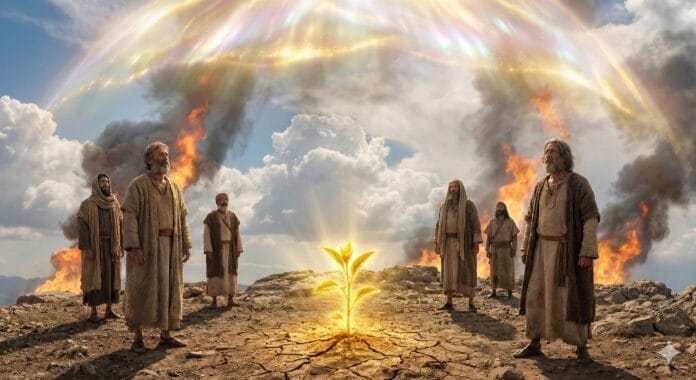
A reading from the book of the prophet Isaiah
On that day, the Shoot that the Lord will cause to grow will be the pride and splendor of the survivors of Israel, the Fruit of the earth will be their pride and their beauty.
Then those who remain in Zion, the survivors from Jerusalem, will be called saints: all will be registered in Jerusalem to remain there.
When the Lord has washed away the filth of the daughters of Zion, and cleansed Jerusalem from the bloodshed, by blowing through it a spirit of judgment, a spirit of fire, then over all Mount Zion, over the assemblies that gather there, the Lord will cause a cloud by day and smoke with blazing flames by night.
And above all, like a canopy, the glory of the Lord: it will be, against the heat of the day, the shade of a tent, a refuge, a shelter from the storm and the downpour.
When God gives new life to hope: the promise of the seed that transforms ruins
The future belongs to those whom God purifies and renews..
Perhaps you are going through a time of desolation. You look around and see only ruins, failures, broken relationships, and abandoned dreams. The prophet Isaiah was speaking to a people who were living this very reality: Jerusalem in ruins, the looming threat of exile, the feeling that God himself had turned his face away. Yet, in the very heart of this desolation, a promise springs up like a seed in scorched earth: «The Branch that the Lord will cause to grow will be the glory and honor of the survivors of Israel.» This passage from Isaiah 4:2-6 is not simply about a distant future or abstract consolation. It reveals how God always works: by bringing forth life precisely where all seemed dead, by transforming the weary survivors into bearers of holiness.
We will first explore the historical and theological context of this prophecy, then analyze the central dynamic of the text: how God transforms judgment into purification, and purification into glorification. Next, we will delve into three essential dimensions: the divine logic of the remnant, holiness as a renewed identity, and God's protective presence. We will conclude with concrete suggestions for living out this promise today.
The context of a people on the brink of the abyss
Isaiah prophesied in the 8th century BCE, in a kingdom of Judah threatened on all sides. The Assyrian and Babylonian superpowers were drawing closer. Corruption reigned among the elites, social injustice was rampant, and idolatry even tainted the Temple. The first three chapters of the Book of Isaiah present an implacable indictment: "From the soles of the feet to the crown of the head, there is nothing sound."«
In this context, Isaiah announces the inevitable judgment. Jerusalem, the holy city, will be devastated. But then, in chapter 4, immediately following the pronouncements of condemnation, this astonishing vision of a radically different future emerges. The text functions as a theological turning point: God judges, certainly, but his judgment is never the final word. The fire that consumes is also the fire that purifies.
The "Sprout" mentioned here possesses remarkable symbolic weight. In prophetic literature, this term often designates the awaited Messiah, the one who will perfectly embody God's plan for his people. Jeremiah and Zechariah adopt this image. But here, the text plays on a double meaning: the Seed as a messianic figure, and the "Fruit of the Earth" as the concrete restoration of all that the people have lost. It is simultaneously a spiritual and material promise, both individual and collective.
The «remnants of Israel» are not simply statistical survivors of a catastrophe. Rather, the Hebrew vocabulary suggests those who have been intentionally preserved, chosen, set apart by God himself. This remnant is not defined by its merits, but by divine election, which transcends even judgment. Herein lies the central paradox: God judges his people because he loves them enough not to leave them in their corruption, and he preserves a remnant because his promises remain irrevocable.
The mention of Zion and Jerusalem is not insignificant. These places represent far more than mere geography: they embody God's presence among his people, the place where heaven and earth meet, where the covenant is lived out concretely. When Isaiah announces that those who remain in Zion will be "called saints," he is not speaking of a spiritual elite who have earned this status, but of a radical transformation wrought by God himself.
The image of washing and purification directly evokes the rituals of the Temple, but Isaiah transposes them to the scale of the entire city. It is no longer just the priest who purifies himself before entering the sanctuary; the whole community becomes a sanctuary. The "breath of judgment" and the "breath of fire" simultaneously recall the wind of the creative Spirit and the fire that consumes what is impure. God uses what could destroy in order to recreate.
The final reference to the cloud and the flames echoes the Exodus: the pillar of cloud that guided Israel through the desert, the divine presence that accompanied the people on their journey to the promised land. Isaiah thus announces a new Exodus, a new covenant, a new beginning. But this time, God's presence will no longer be itinerant but permanent, no longer external but all-encompassing, protecting every gathering of the people. The canopy of glory suggests both a bridal covering and military protection: God as bridegroom and as warrior defending his people.
This context therefore reveals a God who never abandons his initial plan, even when all seems lost. Judgment itself becomes an instrument of salvation.
The paradoxical dynamics of purifying judgment
The central idea of this passage lies in a paradox that runs throughout the Bible: God judges to save, destroys to rebuild, burns to purify. This logic confounds us because it contradicts our ordinary understanding of justice as simple punishment or reward.
The text presents a three-part sequence. First, the Seed grows and becomes honor and glory. Then, the Lord washes and purifies through judgment. Finally, he creates permanent protection for those who have been purified. This sequence is not chronological but theological: it describes how God always works, in every crisis situation.
The first movement reveals that the initiative belongs entirely to God. The Seed is not something the people cultivate or earn; it is "the Seed that the Lord will cause to grow." Hope does not arise from our efforts to rehabilitate ourselves, but from God's creative action that brings forth new life. This absolute gratuitousness radically distinguishes biblical faith from all spiritualities of merit or self-improvement. You cannot save yourself, and that is precisely why you can hope.
The second movement describes the purification as a violent but necessary process. The text speaks of "defilement," "shed blood," and "a breath of fire." It does not minimize the gravity of the evil infecting Jerusalem. God does not turn a blind eye, does not relativize, does not pretend that everything is fine. The judgment acknowledges the reality of sin, calls it by its true name, and refuses to let it further corrupt the community. But this judgment is not vengeance: it is surgery. The doctor who operates on a tumor inflicts suffering in order to heal.
This understanding of judgment as purification radically transforms our relationship to divine discipline. When you go through a trial that strips you of your illusions, your false securities, your comfortable idols, you can see it either as an arbitrary curse or as the painful but salvific process by which God frees you from what destroys you. The fire consumes what is combustible: your pride, your toxic attachments, your comforting lies. But it also reveals what remains: your deep identity as a child of God, your calling, your capacity to love.
The third movement manifests the ultimate goal of the entire process: the permanent and protective presence of God. The cloud, the fire, the canopy of glory are not external rewards added afterward, but the natural consequence of purification. When you are washed clean of what separated you from God, his presence becomes perceptible, tangible, experienced. The text even suggests that God will "create" this presence: it uses the verb of original creation, that of Genesis 1. In other words, having one's glory dwell in the midst of one's people is an act as fundamental as creating the world.
This presence manifests itself paradoxically: it is both cloud and fire, shadow and light, protection from heat and rain. God adapts precisely to the needs of the moment. Against the scorching sun of past judgment, he becomes a refreshing shade. Against the storm of external threats, he becomes a solid shelter. The divine presence is never abstract or generic: it responds precisely to your concrete situation.
What this text ultimately reveals is that God always works according to a Paschal logic, a logic of passage through death to life. Long before the cross of Christ, Isaiah perceived this fundamental truth: there is no resurrection without crucifixion, no purification without fire, no glory without passing through judgment. But judgment is never the goal: it is the necessary path toward restored communion.
The theology of remnants: when God preserves a seed
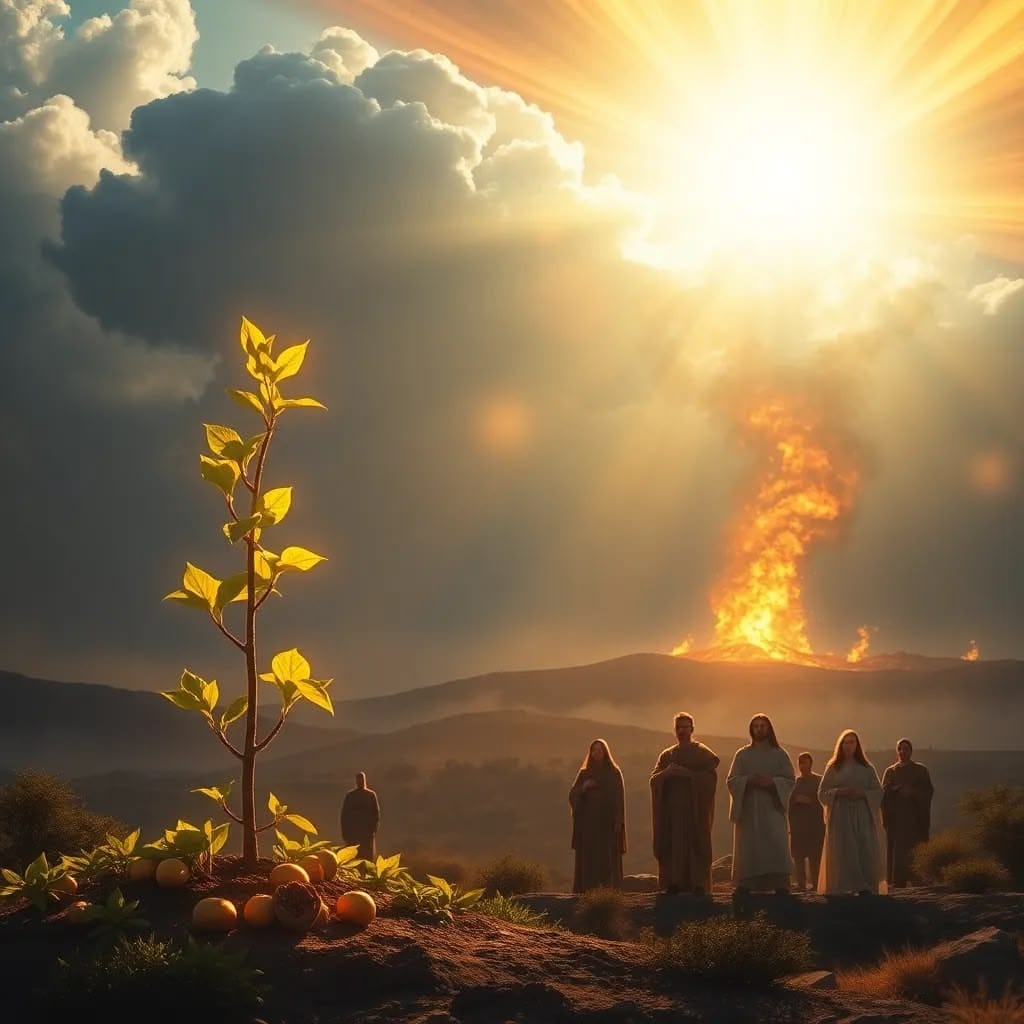
One of the most powerful theological concepts in this passage is that of the "remnant": "those who remain in Zion, the survivors of Jerusalem." This notion runs throughout the Bible and reveals something fundamental about how God guides history.
The remainder is never a majority. When God preserves Noah and his family, he saves eight people out of an entire humanity. When he calls Abraham, he chooses a single man to bless all nations. When Gideon has to confront the Midianites, God reduces his army from thirty-two thousand to three hundred men. Divine logic always prioritizes quality over quantity., loyalty on the number, the intensity on the extension.
This "what's left" logic deeply disturbs us. We live in a culture obsessed with growth, measurable success, and massive impact. The Church itself has often succumbed to this temptation, measuring its health by the number of its members rather than the depth of their conversion. But Isaiah reminds us that God works differently. He prefers a small, purified, and transformed group to a lukewarm and compromising multitude.
The rest is defined by three characteristics in our text. First, it consists of "survivors," that is, people who have gone through judgment and emerged alive. They bear the scars of the ordeal, know the fragility of all things human, and have seen what they believed to be indestructible crumble. This experience has stripped them of their illusions, but has also made them more authentic, more humble, and more aware of their absolute dependence on God.
Imagine a couple who nearly divorced, endured months of silence and pain, and then found their way back to reconciliation. Their love after this ordeal is no longer the same: it has lost its naiveté but gained in depth. They now know how precious and fragile their union is. This is the kind of transformation that judgment brings about: it strips away the superficial to reveal what is essential.
Secondly, the rest will be «called holy.» Holiness here is not a moral achievement or a spiritual perfection attained through effort. It is an identity conferred by God himself. «Called holy» means that God gives them a new name, a new definition of who they are. Before, they may have been defined by their failures, their sins, their mediocrity. Now, God redefines them by his own imparted holiness. You are holy not because you are blameless, but because God has set you apart for himself and is gradually imprinting his character upon you.
Third, all will be «registered in Jerusalem to live there.» This registration evokes the register of citizens, but also the book of life mentioned elsewhere in Scripture. To be part of the remnant means having your place guaranteed in the city of God, belonging definitively to his community. This belonging precedes and grounds your identity: you do not try to earn a place that has already been given to you; you live from this already assured place.
The logic of what remains also reveals something crucial about apparent failure. When everything collapses around you, when your business fails, when your ministry dwindles to almost nothing, when your ambitions prove unrealistic, you can see it either as a definitive catastrophe or as the process by which God reduces you to the essentials. Many saints have had this experience: Francis of Assisi, stripped of everything, Teresa of Avila reduced to a handful of faithful nuns, Charles de Foucauld died alone in the desert without having converted a single Tuareg. But it was precisely in this destitution that they became fruitful, that God was able to work through them.
The remnant is therefore never a contemptible residue, but a concentrated seed. A single seed contains within it the entire potential of a forest. God preserves the remnant not to isolate it, but so that it may become a source of renewal for all. The survivors of Israel are not saved for themselves alone, but to carry the promise to the nations. Their honor and glory will shine forth beyond them.
This truth concerns you directly. Perhaps today you feel like an insignificant remnant: the years have passed, your dreams have shrunk, you are now but a shadow of what you hoped to become. But if God has preserved you, it is because He has a plan for you. Your apparent weakness can become the very ground where His strength is best displayed. Your smallness can free others from the tyranny of appearances. Your accepted failure can become a testament of grace.
Holiness as a renewed collective identity
The text of Isaiah effects a revolutionary shift: it democratizes holiness. «All will be called saints.» Not only priests, not only prophets, not only a spiritual elite, but all those who belong to the purified remnant. This universalization of holiness foreshadows the New Testament revelation of the universal priesthood of believers.
In Israel's ancient religious system, holiness operated through degrees and separations. The outer court was for everyone, the holy place for the priests, and the Holy of Holies for the high priest alone, once a year. This sacred geography created a strict hierarchy of proximity to God. But Isaiah announces a radical change: when God has purified Jerusalem, the entire city will become a temple, and all its inhabitants will become priests.
This vision does not dissolve holiness into banality, nor does it dilute it. On the contrary, it intensifies it by expanding it. Holiness remains what it has always been: the presence of God, likeness to his character, setting oneself apart for his mission. But it ceases to be the privilege of a few and becomes the vocation of all.
What does it mean in concrete terms to be called a saint? Three dimensions emerge from the text and its broader biblical context.
First, holiness implies separation from evil. The text explicitly mentions the washing away of defilement and the purification of shed blood. To be holy is to refuse to participate in the pervasive corruption, the compromises that seem inevitable, and the normalized injustices. In Isaiah's context, this meant denouncing the exploitation of the poor, idolatry disguised as religion, and trust in political alliances rather than in God. Today, it can mean rejecting the culture of acceptable lies, addictive consumerism, and indifference elevated to the status of wisdom.
This separation is not an escape from the world but a prophetic resistance within the world. The saints remain in Jerusalem; they do not leave. They live in the heart of the city, work in its markets, and raise their children in its streets. But they embody an otherness that questions and transforms. Their very presence becomes a sign of contradiction, a reminder that another way of living is possible.
Furthermore, holiness implies consecration to God. Being set apart does not simply mean "separated from" but also "dedicated to." You are not holy because you avoid certain things, but because you are oriented entirely toward someone. Holiness is a matter of direction, ultimate loyalty, and exclusive belonging. When the text says that all will be "enrolled in Jerusalem to live there," it indicates this definitive belonging: you no longer belong to yourself; you belong to God and to his holy city.
This consecration is lived out in daily choices. Who do you prioritize in your schedule? What values guide your financial decisions? How do you structure your week to preserve time for prayer and Bible reading? Holiness is not primarily manifested in the extraordinary, but in the ordinary transformed. A meal shared mindfully, work accomplished with excellence for the glory of God, a conversation conducted with respect and truth: these are the concrete fabric of a holy life.
Finally, holiness implies mission. The holy remnant does not exist for its own sake. The Seed that becomes their honor and glory shines beyond them. Their purification enables them to carry God's presence into the world. Later prophets will develop this idea: restored Israel will become a light to the nations, a witness to loyalty divine, sacrament of universal salvation.
Your personal sanctity is never just personal. It affects your family, your community, your workplace. When you choose integrity in a culture of corruption, you create a space where others can breathe. When you practice forgiveness In a society rife with resentment, you create an opening through which grace can seep. When you embrace joyful simplicity within an anxious, over-consumerist economy, you bear witness to the existence of another kind of wealth.
The text of Isaiah contains an implicit promise: God does not ask you to become holy through your own strength. He promises to cleanse you, to purify you, to inscribe you himself in the book of the living. Holiness is first received, then lived. It begins with a willing passivity where you allow God to work his purifying work, then it blossoms into active collaboration where you cooperate with what the Spirit has initiated.
This understanding of holiness liberates us from two opposing errors. On the one hand, laxity, which abandons all demands in the name of grace, transforming Christian freedom into license. On the other, legalism, which transforms holiness into anxious performance, an exhausting race toward an unattainable ideal. The text of Isaiah maintains this tension: God purifies radically, but only so that you may then live in a radically different way. His grace is freely given, but it is not neutral. It transforms you.
The protective presence: when God becomes your climate
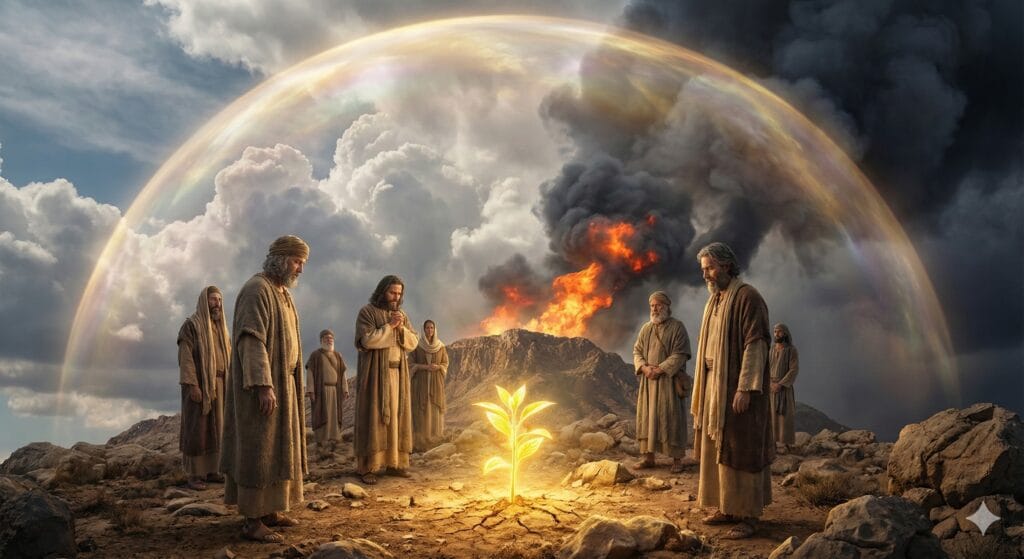
The final section of Isaiah's text unfolds a series of extraordinary images to describe how God protects and accompanies the purified remnant: cloud by day, smoke and fire by night, a canopy of glory above all, shade from the heat, refuge from the storm and rain. This accumulation of images is not poetic redundancy, but an attempt to grasp a reality that transcends ordinary language.
The first thing these images reveal is the permanence of the divine presence. «On all Mount Zion, and on all the assemblies that gather there»: no gathering of the people will be held outside of this presence. You no longer need to seek God in special places or exceptional times. He encompasses your entire existence, covers all your gatherings, and accompanies all your activities.
This promise addresses the fundamental anguish of abandonment. The judgment the people endured could easily be interpreted as a definitive withdrawal of God. «He has abandoned us, he no longer loves us, we are left to ourselves.» But Isaiah proclaims precisely the opposite: after the purifying judgment, God returns with unprecedented intensity. Not only has he not abandoned you, but he establishes himself permanently in your midst.
This constant presence manifests itself differently depending on your needs. The text explicitly distinguishes between day and night, heat and storm. God does not protect you uniformly and abstractly, but in a way that is tailored and concrete. During the day, when dangers are visible and tasks demand your attention, he becomes a discreet cloud that does not blind you but guides you. During the night, when fears intensify and darkness disorients you, he becomes a bright fire that reassures and warms you.
Think about your own experience. There are seasons in your life when God manifests as a discreet, almost imperceptible presence: everything is going relatively well, you're making progress on your projects, your faith is working quietly. The cloud of day. Then come crises, grief, gnawing doubts, and suddenly you need a more intense, more tangible manifestation. The fire of night. God adjusts his presence to your changing needs.
The image of the canopy of glory suggests protection that envelops you on all sides. A canopy covers you from above, but the text also speaks of shade from the heat and shelter from the storm. The divine presence becomes your climate, your spiritual atmosphere. You live and breathe in this presence like a fish in water, like a bird in the air.
This metaphor of climate Spiritual power is strong. Likewise, climate Physical activity profoundly influences your mood, your energy, your work capacity, the climate The spiritual environment in which you live determines your spiritual health. If you are constantly immersed in a climate Criticism, judgment, and anxious performance wither your soul. But if you dwell under the canopy of glory, in the atmosphere of grace and divine presence, you find the resources to face what is to come.
The text also mentions the heat of the day and the storm of rain as dangers against which God protects. These images evoke two types of threats. Excessive heat represents slow, progressive, exhausting oppression: chronic stress, overwhelming responsibilities, spiritual fatigue that gradually drains you. The storm represents sudden crises, unpredictable disasters, violent blows that can destroy you in an instant.
God promises to protect you from both. From the heat, he becomes the shade of a hut, that is, coolness and rest. He invites you to stop, to take shelter, to slow down before you are consumed. How many times have you ignored this invitation, continuing your activities until you are exhausted? But God insists: «Come under my shade, rest, breathe.» From the storm, he becomes refuge and shelter, a solid structure that withstands the winds and keeps the rain from soaking you. When everything collapses, he remains steadfast. When everything assails you, he hides you.
These promises of protection do not mean you will not experience heat or storms. The text does not say that God eliminates these realities, but that He protects you from them, that He mitigates their destructive effects. You will go through trials, but you will not be destroyed. You will face challenges, but you will not be alone. The difference between a storm that ravages and a storm that purifies is the presence of a solid shelter.
This understanding radically transforms how you face difficulties. Instead of asking, «Why does God allow this?» as if his absence were the cause of your trials, you learn to ask, «How is God present in this?» seeking the shade he offers, the refuge he provides. You move from a theology of absence to a theology of faithful presence in the very heart of the storms.
The text culminates in a stunning assertion: God will "create" this cloud, this fire, this glory. The word of original creation. In other words, establishing his protective presence among his people is an act as fundamental as creating the universe. God deploys the same creative power to envelop Zion in his glory as he deployed to bring forth light from the original darkness.
This means that God's presence with you is not an optional addition, a nice bonus. It is the very structure of renewed reality. When God recreates, he doesn't just fabricate new circumstances; he makes himself present in unprecedented ways. The new world is a world where God is with us, Emmanuel, permanently and tangibly.
Echoes in tradition: from the Exodus to Pentecost
The text of Isaiah 4 does not arise from a theological void. It takes up and reinterprets themes that run throughout the history of Israel, and Christian tradition sees in it the announcement of realities fulfilled in Christ and the Church.
The image of the cloud and the fire immediately evokes the Exodus. When God freed his people from Egyptian slavery, he guided them with a pillar of cloud by day and a pillar of fire by night. This visible presence accompanied Israel during the forty years in the desert, preceding them, protecting them, and indicating when to advance and when to stop. Isaiah thus promises a new Exodus, a new liberation. But this time, the divine presence will no longer be an external pillar to be followed, but a canopy that covers, an atmosphere to be inhabited.
The Church Fathers meditated at length on this progression. Augustine notes that in the Old Covenant, God walked with his people; in the New, he dwells in his people. The external presence becomes an internal presence. The stone temple becomes a living temple. This internalization does not eliminate the community dimension and visible from the divine presence, but transfigures it.
Liturgical tradition has also seen in this text a prefiguration of Pentecost. When the Spirit descends upon the assembled disciples, it appears in the form of tongues of fire that rest upon each one. The fire that purified Jerusalem becomes the fire that empowers the Church. The cloud of glory that covered Zion now spreads over all who call upon the name of the Lord. What the prophet foretold for a remnant geographically located in Jerusalem, the day of Pentecost fulfills for a remnant scattered to the four corners of the world.
Christian mystics developed the image of the canopy of glory to describe the experience of God's all-encompassing presence. John of the Cross It speaks of the transformed soul that lives constantly under the loving gaze of God, as if under an inner heaven. Teresa of Avila It describes the inner mansions of the soul's castle, each more deeply inhabited by the divine presence. These mystical experiences are not reserved for an elite: they fulfill Isaiah's promise that all will be called saints.
Monastic tradition has particularly honored the image of the hut as a place of rest in God. Desert Fathers They were seeking precisely this refreshing shade from the heat of the world and its passions. Their flight from the world was not contempt for creation, but an intense quest for that protective presence foretold by the prophet. Benedict of Nursia would organize this quest into a communal discipline where the monastery itself becomes the hut, the place where the rule creates a climate spirituality conducive to growth.
More recently, theologians like Karl Barth have reinterpreted this passage in the context of justification by faith. Being "called a saint" does not depend on our merits but on God's gracious call. Purification is not our moral effort, but the work of Christ, who took upon himself our defilement and shed blood. The Branch that the Lord causes to grow is ultimately Christ himself, rejected like a shoot from dry ground, but now the honor and glory of all who believe in him.
Christian liturgy often incorporates this text into celebrations of Advent, as a promise of what the Messiah will accomplish. She also sometimes reads it in Eastertide, as the fulfillment of this promise in the resurrection. This twofold reading reveals the fundamental structure of the Christian faith: the already and the not yet. The Seed has grown in Jesus Christ, the rest has been formed in the Church, the divine presence dwells among us through the Spirit. But we still await the full manifestation, the new Jerusalem where God will be all in all, where the canopy of glory will cover the entire universe.
Concrete ways to live out this promise today
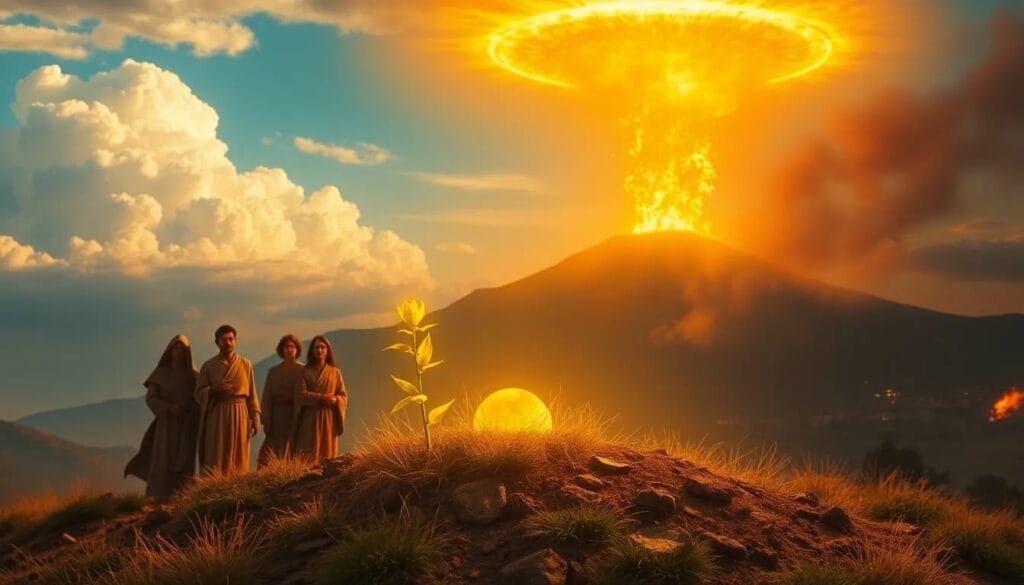
How can you move from contemplating this promise to embodying it in your daily life? Here are some practical suggestions, not as magic formulas, but as paths explored by countless believers before you.
Accept the purifying discipline. When a trial strikes, resist the temptation to flee immediately or simply curse it. First, ask yourself, «What is God trying to burn away in me through this situation?» Perhaps it’s your compulsive need for control, perhaps your idolatry of comfort, perhaps your excessive attachment to the opinions of others. Let the fire do its work, even if it burns.
Consciously identify yourself as holy. Begin your day by remembering not what you must accomplish to earn God's approval, but what God has already declared about you: you are called holy, written in his book, purified by his blood. This identity precedes and grounds your behavior. You do not act to become holy; you act because you are holy.
Cultivate awareness of presence. Several times a day, pause for thirty seconds to simply acknowledge that you are living under the canopy of glory, that the divine presence envelops you in this very moment. Consciously breathe in this presence. This exercise may seem artificial at first, but it gradually transforms your perception of reality. You begin to live constantly in this atmosphere instead of seeking it only in isolated "spiritual" moments.
Practice intentional shelter. When the heat of the day becomes oppressive, when responsibilities overwhelm you, physically stop. Find a quiet place, close your eyes, and explicitly present your weariness to God: «You promised to be the shade of my hut. I come into your shade now.» Simply remain there, doing nothing, asking for nothing, just sheltered. Ten minutes of this mindful rest can restore you more deeply than hours of restless entertainment.
Intentionally join the remnant. Isaiah's promise is communal: it is "the assemblies that stand on Mount Zion" that God covers with his glory. You cannot live out this promise in isolation. Seek out a community of believers who take purification and holiness seriously, where you can be known and loved despite your flaws, where you are called to grow without being crushed by judgment. The remnant is not a collection of isolated individuals but a people gathered together.
Bear witness to God's protective presence. When you go through a storm and discover that God is holding firm, share your story. Don't downplay the violence of the storm or the strength of the refuge. Your testimony can become a sign to others that they are not abandoned. Be specific: don't just say, "God is good," but, "When I lost my job and didn't know how I was going to feed my children, this is how God provided in a completely unexpected way." Concrete details make the promise believable.
Wait patiently for the Seed. A seed's growth cannot be forced or accelerated by anxiety. You have sown, you have watered, now you wait for God to make it grow. This waiting is not passive: you continue to cultivate the soil of your heart, to weed out the toxic attachments, to protect the young shoot from your initial transformations. But you cannot produce the growth itself. Only God can. Learn to wait with active hope.
Practice ordinary holiness. Don't seek spectacular heroism first. Start with loyalty In the little things: telling the truth when a lie would be more comfortable, honoring your commitments even when it costs you, truly listening to someone who bores you, working with excellence even when no one is watching. These microscopic acts weave the garment of everyday holiness.
Reinterpret your past failures. Look back and identify the times when you believed it was all over, that you had missed something important forever. In retrospect, do you see how God used even those failures, how He purified you through them, how what remained was actually what truly mattered? This reinterpretation transforms your relationship to the present: what seems like a catastrophe today could be a purifying judgment, opening the door to a glory you cannot imagine.
The revolutionary hope of fertile ruins
Together, we explored this text from Isaiah as a territory with multiple landscapes: the context of desolation that makes the promise necessary, the paradoxical dynamic of judgment that purifies, the theology of the remnant that reveals the divine strategy, the universalized holiness that democratizes the vocation, the protective presence that envelops the purified. All these elements converge on a central truth: God never abandons his plan to have his glory dwell among a people who resemble him.
This promise is not a fairy tale for detached dreamers. It anchors your hope in the very logic of who God is. He is the God who makes deserts sprout, who gives life to the dead, who transforms exhausted survivors into bearers of radiant holiness. Your present situation, however desperate it may seem, is not beyond his creative power.
The revolutionary message of Isaiah 4 lies in this assertion: your ruins are fertile. What has collapsed within you, around you, can become the soil where God makes something radically new grow. But for this to happen, you must accept the process of purification, consent to the fire that burns away what is combustible in order to reveal what remains.
The constant temptation is to try to rebuild quickly, to patch up the facades, to restore the old rather than let God create the new. We want to repair our tarnished reputation, regain our lost comfort, and reclaim our diminished influence. But God offers something else: not to repair the old but to create the new, not to restore your glory but to become your glory, not to rebuild your temple but to make you his temple.
This transformation requires a radical shift in perspective. You must learn to see with God's eyes, for whom what remains is never residue but seed, for whom purification is never punishment but healing, for whom holiness is never performance but received identity. When you begin to see in this way, the circumstances that overwhelmed you can become opportunities to discover an abundance of presence you had never perceived.
The text of Isaiah ultimately invites you to an existential choice: will you define your life by what you have lost or by what God promises to create? Will you remain fixated on the ruins or seek the Seed that is already growing through the rubble? This choice is renewed daily, sometimes several times a day, between a gaze that laments and a gaze that hopes.
The early Church experienced this promise through persecution. Christians Decimated, hunted down, and martyred, they recognized that they were the remnant of Israel, the purified people upon whom the glory of the Lord rested. Their weakness digital And politics did not prevent them from transforming the Roman Empire from within. Because they knew who they were: not a marginal sect destined to disappear, but the seed of a new humanity, the remnant bearing the universal promise.
Even today, in a West where the Christianity Though it may seem to be in decline, with churches emptying and cultural influence evaporating, Isaiah's promise remains. Perhaps we are living through the purifying judgment, the moment when God burns away what was merely cultural religion to reveal the authentic remnant. Perhaps this apparent shrinking is preparing the way for a deeper renewal, a truer holiness, a more manifest presence of God.
Never mistake apparent success for divine blessing, nor visible failure for God's abandonment. The Seed that the Lord causes to grow often sprouts in the most unlikely places, among the most unlikely survivors, manifesting a glory that confounds all our expectations.
Your personal calling is part of this dynamic. God purifies you to sanctify you, sanctifies you to use you, and uses you to manifest His glory. Each step prepares the next. The judgment you face today shapes the witness you will become tomorrow. The limitations that currently humble you create the space where God's power can be fully unfolded.
So live as a grateful survivor, as a saint who bears his name without merit but with responsibility, sheltered beneath the canopy of glory that protects you day and night. Let the Seed grow within you, through you, beyond you. And when the storms come, remember: you have a refuge that stands firm, a presence that never abandons you, a promise stronger than all your failures.

What you can do right now
Identify your current desert. Describe precisely the desolate situation you are experiencing, without minimizing or dramatizing it, simply with the truth. Write it down on a piece of paper. Then ask God to show you where the Seed could grow in this barren ground.
Memorize the central sentence. «The Branch that the Lord will cause to grow will be the honor and glory of the survivors of Israel.» Repeat this every morning for a week, letting it take root in your consciousness. Let it become your mantra of hope.
Practice resting in the shade. Each day, for at least ten minutes, stop all productive activity. Sit in silence, close your eyes, and visualize yourself in the shade of a hut where God welcomes you. Breathe slowly. Ask for nothing, demand nothing, simply rest.
Join a community of the rest. Look for a Christian group that takes purification and holiness seriously, where vulnerability is honored and transformation is expected. If you can't find one, start one: invite two or three people to meet regularly to read Scripture, praying together, to encourage each other.
Document manifestations of presence. Keep a simple journal in which you note down at least one way each day you have experienced God's protective presence: an unexpected refuge, a surprising provision, an inexplicable peace, a strength beyond your resources. Review these notes regularly to strengthen your faith.
Embrace your identity as a saint. Each morning, before looking in the mirror, say aloud: «I am called holy by God himself. I am written in his book. I live under his canopy of glory.» Let this truth precede all your activities of the day, transforming the way you see yourself and others.
Read the prophets of hope. Extend this meditation by reading other texts that develop the same themes: Isaiah 40-55, Jeremiah 31, Ezekiel 36-37, Zechariah 8. See how these prophets tirelessly repeat the promise that God never abandons his plan, that he purifies to renew, that he always makes life sprout from ruins.
Biblical and theological references
Isaiah 4:2-6 (central text of this meditation, Liturgical Translation of the Bible).
Isaiah 1-3 (context of judgment preceding the promise).
Isaiah 11, 1-10 (development of the image of the Messianic Seed).
Jeremiah 23:5-6 and 33:14-16 (prophetic reiteration of the theme of the Branch of Righteousness).
Zechariah 3:8 and 6:12 (identification of the Branch with the high priest and the coming king).
Exodus 13, 21-22 and 40, 34-38 (divine presence in the form of cloud and fire guiding Israel).
1 Peter 2:9-10 (royal priesthood and holy people, New Testament fulfillment of universal holiness).
Revelation 21:3-4 (eschatological fulfillment of the promise that God will dwell with his people).
Augustine of Hippo, The City of God (reflection on the faithful remnant and the presence of God in history).
John of the Cross, The Dark Night (purification as a path towards union with God).
Dietrich Bonhoeffer, The Price of Grace (distinction between cheap grace and costly grace that transforms).
Karl Barth, Ecclesial Dogmatics (justification by faith and received identity of the believer).