










Gospel of Jesus Christ according to Saint Matthew
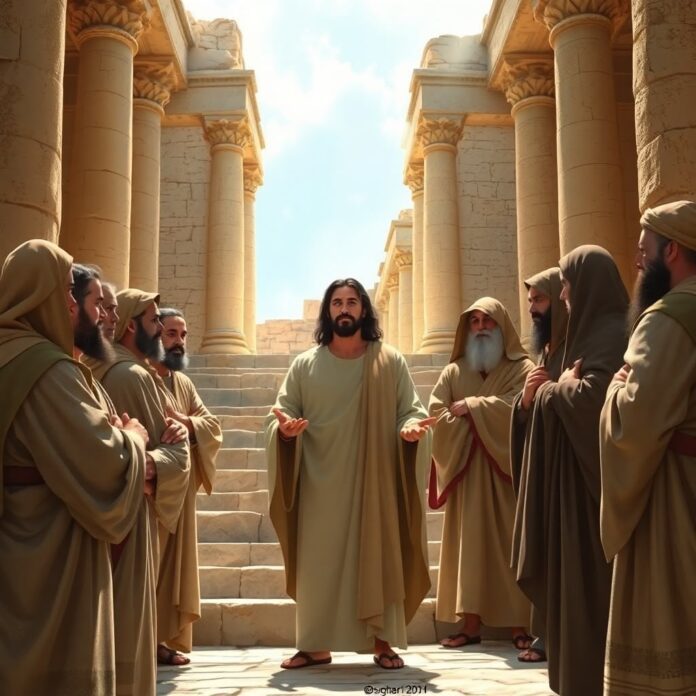
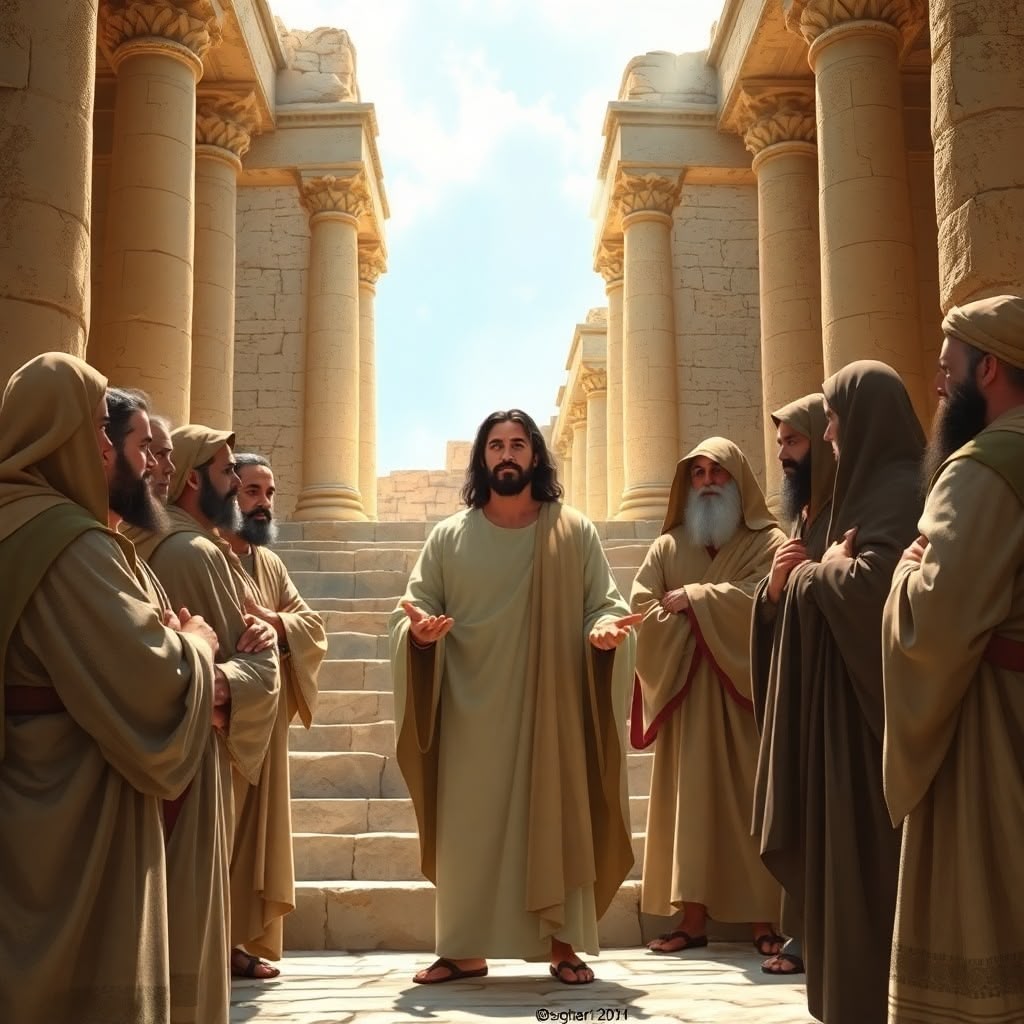
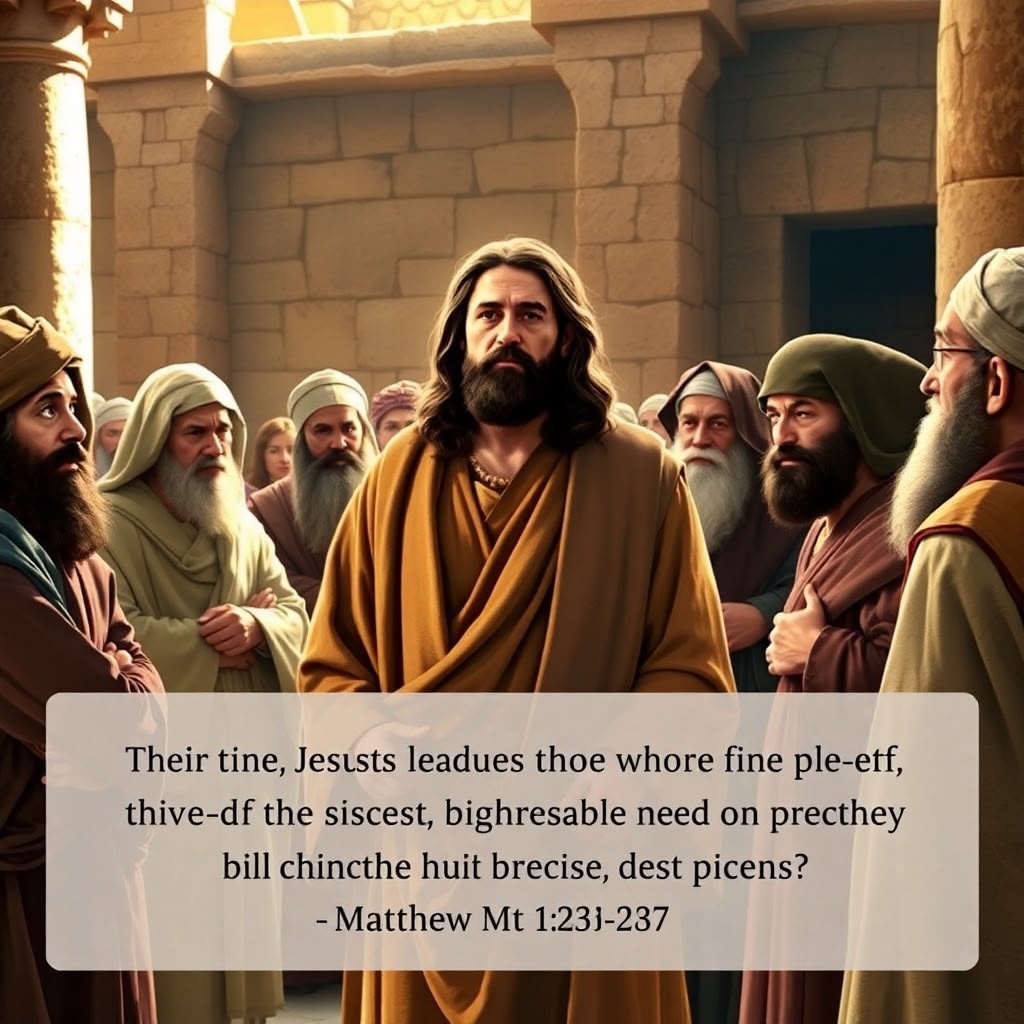
At that time, Jesus entered the Temple, and while he was teaching, the chief priests and the elders of the people came to him and asked, «By what authority are you doing these things, and who gave you this authority?» Jesus answered them, «I will ask you one question, and if you answer me, I will tell you by what authority I am doing these things: John’s baptism—where did it come from? From heaven or from men?» They discussed this among themselves: «If we say, «From heaven,» he will say to us, «Why then did you not believe him?» But if we say, «From men,» we are afraid of the crowd, for they all hold John to be a prophet.» So they answered Jesus, «We do not know.» He said to them, «Neither will I tell you by what authority I am doing these things.»
When divine authority unmasks human calculations
How Jesus turns the question of legitimacy around to reveal the truth of hearts and call for authentic discernment.
Do you ever feel caught between what you know to be right and what seems politically viable? This tension has persisted through the centuries since that day when, within the Temple in Jerusalem, religious authorities tried to trap Jesus with a seemingly simple question about his legitimacy. Their trap backfired, revealing not only Christ's divine wisdom but also our own difficulty in choosing truth when it threatens our established positions. This story speaks to us of authority, courage, discernment, and the formidable art of asking the right questions.
The biblical foundations of true spiritual authority, distinct from institutional power • Jesus' rhetorical strategy in the face of bad faith and his teaching on discernment • The concrete implications for our daily choices between authenticity and compromise • A practical meditation to recognize and follow the authority that comes from heaven.
The confrontation at the Temple: deciphering a theological duel
The Gospel of Matthew places us in chapter 21, during the final days of Jesus' public ministry in Jerusalem. The immediate context is explosive: just a few verses earlier, Jesus had driven the merchants from the Temple and cursed the barren fig tree, two powerful prophetic acts that challenged the established authorities' management of religious worship. Matthew situates this exchange after the triumphant entry into Jerusalem, a time when Jesus' popularity was at its peak while the hostility of the religious leaders was becoming entrenched.
The spatial context is crucial: Jesus teaches in the Temple, the spiritual heart of Israel, the place where the divine Presence is believed to dwell. This is their territory, their domain of legitimate authority. The high priests and elders of the people represent the religious establishment, those who officially hold the power to teach and lead worship. Their question is not neutral: «By what authority are you doing this, and who gave you this authority?» It presupposes a system of human delegation, a hierarchical chain of which they are the guarantors. They are trying to trap him: either Jesus claims divine authority (which would be blasphemy in their eyes), or he admits to acting without legitimate mandate (which would discredit his teaching).
Jesus' response reveals exceptional rhetorical mastery. Rather than answering directly, he poses a counter-question that exposes their moral dilemma: "John's baptism—where did it come from? From heaven or from men?" This question is not an evasion but a symmetrical trap that reveals their hypocrisy. John the Baptist enjoyed immense popularity as a genuine prophet, but the authorities had never officially recognized him, cautiously waiting to see how his movement would develop. Matthew gives us access to their inner thoughts, revealing their political calculation rather than their search for truth: "If we say, 'From heaven,' he will say to us, 'Why then did you not believe him?' But if we say, 'From men,' we are afraid of the crowd."«
Their final response – «We do not know» – constitutes an unwitting admission of spiritual incompetence. How can they presume to judge Jesus« authority if they are incapable of discerning John’s, which is clearly prophetic? Jesus then turns their unanswered question back on them: »Neither will I tell you by what authority I do these things.” This apparent silence is in reality a resounding answer: his authority comes from the same source as John’s, from heaven, but they are spiritually blind. The Matthean narrative thus underscores that true authority is recognized not by institutional certificates but by spiritual fruits and prophetic consistency.
Heavenly authority versus earthly power: an analysis of a foundational conflict
A thorough analysis of this passage reveals a fundamental opposition between two conceptions of authority that runs throughout the history of salvation. On the one hand, the institutional authority of the high priests and elders rests on succession, official function, and control of the cultic apparatus. On the other hand, the prophetic authority of John and Jesus stems from a direct call from God, attested by signs, a powerful word, and the spontaneous recognition of the people.
This tension is not new in Scripture. Old Testament prophets like Amos, Jeremiah, and Ezekiel often faced opposition from official priests and false court prophets. Amos, a simple shepherd called by God, was forbidden to prophesy in Bethel by the priest Amaziah, who ordered him to return to Judah to earn a living (Amos 7:10-17). Jeremiah faced fierce resistance from the Temple authorities, who threatened him with death for announcing its destruction (Jeremiah 26). The conflict in Matthe's Gospel is thus part of a long biblical tradition in which the authentic word of God disturbs those who have institutionalized religion.
The brilliance of Jesus' strategy lies in his ability to shift the debate from the legal-formal terrain to the terrain of spiritual discernment. His interlocutors want papers, credentials, bureaucratic validation. Jesus refers them to a question of faith: have they recognized in John the forerunner foretold by Malachi? Their inability to answer frankly betrays their lack of inner freedom and their submission to political calculation. Matthew uses the verb "dialogizomai" to describe their inner reasoning, a term that elsewhere in the Gospel often denotes doubt, anxious perplexity, paralyzing hesitation (Mt 16:7-8; 21:25).
What is particularly striking is the fear that governs their deliberation: «we must fear the crowd» (phoboumetha ton ochlon). They do not fear God but public opinion. Their position of power has made them captives of popularity, incapable of taking the risk of truth. This dynamic illuminates a crucial spiritual mechanism: when one chooses institutional power as an end in itself rather than as a service to truth, one gradually loses the capacity to discern that truth. True authority liberates; power enslaved to human calculation imprisons even those who wield it. Jesus, on the contrary, manifests radical freedom: he teaches with authority (exousia), not like the scribes who cite previous authorities (Mt 7,29), because his word proceeds directly from his communion with the Father.
The three dimensions of authentic authority
Recognizing the source: from the sky or from men
The question Jesus poses about John's baptism—"Where did it come from? From heaven or from men?"—establishes a fundamental dichotomy that structures the entire spiritual life. This alternative is not metaphorical but ontological: there are two radically different sources of authority, legitimacy, and action. What comes "from heaven" (ek ouranou) proceeds from God, participates in his saving initiative, and is part of his plan. What comes "from men" (ex anthrôpôn) is a human construct, perhaps legitimate in its own way, but fundamentally different.
This distinction runs throughout the Bible. Already in Deuteronomy, Moses warns against false prophets who speak without having been sent by God (Deut 18:20-22). The criterion for verification? The fulfillment of what is announced, consistency with previous revelation, and above all, the fact that the word points to God rather than to the man who utters it. John the Baptist perfectly embodied this heavenly authority: all his preaching pointed to "the one who comes after me," he diminished himself so that Christ might increase (John 3,30). His baptism of conversion was not a self-instituted ritual but an obedient response to the divine call, preparing the way of the Lord.
Yet, recognizing this divine source requires active and courageous discernment. The high priests and elders possessed all the intellectual and scriptural tools to identify an authentic prophet. They knew the criteria, the texts, the messianic prophecies. But their will was corrupted by self-interest. Matthew shows us their calculation: they weighed the political consequences of every possible answer rather than simply seeking the truth. This is where the spiritual tragedy lies: the heavenly source of authority is not imposed by force but is revealed through faith. It requires a free, upright heart, capable of putting God before one's own interests.
This dynamic directly concerns us today. In our churches, our communities, and our personal choices, we are constantly confronted with this question: what is the source of what we do, say, and decide? Do we act out of social conformity, religious habit, or institutional self-interest? Or do our actions stem from a genuine listening to the divine will, from an inner calling verified by communal discernment and consistency with the Gospel? The temptation is ever-present to label our human projects "the will of God," when they are merely driven by the desire for comfort, prestige, or security. The history of the Church is littered with decisions made "in the name of God" that, in reality, served earthly ambitions. The question posed by Jesus remains our constant examination of conscience.
Embracing the risk of truth
The contrast between Jesus' attitude and that of the religious authorities reveals a second dimension of authentic authority: the courage of truth versus the calculation of prudence. The high priests and elders are prisoners of their fears: fear of losing face, fear of popular reaction, fear of the consistency that would force them to change. Their response, "We do not know," is a transparent lie. They know perfectly well what they think of John the Baptist; they are simply afraid of the consequences of being frank.
Jesus, on the contrary, manifests a radical freedom. He does not seek to please, to avoid offending anyone, or to preserve his own safety. His response, a counter-question, is not an empty rhetorical flourish but a profound pedagogical method: he refers his interlocutors back to their own conscience, forcing them to confront their inconsistency. This Socratic method, which Jesus often employs in the Gospels (think of the woman caught in adultery, the rich young man, Peter after his denial), always aims at inner truth rather than dialectical victory. He could easily crush his adversaries with a demonstration of his divinity; he chooses instead to refer them back to their own judgment, dramatically respecting their freedom even when they misuse it.
This attitude teaches us something essential about the exercise of spiritual authority. It is never a domination that crushes, but an invitation that liberates. Jesus does not say, «I am the Son of God, bow down,» even though it is true. He lays the groundwork for authentic discernment: if you were able to recognize John, you can recognize the one he foretold. True authority creates space for free recognition; it does not impose itself through violence. Saint Paul develops this insight: «We do not lord it over your faith, but we work with you for your joy» (2 Corinthians 1:24).
The risk Jesus took was absolute. A few days after this confrontation, the same authorities would orchestrate his death sentence. He knew this, and yet he yielded nothing on the truth. This uncompromising stance was not pride but love: to truly love people is to tell them the truth, even when it is uncomfortable, to refuse to let them become trapped in their comfortable lies. The easy pastoral approach that avoids difficult questions, the watered-down teaching that never risks causing offense, the complacent spiritual guidance that reinforces illusion: all of this stems not from love but from cowardice. Jesus shows us another path, more demanding, more perilous, but infinitely more liberating.
To show recognizable results
The third dimension of authentic authority, implicit in our passage, concerns observable fruits. Jesus does not ask his listeners to believe blindly in his authority; he refers them to the verifiable experience of John the Baptist. «Everyone holds John to be a prophet,» Matthew notes. This popular recognition is not mere demagoguery; it reflects a sound spiritual perception that the elites have lost. The common people recognized John's prophetic authenticity because they saw its fruits: an ascetic life consistent with his message, a word that converted hearts, an integrity that was not afraid to denounce even King Herod.
Jesus himself applies this criterion of fruits to the evaluation of the prophets: "By their fruits you will recognize them" (Mt 7,(p. 16-20). A good tree produces good fruit; a bad tree produces bad fruit. This simple but formidable truth applies to all forms of authority, including ecclesiastical authority. Authority that truly comes from God will produce fruits of conversion, liberation, spiritual growth, and charity authentic. An authority that proceeds only from human mechanisms will produce at best outward conformity, at worst oppression, hypocrisy, sterile legalism.
The Church Fathers extensively pondered this question of the fruits of spiritual authority. Saint John Chrysostom, in his homilies on Matthew, insists that pastoral authority is verified by the holiness The life of the pastor and the actual building up of the community. Saint Gregory the Great, in his Pastoral Rule, develops the idea that whoever exercises authority must first govern themselves, manifesting the virtues they teach, otherwise their words are empty. This patristic tradition aligns with biblical wisdom: spiritual authority is not primarily functional (holding a title) but existential (embodying the truth one proclaims).
For us today, this means that we must constantly examine the fruits of our actions, our communities, and our commitments. Intense religious activity that does not produce growth in charity, peace, justice, mercy, This should give us pause. A teaching that multiplies dependent disciples rather than free and spiritually mature ones reveals a distorted authority. A church structure that protects the institution at the expense of its victims, that stifles prophetic voices for the sake of tranquility, that prefers appearances to truth, has lost touch with its heavenly source. Examining the fruits of this faith is a demanding but essential discipline for maintaining the authenticity of our life of faith.
Discerning and choosing true authority in our concrete lives
How does this theological reflection on authority translate into our daily lives? The question is not merely academic but vital. Every day, we are confronted with voices that claim to tell us how to live, believe, and act. Some come from heaven, others from humankind; some liberate, others enslave. Learning to discern becomes an essential spiritual skill.
In the sphere of our personal faith, we must distinguish between mechanical obedience to religious norms and a free response to God's call. The high priests and elders knew the Law perfectly, scrupulously observed its rules, and occupied legitimate positions within the religious system. Yet, they completely missed the coming of the Messiah. Why? Because their religious practice had been emptied of its relational substance with God, reduced to mere ritual administration and the preservation of power. We risk the same confinement: regular sacramental practice, solid doctrinal knowledge, and active participation in parish life can coexist with a profound deafness to what the Spirit is saying today. The criterion for verification? Genuine spiritual fruitfulness: does my practice make me more loving, freer, more attentive to the poor, and more inwardly unified?
In our relationships and communities, the question of authority arises differently but with the same urgency. When someone claims to exercise authority over us—a pastor, a spiritual director, a community leader, a parent—we must discern the source of that authority. Does it stem from genuine service that seeks our well-being and freedom? Or is it disguised domination, emotional manipulation, a need for control in the other person? Abuses Spiritual conflicts within the Church and Christian communities often stem from a confusion between authority and power, between guidance and domination. Healthy spiritual authority expands our freedom, helps us to hear God's voice for ourselves, and leads us back to our own enlightened conscience. False authority infantilizes us, makes us dependent, and replaces our personal discernment.
In the public and civic sphere, the lesson of our Gospel passage remains relevant. We live in societies where political, media, and economic authorities compete to capture our support, guide our choices, and shape our opinions. Like the high priests facing John and Jesus, these authorities may be tempted to prioritize managing their image and preserving their position over the honest pursuit of the common good. Our faith calls us to critical and courageous discernment: which voices deserve our trust? Which ones manipulate us? On what criteria do we judge: popularity, consistency, the concrete fruits of justice and peace? The fear of displeasing or being marginalized can paralyze us as it paralyzed the Jewish authorities. But loyalty In truth, it sometimes requires swimming against the current, denouncing what is unjust even when it is socially costly.
Finally, in our own exercise of influence and responsibility, we must examine ourselves with the same clarity. Parents, teachers, professional leaders, church leaders—we all wield some form of authority over others. Where does it come from? Do we serve our ego, our need for recognition, our comfort? Or do we truly seek the good of those entrusted to our care, at the risk of displeasing others, losing our popularity, or facing resistance? The temptation to "not know" in order to avoid the consequences of a clear stance lies in wait for us all. But the example of Jesus reminds us that the authority that comes from heaven accepts the risk of truth, even when it leads to the cross.
When Christian tradition reflects on authority and discernment
The Church Fathers contemplated this passage from Matthew 21 with particular attention, discovering in it theological riches that still nourish our reflection. Saint John Chrysostom, in his homilies on Matthew, marvels at the pedagogical wisdom of Christ, who does not respond directly but leads his interlocutors to recognize their own blindness. For Chrysostom, this method reveals divine philanthropy: God never crushes us with his power but patiently seeks to awaken our freedom. The Doctor of Antioch also notes the difference between the fear that paralyzes the authorities («we must fear the crowd») and the filial trust that animates Jesus in his relationship with the Father.
Saint Augustine, In his commentaries on the Gospels, he meditates at length on the "we do not know" of the high priests and elders. For the Bishop of Hippo, this false admission of ignorance illustrates the fundamental lie of sin: preferring darkness to light because our works are evil (John 3,(p. 19-20). Augustine sees in this scene a prefiguration of the judgment: before Christ, all evasions will fall away, all hypocritical justifications will dissolve. But he also emphasizes mercy This is present in Jesus' counter-question: right to the end, the Lord offers a way out, a possibility of conversion. If they had had the courage to say, "John's baptism came from heaven," they could then have acknowledged, "And you too come from heaven."«
The monastic tradition, particularly through the writings of Saint Benedict and John Cassian, made the discernment of spirits and obedience to legitimate authority two pillars of the spiritual life. But this is always a free and enlightened obedience, not a blind submission. The Rule of Saint Benedict insists: the abbot must teach more by example than by words, and his authority is verified by his conformity to Christ, the Good Shepherd. This spiritual tradition echoes our Gospel passage: authentic spiritual authority is recognized by its source (rooted in the Gospel and sacramental life), by its fruits (holiness of life, building up of the community), and to its purpose (to lead to Christ, not to oneself).
In the modern magisterium, the Second Vatican Council renewed the theology of authority in the Church by recalling that all ecclesiastical authority is a service (diakonia) and not a domination. The Constitution Lumen Gentium insists that the pastors must carry out their duties "following the example of the Good Shepherd," in the«humility and service. This conciliar vision echoes our passage: Jesus does not claim an authority that would crush or dominate, but he invites discernment and free recognition. The pope François, In Evangelii Gaudium, he denounces the "ecclesiastical structures that can foster a disembodied spirit of the Church" where authority becomes self-referential rather than serving the mission. This critique directly extends Jesus' confrontation with the high priests and elders who had lost sight of the prophetic purpose of their office.
Contemporary theology, particularly with authors such as Hans Urs von Balthasar or Joseph Ratzinger (Benedict XVIRatzinger, in his work *Jesus of Nazareth*, further explored the distinction between power and authority. Power can be maintained through coercion, manipulation, and political skill; authority, in the theological sense, arises from truth freely recognized and cherished. This distinction illuminates our passage: the high priests hold institutional power, but they have lost the spiritual authority that the people spontaneously recognize in John and Jesus. In *Jesus of Nazareth*, Ratzinger extensively discusses Jesus' controversies in the Temple, demonstrating how Christ reveals a new form of authority, rooted not in institutional succession but in immediate communion with the Father, attested to by signs and teaching.
A four-movement meditation to welcome the authority of Christ
First step: To situate oneself in the Temple of one's own life
Begin with a moment of silence, imagining yourself within the Temple in Jerusalem, this place of prayer that also became a place of commerce and power. Identify the "temples" of your life: those spaces, relationships, and activities that you consider sacred, important, and structuring. Then ask yourself the question Jesus implicitly poses: who truly teaches there? What voices, influences, and authorities guide your choices in these crucial areas? Mentally note (or on paper) these different voices without judging them yet, simply by naming them: family opinion, professional standards, church expectations, the media, your own desires, the Word of God…
Second movement: Discerning the source (from heaven or from men)
Take each of the identified voices and ask them Jesus' question: "Where does this authority come from? From heaven or from men?" Specifically, for each influence on your life, ask yourself: does it produce fruits of peace, freedom, and... charity Is it authentic (signs from heaven)? Or does it generate anxiety, dependence, and selfishness (signs of a purely human origin)? Pay particular attention to the areas where you "don't know," where you prefer not to ask the question because the answer would imply changing something. Like the high priests, we all have areas of willful blindness where we avoid lucidity for fear of the consequences.
Third movement: Confronting one's fears and calculations
The Temple authorities reasoned, «If we say… then it will happen…» Identify in your own life these calculations that prevent you from recognizing the truth or acting upon it. What are you specifically afraid of? The judgment of others, losing security, upsetting a fragile balance, facing suffering? Name these fears before the Lord, without minimizing them but also without giving them the power to paralyze you. Jesus himself experienced fear in Gethsemane, but he overcame it by surrendering to the Father. Ask grace to prefer the truth that liberates to the false peace of lies or compromise.
Fourth movement: Choosing free obedience
Conclude by stating a concrete act of obedience to the authority you have recognized as coming from heaven. These don't necessarily have to be dramatic decisions, but small, everyday choices that align your life with the divine will perceived through prayer, community discernment, and Scripture. Perhaps confessing an uncomfortable truth, perhaps relinquishing a false sense of security, perhaps embracing a calling you have been resisting. Ask the Holy Spirit for the courage to say "yes" to what truly comes from God, and "no"—respectfully but firmly—to what stems only from human convention or fear. End by entrusting to Christ your desire for authenticity and your need for help in living it.

Addressing contemporary challenges of authority and discernment
Our era is experiencing a profound crisis of authority in all its forms: political, moral, religious, and intellectual. This crisis has positive aspects—a welcome rejection of authoritarianism, a legitimate affirmation of the freedom and dignity of every person—but also worrying excesses: a relativism that makes all discernment impossible, an individualism that rejects all external voices, a skepticism that undermines the very possibility of truth. How does our Gospel passage shed light on these tensions?
First, Matthew's account validates the legitimacy of questioning. Jesus doesn't reproach the authorities for asking "By what authority?"; he reproaches their bad faith, their inability to truly seek the answer. In a pluralistic society where a thousand competing voices claim to possess the truth, it is not only legitimate but necessary to ask about the source and legitimacy of information. The problem arises when this question becomes purely rhetorical, a cynical game that doesn't genuinely seek an answer. Our time suffers less from an excess of questions than from a lack of rigor in the search for answers, from an intellectual and spiritual laziness that is content with "we don't know" without even trying to find out.
Next, the episode warns us against two symmetrical temptations. On the one hand, fundamentalism, which absolutizes human authorities (texts, institutions, leaders) by claiming they come directly from heaven, thus avoiding any critical examination. This attitude mirrors that of the high priests who believed themselves the owners of religious legitimacy and refused to recognize any prophetic word outside their system. On the other hand, relativism, which rejects all transcendent authority and reduces all claims to truth to mere equivalent human constructs. This position even refuses to ask the question "from heaven or from men?" by asserting a priori that everything comes from humankind. Between these two pitfalls, the Gospel proposes a third way: a patient, humble discernment, attentive to the fruits, open to the surprise of God who can speak in unexpected ways (like John in the desert), but also capable of recognizing authenticity when it manifests itself.
A particular challenge concerns the relationship between the institutional authority of the Church and the freedom of conscience of the faithful. The episode in Matthew 21 reminds us that these two realities are not necessarily opposed: legitimate authority (that of the high priests and elders had an objective basis in the Law of Moses) must constantly verify and renew itself through its fidelity to its divine source and through the fruits it produces. When an ecclesiastical authority authentically exercises its service, in the’humility And in its pursuit of the good of souls, it helps consciences to form and discern; it does not oppress them. But when this authority becomes self-referential, concerned above all with preserving itself, it loses its credibility and its fruitfulness. The scandals that have shaken the Church in recent decades largely stem from an authority that has been exercised to protect the institution rather than to serve the truth and the victims. Our Gospel passage is a prophetic reminder addressed to all ecclesiastical authorities: they will be judged on their ability to recognize the signs of the times, to welcome even disturbing prophetic pronouncements, and to choose truth over political calculation.
Finally, the contemporary difficulty of discernment in a world saturated with contradictory information resonates with our story. The high priests and elders are paralyzed not by a lack of information but by an excess of considerations: «If we say this… if we say that…» Our era multiplies «ifs» ad infinitum, producing a paralysis of decision-making. The wisdom of Jesus teaches us to simplify: what is the truly important question? What is the fundamental truth that guides everything else? For him, the central question is not «How do I preserve my power?» but «Where does John’s authority come from?»—a question that ultimately leads back to «Who is sent by God?» Rediscovering this ability to prioritize questions, to identify the decisive criterion, becomes a vital spiritual discipline in our context of information overload and increasing complexity.
Prayer to welcome the authority of Christ into our lives
Lord Jesus, living Word of the Father,
you who taught in the Temple with authority that came from heaven,
We acknowledge you as our only Master and Lord.
In a world where so many voices claim to guide us,
Give us the discernment to recognize your voice.,
the wisdom to distinguish what comes from you
of that which results solely from human constructions.
Forgive us when, like the high priests and the elders,
We calculate the consequences before seeking the truth.,
when we prefer the comfort of willful ignorance
at the demanding risk of lucidity.
Forgive us for all the times we have said "we don't know"«
even though we knew very well but lacked courage
to assume the implications of our knowledge.
Free us from the fear that paralyzes our faith:
fear of being judged by others, fear of losing our security,
fear of disrupting our habits, fear of facing our truth.
Give us the courage of John the Baptist
who announced your coming without seeking his own glory,
who bore witness to the truth even in the face of power,
which was decreasing so that you could grow.
Teach us to practice with precision
any authority we might have over others:
in our families, our communities, our professional responsibilities.
That we should never seek to dominate but always to serve,
that we never manipulated but liberated,
that we never impose upon ourselves but humbly bear witness
of the truth that infinitely surpasses us.
Strengthen our ability to discern spirits:
to recognize what comes from you and what is contrary to you,
to distinguish genuine authority from illegitimate power,
to identify the true prophets and the false messiahs.
Grant us to seek the fruits rather than the appearances,
consistency rather than popularity,
there holiness rather than worldly success.
Lord, we pray for all those who exercise authority:
in your Church, in our societies, in our families.
Let them recognize that all authority comes from you.
and must be exercised according to your Spirit of service and truth.
Convert hardened hearts, enlighten darkened minds,
strengthens those who bravely resist pressure.
to remain faithful to your will.
We entrust to you especially those who are suffering.
abuse of spiritual authority, religious manipulation,
domination disguised as pastoral service.
Comfort them, set them free, heal their wounds.
Give them the opportunity to meet authentic witnesses of your love.
who reveal your true face to them.,
so different from the caricatures that were imposed on them.
May your Holy Spirit make us docile to your word,
free from the powers of this world,
courageous in bearing witness to the truth,
merciful to those who sincerely seek,
patients with our own slowness and resistance.
Make us true disciples,
who recognize your authority not by force
but out of joyful love for your liberating truth.
That we may bear fruits worthy of your life within us:
love, joy, peace, patience, kindness,
kindness, loyalty, gentleness, self-control.
Through your intercession, Married, you who said "yes"«
to the authority of the divine Word borne by the angel,
teach us free and fruitful obedience
who gives birth to Christ in our lives and in our world.
Amen.
Becoming disciples of authentic authority
The exchange in the Temple between Jesus and the religious authorities leaves us with a burning question: whose side are we on? Do we truly seek to recognize what comes from heaven, or do we carefully weigh the pros and cons of each position? The issue goes far beyond an abstract theological debate; it involves our entire way of life. faith, to exercise our responsibilities, to situate ourselves in the world.
This story calls us to a threefold conversion. First, an intellectual conversion: accepting that truth exists, that it can be known, that it judges us rather than we judge it. In a climate From a relativistic cultural perspective, asserting that there is truth and falsehood, justice and injustice, legitimate authority and illegitimate power, already constitutes an act of resistance. But this assertion is not arrogant if it is accompanied by’humility : we recognize the truth, we do not create it; we serve it, we do not possess it.
Next, a conversion of the heart: choosing the freedom of truth over the slavery of calculation. High priests and elders are prisoners of their fears, their position, and public opinion. We all are, to varying degrees. Faith Christian faith offers a gradual liberation from these bondages: «You will know the truth, and the truth will set you free» (John 8:32). This freedom is not won all at once but is cultivated day after day, in small choices where we accept losing something to gain authenticity, where we risk conflict so as not to betray our conscience, where we speak the truth that disturbs rather than the lie that comforts.
Finally, a practical conversion: placing our lives under the authority that truly comes from heaven. Concretely, this means prioritizing listening to the Word of God, discernment in prayer, and participation in the sacraments where Christ exercises his authority of grace. It also means regularly examining the fruits of our choices, our commitments, and our relationships: are they bearing fruit? peace, joy, charity Which bear witness to the Spirit? Or do they generate division, bitterness, spiritual barrenness? Examining the fruits requires time, of patience, We need perspective; our culture of immediacy resists it. But there are no shortcuts to authentic discernment.
The path Jesus opens for us in this passage is demanding but profoundly liberating. He does not ask for blind submission but for a clear-sighted commitment, not for servile obedience but for a free and joyful embrace of what comes from the Father. The Temple authorities missed the moment of divine visitation because they preferred their comfortable system to the unsettling newness of the Kingdom. Let us not make the same mistake. Let us allow Christ to question our certainties, to challenge our assumptions, to lead us beyond our fears toward the truth that saves.
What you can do right now
- Identify a pending decision where you hesitate for fear of the consequences; honestly ask yourself the question: "What would be the truth to tell or the right action to take if I had no fear?" then pray to receive the necessary courage.
- Examine a religious habit that you practice regularly (Sunday Mass, daily prayer, charitable work) while asking yourself: "Does this still come from a living desire to encounter God or has it become a mechanical routine?"«
- Identify an authority (person, institution, tradition) to which you often refer in your choices; check the fruits it produces concretely in your life: freedom or dependence? Peace or anxiety? Charity or selfishness?
- Practice discerning silence by setting aside a weekly moment to listen to the voice of God without an agenda, without specific expectations, simply open to whatever might emerge from your spiritual depths.
- Engage in a real conversation with someone you trust (friend, spiritual director, sharing group) on a question where you "don't know" because you prefer not to know; agree to be helped to see more clearly.
- Read a prophetic biblical text (for example, Jeremiah 7 or Amos 5) which denounces empty and superficial religion; let this word question your own practice of faith.
- Offer a true word to someone who needs to hear it, even if it might displease or complicate your relationship; choose true love over the false peace of complacency.
References
Biblical texts
Matthew 21:23-27 (main passage) • Matthew 7,15-20 (The Fruits of True and False Prophets) John 3,27-30 (John the Baptist's testimony of authority from heaven) • Amos 7:10-17 (conflict between the prophet Amos and the priest Amasias) • Jeremiah 26 (Jeremiah's trial for prophesying against the Temple)
Patristic tradition
John Chrysostom, Homilies on the Gospel according to Matthew, Homily LXVII • Augustine of Hippo, Comments on the Harmony of the Gospels • Gregory the Great, Pastoral Rule (on the exercise of pastoral authority)
Magisterium and contemporary theology
Second Vatican Council, Lumen Gentium, No. 27 (on authority as a service) • François, Evangelii Gaudium, no. 49 (critique of self-referential ecclesiastical structures) • Joseph Ratzinger / Benedict XVI, Jesus of Nazareth, Volume II (Commentary on the Controversies at the Temple) • Hans Urs von Balthasar, The Truth is Symphonic (distinction between power and authority)