












Gospel of Jesus Christ according to Saint Luke
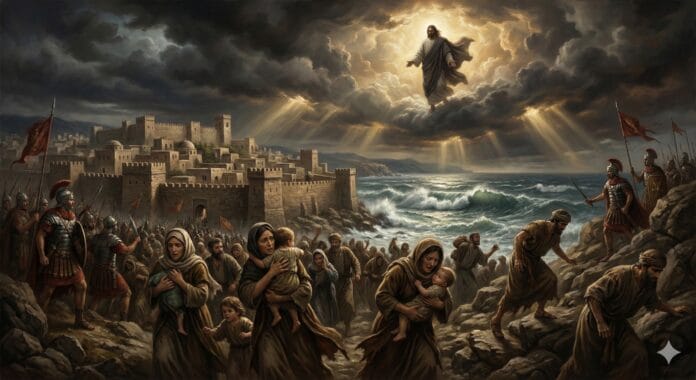
At that time, Jesus said to his disciples:
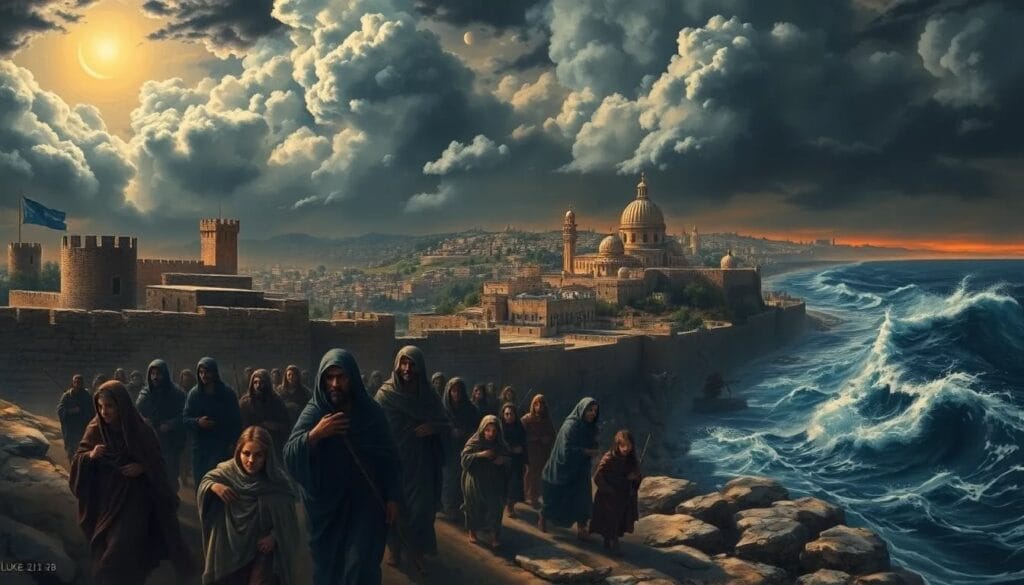
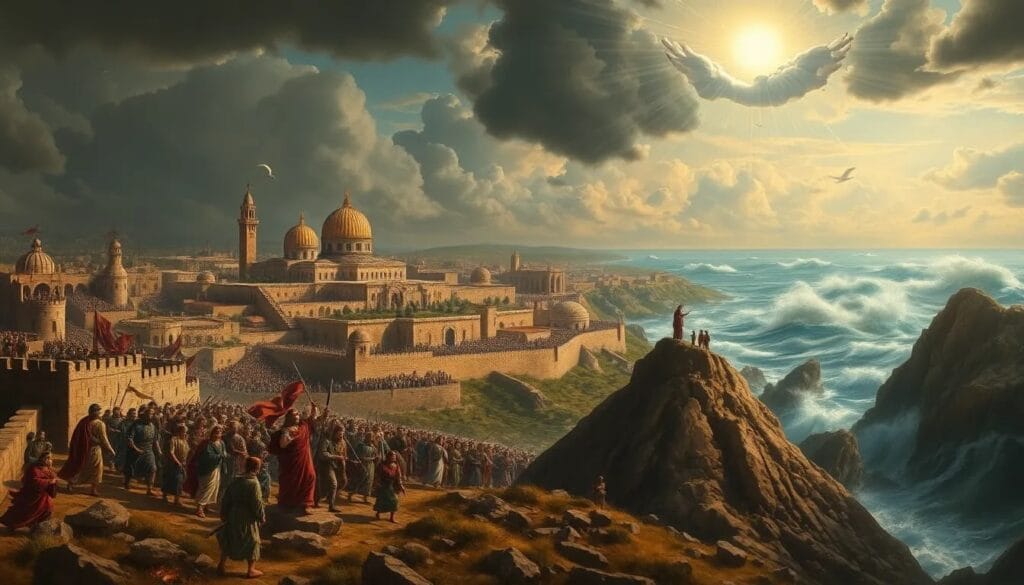
«When you see Jerusalem besieged by troops, then understand that its destruction is near. At that time, let those who are in Judea flee to the mountains; let those who are in the city leave it; let those who are in the country not return there, for these are the days of judgment in which all the Scriptures will be fulfilled.”.
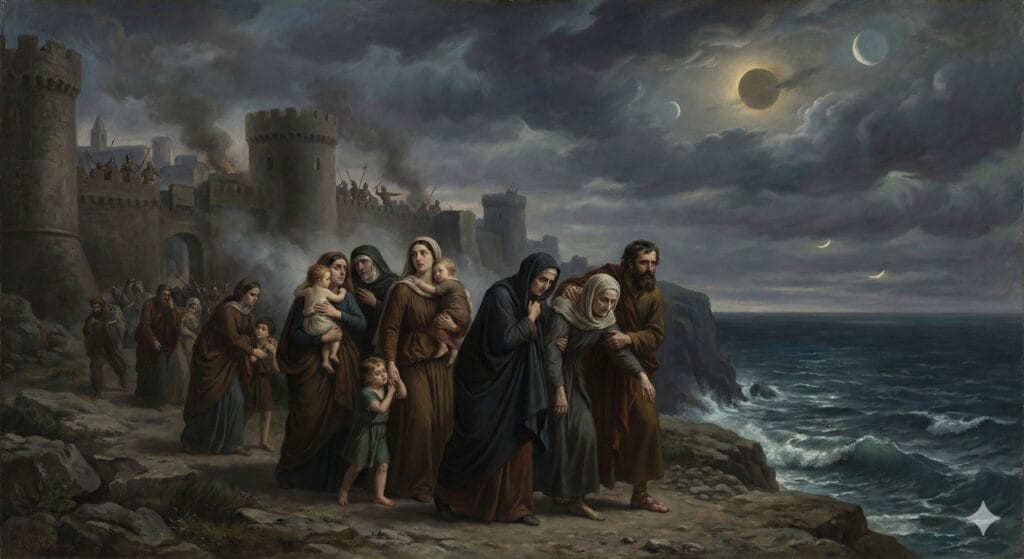
Woe to pregnant women and nursing mothers in those days, for great distress will fall upon the land, and terrible fury against this people. They will perish by the sword and be deported among all nations; Jerusalem will be trampled underfoot by foreigners until their time is fulfilled.
Signs will appear in the sun, moon, and stars. On Earth, people will be terrified and bewildered by the roar of the ocean and the waves. Humanity will faint with fear, awaiting what is to come upon the world, for the celestial forces will be shaken.
Then they will see the Son of Man coming in a cloud, with power and great glory.
When these things begin to happen, stand up straight and lift up your heads, for your deliverance is near.»
Understanding and living the prophecy of Jerusalem trampled by the pagans: a theological and practical guide for today
Explore the passage of Luke 21, 20-28 to draw meaning, hope and concrete applications in the light of the Christian faith.
This text offers an in-depth reading of the Gospel of Luke 21Chapters 20-28, where Jesus announces the devastation of Jerusalem and the coming of the Son of Man. Intended for believers seeking to understand this biblical passage in its theological depth and its implications for daily life, it combines scriptural analysis, theological perspectives, spiritual reflections, and practical advice. The goal is to support each disciple in their faith as they face trials and divine promises.
Dive into the historical and scriptural context — Clear analysis of the message and symbols — Deployment of spiritual, eschatological and practical dimensions — Concrete applications in personal, community and ecclesial life — Resonances in the Christian tradition — Guide for meditation — Responses to contemporary challenges — Liturgical prayer to nourish hope — Conclusion and implementation.
Jerusalem at the heart of the Salvationist prophecy
In this passage of the’Gospel according to Saint Luke, In this passage, Jesus addresses his disciples, announcing difficult times for the holy city. Jerusalem, symbol of the chosen people and the sanctuary, will be surrounded by enemy armies and trampled by pagans until their time is fulfilled. This text is situated within an apocalyptic and eschatological context (end times) characteristic of Jesus' teachings as recorded in the Gospels. Synoptic Gospels. Historically, it echoes the destruction of Jerusalem by the Romans in 70 AD, a catastrophe that was a true shock to the nascent Christian community. Theologically, this passage illustrates the tension between judgment, exile, and the final promise of redemption. Jesus calls for vigilance and hope despite the signs of cosmic and human chaos. The text is at once a warning, a consolation, and an announcement of the glorious coming of the Son of Man, messianic and redeemer. This proclamation resonates through the centuries as a call to perseverance and active faith, especially in times of trial.
The fulfillment of Scripture and its prophetic scope
The central idea of this passage is twofold: first, the certainty of the fulfillment of God's plan, even through suffering and destruction; second, the announcement of imminent redemption, the source of hope. Jerusalem trampled underfoot by the pagans is not a final curse but a painful stage in God's plan, in accordance with "all Scripture," which foretells a period of judgment before restoration. Jesus specifies the conditions for survival (fleeing to the mountains), which underscores the concrete and urgent nature of the message. The signs "in the sun, moon, and stars" are classic biblical images announcing a cosmic and spiritual upheaval. The arrival of the Son of Man "in a cloud, with power and great glory" concludes this prophecy, assuring a definitive victory. The call to lift up one's head is thus a command to live in hope and trust, even when the world seems to be collapsing. This analysis reveals a theology of history where God ultimately governs through his justice and mercy, inviting the believer not to give in to fear but to actively prepare for salvation.
Divine judgment and the suffering of believers
Jerusalem, a symbol of Israel and the Church, is the scene of a harsh judgment. The predicted calamity particularly affects the most vulnerable (pregnant women, infants). This suffering is neither gratuitous nor eternal, but rather corresponds to a purification. Biblical theology teaches that God allows trials to lead to conversion and restoration. This theme invites the believer to understand that loyalty Turning to God sometimes involves going through periods of adversity, but always relying on the divine promise of justice and deliverance.
Cosmic sovereignty and eschatological hope
The cosmic signs announce that human history is integrated into the larger divine plan. The "cloud" and the "power" of the Son of Man recall his divinity and his dominating role over the universe. Eschatological hope is fundamental here: turmoil and fear are only temporary, for the final reign of God is established. This grandiose dimension invites a bold faith, one that transcends mere material survival and focuses on eternal salvation.
The active responsibility of disciples towards the future
Jesus does not leave his disciples passive. He urges them to "stand up and lift up their heads," a posture of attentiveness, courage, and trust. This entails an ethical and spiritual responsibility: to be vigilant, to act accordingly. love and justice, bearing witness to hope, even in distress. Christian life is therefore built both on eschatological faith and on concrete daily commitment, making the expectation of the Kingdom a driving force for transforming the present.
Practical implications in Christian life
- On a personal level: to live through trials with faith, without giving in to fear, seeking to grow in hope and prayer.
- Within the ecclesial community: to encourage solidarity, especially towards the most vulnerable, and to cultivate unity in anticipation of Christ's return.
- Within the world: to bear witness to the Gospel message, to promote justice and peace, by challenging the logic of violence and oppression.
- For pastoral care: to train believers in a sound eschatological doctrine, helping to integrate difficulties within a framework of faith that is soothing and promising for the future.
These points reveal that this prophetic word is very much alive and relevant, nourishing the Christian journey in a world often fraught with uncertainties and crises.
Traditional resonances and theological scope
This prophecy is part of a rich biblical and Christian tradition, particularly in dialogue with:
- The Old Testament: the oracles about Jerusalem, the concept of captivity and restoration (example: Jeremiah, Ezekiel).
- The New Testament: Johannine eschatology (Apocalypse), and the Christian doctrine of the Last Judgment.
- The Church Fathers and the liturgy, who have always interpreted these images as a call to vigilance, conversion and active hope.
Theologically, this text illustrates the unity of the divine plan between justice and mercy, judgment and redemption, providing a scriptural foundation for the deepest Christian hopes. Its study enriches faith and illuminates the contemporary spiritual experience of troubled times.
Three-step meditations
- Read and reread Luke 21, 20-28 in silence, focusing on the last verse of hope.
- To reflect on one's own "mountains" to which to flee spiritually in times of crisis (prayer, speech, community).
- Write in a notebook what "holding your head high" means to you in the face of adversity, and what concrete action this invites you to take today.
This simple meditation allows one to personally integrate Jesus' active message of hope, linking the biblical call to one's own spiritual life.
What does this text confront us with today?
The passage of Luke 21Verses 20-28 resonate particularly strongly in the face of contemporary crises—wars, persecution, and ecological and social upheaval. They invite us to confront fear and discouragement without closing ourselves off to profound spiritual meaning. The challenge is not to interpret prophecy as inevitability or an anxiety-inducing prediction, but as a space for clear-sighted vigilance and a contrary hope. The temptation may be disengagement or naive activism. The biblical response is a posture of active waiting: vigilance, prayer, commitment, and resistance in faith. Furthermore, the passage underscores the need to acknowledge the real suffering of the most vulnerable and to demonstrate concrete solidarity. Biblical spirituality calls us to combine faith and action, realism and hope.
Prayer to nourish hope
Lord Jesus, Son of Man,
You who announced the distress upon Jerusalem,
In these trying times, when so many are faltering,
Give us the strength to hold our heads high, to stand firm.
May your word be our light in the darkness
May your glorious return be our living hope,
Make us courageous witnesses of your peace.
And guide our steps towards your justice and your mercy.
Protect the weak, comfort the afflicted,
Transform our fears into renewed faith,
And lead us, despite everything, to eternal redemption.
Hallelujah, Hallelujah,
Amen.
Conclusion
This passage from Luke 21Chapters 20-28 invite us to a reading that goes beyond the mere prediction of historical disaster to embrace a profound theological vision of time: that of a God who governs history with justice, mercy, and promise. It calls believers to a hopeful vigilance and responsible action. In these troubled times, this text remains a sure guide, placing faith at the heart of the active expectation of redemption. To become disciples once again, standing upright, looking toward heaven, is to position ourselves in the present as builders of the coming Kingdom.
Practical
- Set aside time each day for meditative reading. Luke 21, 20-28.
- Identify the current signs of the "times fulfilled" without giving in to fear.
- Cultivating communal prayer for peace and justice.
- To provide concrete support to those who are experiencing persecution or distress.
- To practice spiritual vigilance by strengthening one's trust in God.
- To bear witness to Christian hope in words and deeds.
- Integrating the eschatological dimension into one's life without fatalism.
References
- Gospel according to Saint Luke, chapter 21, verses 20-28.
- Michael Lawrence, A Practical Guide to Biblical Theology, 2022.
- Bible Institute, articles and resources on biblical interpretation.
- Writings of the Church Fathers on eschatology (e.g. Augustine, John Chrysostom).
- Catholic and liturgical theological encyclopedia.
- Contemporary resources for biblical and pastoral exegesis (Protestant Institute of Theology).