













Gospel of Jesus Christ according to Saint Luke
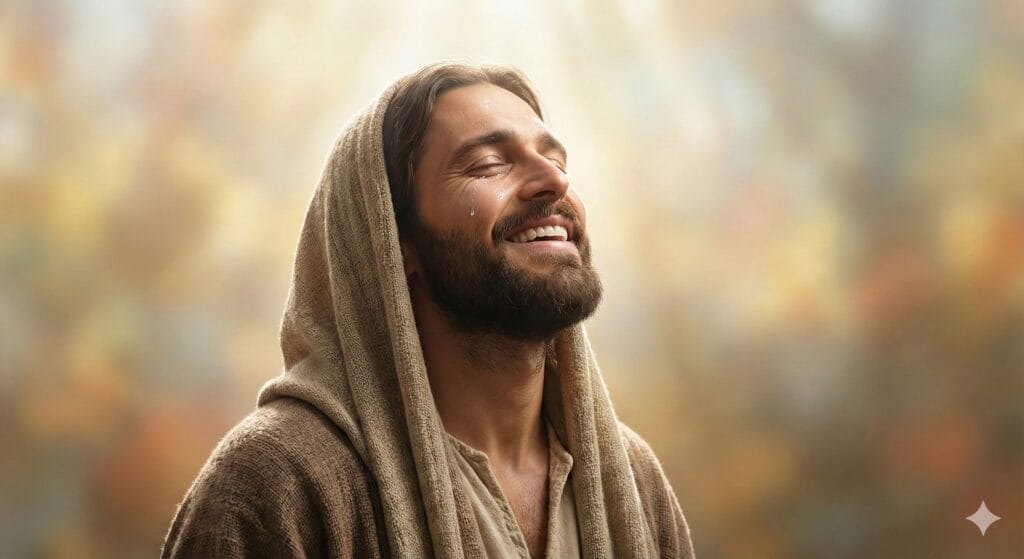
At that very moment, Jesus, filled with joy by the Holy Spirit, said: «Father, Lord of heaven and earth, I thank you that you have hidden these things from the wise and learned, and revealed them to the humble. Yes, Father, for this is what you were pleased to do. All things have been entrusted to me by my Father. No one knows who the Son is except the Father, and no one knows who the Father is except the Son and those to whom the Son chooses to reveal him.»
Then he turned to his disciples and said to them privately, «Blessed are the eyes that behold what you behold! For I tell you, many prophets and kings longed to see what you see, but did not see it, and to hear what you hear, but did not hear it.»
Rediscovering the joy of God by becoming small: when humility opens the doors of the Kingdom
A meditation on Luke 10, 21-24 where Jesus reveals to us that true wisdom comes through self-denial and simplicity of heart.
In a world obsessed with performance and expertise, Jesus surprises us by exulting in joy for a disconcerting reason: what the wise do not understand, the little ones grasp. This passage from the Gospel of Luke invites us to a radical reversal of our values. Far from being a condemnation of intelligence, it is an invitation to discover a deeper knowledge, the kind that comes from...’humility and the openness of the heart. You who seek to encounter God authentically, this text concerns you directly.
We will first explore the immediate context of this revelation by Jesus after the return of the seventy-two disciples. Then we will analyze the Trinitarian structure of this prayer and its connection to the revelation. We will develop three main points: joy In the Spirit, we will explore the paradox of hidden and revealed wisdom, and the blessedness of the witnesses of the Kingdom. Finally, we will see how to live this spirituality of humility concretely in our daily lives, before concluding with a prayer and some practical suggestions.
The triumphant return that provokes divine exultation
The passage of Luke 10, Chapters 21-24 fall within a pivotal moment in Jesus' ministry. Just before this scene, the seventy-two disciples return from their mission, brimming with enthusiasm. They have cast out demons, healed the sick, and proclaimed the Kingdom. Their success amazes even them. "Lord, even the demons submit to us in your name!" they exclaim with almost childlike joy.
Jesus acknowledges their wonder but immediately sets the record straight. He reminds them that he saw Satan fall like lightning from heaven, confirming that their mission is indeed part of the victory over evil. But he adds a crucial nuance: «Do not rejoice that the spirits submit to you, but rejoice that your names are written in heaven.» True joy does not come from spectacular successes, but from belonging to God.
It is precisely at this moment that Luke uses an expression unique in his entire Gospel: Jesus «rejoiced in the Holy Spirit.» This Greek verb, «agalliaomai,» expresses a transport of jubilation, an overflowing joy that seizes the whole being. The text insists that this joy is brought about «in» or «within» the Holy Spirit, highlighting its Trinitarian dimension. It is not mere human satisfaction, but a participation in joy divine herself.
This joy of Jesus contrasts sharply with the general atmosphere of his ministry at this stage. Shortly before, he had delivered harsh rebukes against the towns that had rejected his message. He spoke of Chorazin, Bethsaida, and Capernaum with a sorrow tinged with judgment. But now, suddenly, amidst these rejections, something sparks an explosion of joy within him. This something is precisely the receptiveness of the "little ones" to the revelation.
The broader context of Luke reminds us that Jesus is on his way to Jerusalem, on his journey toward the Passion. The evangelist structures his narrative around this great journey, which occupies nearly ten chapters. In this context of growing tension, this scene of Trinitarian joy becomes all the more significant. It shows us that at the very heart of Christ's painful mission, joy The divine remains present and accessible.
The Trinitarian structure of a revelatory prayer
An analysis of this passage reveals a remarkably dense theological architecture. In just a few verses, Luke offers us a concentrated dose of Christology, pneumatology, and Trinitarian theology. Let us begin by observing the relational dynamic that structures this prayer.
Jesus addresses the Father with a dual title: «Father, Lord of heaven and earth.» This combination unites filial intimacy with the recognition of absolute sovereignty. The word «Father» evokes the unique relationship Jesus has with God, this mutual understanding that he will explain shortly. But «Lord of heaven and earth» places this intimacy within a cosmic framework: the Father is not only «my» Father, he is the Creator and Master of all reality.
The content of the thanksgiving focuses on a paradox: «What you have hidden from the wise and learned, you have revealed to little children.» The verbs «to hide» (apokryptô) and «to reveal» (apokalyptô) are built on the same root. These are not two opposing actions but two facets of the same reality. God is not actively concealing something from the wise to punish them. Rather, the posture of the wise, their intellectual self-sufficiency, makes it impossible for them to receive what is given only in the’humility.
The "wise and learned" (sophoi kai synetoi) refer to those who have mastered systems of thought, experts in the Law, and scholars. The "little ones" (nèpioi) are literally infants, those who cannot yet speak. By extension, they are the simple, the ignorant according to worldly standards, those who cannot rely on any particular skills.
Jesus adds an essential validation: «Yes, Father, this is what you so willed.» This statement confirms that the paradox is not an accident or a secondary consolation. It is the modus operandi willed by God himself. The term «benevolence» (eudokia) expresses divine good pleasure, his sovereign and loving will. God is not compelled to this mode of revelation; he chooses it because it corresponds to his nature.
The second part of the discourse concerns the mutual understanding between the Father and the Son. «All things have been handed over to me by my Father.» This «all» (panta) is universal: authority, revelation, mission, identity. Jesus possesses nothing of himself; everything comes to him from the Father. But this dependence is precisely what grounds his absolute authority.
This is followed by the affirmation of mutual knowledge: «No one knows who the Son is except the Father; and no one knows who the Father is except the Son and those to whom the Son chooses to reveal him.» This knowledge is not merely intellectual information. The verb «to know» (ginôskô) implies an intimate experience, a communion of being. The Father and the Son know each other from within, in a total transparency that excludes any third party.
But Jesus immediately adds an opening: «and to whomever the Son chooses to reveal him.» The exclusivity of the Father-Son relationship is not closed in on itself. The Son chooses to share this knowledge with whomever he wills. This sharing is not a dilution of Trinitarian intimacy but its expansion. The disciples are invited to enter into the very movement of love between the Father and the Son.
Joy in the Spirit as a divine signature
The first dimension that deserves our attention is this joy of Jesus "through the action of the Holy Spirit." This detail from Luke is not a pious remark. It introduces us to the heart of the Trinitarian mystery and reveals something essential about the nature of divine life.
In Christian theology, the Holy Spirit is often described as the bond of love between the Father and the Son, as their mutual joy personified. When Jesus exults "in" the Spirit, he visibly manifests the inner life of the Trinity. This joy is not a passing emotion brought about by an external event. It is joy God's eternal power shines through in the humanity of Jesus.
Let's think for a moment about what this means in concrete terms. Jesus, as a man, experiences human emotions. He weeps over Jerusalem, he is irritated with the merchants in the Temple, he feels sorrow in Gethsemane. But here, his human joy is completely unified with joy divine of the Spirit. There are not two juxtaposed joys, but a single two-dimensional reality. The humanity of Jesus becomes the place where joy God makes himself visible and tangible.
This joy in the Spirit has a specific purpose: revelation to the humble. It is not just anything that provokes Jesus' exultation. It is specifically the fact that ordinary people, without prestige or particular skill, have access to the mystery of the Kingdom. Why does this reality evoke such divine joy? Because it manifests the very nature of God: a God who gives himself freely, who is not earned, who prefers the poor and the little ones.
Imagine the scene. Jesus has just listened to the report of the seventy-two. These are ordinary people, not scribes or teachers of the Law. Some may be fishermen, others artisans or farmers. They have just witnessed extraordinary things: healings, deliverances, conversions. But the most extraordinary thing is that they themselves have understood something that specialists cannot grasp. They have "seen" the Kingdom in action.
This joy of Jesus has a prophetic dimension. It anticipates joy Pascale, that of the resurrection. It also foreshadows joy from the early Church which would discover that the Gospel was spread not by the elites but by the slaves, women, Foreigners, all those without social capital. God's missionary strategy goes through the "least," and this brings about the exultation of Christ in the Spirit.
For us today, this dimension of joy in the Spirit should prompt us to examine our spiritual lives. Do we experience this joy as the hallmark of our union with God? Or does our relationship with God remain trapped in duty, effort, and performance? Joy The Spirit is not an optional bonus of the Christian life; it is its beating heart. Without it, we risk living a religion of obligations rather than a relationship of love.
This joy also has a community dimension. Jesus rejoices because his disciples have understood. His joy comes from what happens to others. He doesn't keep the revelation to himself; he rejoices to see it shared. This is a model for all authentic spiritual relationships: true joy is not possessive but expansive. We rejoice that others grow, understand, and flourish in faith.
Finally, let us note that this Trinitarian joy is manifested at the very moment when Jesus prays. Prayer is not merely asceticism or discipline; it is the realm of exultation. To pray is to enter into the very movement of divine life, to allow the Spirit to draw us into the dance between the Father and the Son. When our prayer becomes routine or tedious, perhaps we have forgotten this dimension of joy that is its lifeblood.
The reversal of values: wise men confused, enlightened children
The second major theme of this passage concerns the paradox of revelation. Jesus states it bluntly: what is hidden from the wise and learned is revealed to little children. This statement deserves careful consideration because it touches the very heart of our relationship to knowledge and truth.
Let's begin by clearing up a common misunderstanding. Jesus does not condemn intelligence in itself. He does not praise ignorance or obscurantism. Many of his disciples were educated, Paul was a brilliant intellectual, and the history of the Church is replete with theologians and thinkers. What Jesus criticizes is a certain intellectual stance: the one that believes conceptual mastery equates to true knowledge, the one that thinks God can be grasped through rational effort alone.
The "wise and learned" represent those who rely on their own abilities to access truth. They have studied, accumulated knowledge, and developed explanatory systems. In the Jewish context of the first century, these were the scribes, Pharisees, and doctors of the Law who spent their lives scrutinizing the Scriptures. Their problem was not their erudition but their self-sufficiency. They thought they possessed the keys to understanding and failed to realize that the true key was...«humility receptive.
Conversely, the "very young" are those who have nothing to offer. Their very ignorance becomes an opportunity. Because they cannot rely on their intellectual merits, they are available to receive what is freely given. They resemble children who learn not through critical analysis but through trust and wonder.
This reversal reveals something fundamental about the nature of divine truth. God is not an object that can be mastered through study, a system that can be deciphered by intellect. He is a subject, a person, who freely reveals himself. He cannot be "grasped," only welcomed. And to welcome him, one must have empty hands and an open heart.
Let's take a concrete example. Imagine two people trying to understand love. The first reads psychology treatises, studies the neuroscience of attachment, and analyzes sociological data on couples. She accumulates an impressive knowledge of the mechanisms of love. The second has read nothing, but she allows herself to be loved and learns to love in return. She experiences vulnerability, selflessness, and communion firsthand. Who truly knows love? The second person's understanding, even if less articulated, is more genuine because it is lived from within.
The same is true with God. One can study theology, philosophy, and biblical exegesis for years and remain detached from the mystery. Or, with a simple and open heart, one can enter into a living relationship with God that transforms our entire existence. The first form of knowledge is not useless, but it only becomes fruitful if it is rooted in the second.
This paradox directly challenges our contemporary culture, obsessed as it is with expertise. We live in a society where a person's worth is measured by their degrees, skills, and ability to produce and perform. This logic also permeates our churches. How many communities value eloquent preachers, talented musicians, and efficient managers above all else, to the detriment of those who simply live the Gospel in quiet dignity?
Jesus' criterion overturns this hierarchy. What matters is not what we know or what we do, but our capacity to receive. The lowly are blessed not because they possess a particular virtue, but because their poverty it even creates the space for the reception of revelation.
This logic of reversal runs throughout the Gospel. The first will be last, whoever wants to save their life will lose it, one must become like children to enter the Kingdom. This is not a moral discourse on the virtues of the’humility, This is a description of spiritual reality. God works in this way: he gives himself to those who can offer him nothing in return, he reveals himself to those who do not claim to already know everything.
The beatitude of the witnesses of time fulfilled
The third major theme of our passage concerns the beatitude that Jesus proclaims over his disciples. After giving thanks to the Father, he turns to those around him and says, «Blessed are the eyes that see what you see!» This statement is not an anecdotal compliment; it is a revelation of the uniqueness of the present moment.
Jesus immediately places this beatitude in a historical perspective: «Many prophets and kings longed to see what you see, but did not see it, and to hear what you hear, but did not hear it.» The disciples are experiencing something that the greatest figures of the Old Testament ardently desired but could not attain. They are witnessing the fulfillment of the promises, the coming of the Kingdom, and the very presence of God among humankind.
What exactly do they see? They see Jesus, of course. But not just his physical appearance, which anyone could have passed in the streets of Galilee. They "see" in the biblical sense of the word: they perceive spiritually who he truly is. They recognize in this man the Son of God, the ultimate revelation of the Father, the awaited Messiah. This vision is not the fruit of their own perspicacity but the gift that Jesus bestows upon them by admitting them into the secret of his relationship with the Father.
They also hear what the ancients did not hear. Jesus' words are not simply wise teachings among others. They are the very words of God, spoken no longer through intermediaries but by the one who is the Word made flesh. When Jesus speaks of the Father, he is not reporting what someone else has told him; he is directly expressing his intimate knowledge of God.
This privileged situation of the disciples raises a question: in what way are we, living twenty centuries later, in a comparable position? We do not see Jesus with our physical eyes, we do not hear his audible voice. Yet, Christian tradition affirms that we, too, are recipients of this beatitude.
The answer lies in the nature of the vision Jesus speaks of. It is not sensory perception that matters first, but faith. Jesus' contemporaries who saw him without recognizing him were not "blessed." Only those who perceived his true identity were. And this perception of faith remains accessible today through the Holy Spirit, through Scripture., the sacraments, the life of the Church.
John goes further, writing: «Blessed are those who have not seen and yet have believed.» This is not a consolation for those who may have missed the good times. It is an affirmation that faith that does without the visible is even purer, more stripped down, and therefore closer to the true knowledge of God, who is spirit.
The beatitude proclaimed by Jesus also has a dimension of urgency. «Now» is the opportune time, «today» is the day of salvation. The disciples must not take lightly what is offered to them. They are experiencing a kairos, a unique moment in the history of salvation. This urgency concerns us as well. Every age is called to recognize the presence of Christ and to respond to it.
But there is more. Jesus said that prophets and kings longed to see this time. This longing was neither vain nor misguided. Abraham, Moses, David, Isaiah—all yearned for this fullness. Their faith was genuine, even if they saw only shadows and promises. We have access to the fulfilled reality, but we must remain aware that we are heirs to their expectation.
This perspective changes our relationship to the Old Testament. It is not an outdated or obsolete text, but the testimony of those who paved the way. When we read the Psalms, the prophecies, the accounts of the Exodus, we are not engaging in religious archaeology. We are entering into communion with those who hoped against all hope, who kept the promise alive throughout the ages.
To experience the spirituality of smallness in a concrete way
How can we translate this revelation about the revelation made to the little ones into our daily lives? It's not simply a doctrine to contemplate, but a path to follow. Let's explore the practical implications of this text in different spheres of our lives.
In our personal relationship with God, this passage first invites us to an honest examination. On what is our spiritual life based? On our efforts, our practices, our knowledge of Scripture? All of this is good and necessary, but if we come to believe that our worth before God depends on our religious performance, we are among the "wise" who do not understand. True prayer begins when we stand before God with empty hands, acknowledging that we possess nothing of our own.
In practical terms, this can mean daring to pray with simple words, without trying to impress God or ourselves with sophisticated formulations. Like a child telling their father about their day, we can simply share what's on our minds, our joys and sorrows, our questions and our misunderstandings. This simplicity is not a lack of respect but, on the contrary, a true expression of trust.
In our church life, this spirituality of littleness overturns our criteria for valuing others. Whom do we honor in our communities? Those who hold visible positions, who preach or lead? Or also those who pray in secret, who welcome discreetly, who visit? the sick without talking about it? Jesus reminds us that the "little ones" often have access to spiritual insights that those in positions of authority, caught up in their management concerns, may miss.
This does not mean despising institutional ministries, but recognizing that the Spirit blows where it wills. An old woman praying the rosary Every day, anyone can possess a deeper understanding of faith than a professor of theology. A child asking naive questions can reveal truths we have forgotten through over-sophistication.
On a professional and intellectual level, this perspective frees us from a certain idolatry of expertise. Our modern society tends to believe that only specialists can legitimately speak on a subject. When this logic is applied to the spiritual realm, it creates a caste of faith professionals who would monopolize access to God. Jesus reverses this logic: it is precisely by stepping out of the expert role that we become open to revelation.
In our approach to the Bible, this also changes our method. Serious study of the texts, using the tools of exegesis, is valuable. But it must remain at the service of humble and prayerful listening. It is better to read a verse with an open heart and find a word that transforms us than to read entire chapters with a critical mind that analyzes without engaging with the text.
Faced with the challenges of our time, this spirituality also provides us with resources. We live in a complex world where problems seem insoluble: ecological crisis, growing inequalities, social fragmentation. Faced with this, the temptation is to think that we must first understand everything in order to act. Yet Jesus tells us that we can act from a place of humility. Mother Teresa did not solve poverty global, but she was picking up the dying in the streets of Calcutta. This "small" act revealed God more than many development plans.
The echoes of this revelation in the Christian tradition
This theme of revelation to the little ones resonates powerfully throughout the history of Christian spirituality. The Church Fathers, mystics, and saints have constantly meditated on this paradox and drawn abundant fruits from it.
Saint Augustine, In his Confessions, John recounts his own journey, which perfectly illustrates Jesus's point. A brilliant intellectual, trained in rhetoric and philosophy, he initially sought truth through pure reason. His exploration of Manichaeism, then Neoplatonism, testifies to this quest for knowledge that could satisfy his mind. But it was ultimately in a garden, upon hearing a child's voice singing "Tolle, lege" ("Take and read"), that he opened himself to revelation. He embraced the Scriptures like a child, and his life was transformed.
Thérèse of Lisieux, a Doctor of the Church despite her young age and lack of theological studies, is the modern embodiment of this "little way." She understood that her very weakness was her strength. Unable to climb the ladder of perfection, she allowed herself to be carried by God like a child in its father's arms. Her doctrine of spiritual childhood is a living commentary on Luke 10, 21-24. She wrote: "To remain small is to recognize one's nothingness, to expect everything from God."«
Francis of Assisi also radically embodies this logic of reversal. The son of a wealthy merchant, he left everything to marry Lady Poverty. He called his brothers the "Minor Brothers," the "Little Brothers," rejecting all institutional grandeur. His simple preaching, his direct connection to creation, and his overflowing joy perfectly reflect the exultation of Jesus in the Spirit in the face of the revelation given to the humble.
The contemplative tradition, particularly among the Carthusians and Carmelites, developed a whole theology of "learned ignorance" inherited from Pseudo-Dionysius and Meister Eckhart. The idea is that the more one progresses in the knowledge of God, the more one realizes that He is unknowable. True mystical knowledge consists in accepting not knowing, in entering the "cloud of unknowing" where God allows Himself to be encountered beyond all concepts.
Saint John of the Cross, In The Ascent of Mount Carmel, he explains that to achieve union with God, one must strip oneself of all the ideas, images, and representations one might have of Him. Even the most accurate theological knowledge must be transcended in the face of pure faith. It is by becoming "nothing" that one can receive everything.
More recently, theologians such as Karl Rahner and Hans Urs von Balthasar have reflected on this mystery of revelation given in kenosis, in self-abasement. Balthasar particularly emphasizes that the cross of Christ, a moment of greatest apparent weakness, is the site of God's supreme revelation. Divine omnipotence is manifested in this assumed powerlessness.
The Council Vatican In his constitution on revelation (Dei Verbum), John II reminds us that God revealed himself progressively, adapting to humanity's capacity for understanding. This divine pedagogy culminates in Christ, who is himself the Revealer and the Revelation. And this revelation continues to be transmitted not through elitist channels but through the simple witness of believers.
In Orthodox spirituality, the notion of "apophatism" (negative theology) resonates deeply with our text. One cannot say what God is, only what he is not. This humble approach to the divine mystery keeps the mind in a state of smallness and wonder. Desert Fathers, With their brief and incisive words, they embody that simple wisdom that goes straight to the heart of the matter.
A path of meditation to become small
How can we concretely enter into this experience of revelation to children? Here is a multi-step meditation path that you can follow at your own pace.
Start by choosing a quiet moment, a place where you won't be disturbed. Read the passage slowly from Luke 10, Read lines 21-24 two or three times, letting the words resonate within you. Don't immediately try to understand intellectually; let the text sink into you.
Then take a moment to reflect on your own relationship with God. When do you feel closest to Him? Is it in moments of control, when everything is going well, when you are effective? Or rather in moments of vulnerability, failure, and acknowledgment of your limitations? Often, we discover that it is paradoxically in weakness that we have had the deepest encounters.
Next, identify the areas of your life where you operate as a "wise and knowledgeable" person. Where do you seek to control, to understand everything, to master everything? Perhaps in your professional life, in your relationships, or even in your religious practice? Name these areas of false self-importance without judging yourself, simply by becoming aware.
Then make a symbolic gesture of letting go. This can be very simple: open your hands, palms up, as a sign of availability. Or visualize yourself laying these burdens at the feet of Christ. The essential thing is to perform an act that signifies your desire to release.
Then ask for the grace to become small. Not in the sense of devaluing or despising yourself, but in the sense of rediscovering the capacity for wonder and receptiveness of a child. Pray in your own words or in the words of the psalmist: «Lord, my heart is not proud, nor my eyes haughty; I do not concern myself with great things or things too wonderful for me.» (Psalm 131)
Remain in silence for a moment, simply being open to God. Expect nothing spectacular. Revelation to the little ones is not necessarily accompanied by extraordinary phenomena. It is often a profound peace, a quiet certainty, a feeling of being loved unconditionally.
Conclude by rereading the beatitude one last time: «Blessed are the eyes that see what you see.» Acknowledge that now, at this very moment, you are the recipient of this word. You see Christ present in your life; you hear his voice in the Scriptures. Give thanks for this gift.
In the days that follow, regularly return to this attitude of humility. You can cultivate it through brief, spontaneous prayers throughout the day: "Lord, without you I can do nothing" or "Teach me to receive." Each time you find yourself functioning self-sufficiently, gently remind yourself that you are called to another path.

Contemporary challenges to the logic of smallness
Our era poses particular challenges to the spirituality of humility advocated by Jesus. It is important to identify them and respond to them with nuance.
The first challenge stems from the performance-driven culture that permeates even our churches. We measure the success of a community by its growth. digital, to the quality of its programs, to its social impact. None of this is bad in itself, but when these criteria become exclusive, we forget that God also works in the small, the hidden, the invisible. A community of three people who pray together with faith can have more spiritual fruitfulness than a spectacular but superficial megachurch.
The answer is not to despise excellence or growth, but to put them into perspective. We must learn to value even the subtle signs of God's presence. loyalty over time, through the depth of relationships and the slow but real transformation of hearts. These realities cannot be measured in numbers, but they constitute the true fabric of the Kingdom.
The second challenge stems from the hyper-intellectualization of certain Christian circles. Faced with secularization, some believe that faith must be defended primarily on intellectual grounds, through sophisticated philosophical or scientific arguments. This apologetic approach has its place, but it becomes problematic when it gives the impression that one must first have an education to believe.
The Gospel, on the contrary, affirms that an illiterate woman who loves God with all her heart has access to essential truth, even if she cannot explain the theology of the Incarnation. The danger of intellectualization is that it creates a secondhand faith, where one believes because one has found the arguments convincing, rather than a firsthand faith, born of a personal encounter with Christ.
A third challenge paradoxically arises from certain forms of spiritual movements that value immediate experience, intense emotional states, and spectacular manifestations of the Spirit. While claiming to be simple, these approaches can create a new form of performance: that of constantly seeking extraordinary experiences to prove that one is truly filled with the Spirit.
True humility, as expressed in the Gospel, also embraces spiritual dryness, periods of feeling detachment. It does not confuse God's presence with the intensity of our emotions. Saint Thérèse of Lisieux experienced long periods of spiritual aridity and temptations against her faith. It was precisely in this darkness that she lived her "little way" most profoundly, continuing to love without feeling anything.
A fourth, more subtle challenge arises from the recovery of the notion of’humility through a certain popular psychology. We sometimes hear that we must "accept ourselves as we are," "be authentic," with a discourse that can slip into complacency towards our flaws.«humility Christian faith is not a form of soft resignation, it is a lucidity that recognizes both our misery and our dignity as children of God.
Being small doesn't mean remaining small. It means accepting to start small, to receive everything as a gift, but then growing in love. Saint Paul says: «When I was a child, I spoke like a child, I thought like a child, I reasoned like a child. When I became a man, I put the ways of childhood behind me.» Evangelical smallness is a spiritual attitude, not an immaturity to be cultivated.
Finally, we must respond to those who would accuse this spirituality of being an "opium of the people," a way of keeping the oppressed in submission. If God prefers the poor And the poor, why change the structures of injustice? This objection misunderstands the profound dynamic of the Gospel message. Jesus values the poor not so that they remain so, but because their situation makes them available for the radical transformation of the Kingdom. The Magnificat of Married It celebrates a God who "has brought down the powerful from their thrones and lifted up the humble." This is a revolutionary program, not a conservative one.
A prayer of exultation and self-denial
Father, Lord of heaven and earth, I come before you with empty hands and an open heart. You know all that I have tried to build by my own strength, all the fortresses of knowledge and skill behind which I have sheltered myself. Today, I choose to step out of those defenses and stand before you in my poverty.
Teach me to be small, not through false modesty which would still be a form of pride, but through the joyful recognition of what I am: your creature, entirely dependent on you, and precisely in this dependence, called to communion with you.
I give you thanks for all those who have preceded me on this path of humility: Francis of Assisi who embraced poverty, Thérèse of Lisieux, who discovered the "little way," and so many anonymous people who lived the Gospel in secret, without fanfare or fuss. May they intercede for me so that I may follow in their footsteps.
Holy Spirit, who filled Jesus with joy, come into me and let that same joy spring forth. May I discover that true jubilation does not come from my successes or achievements, but from the pure grace of being loved by God, of knowing the Father through the Son, of being admitted into the secret of your Trinitarian life.
Deliver me from this contemporary obsession with understanding everything, mastering everything, controlling everything. Teach me to let go, to trust, to allow myself to be guided. When I don't understand your path, grant me the belief that you know where you are leading me. When my plans fail, help me embrace your plans, which are infinitely better.
I entrust to you especially those areas of my life where I still resist this logic of pettiness: my work where I seek recognition, my relationships where I want to be right, my religious practice where I can fall into routine or performance anxiety. Transform all of this by your grace.
Lord Jesus, you said that no one knows the Father except the Son and those to whom the Son chooses to reveal him. I pray you, reveal the Father to me. Let me know not ideas about God, but God himself. Draw me into that intimacy you have shared with him from all eternity. May I say "Abba" with the same filial trust as you.
And as you blessed your disciples by saying to them, «Blessed are the eyes that see what you see,» open my eyes so that I may recognize your presence in my life today. You are not a figure of the past studied in books. You are living, active, present here and now. Grant me to see you at work in the events of my day, in encounters, in surprises, and even in trials.
I also pray for all those who feel excluded, marginalized, despised because of their lack of education, their poverty social vulnerability, their weakness. May they discover that they are your privileged ones, that you have in store for them revelations denied to the proud. Grant them to hear this liberating word: "Come to me, all you who are weary and burdened, and I will give you rest."«
Father, may this prayer not remain confined to this moment but may it nourish my whole life. May I rejoice in the Spirit each day, discovering new facets of your love. May I grow not in self-sufficiency but in my capacity for wonder. May I become small enough to enter your Kingdom, which is already here, in our midst, hidden from the wise but revealed to simple hearts.
Through Jesus Christ our Lord, who lives and reigns with you in the unity of the Holy Spirit, now and forever. Amen.
An invitation to wonder
This passage from the Gospel of Luke confronts us with a crucial choice. We can continue to live according to the logic of accumulation and performance, seeking our worth in our achievements and skills. Or we can accept becoming humble, recognizing that true wisdom is a gift that can only be received with gratitude.
The paradox that Jesus reveals to us is not an intellectual puzzle to be solved, but a truth to be lived. God hides himself from the wise not out of whim, but because an attitude of self-sufficiency closes the door to revelation. He reveals himself to the humble because their poverty creates the space for welcome. This dynamic runs throughout the history of salvation and remains at work today.
Jesus' exultation in the Spirit shows us that this revelation is not sad or austere. It is an explosion of divine joy that springs forth when human beings enter into the true knowledge of God. This joy is accessible to each of us, whatever our situation. It does not depend on external circumstances but on an inner disposition: accepting to be loved freely, without any merit to prove.
The beatitude proclaimed over the disciples concerns us directly. We live after the resurrection, We have access to the sacraments, we can read the Scriptures, we are filled with the Holy Spirit. We are in a privileged position that our ancestors desired without realizing it. But we must still be aware of it and not squander this treasure through indifference or routine.
The path of humility is not reserved for a mystical elite. It is the only way for all who truly want to encounter God. It does not require extraordinary abilities; on the contrary. It simply requires relinquishing our pretensions, accepting our poverty, and to let us be guided with confidence.
In a world that values autonomy, control, and visible success, choosing evangelical humility is a profoundly countercultural act. It is also profoundly liberating. We no longer have to exhaust ourselves proving our worth or earning love. We can simply be, receive, and radiate what we have received.
May this meditation encourage you to take the next step. Right where you are, with who you are, accept becoming small before God. Not to remain so, but to be lifted up by Him; not to be crushed, but to be filled. Divine revelation awaits you, not at the end of a long journey of acquiring knowledge, but in the simple openness of your heart.
Practices for living out evangelical humility
Cultivate a moment of silence each day where you simply stand before God without an agenda or any particular request, just open to what He wants to reveal to you.
Identify one area of your life where you function as an "expert" and deliberately choose to adopt a humble learning attitude in it, accepting that you don't know everything.
Read slowly a short passage from the Gospel each day, not to study it but to let it touch you personally, like a word addressed to you today.
Practice gratitude by noting down three things received freely each evening during your day, thus cultivating the awareness that everything is a gift.
Seek the company of people who are "small" according to worldly standards but spiritually rich, listen to their wisdom and let yourself be taught by them.
Regularly practice intercessory prayer for those who are despised or excluded, asking that the revelation of God's love be given to them in abundance.
Gradually simplify your spiritual life by eliminating unnecessary complications to keep what is essential: the loving relationship with God and neighbor.
References
L'Gospel according to Saint Luke, chapter 10, verses 21 to 24, in its immediate context of the return of the seventy-two disciples and in connection with Jesus' ascent to Jerusalem.
The Magnificat of Married (Luke 1, 46-55) which develops the theme of the reversal brought about by God, raising up the humble and bringing down the powerful.
The Beatitudes (Matthew 5, 1-12) who proclaim blessed the poor in spirit, the meek, those who hunger and thirst for righteousness, establishing the program of the Kingdom.
Saint Augustine, Confessions, Book VIII, account of his conversion by the voice of a child, illustrating how divine grace comes to shake up intellectual certainties.
Saint Thérèse of Lisieux, Story of a Soul, development of the doctrine of the "little way" of spiritual childhood as a privileged path to holiness.
Karl Rahner, The Fundamental Course on Faith, a reflection on divine revelation which is given in history and adapts itself to the receptive capacity of humanity.
Constitution Dei Verbum of the Council Vatican II, on divine revelation and its transmission in the Church through Tradition and Scripture.
John of the Cross, The Ascent of Mount Carmel, a treatise on the necessity of spiritual stripping away and the "night" to achieve union with God.