













Gospel of Jesus Christ according to Saint Luke
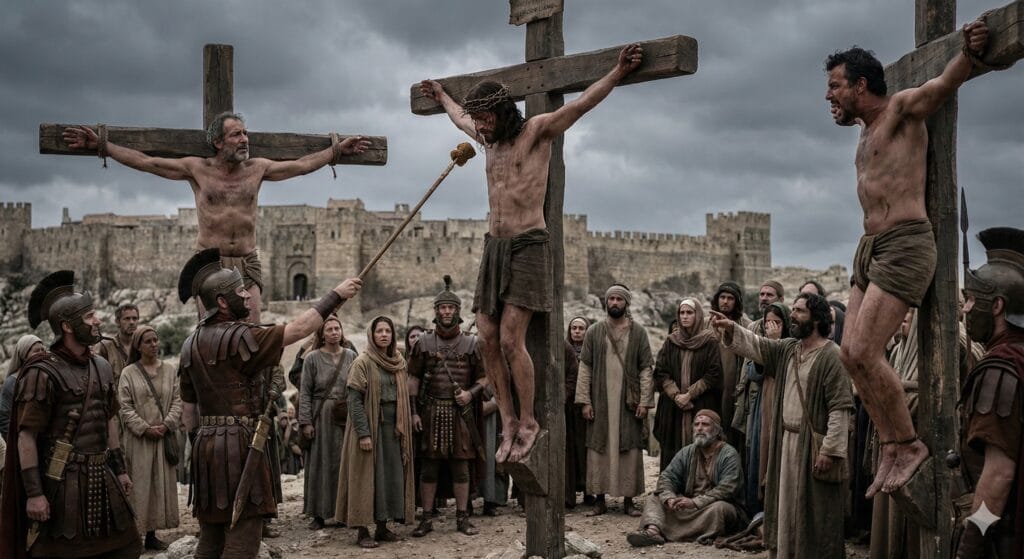
At that time, Jesus had just been crucified, and the crowd stood watching. The rulers mocked Jesus, saying, «He saved others; let him save himself, if he is the Christ of God, the Chosen One!»
The soldiers also mocked him; they approached and offered him sour wine, saying, "If you are the king of the Jews, save yourself!"«
An inscription was also placed above him: "This is the King of the Jews."«
One of the criminals hanging from the cross insulted him: "Aren't you the Christ? Save yourself, and us with you!"«
But the other rebuked him severely: «Do you have no fear of God? You too are condemned! As for us, we deserve it: we receive what our deeds deserve. But this man has done nothing wrong.»
Then he added, "Jesus, remember me when you enter your Kingdom."«
Jesus answered him, «Truly I tell you, today you will be with me in Paradise.»
Jesus, remember me: understanding the grace of the Kingdom on the cross
Exploring hope, mercy and faith in the word of Christ at the threshold of the heavenly Kingdom.
In this poignant statement by the’Gospel according to Saint Luke, Herein lies the central mystery of Christian salvation: the encounter between the repentant sinner and the infinite grace of Jesus on the cross. This text is addressed to every believer seeking comfort, hope, and an understanding of the Kingdom of God. The biblical analysis offered here will illuminate the dynamics of faith, forgiveness, and the invitation to Paradise, providing spiritual and practical guidance for daily life.
- Context and source text: setting the scene and the importance of the passage
- Theological analysis: the promise of the Kingdom in human finitude
- Thematic focus: faith, mercy, and divine justice
- Practical applications: personal, community, and pastoral life
- Traditional resonances: patristics and spiritual theology
- Meditation prompt: the journey towards faithful conversion
- Contemporary challenges: responding to doubt and suffering
- Final liturgical prayer: encounter with the King of the Jews
Context
The account in Luke 23:35-43 takes place during the Passion of Christ, immediately after his crucifixion. Jesus, surrounded by a crowd reacting with hostility, mockery, and curiosity, is confronted by two criminals crucified beside him. While the crowd and the soldiers ridicule him, challenging him to save himself if he is truly the Messiah, one of the criminals repents and humbly appeals to him: «Jesus, remember me when you come into your kingdom.» This brief but exceptionally powerful theological plea elicits Jesus« saving response: »Today you will be with me in Paradise.”.
This passage is unique in that it reveals the universality of the salvation offered by Christ, based not on works, but on trust in his person. It is situated in a context where Jesus is publicly rejected, highlighting the tension between the earthly and heavenly kingdoms. The ironic inscription "King of the Jews" here becomes a declaration of divine kingship, clarifying the profound meaning of the Kingdom to which it alludes. The repentant criminal thus becomes a model for every believer confronted with the limitations of their human condition and with divine grace.
The promise of the Kingdom at the threshold of death
The central idea of this text is that divine grace transcends all barriers, including death and sin. Jesus immediately responds to the criminal's request, announcing a presence in Paradise from that very day. This promise opens a revolutionary perspective: the Kingdom of God is not a distant place reserved for the righteous, but a present gift accessible through faith.
The contrast between the two wrongdoers illustrates divine justice versus mercy. One acknowledges his guilt and the justice of his condemnation, while the other rejects all responsibility. Sincere repentance becomes the key to entering the Kingdom. Jesus embodies the perfect mediation between justice and mercy, offering eternal life not through human merit, but through trust in him alone.
This passage also highlights the theme of "today": this precise moment of the Passion becomes the decisive instant of salvation, defying human chronology. It demonstrates that an intimate encounter with God is always possible, even in the most extreme circumstances.
The faith that saves
The criminal's request expresses a simple and genuine faith. It is not a prophecy or a grand speech, but a humble request. The Bible reaffirms that it is faith that justifies, not works (Romans 3,28). This faith is an act of recognition that Jesus is Messiah and King, and of total surrender to his mercy. It is a model for all spiritual journeys, reminding us that holiness often begins with a naive but profound trust.
Divine mercy manifested in the cross
Jesus, although unjustly condemned, reveals the nature of God through his compassionate response. Forgiveness Offering forgiveness to the wrongdoer, despite his past sins, underscores God's vocation to unconditional forgiveness. This is an invitation to renew our understanding of justice, which is not limited to retribution, but flourishes in reconciliation and restoration.
Justice and human responsibility
The text clearly distinguishes between acknowledging wrongdoing and accepting the consequences. The wrongdoer's repentance includes this act of responsibility, which prepares them for mercy. This reminds us of the biblical balance between grace and justice. Grace does not eliminate the awareness of sin, but transforms it into a path of conversion.

Practical applications
Personal life
This passage invites every believer to a renewed trust in mercy of God, particularly in moments of doubt, weakness, or moral failure. He calls for an attitude of’humility, acknowledging one's own limitations and an act of faith towards Christ, the only Mediator.
Community life
Within the Church and the community, this message encourages us to welcome everyone, even the most distant or sinful, with active mercy. The simple yet vibrant witness of faith of the wrongdoer should inspire a non-judgmental welcome, founded on the conviction that grace can work in all.
Pastoral Ministry
For pastors and spiritual directors, this story teaches the importance of words of hope and absolution, especially when faced with people at the end of their lives or suffering greatly. It invites us to proclaim the immediate presence of the Kingdom to those who turn to God.
Traditional resonances
The Church Fathers, like Saint Augustine Saint John Chrysostom and St. John Chrysostom emphasize the redemptive power of Jesus' words on the cross. Christian liturgical tradition rejects definitive condemnation for the repentant sinner, as illustrated here. The dialogue between justice and mercy is at the heart of Christian doctrine, based on this text, which reveals patience God's infinite.
In contemporary theology, this passage is often cited to affirm Christian hope in the face of death and to encourage a pastoral approach of merciful accompaniment. It recalls the truth of the resurrection and of eternal life, promoted from the Cross.
Meditation track
- Slowly reread the wrongdoer's plea, absorbing its meaning. humility.
- Meditate on Jesus' promise: "Today you will be with me in Paradise.".
- Identify a situation in your life where it is difficult to maintain trust in God.
- To create a personal prayer of grace, inspired by the wrongdoer.
- To commit to bearing witness to this hope around you, even in times of hardship.
Current challenges
The passage poses several theological and pastoral challenges in a world often marked by skepticism: how can one believe in immediate salvation when death is often seen as an impossibility of change? How can one reconcile divine justice and mercy in the face of reprehensible acts?
The answer lies in a dynamic faith, capable of integrating the acceptance of sin with the divine promise. This implies pastoral work that does not judge, but invites immediate conversion. It is also necessary to forcefully reaffirm Christian hope against the nihilism contemporary, by proposing an incarnate and hopeful theology.
Prayer
Lord Jesus, King of the Jews, you who in the agony of the cross answered the request of the evildoer, remember us also in your Kingdom.
Grant us the grace of a simple and profound faith, capable of surrendering to your mercy.
In our doubts and weaknesses, come and strengthen us so that, living here below, we may walk towards eternal life.
Inspire our hearts to welcome justice into the’humility and to practice mercy with courage.
May we at every moment hear your voice transforming us from sinners into children of the Father.
Through Jesus Christ, our Savior and Lord. Amen.
Conclusion
This passage from Luke 23:35-43 is an inexhaustible invitation to trust in mercy divine, even in the final hour. He illuminates the path to the Kingdom, accessible through faith and repentance, defying all fatalism. May each of us draw strength and hope from it to live and bear witness in the light of love redeemer of Christ.
Practical
- Read the plea of the evildoer in the Bible daily.
- Practicing welcoming others without judgment, according to mercy of Christ.
- Cultivate a simple faith, through short prayers of trust.
- Participate regularly in times of confession and reconciliation.
- Helping people at the end of their lives to find peace and hope.
- To promote a pastoral approach of merciful accompaniment within the community.
- Meditating on the kingship of Christ in the weekly liturgy.
References
- Gospel according to Saint Luke 23, 35-43, Jerusalem Bible
- Augustine of HippoSermons on the Passion of Christ
- John Chrysostom, Homilies on the Cross
- Michael Lawrence, A Practical Guide to Biblical Theology, 2022
- Magisterium documents on Mercy divine, Vatican II
- Theology of the Cross, Karl Barth
- Contemporary pastoral memoirs on end-of-life care