










Gospel of Jesus Christ according to Saint Luke
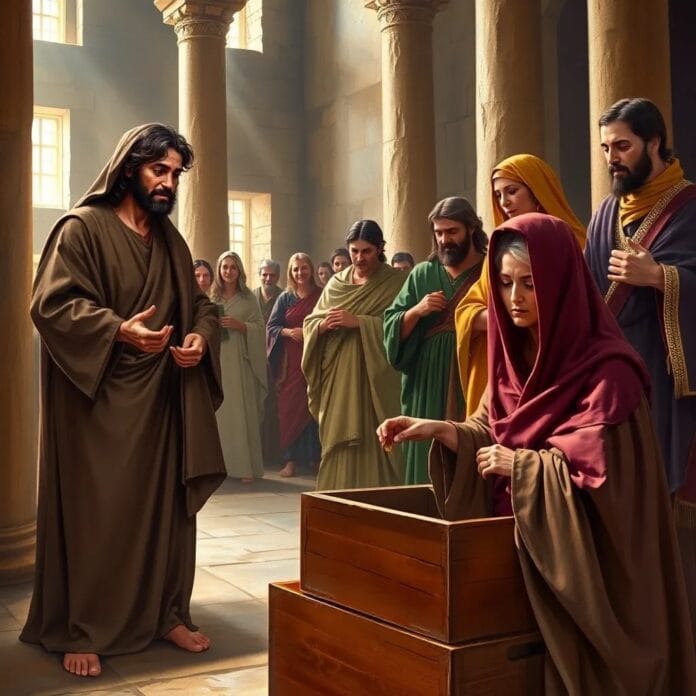
At that time, while Jesus was teaching in the Temple, he looked up and observed the wealthy people placing their gifts in the offering box. He also noticed a poor widow slipping in two small coins.
Then he declared, «Truly I tell you, this poor widow has put more into her offering than all the others. For all of them gave out of their abundance, but she gave out of her poverty She gave everything she owned to survive.»
Giving fully: understanding and living the gift of the poor widow according to Luke 21:1-4
To deepen the humble and radical gesture of offering in the Gospel in order to nourish faith, charity and spiritual life on a daily basis.
The episode of the poor widow who gives her two small coins in the Temple (Luke 21, (verses 1-4) is a powerful invitation to reflect on true giving. This text is particularly aimed at believers who are tempted to measure their giving by their abundance rather than by their faith and love. Through a nuanced theological and biblical reading, this article proposes an approach to integrating this attitude into all dimensions of life.
First, place the passage within its evangelical and liturgical context. Then analyze the profound meaning of this paradoxical gift. Three thematic axes further illuminate the nature of the gift according to Jesus: authenticity, gratuitousness, and poverty. Concrete applications in personal, community, and spiritual life follow, before exploring the resonance of this text within the Christian tradition. Finally, a practical meditation and a reflection on contemporary issues conclude the study, accompanied by a powerful liturgical prayer.
In the temple, a breathtaking gaze and a profound teaching
The Gospel of Luke 21, Revelation 1-4 takes place during the final days of Jesus' public ministry, as he teaches in the Temple in Jerusalem, the sacred site of Jewish worship. He observes how the wealthy deposit their offerings, taken from their surplus, into the Temple treasury, an expression of their ability to participate in divine service. Beside them, a destitute widow places two small coins, leptas, which symbolize the lowest currency of the time, equivalent to a few pennies. By proclaiming that she has given more than all the others, Jesus reveals a fundamental principle: the value of a gift does not depend on its quantity but on what it costs the giver, for this woman puts down "all she had to live on," thus expressing a radical act of giving.
This passage echoes other biblical texts that value poverty authentic and selfless offering, like the prophet Amos or the invitation to the generosity of the wise. The widow becomes an exemplary figure of active faith that gives even to the point of risking everything, in total trust in divine providence. This context also sheds light on the prophetic tone and the call for constant spiritual vigilance, in the perspective of the coming of the Son of Man, a major theme in Luke (Mt 24, 42a.44).
The authentic gift revealed by radical poverty
The central idea of this passage is that the greatness of a gift is not measured by its amount but by the inner attitude and sacrifice that underpin it. Jesus explicitly contrasts the gesture of the rich, who draw upon their surplus without deprivation, with that of the widow, who gives away all she possesses and thus places herself in a position of total dependence.
Poverty Here, it is not only economic, it is also spiritual: it reflects a disposition of’humility and courageous faith. The widow demonstrates absolute trust that God will provide for her future needs, which gives her offering infinite value in Jesus' eyes. Furthermore, this text denounces the false social and religious values that glorify appearances at the expense of the heart.
Thus, the widow's gesture calls into question the very nature of Christian giving: it is a gift of love, free and total, given without calculation, in an attitude of poverty inner peace and deep faith. Jesus invites his disciples to free themselves from material securities in order to live this radical gift, in the image of the one he will fully live in his Passion.
Giving beyond appearances: authenticity and truth of the heart
This text invites us to move beyond superficial judgment based on quantity or social status. Jesus sees the heart, not just outward gestures. His gaze illuminates the sincerity and depth of the widow's sacrifice, not her wealth. The true value of a gift is measured by the truth of the giver, in simplicity and authenticity. This principle encourages us to cultivate this authenticity in our spiritual life, rejecting hypocrisy and pride.
The free gift: giving without expectation, as an act of total love
The widow's gift is free and total; she seeks no return or recognition. This gratuitousness is the heart of every Christian offering. Moreover, it is a mirror of love unconditional love that God has for humanity. Through this gesture, Jesus affirms that giving what one has most precious, out of love, is the true measure of discipleship. This principle overturns human logics of exchange and calculation.
Poverty and trust: the spiritual source of radical giving
Poverty The widow's words express her total dependence on God. Her radical generosity is rooted in absolute trust, a surrender that transcends the fear of want. Poverty Here is a spiritual invitation to let go of our material attachments and live in the freedom that faith gives. This gift in poverty It thus becomes a prophetic and liberating act.

Living out the gift in all spheres of life
In personal life, this passage invites us to reconsider our gifts — whether it be time, talents or financial resources — not based on abundance, but on authenticity and courage. For example, giving time to support a loved one in difficulty can be invaluable.
Within the Christian community, it fosters a solidarity that values every offering, regardless of its size, and unites people around the truth of the heart beyond appearances. This provides genuine freedom from judgment and comparison.
Spiritually, the passage leads to a life of trust and complete surrender to God, through prayer, renunciation, and charity experienced as a total gift of self. This model is part of a path of spiritual growth that leads to union with God.
Traditional resonances
The figure of the widow is traditionally emblematic in the Bible, a symbol of vulnerability entrusted to divine protection (Exodus 22:21-23). The Church Fathers, such as Saint Augustine, They meditated on this passage to illustrate the generosity that arises from’humility and deep faith, not wealth.
Theologically, the widow's total self-giving prefigures Christ's sacrificial offering. She becomes a type of disciple who imitates Christ by giving even to the point of impoverishment in service to God. Spiritually, this text invites us to a radical self-denial and a life rich in love despite poverty.
Giving with heart
- Sit in silence, and recall the gesture of the widow in the Temple.
- Identify the areas where we are giving in excess and those where we could take more risks.
- Pray to ask for the grace to give authentically and without calculation.
- Find a small, concrete action that expresses this total gift, however modest.
- Thank God for the trust placed in us and for his providence.
- Meditate on this passage regularly to cultivate this inner disposition.
Current challenges
Giving completely, even into poverty, can be shocking in a world marked by the market economy and material security. How can one live this kind of giving without jeopardizing one's own survival?
Answer: The text does not call for madness, but for a trust based on God, wisdom in giving, and a protective community solidarity. Authentic giving is also desired with respect for one's own life and the lives of others. Furthermore, it invites us to overcome the fear of lack so that giving becomes an expression of freedom and love.
Prayer: offering of the heart and trust
Lord Jesus, You who looked upon the widow in the temple, teach us to give with a sincere heart, free from pride and yearning for You. May our offering be an act of love, where we place all that we are in Your hands, with complete trust. Enable us to give without fear, even risking our safety, knowing that You are the source of all life. May our lives be a constant praise, a sacrifice pleasing to You, in simplicity and poverty From the heart. Amen.
Conclusion
This act of the widow profoundly shakes us: it reveals the true nature of Christian giving, a gift given with faith, authenticity, and without reservation. Her example is a call to revisit our own ways of giving, not according to quantity but according to the quality of our faith and love. It commits us to living in the greatest trust, to following Jesus in a radical gift that transforms and elevates existence. The path leads through the healing of our gaze, the courage of selfless giving, and a trusting surrender to divine providence.
Key practices
- Look beyond appearances, value the gifts of the heart.
- Give with authenticity, not out of mere obligation.
- Cultivating free access as a hallmark of love divine.
- Live poverty of the heart as a source of freedom.
- Practice surrender and trust in providence.
- To concretely express one's gift through solidarity and charity.
- Meditate regularly on this dynamic of radical giving.
Main references
- Gospel according to Saint Luke 21, 1-4 (AELF)
- Exodus 22:21-23 (Laws for the widow and the orphan)
- Matthew 24, 42a.44 (Watch: eschatological context)
- Saint Augustine, Sermons on Giving and poverty
- Church Fathers on poverty and the gift
- Contemporary commentaries: Father Sébastien Antoni, Father Arnaud Alibert
- Modern Spiritual Meditations (Regnum Christi, Opus Dei)