













There lectio divina This is an ancient method of prayerful reading of the Bible. It aims to establish a living dialogue between the reader and the Word of God, thus transforming reading into a profound spiritual experience. This practice invites attentive and contemplative listening, the kind that nourishes faith and shapes the inner life.
This approach has its roots in the early centuries of Christianity. Transmitted by the Church Fathers, such as Saint Augustine or Saint Gregory the Great, lectio divina has survived through the ages thanks to their testimony and writings. It constitutes a precious spiritual heritage, fundamental in the Catholic tradition.
In the contemporary Catholic Church, lectio divina retains all its importance. pope Benedict XVI speaks explicitly about it in his apostolic exhortation Verbum Domini, where he emphasizes that this prayerful reading is an essential "school of prayer" for deepening one's relationship with God. He encourages the faithful to practice this method to fully experience the divine Word in their daily lives.
Do you want to discover how to practice prayerful reading of the Bible? Lectio divina offers you an accessible and rich path to encounter God in his Word.
Understanding the foundations of lectio divina
There lectio divina is a spiritual method aiming to transform reading the Bible into a genuine experience of faith. It is not limited to the intellectual study of the text, but seeks to establish a living encounter with God. This practice invites one to nurture the inner life through deep and continuous biblical meditation.
The spiritual objectives of lectio divina can be broken down as follows:
- Nourishing inner life and faith. Prayerful reading opens a space where the soul can drink from the source of the divine Word. This time fosters the inner silence necessary to receive and integrate spiritual messages.
- To deepen the personal relationship with God. Divine reading is not simply a matter of reading; it is a dialogue that allows us to grow in intimacy with God. Each passage read becomes a path toward a deeper knowledge of Christ and a transformation of the heart.
- Develop attentive and respectful listening skills. This method teaches us to slow down, avoiding all superficiality, in order to fully welcome what God wants to communicate.
- Awaken the spiritual consciousness. By meditating on the text, you are invited to perceive not only the literal meaning, but also its application in your daily life.
There lectio divina It is part of a tradition where the ultimate goal is to enter into a living relationship with God through his Word. It increases your capacity to live according to the Spirit, gradually transforming the way you think, act, and love.
Practicing this spiritual method regularly will help you cultivate a receptive heart, capable of recognizing God's active presence in every moment of your existence. lectio divina It then becomes a privileged means to deepen your prayer life and develop an intimate communion with the Lord.

The essential steps for practicing lectio divina
Lectio divina is a method of prayerful reading that unfolds in several specific stages. Each stage aims to deepen your spiritual experience and your understanding of the sacred text. This practical guide will help you master the stages of lectio divina for a attentive Bible reading and enriching.
1. Lectio: the attentive reading of the biblical text
The first step, lectio, This involves a slow and thoughtful reading of the chosen passage. You are not simply engaging in intellectual study or a quick overview, but rather in a deep immersion into the heart of the Word.
- Slow and thoughtful reading
- Take the time to read each verse slowly, letting the words resonate within you. Don't try to read a lot, but read well. This careful attention allows you to grasp nuances you might otherwise miss.
- Identify the key words or phrases
- As you read, note down words, expressions, or phrases that catch your attention or evoke a particular emotion. They often carry an important message or a personal revelation. These striking elements serve as points of reference for deepening your meditation.
- Structure the passage read
- Analyze the text to discern its internal structure: introduction, development, conclusion; dialogues, actions, descriptions. Identifying these parts helps to better understand the overall message and the intention of the sacred author.
- Establishing links with other biblical texts
- Look for parallels or cross-references with other biblical passages. Since the Bible is a coherent whole, certain themes or images recur in different forms. Making these connections enriches understanding and opens new spiritual perspectives.
This phase of attentive Bible reading This is essential because it prepares the ground for the deep meditation that follows. Fully grasping the sacred text requires this patient and respectful approach to the divine words.
In your daily practice, choose a passage suited to your available time and your current spiritual needs. This could be a psalm, an excerpt from the Gospels, or an apostolic letter. The essential thing is to approach this moment with calm and inner openness.
A practical tip: bring a notebook to jot down your observations on key words or striking images. This personal record will prove invaluable in the following stages—meditation, oration, and contemplation—where you will delve deeper into these initial impressions.
The lectio divina method thus offers a structured but flexible path that adapts to both beginners and experienced practitioners wishing to nourish their inner life with authenticity.
For more information on this enriching method, I invite you to consult this [detailed document on lectio divina]
2. Meditatio: deep meditation of the message
Meditation is a key step in the prayerful reading method known as lectio divina. After carefully reading the biblical text during the lectio, the next step is to delve deeper into its message to grasp its spiritual and human values.
Reflection on the values conveyed by the text
This phase invites you to examine the passage you have read in order to extract its essential lessons. What virtues are highlighted? For example, a text on the parable of the prodigal son might evoke notions such as forgiveness, mercy or hope. These values do not remain abstract: they become reference points for your daily life.
Analysis of the characters' attitudes and their relationship to Jesus
Observing how the characters react to events or to Jesus provides valuable insight into their faith, doubts, and transformations. You can identify with some of them, understand their inner struggles, or admire their confidence. This dynamic approach enriches your understanding of the passage and brings you closer to its deeper meaning.
Awakening of core human emotions and values
Meditation is not merely an intellectual exercise. It also opens the door to an emotional experience where compassion, joy, sadness, or wonder can arise. These feelings often reveal the human issues underlying the sacred text and nourish your inner life. By welcoming these emotions, you allow the Word to work on your heart.
«Biblical meditation is a dialogue between the sacred text and your mind; it transforms understanding into a living experience.».
This spiritual reflection is thus rooted in attentive listening and an openness to the divine presence that dwells in every word of the Bible. Meditation acts as a bridge between simple reading and the personal dialogue with God that will follow during prayer.
By regularly practicing these lectio divina steps, you develop an ever more intimate relationship with Christ. Your attentive Bible reading becomes a source of inner wisdom, capable of guiding your choices and actions daily.
Biblical meditation thus prepares the ground for entering into authentic prayer that expresses what God stirs in you after this encounter with his living Word.
3. Oratio: personal dialogue in prayer
The stage Oratio Lectio divina is a moment of intimate encounter with God, where you respond to the divine Word through personal prayer. After attentive reading (Lectio) and deep meditation (Meditatio), you enter into a sincere dialogue with God, expressing what the Word has awakened within you.
You can formulate your prayer in different forms depending on what you feel and experience internally. Here are some essential aspects of this step:
- Praise : to recognize God's greatness and his presence in your life. To express your admiration for his works, his goodness, and his infinite love.
- Gratitude : to thank God for the gifts received, for the teachings discovered in the sacred text, for his daily faithfulness.
- Repentance confess your shortcomings, ask forgiveness for your mistakes, open your heart to mercy divine.
Prayer at this stage becomes a concrete manifestation of faith, hope and charity. It is not limited to simple recitation but is rooted in the spiritual experience you have had in the previous stages. Personal dialogue with God makes room for authentic feelings and deep aspirations.
L'’intercession, Praying for oneself or for others also has its place here. You can entrust your needs, those of your loved ones, or even broader intentions to God. This collective dimension expands the spiritual impact of your lectio divina.
This phase invites active listening of the heart, where each word spoken is a living response to the Word heard:
«"Prayer transforms our perspective, it opens our hearts to God and to others" — traditional teaching linked to the stages of lectio divina.
In your regular practice, Oratio becomes a special time to deepen your personal relationship with God. By blending your emotions and spiritual reflections with prayer, you allow the Word of Christ to work within you.
Practicing this method of prayerful reading requires patience and inner openness. Allow yourself to be guided by the breath of the Spirit so that each prayer is authentic and nourishes your faith.
This moment of dialogue deepens your understanding of the sacred text while gradually transforming your daily life. You move from attentive Bible reading to a true communion with God who speaks to your heart.
The five key stages of lectio divina — Lectio, Meditatio, Oratio, Contemplatio, Actio — thus follow one another naturally. Each phase prepares the one that follows, leading to a complete and vibrant spiritual experience.
Oratio is therefore much more than just another step: it is the pivot where the personal link between you and God is forged through prayer inspired by his Word.
4. Contemplation: the silent and transformative welcome
There contemplation This is an essential step in the practice of lectio divina, marking a transition from discourse to profound inner silence. After reading attentively (lectio), meditating on the text (meditatio), and engaging in prayerful dialogue (oratio), you enter into this moment of listening without words or immediate actions. It is a time dedicated to the humble and attentive reception of what God wants to tell you in the very depths of your being.
«Christian contemplation does not consist of seeking God with words, but of allowing oneself to be found by Him in silence.»
Here are some key elements to understand and fully experience this stage:
- Inner listening
- You place yourself in a state of total openness, suspending all desire to analyze or react. This inner silence fosters receptivity to the movements of the Holy Spirit, which works deep down to renew your perspective and your heart.
- Adopting God's perspective
- Contemplation invites you to see your own life, your relationships, and the world around you through God's eyes. This shift in perspective leads to profound personal transformation, illuminating areas of darkness, revealing hidden truths, and nurturing hope.
- Silent transformation
- Silent reception requires no visible action but works powerfully within you. It allows the divine Word to permeate your mind and heart, gradually transforming your thoughts, desires, and way of being. It is an inner conversion that extends beyond the time spent in lectio divina.
- A sacred space
- This contemplative moment becomes a sacred place where the soul rests in God. Without expectations or demands, you allow the living Word to be incarnated within you through a simple look of love.
This step may seem demanding because it requires patience and trust in the face of apparent silence. Yet, it fits naturally into the prayerful reading method offered by lectio divina. By welcoming this inner silence, you deepen not only your understanding of the sacred text but also your personal relationship with God.
Christian contemplation as experienced in lectio divina is therefore much more than a simple moment of calm: it is a true school of the heart where one learns the art of listening to the One who always speaks, often in the discreet murmur of silence.
The stages of lectio divina (lectio, meditatio, oratio, contemplatio, actio) thus form a progressive path towards a complete spiritual experience. Contemplation naturally prepares the way for...’action, where what you have received concretely transforms your daily life and your commitments.
5. Actio: to live concretely according to spiritual experience
L'’action This represents the final stage of the lectio divina process, where the meditated Word is translated into concrete actions and daily commitment. This phase is essential in the prayerful reading method because it brings to life the understanding of the sacred text and renews our way of acting according to divine inspiration.
You have gone through the steps of the lectio (careful reading), of the meditation (deep meditation), of the’oration (personal prayer) and of the contemplation (Silent welcome). The’action This journey is further enriched by inviting you to embody, in your daily life, the spiritual message you have received. This means putting Christ's commandment into practice, not only in your relationship with God, but also in your human interactions.
Here are some suggestions for living out this Christian action inspired by the Bible:
- To act according to Gospel values : implement love, compassion, forgiveness and justice in your personal and social life.
- Show your support through your choices and behaviors : to be a living witness of the Word in your family, your work and your community.
- To engage in concrete actions : solidarity towards the most disadvantaged, participation in charitable works or service within your parish.
- Think about spiritual fruits produced : regularly assess whether your actions accurately reflect the spiritual experience you had during lectio divina.
L'’action This transforms a simple, attentive reading of the Bible into a true school of life. It prevents meditation from remaining a purely internal experience. Understanding the sacred text becomes the source of an active conversion that touches every dimension of your existence.
Adopting this approach allows you to deepen your faith even further. You are no longer content simply to hear or understand the Word; you become an active participant in its fulfillment. This vibrant dynamic between prayerful reading and daily action reveals the full transformative power of lectio divina.
You are invited to integrate this concrete commitment as a natural extension of the first four key steps (Lectio, Meditatio, Oratio, Contemplatio). This practical guide emphasizes that every moment spent reading and meditating must necessarily lead to a tangible renewal of behavior.
Thus, fully practicing this method not only enriches your inner life but also guides your steps on the path of Christ.’action, through its realism and simplicity, anchors permanently in reality what you have received in silence and prayer.
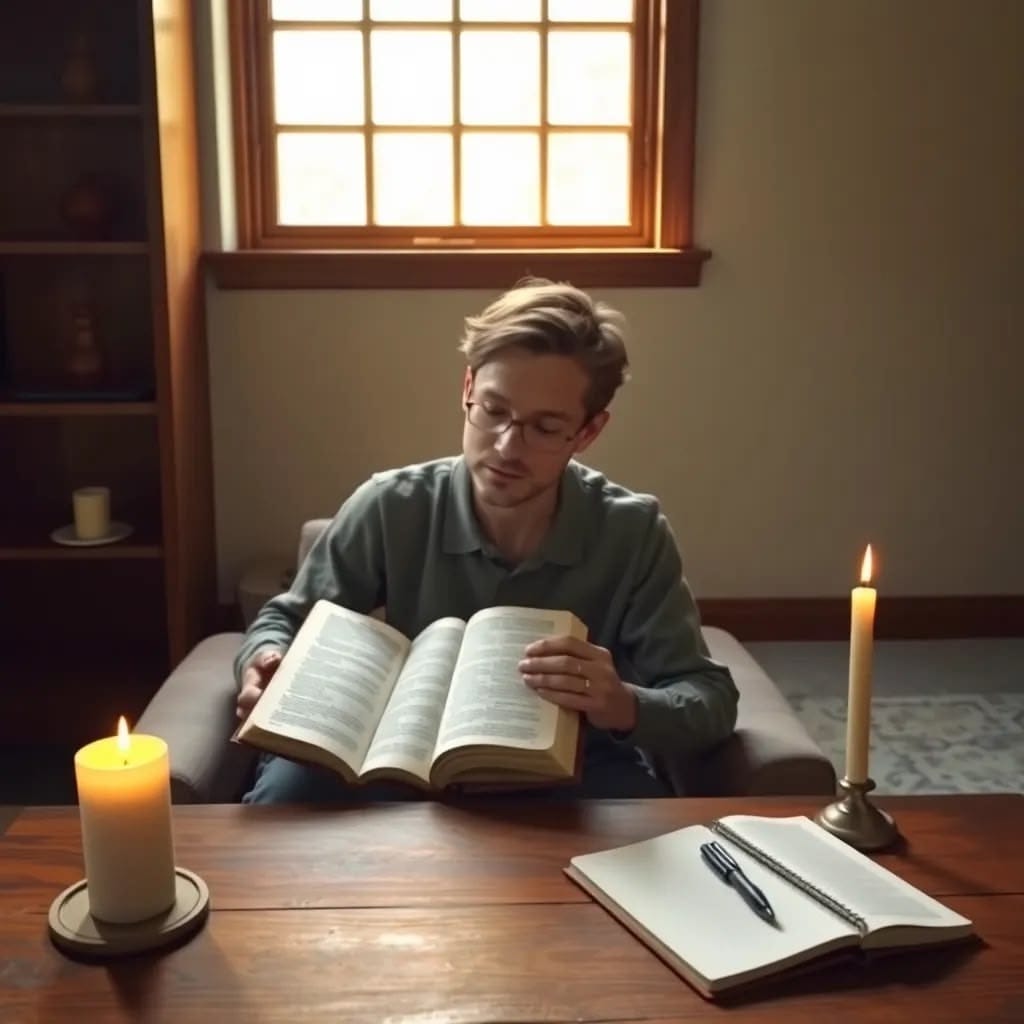
Practicing lectio divina alone or in a group
The practice of lectio divina can be experienced individually or collectively, each offering specific benefits to nourish faith and deepen the relationship with God.
Individual lectio divina
- It fosters a deep spiritual intimacy, as you enter into a personal and silent dialogue with the Word.
- Allows you to progress at your own pace, allocating more time to meditation or prayer as needed.
- It offers a special space to receive the messages that God specifically addresses to your heart.
- It strengthens the internalization of biblical texts, because you are alone with the text, free to explore without external constraints.
This approach is particularly suitable if you are seeking an intimate spiritual experience, centered on your inner life. It helps develop attentive listening and personal discernment on your faith journey.
Collective lectio divina
- It enriches the understanding of the text through exchanges between participants who share their interpretations and personal experiences.
- It promotes fraternal communion around the Word, strengthening community bonds and the spirit of the Church.
- It stimulates reflection by confronting different visions, which allows for a deeper understanding of the biblical message from multiple perspectives.
- Offers mutual support on the spiritual path, especially when it comes to putting the teachings received into practice.
Sharing in a group fosters a vibrant dynamic where everyone contributes to the collective learning. This allows you to benefit from a wealth of experiences that further illuminate the text and nourish your faith.
Choose between lectio divina Individual and group prayer depends on your current spiritual needs. You can also alternate between these two forms to fully benefit from the advantages of each and continually enrich your prayer experience with the Word.
Lectio divina as a school of prayer and Christian life
Lectio divina is at the heart of the spiritual formation Catholic by offering a structured framework for a regular and nourishing prayer life. By practicing this method, you learn to welcome the Word of God not only as a text to be read, but as a living source that nourishes your daily life.
Training for a life of constant prayer
- The repetition of the steps — reading, meditation, prayer, contemplation and then action — gradually forms a stable spiritual rhythm.
- This regularity helps you to move beyond simply reading the Bible occasionally and to enter into a dynamic where prayer becomes a natural breath.
- You develop a finer inner listening, capable of discerning the personal calls that God addresses in each biblical passage.
Personal Transformation Through the Word
- Lectio divina acts on the heart and mind, profoundly changing your view of yourself and others.
- It encourages you to embody Gospel values in your daily choices: patience, mercy, justice, love of neighbor.
- The time spent in this prayerful reading produces a concrete change in your behavior; you are no longer just a receiver but a living actor of the grace received.
Impact on Christian Witness
- A life shaped by this practice naturally becomes a coherent and authentic testimony.
- You manifest through your actions what you have received in silence during contemplation, thus translating interiority into concrete gestures of love and service.
- The personal transformation experienced in lectio divina is a constant invitation to deepen your daily Christian commitment.
This path transforms lectio divina into a true "school" where an attentive and faithful disciple is forged. You discover how to engage the Word with your life so that it illuminates every moment and guides your steps toward Christ.
Practical tips for starting an effective lectio divina
Practicing lectio divina It requires some preparation to ensure that this prayerful reading of the Bible is both enriching and accessible. Here are some practical tips for beginners in lectio divina that will help you embark on this spiritual journey.
Selection of suitable texts
- Favor simple Gospel excerpts : start with short passages from the Gospels, such as the parables or the teachings of Jesus. These texts are often clear and rich in meaning, perfect for a first approach.
- Avoid overly complex or long texts. The letters of Saint Paul or certain psalms can be more difficult to meditate on without prior experience. It is better to venture into them gradually.
- Use an accessible translation Choose a version of the Bible that speaks to you, with understandable vocabulary. This facilitates slow and thoughtful reading.
Setting aside dedicated quiet time
- Schedule a regular appointment with God : a daily or weekly moment, depending on your availability, promotes the regularity necessary for true spiritual growth.
- Create a space conducive to contemplation : a quiet place, with few distractions, helps to focus your attention on the text and to listen to the Word.
- Allow sufficient time for each step : do not rush your lectio divina; allow time for reading, then for meditation, prayer and contemplation.
«"Lectio divina is not simply reading, but a living encounter with God through his Word."»
These practical tips for beginners in lectio divina will help you establish this spiritual practice in your life. The more you practice, the more this method will become a special place where your faith will be nourished and deepened. Feel free to share your experience or ask questions so we can progress together in this beautiful school of prayer.
Frequently Asked Questions
What is lectio divina and what is its importance in the Catholic tradition?
Lectio divina is a method of prayerful reading of the Bible that allows one to deepen their personal relationship with God through the Word. Passed down by the Church Fathers and emphasized by the pope Benedict XVI in Verbum Domini, it occupies a central place in Christian prayer and Catholic tradition.
What are the spiritual objectives of lectio divina?
The spiritual goals of lectio divina are to nourish the inner life and faith, as well as to deepen the personal relationship with God. This spiritual method fosters attentive biblical meditation, which enriches the prayer life.
What are the essential steps to practice lectio divina?
Lectio divina is practiced in five key stages: 1) Lectio: attentive reading of the biblical text, 2) Meditatio: deep meditation on the message, 3) Oratio: personal dialogue in prayer, 4) Contemplatio: silent and transformative reception, and 5) Actio: action inspired by the Word.
How to practice the Lectio stage in lectio divina?
During the Lectio stage, it is important to read the chosen biblical text slowly and thoughtfully. One should identify significant words or phrases, structure the passage by identifying its different parts, and make connections with other biblical texts to enrich one's understanding.
What is the Meditatio stage in lectio divina?
The Meditatio stage involves a deep spiritual reflection on the message of the text read. One analyzes the values conveyed, the attitudes of the characters in relation to Jesus, and awakens the emotions as well as the central human values present in the passage.
What is the significance of the Oratio stage in the practice of lectio divina?
Oratio is the moment of personal dialogue with God through prayer. It is a spiritual response to the divine Word in which one expresses praise, gratitude, or repentance. This stage manifests faith, hope, and charity, sometimes including intercession for oneself and others.