









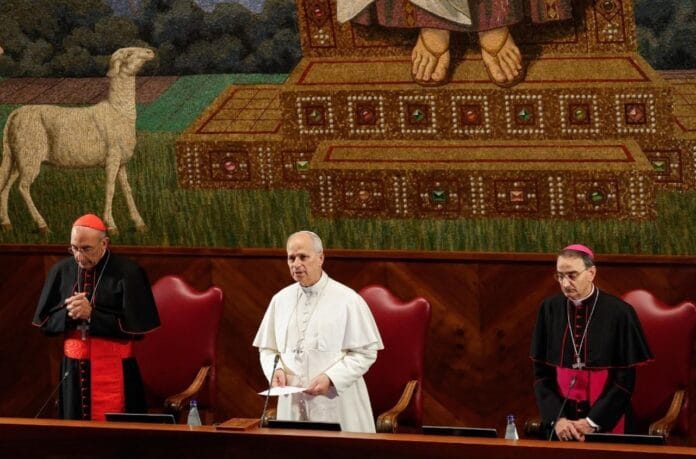
This Friday, November 14, 2025, the main hall of the Pontifical University of Lateran vibrated with a particular fervor. Students, professors, religious and lay people welcomed the Pope Leo XIV came to inaugurate the 253rd academic year of this unique institution, founded in 1773 by Clement XIV. Where so many generations have sought to unite faith and reason, the Sovereign Pontiff delivered a clear message: the search for truth remains the noblest and most urgent mission of any Christian university.
THE Lateran, often nicknamed "the university of Pope »" Since John Paul II, retains an exceptional status in the landscape of pontifical studies. Under its vaults, research in theology, philosophy, canon law and sciences of peace are part of a constant dialogue between the Gospel and modern challenges. This vocation of intellectual and spiritual unity, Leo XIV He revived it with simple words: "Dream big, imagine a Christianity of tomorrow, so that everyone can discover Christ."
A university at the service of the magisterium
For two and a half centuries, the Lateran is not simply a theological campus. It is, according to the Pope, a thinking heart of the’Universal ChurchHe reiterated that his particular “charisma” is not linked to a founder or a religious order, but to the papal magisterium itself. In other words, his mission is to reflect on, reformulate, and contextualize the Church's thought in light of the times. Leo XIV He sees it as a center for developing Christian discernment for the contemporary world — a kind of permanent laboratory for the intelligence of faith.
Cardinal Baldassare Reina, Grand Chancellor of the University, shared his emotion: «Through this visit, the Pope This demonstrates that truth remains at the heart of academic work. This link between Rome, reason, and faith is the hallmark of the Lateran »".
At the crossroads of cultures and disciplines
The papal address placed great emphasis on the interdisciplinary dimension. Theology, law, philosophy, ecology: all these disciplines must listen to one another, engage in dialogue, and enrich each other. The 28 institutes affiliated with Lateran This openness is already evident across three continents. Leo XIV He sees it as "a vast and differentiated reality, an expression of the richness of cultures and the search for unity.".
With this sentence, the Pontiff paints a portrait of a university that is both rooted and global — a model of intellectual catholicity.
Faith and reason, pillars of truth
Rediscovering faith as an act of intelligence
The search for truth—the central theme of the speech—found its resonance in a vibrant appeal: «Faith must be reflected upon, and reflection must be open to faith.» Leo XIV, Our era suffers from a cultural void manifested by superficiality and a loss of meaning. Against this, he calls for "restoring human credibility to theological reflection.".
In other words, faith cannot be reduced to an emotion or a tradition: it becomes credible when it illuminates reason and the human condition.
In a world saturated with information but hungry for meaning, this invitation sounds like a manifesto. Studying faith today, according to the Pope, It means resisting the temptation of oversimplification and daring to confront the complexity of spiritual and social issues. The university is therefore not a refuge, but a springboard into the real world.
Philosophy and Dialogue of Cultures
Revisiting an idea dear to John Paul II, Leo XIV He emphasized philosophy as the royal road to truth. Studying truth philosophically, he declared, requires uniting the resources of human reason with listening to Revelation. It is here that the fruitful encounter between Greek thought, Latin wisdom, and the light of Christ takes place.
He invited the faculties to encourage this “dialogue between cultures” that transcends academic boundaries. For truth, he reminded them, is not the possession of one person, but the common path of all.
This approach aligns with the overarching idea of Vatican II: Human reason, far from being the adversary of faith, is its companion. Similarly, Leo XIV He thanked the professors who teach canon and civil law for "maximizing the comparison between legal systems," a sign of exemplary intellectual universalism.
Humanities, ecology and peace
By highlighting the new disciplines introduced at Lateran — the science of peace and ecological studies — Leo XIV He broadened the search for truth to encompass all of creation. For him, Christian truth includes respect for the environment., brotherhood between peoples and social responsibility.
Peace, He reminded everyone that "faith is a gift from God, but it is also the fruit of human labor." Here we find his vision of an embodied faith, where truth does not oppose action, but rather makes it fruitful.
Research, an act of love and service
The truth in university life
Beyond knowledge, Leo XIV has restored the value of the Catholic researcher: «Scientific research and the indispensable efforts of thought are acts of charity toward truth.» To train competent, motivated lay people and priests, capable of linking faith, science, and culture—this is the vocation of the Lateran.
THE Pope He emphasized the need to provide teachers with the material and pastoral conditions necessary to fully carry out their academic mission. This rare and concrete statement demonstrates a recognition of the human dimension of the intellectual vocation—often lived with discretion and perseverance.
Moving beyond self-referentiality
Another strong warning: the danger of individualism. "The university must teach us to step outside of ourselves to encounter others." From this perspective, research becomes an exercise in...humility : to recognize that we do not hold the truth alone, but that we seek it together.
Understood in this way, intellectual training forges a culture of reciprocity and dialogue, an antidote to the fragmentation of modern societies.
In his words, the Lateran becomes a school of global fraternity. Students from all five continents already embody this living laboratory of ecclesial communion. This mixing of ideas, languages, and practices represents more than diversity: it is a concrete prophecy of what the’Universal Church can offer to society.
Research as a spiritual vocation
Finally, the Pope He evoked the “passion for truth” as a spiritual exercise. To seek is to believe that truth exists, that it can be approached. In this vision, each thesis, each seminar, each dialogue becomes an intellectual prayer.
«Continue to explore the mystery of the Christian faith, practice dialogue with the world, with the challenges of today,» he concluded. Simple words, but ones that conveyed a program: that truth be an adventure, not a fixed dogma.
A call for the future
At the end of this inauguration, Leo XIV It didn't just open an academic year: it opened a horizon. In an era where truth often seems relative, divided or instrumentalized, it gently reminds us that truth liberates, unites, and humanizes.
His speech at Lateran It reconciles the intellectual world and faith, reason and heart, science and hope. It places Christian research in a universal perspective: seeking truth, not to dominate, but to serve.
In the hushed silence of the university Pope, This message resonated. We imagine that each listener, upon leaving, carried away the conviction that studying, thinking, and engaging in dialogue are very real ways of loving God and humanity.