












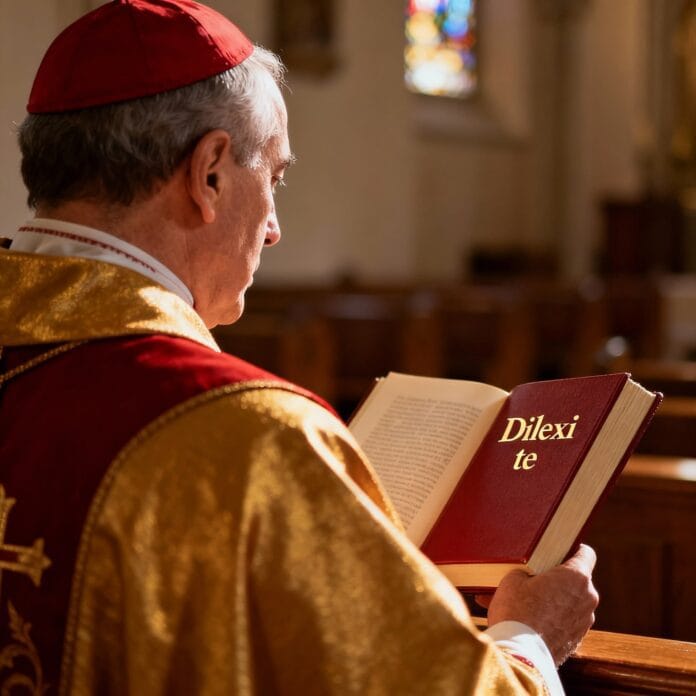
The apostolic exhortation "« Dilexi te »" of Pope Leo XIV, published in October 2025, marks a turning point for the French Catholic Church, energizing public discourse around love of the poor, on the occasion of the Jubilee of the Poor held in Rome. This article offers a structured, engaging analysis, illustrated with concrete examples, to determine whether this text foreshadows a "small revolution" in ecclesiastical and social practices in France.
An exhortation that challenges us: its origin and spirit
Genesis of a radical text
Cardinal Konrad Krajewski presented "« Dilexi te »"during a press conference at Vatican, in October 2025, highlighting the pontiff's renewed interest in a Church that puts back the poor at the heart of his mission. This text is part of the Gospel tradition, that of a Francis of Assisi transformed by his encounter with the excluded, but also in line with the logic conveyed by the pope Francis and his repeated calls for a "poor Church for the poor »".
Leo XIV, by publishing "« Dilexi te »", offers a lucid diagnosis of the illusions of contemporary society: the accumulation of wealth and competition do not lead to happiness. He warns against austerity policies that forget the human dignityThe radical nature of the text lies in its rejection of passive assistance: charity The authentic approach does not simply do things for, but aims to do things with the most vulnerable, recognizing their creative capacity.
A direct appeal to Catholics
Leo XIV He challenges the faithful: the Christian mission is not limited to prayer or doctrinal teaching, but involves concrete engagement with the poor. He criticizes an individualistic vision and denounces the reduction of the Church's commitment to mere charitable action, in order to revalue the experience and voice of people living in poverty.
This message directly echoes what French diaconates have been experiencing for decades: putting the poorest back at the heart of Church life, following the example of Gilles Rebêche in the Var region, whose the work in diaconal service is cited as a model.
A strong social and political impact
Contrary to a privatized conception of faith, "« Dilexi te »"Offers a political message with very strong social resonance." pope it connects loyalty to the Gospel to active attention towards those excluded by a society organized around the interests of a minority. Leo XIV calls for the Church to act for "the integral development of the most abandoned" and proposes the service to the poor as a central criterion of Christian authenticity.
The Church's Response to Exhortation: Reception and Challenges
An enthusiastic but demanding reception
Upon its publication, "« Dilexi te » had a unique impact in France, particularly among those working with people in precarious situations. In several dioceses, the word of pope was felt as an encouragement to deepen this work which sometimes began forty years ago, as in Fréjus-Toulon.
Some church leaders attest that the text strikes them as radically new, going beyond mere accompaniment and calling for a genuine reversal of practices: no longer simply providing assistance, but walking alongside the most vulnerable and learning from them. This approach, already visible in some diaconal ministries, now finds its institutional and theological legitimacy.
Proven practical applications
Several French dioceses, particularly those affected by significant social inequalities, have developed "diakonic services" that attempt to respond to the challenge posed by "« Dilexi te »This long-term work aims to fully recognize the dignity and agency of the poor. The initiatives are varied: listening, support, co-creation of projects, involvement in the liturgy, etc.
The Jubilee of the Poor, held in Rome from November 14 to 16, 2025, brought together 10,000 participants, including 1,500 French speakers led in particular by the Fratello association. This mobilization concretely illustrates the papal message and gives increased visibility to the efforts of local churches, lending credibility to the shift proposed by Leo XIV.
Persistent resistance and questions
While enthusiasm is widely shared, some leaders point to the difficulty of changing mindsets within the Church, where the risk of reducing the social mission to mere "charity" remains. The text examines institutional habits and governance models, and calls for a profound change in pastoral practices.
Concrete questions arise: how to promote the effective involvement of the poor in Church institutions? How to move from a logic of aid to one of co-responsibility? These points remain challenges to be addressed if the revolution advocated in the text is to become a reality in the daily life of the Church.
Towards a minor revolution? Developments and horizons for the Church
A theological and pastoral turning point
«"« Dilexi te » proposes a major theological shift: charity is not an option, but the burning heart of the Church's mission. Poverty, far from being an inevitability or a marginality, constitutes – according to Leo XIV – the touchstone of loyalty to Christ and community vitality. He reminds us that attention to the poor is inseparable from Christian hope, a source of unity and creativity for all the people of God.
For the Church in France, this vision paves the way for a renewed pastoral approach, where the peripheries are not marginalized but at the heart of ecclesial life. This encourages collaboration between dioceses, associations, and communities to build inclusive models and transform the relationship with poverty.
Concrete examples and approaches
Let us take the example of the diocese of Fréjus-Toulon in the Var region, where for over forty years the diaconate has been encouraging the integration of the poor into the local Church. Initiatives such as shared meals, group listening sessions, and the active participation of people in precarious situations in liturgical life are now recognized and celebrated.
The mobilization during the Jubilee of the Poor is another striking example: people from the streets, shelters, and associations are invited to meet the pope and to bear witness to their experience; their approach is considered exemplary and inspiring for the entire Church.
Ideas for extending the momentum
Here are some suggestions, inspired by the spirit of "« Dilexi te »"and already tested locally:"
- Systematically involve people in precarious situations in the decisions and activities of parish communities (e.g., parish councils, organization of liturgical gatherings).
- To value the testimony of the poorest as an expression of Christian vitality during major events (e.g. Jubilee, pilgrimages, public conferences).
- Supporting and increasing partnerships between secular and diocesan associations to strengthen the social justice and the human dignity in all territories.
- To raise awareness among the faithful of a spirituality of encounter and "doing with", by inviting them to recognize the unique creativity of the poor.
- To train priests, deacons and leaders in an attitude of listening andhumility, to promote dialogue with people on the margins of the Church.
- Regularly evaluate social practices in light of the challenge posed by the text and engage in a continuous institutional conversion.
A quiet but profound revolution
Far from mere announcements, "« Dilexi te »"This is bringing about a lasting transformation which, while not spectacular, could well constitute the dawn of a 'small revolution' for the Church in France. This friendly, demanding, and visionary text invites each community to move beyond a logic of assistance and build a fraternal relationship with the poor.
The Church in France, supported by its diaconates and committed faithful, seems ready to meet this challenge. The signs are there: local initiatives, mobilization during the Jubilee of the Poor, renewed theological reflection. It remains to be seen in the coming years whether this momentum will fully usher the Church into an era where love The plight of the poor is not only preached but lived as the heart of Christian life.