












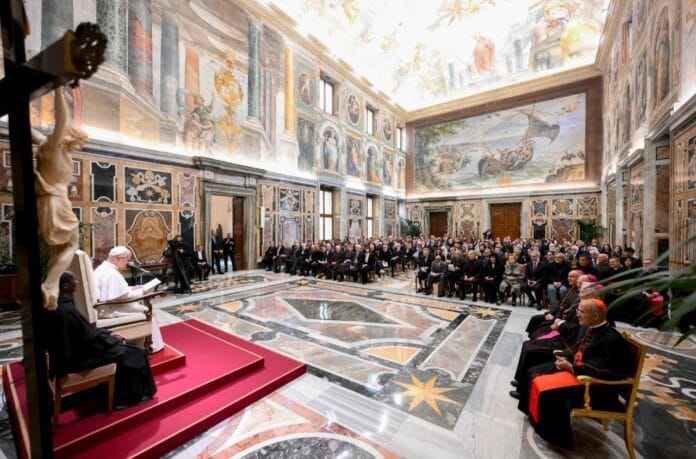
On Saturday, November 15th, a special atmosphere reigned at Vatican. Far from the usual diplomatic gatherings or general audiences, the Clementine Hall, the historic heart of the Apostolic Palace, hosted an unusual delegation. Nearly 200 faces, both familiar and unknown to the general public, from directors to screenwriters, actors to technicians, comprised an assembly representing the diversity of the seventh art. Hailing from numerous countries, they were there for a unique encounter with the Pope Leo XIV.
What could have been a simple exchange of pleasantries transformed into a moment of profound reflection, almost a declaration of love, from the Pope towards the "popular art" that is cinema. In a speech that was both intimate and universal, Leo XIV he not only greeted his guests; he entrusted them with a mission, a vision. Contemplating this art, which he described as a "laboratory of hope" and a "refuge for seekers of meaning," the Pope launched a vibrant appeal, summed up in one powerful phrase: "Make cinema an art of the mind.".
In this Jubilee Year, when the Church is turning to the theme of hope, the encounter took on an added dimension. Pope He did not speak to cinema as an external moral authority, but as a friend, an admirer, a "pilgrim of the imagination" addressing his peers. He offered a spiritual compass to an industry often torn between commerce and creation, inviting it to remember its noblest vocation: to illuminate the human soul.
The spiritual vocation of a "popular art"«
From the very beginning of his speech, the Pope Leo XIV insisted on framing cinema not as a simple entertainment industry, but as a major cultural and spiritual phenomenon, born from a dream and addressing everyone.
A 130-year-old "restless dreamer"
With obvious tenderness, the Pope He began with a historical, almost poetic note. "Cinema is a young, dreamy and somewhat restless art, even though it is now a hundred years old," he declared, before correcting himself with a smile by recalling the real anniversary: "It is celebrating its one hundred and thirty years these days, since that first public screening carried out by the Lumière brothers on December 28, 1895 in Paris.".
This description – «young, dreamy, and restless» – captures the essence of an art that has never stopped reinventing itself. From silent magic to the explosion of sound, from Technicolor to hyperrealism. digital, Cinema is in a state of perpetual transformation. But for Leo XIV, This agitation is not a sign of immaturity; it is a sign of its vitality. He recalled that what began as simple entertainment, a game of "visual effects" intended to "impress," quickly evolved. These moving images managed, almost by accident, to "reveal much deeper realities.".
THE Pope He identified the true mission that cinema discovered for itself: to become "the expression of the will to contemplate and understand life." Cinema, in its moments of grace, does not merely show; it helps us to see. It gives us the tools to "narrate the grandeur and fragility" of human existence, to "interpret the longing for the infinite" that lies dormant within each of us.
By describing it as a "noble folk art," born "for all and addressed to all," the Pope He emphasized its universal and democratic dimension. Cinema is not an art reserved for an elite; its church is the movie theater, open to anyone seeking escape, learning, or experiencing emotion. It is precisely because it touches the hearts of so many that its responsibility is so great.
«"When the magic lantern is lit, the soul's gaze is illuminated."»
This is perhaps the most powerful metaphor in the speech. Leo XIV He drew a direct parallel between the physical experience of cinema and the inner spiritual experience. "It is beautiful to note that, when the magic lantern of cinema lights up in the darkness, the gaze of the soul is simultaneously illuminated," he stated.
This image is rich in meaning. The "magic lantern"—the projector—pierces the darkness of the room, but it also pierces, symbolically, our inner darkness. Pope He beautifully articulated this duality: "cinema knows how to combine what seems to be mere entertainment with the narrative of the spiritual adventure of the human being.".
It is a genuine plea against a reductive view of cinema as mere "escapism". For Leo XIV, Even the lightest entertainment can carry within it the seeds of a deeper quest. He invited the audience to become aware of this alchemy. Cinema, he insisted, has a valuable contribution: "helping the viewer to find themselves, to take a fresh look at the complexity of their own experience, to see the world as if for the first time.".
In this sense, cinema is an exercise in rediscovery, a tool for finding "a part of that hope without which our existence is incomplete." This is not a naive or blissful hope, but the ability to see the potential for light even in the darkest situations. Cinema, through the grace of a shot, a line of dialogue, or a silence, can reframe our reality.
Drawing on the words of his predecessor, Saint Paul VI, who told artists that the world "needs beauty so as not to sink into despair,", Leo XIV has renewed this "friendship" between the Church and art. Beauty is not a luxury, it is a spiritual necessity. And cinema, as a creator of visual, narrative, and emotional beauty, is an indispensable ally of humanity in its fight against despair.
Cinema as a crossroads to heal wounds, to find meaning
For the Pope Leo XIV, Cinema is not merely a passive mirror of reality; it is a dynamic actor in our inner and collective life. It is a place of passage, confrontation, and, potentially, healing.
A remedy for the troubled soul
Continuing his line of thought, the Pope He painted a picture of the seventh art as a "remedy." He acknowledged the dual nature of the modern audience: "Through your works, you address those who seek lightness," he conceded, but he immediately added the essential counterpart: "but also those who harbor within themselves an anxiety, a quest for meaning, justice, and beauty.".
In our era marked by anxiety, uncertainty, and fragmentation, the Pope He positions cinema as a therapeutic space. He describes it as "much more than a simple screen." It is a "crossroads of desires, memories, and questions.".
Let's analyze this metaphor of the "crossroads." A crossroads is a place of choice, of encounter, sometimes of danger, but always of movement. Cinema is this place where our personal desires meet universal narratives, where our intimate memories are awakened by shared images, and where our existential questions find an echo, if not an answer. "It's a sensitive quest where light pierces the darkness and where words encounter silence," he added. Pope, highlighting cinema's unique ability to express the inexpressible.
As a story unfolds, "our gaze is educated, our imagination blossoms, and even pain finds meaning." This idea that cinema can give meaning to pain is central. It doesn't erase it, but it inscribes it within a narrative, giving it form, a beginning and an end, allowing the viewer to process it, understand it, and perhaps even transcend it. Cinema, when it is "authentic," doesn't simply flatter or console us: "it challenges us." It forces us to confront "the questions that dwell within us and, sometimes, even the tears we didn't know we had to express.".
«"Don't be afraid to confront the world's wounds."»
This questioning is not comfortable. Leo XIV He did not invite artists to produce soothing works or religious propaganda. On the contrary, he urged them to be courageous, to confront reality directly in its harshest form.
«Don’t be afraid to confront the world’s wounds,» he told them. And he named those wounds bluntly: «Violence, poverty, exile, solitude, addictions, forgotten wars.
This list is not insignificant. These are the wounds that our society often prefers to ignore, to sweep under the rug of media indifference. Pope He asks cinema to be the voice of the voiceless, to be the light that exposes these "forgotten wars." He assigns cinema an almost prophetic function: "so many wounds that demand to be seen and told.".
But he immediately laid down a crucial ethical condition, a fundamental distinction between art and exploitation. "Great cinema does not exploit pain," he warned, "it accompanies it, it explores it." That is the whole difference between voyeurism and compassion. True art does not feed on the suffering of others for spectacle; it humbles itself beside them, listens to them, tries to understand and share their suffering, inviting the viewer to an act of empathy. Art, he said, «must not flee the mystery of fragility: it must listen to it, it must be able to stand before it.».
The peril of movie theaters and the appeal to institutions
Having raised the debate to these spiritual and moral heights, the Pope came back down to earth to address a very concrete problem. Because in order for cinema to fulfill this role of "crossroads" and "remedy", it needs a place to practice.
With visible concern, the Bishop of Rome lamented the crisis facing the physical space of cinema: "Movie theaters are undergoing a worrying erosion that is distancing them from cities and neighborhoods. Many are saying that the art of cinema and the cinematic experience are in danger.".
In the era of individual streaming and at-home consumption, the Pope He strongly defended the collective experience. He reminded everyone that "cultural institutions like cinemas and theaters are the beating heart of our communities, contributing to their humanization." The movie theater is not just an economic model; it is a social space, one of the last places where strangers from all walks of life gather in the darkness to share a common emotion. It is a vital collective ritual for the "humanization" of our cities.
Aware that the artists present could not solve this problem on their own, Leo XIV He then launched a vigorous appeal "to institutions not to give up and to cooperate in affirming the social and cultural value of this activity." This appeal, which was met with enthusiastic applause from the audience, was a recognition that culture is not simply a market, but an essential common good that requires public and political support. It validated the struggle of creators for the survival of their workplaces and venues.
The future of hope, pilgrims of the imagination, and the art of the spirit
The last part of the speech Leo XIV looked to the future, charting a course for creators. He not only invested them with a mission, but also gave them a title, a community, and an ultimate spiritual challenge.
Artists, these "pilgrims of the imagination"«
Fully in keeping with the context of the Jubilee Year, a time of pilgrimage and hope, the Pope He used this metaphor to redefine the very identity of the artist. He confided that he found "comfort" in the idea that cinema is not "just a series of moving images," but rather "hope in motion!"«
Addressing his guests directly, he told them, "You too, like so many others who have come to Rome from all over the world, are walking as pilgrims." But their pilgrimage is of a particular kind. They are "pilgrims of the imagination, seekers of meaning, storytellers of hope, messengers of humanity.".
This redefinition is profound. It elevates the artist beyond the simple category of "professional" or "entertainer," bestowing upon them an almost priestly dignity, in the secular sense of the term: one who seeks and transmits meaning. Their journey is internal and creative: "Your path is not measured in kilometers, but in images, words, emotions, shared memories, and collective aspirations.".
This pilgrimage, he continued, is an exploration "into the heart of the mystery of human experience." He praised their "penetrating gaze," a gaze capable of seeing beyond appearances, of "recognizing beauty even in the folds of suffering, hope amidst the tragedies of violence and war." In this, they are witnesses. "Our era needs witnesses of hope, beauty, and truth," he urged, "through your artistic work, you can embody them." The power of "good cinema" is to "safeguard and promote the human dignity »"by restoring the authenticity of the image.".
Against individualism, for collaborative charisma
In an art world often dominated by the figure of the sole author or by the competition of egos, the Pope introduced a relevant social and spiritual critique. Recognizing "an era marked by exasperated and opposing individualisms", he reminded us that cinema is, by its very nature, the collaborative art par excellence.
A film is not the work of a single man or woman, but the synergy of dozens, or even hundreds, of talents. Leo XIV He urged each member of the industry to "let their particular charisma shine"—their unique gift—not in opposition to, but in harmony with, others. He expressed his desire for an industry that works "in a collaborative and fraternal atmosphere.".
This appeal is not merely management advice; it is a spiritual vision. For cinema to be a "language of peace" on screen, it must first be a "meeting place" and a space for fraternity on the film set. The ethics of creation must reflect the ethics of the message. This is a challenge to an industry known for its rigid hierarchies and conflicts, a call to make the very act of filmmaking an act of shared humanity.
The ultimate challenge: "Make cinema an art of the mind."«
It is on this final exhortation that the Pope He concluded his speech, giving it its full meaning. After acknowledging their role, recognizing their difficulties, and validating their quest, he presented them with the highest challenge. But what did he mean by "an art of the Spirit"?
This was clearly not a call to make catechism films or didactic works. Pope He himself clarified this: cinema must educate the eye "without being didactic." The key to this formula may lie in a surprising quote that the Pope unearthed that of a pioneer of the seventh art, David W. Griffith: "what modern cinema lacks is beauty, the beauty of the wind in the trees.".
This seemingly simple phrase possesses a radical depth. Griffith wasn't asking for more drama, more effects, or more religion. He was asking for more contemplation. The "beauty of the wind in the trees" is the very image of the transcendent in the immanent, of the spiritual in the mundane. It is the capacity to stop, to look, and to see the world with fresh eyes—to see, in short, grace at work.
Making cinema an "art of the mind," then, is this: it's about rediscovering the capacity for wonder. It's about using the cinematic tool not to overwhelm the viewer with special effects, but to uplift them by showing them the "nostalgia for the infinite" in a face, a landscape, or the simple movement of leaves. It's a cinema that listens to "fragility" without fear, that educates the eye to hidden beauty, that prefers resonance to explanation.
When the applause subsided, it was clear that this meeting on November 15th was not a mere formality. It was a moment of renewal, a public reaffirmation of the "friendship" proclaimed by Paul VI. Pope Leo XIV He offered the world of cinema much more than a blessing; he offered it profound respect and a demanding vision.
The approximately 200 artists, directors, and producers did not leave with a new moral code of conduct, but with a mission and validation. Pope He didn't ask cinema to convert, he asked it to be authentic. He didn't ask it to flee the world, but to plunge into it with courage and compassion.
Wishing them that "the Lord will always accompany you on your creative pilgrimage,", Leo XIV sent these "narrators of hope" back to their cameras, their pens and their stages, with the title of "artisans of hope".
The challenge is immense, commensurate with the power of the art they serve. But in a world searching for meaning, cinema, this 130-year-old "restless dreamer," has just been reminded of its most sacred vocation: to be the magic lantern which, by lighting up in our darkness, illuminates the gaze of our soul.