












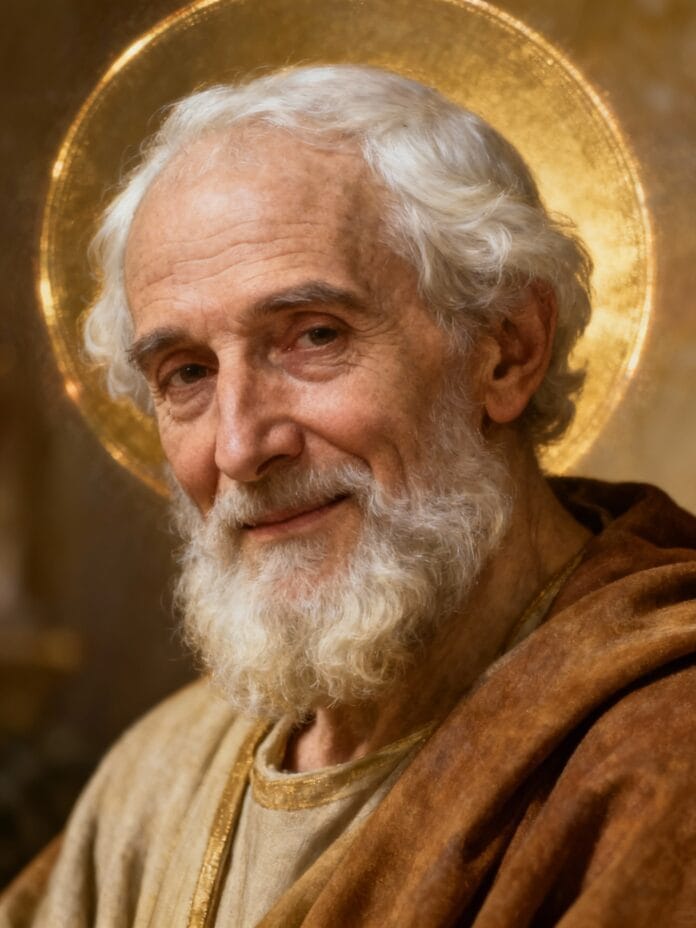
1° The author's person. The name Ίάκωος, in Latin "Jacobus", does not differ from that of the famous patriarch Jacob. Two apostles bore it (Cf. Matt. 16:3; Mark 3:17-18; Luke 6, 14-15; Acts of the Apostles 1, 13): Saint James the Greater, son of Zebedee and brother of Saint John the Evangelist; Saint James the Lesser (we read in the text of St. Mark, 15:40: ὁ μιϰρός, the little one), in contrast to the former. There is no mention here of the brother of Saint John, to whom our letter cannot be attributed, since he suffered martyrdom around the year 42 (cf. Acts of the Apostles 12, 2), long before it was composed.
Saint James the Less was the son of Alphaeus, or Cleophas (Clopas according to the Greek). His mother, Married, She was related to the Blessed Virgin (cf. John 19:25; in Mark 15:40 and 16:1, and in Luke 24:10, she is called Married, (mother of James). This is why he is called brother, that is, cousin, of Our Lord Jesus Christ. In his letter to the Galatians, 1:19, Saint Paul affirms that the "apostle" Saint James was "brother of the Lord." This was the opinion of Papias, Origen (In ep. ad Rom., 4, 8), Clement of Alexandria (see Eusebius, Ecclesiastical History, 2, 1, 6), Saint Athanasius (C. Arian., 3), Saint Jerome (Adv. Helv., 19), Saint John Chrysostom (In Gal., 1, 19), and almost all the ancient ecclesiastical writers.
Saint James the Less was the first bishop of Jerusalem (Eusebius, Ecclesiastical History, 2, 1; 3, 5; 4, 5; Saint Epiphanius, Haremology, 29, 3, etc.). Saint Paul, Galatians, 2, 9, and Saint Luke in the Acts of the Apostles, 15, 13 and following, 21, 18 indicate the considerable influence he wielded in the early Church. His great virtues, which earned him the nickname "the Just" (Eusebius, 11, 2, 1; 4, 22), won him the esteem of the Jews themselves, as the historian Josephus also recounts (Ant., 20, 9, 1). According to Saint Jerome (De vir. ill., 2; Ecclesiastical History, 2, 23), he governed the Christian community of Jerusalem for thirty years and ended his life with a painful and courageous martyrdom in 62.
2° The authenticity of the letter. The letter itself (1:1) identifies itself as the work of "James, servant of God and of Jesus Christ." The author uses no other title, knowing that this designation was sufficient for his readers. Tradition clearly states that he is none other than the Apostle Saint James the Less, who was mentioned on the previous page.
Undoubtedly, early ecclesiastical writers only make relatively rare quotations from this letter, because it provided them with few opportunities to do so; but their testimony is quite sufficient to convince us (while rationalists generally deny its authenticity, many Protestant critics do not hesitate to accept it, thus abandoning Luther's opinion, which rejected it because it was inconvenient for his theory of faith without works). Saint Clement pope And the Shepherd of Hermas knew her. Saint Irenaeus (Haer., 4, 16, 2) and Tertullian (Contr. Jud., 2) borrowed the title "friend of God" (cf. Jac., 2, 23) from her to apply to Abraham. Origen cites her by name on numerous occasions (Hom. in Gen., 13, 2; in Exod., 3, 3; in John, 19, 6; in Letter to Rom., 4, 1). According to Eusebius (Ecclesiastical History, 6, 14, 1), Clement of Alexandria commented on her. If Eusebius himself (Lc. 3.26.3) nevertheless includes it among the ἀντιλεγομένα, that is, among those Holy Scriptures that encountered some opposition, it is because, in reality, it was not initially considered canonical throughout the Church. Indeed, it is not mentioned in the Muratorian Canon, which represents the biblical perspective of the Roman Church in the second century. But its presence in the ancient Syriac version shows that it was accepted in Syria just as well as in Alexandria, in Africa and in Gaul. Soon all doubt ceased, and we see Saint Cyril of Jerusalem (Catech., 4, 33), Saint Ephrem (Opera græca, t. 3, p. 51), Saint Jerome (De Vir. ill., 2) and all other later writers cite it as an authentic writing of Saint James the Less.
The intrinsic arguments fully confirm this traditional view. The author of the letter presents himself to us as a man completely at home in the Old Testament, who lives within it, borrows examples and thoughts from it (cf. 2:20-25; 5:10, 17, 18, etc.); as a man who possesses, in the eyes of his readers, as the authoritative tone of his exposition demonstrates, powers, a position, and a dignity that are more than ordinary. This intimate knowledge of the Old Testament and this official status are easily explained if Saint James the Less composed the letter (interesting coincidences of expression have been found between our letter and the speech delivered by Saint James at the Council of Jerusalem, cf. Acts of the Apostles 15, 13-21).
3° The recipients of the letter According to 1:1, these are the twelve tribes of the dispersion, that is, the members of the theocratic nation scattered throughout the world (cf. John 7:35 and the notes). It is therefore addressed directly to Jews; the expression "twelve tribes" leaves no doubt about this (compare 2:8-13 where the author speaks in such honorable terms of the "royal law"); however, it is not addressed to those among them who remained unbelievers, for it does not preach the Christian faith directly, nor does it seek to convert readers from Judaism to Christianity. Christianity. The Jews whom the apostle exhorts certainly belong to the Christian religion (see 1:1 where the author writes as a "servant of Christ"; 1:18 where he addresses those whom "God has begotten through the word of truth," that is, through the gospel; 2:18 where he assumes that his readers have faith in Our Lord Jesus Christ; 5:14 where he recommends that they call upon the priests of the Church in such special cases; 2:11, 22 and 5:4 etc., where he speaks to them as to men who are well acquainted with Jewish ideas and institutions, and who know the sacred books of the Old Testament. On this last point, see 2:8, 11, 23; 3:9; 4:6; etc.). It is understandable that the holy Bishop of Jerusalem wished to extend his ministry to all Jews who had converted to Christianity and who lived in the various regions of the Roman Empire other than Palestine. Many of them continued to come to Jerusalem to celebrate the great Jewish festivals (cf. Eusebius, Ecclesiastical History, 2, 23), and they naturally venerated Saint James as a spiritual leader whose authority replaced that of the former high priest. However, it is clear from 2, 1 ff. that the author is directly addressing not isolated Christians, but the communities of faithful within the Churches. In this sense, the letter is a kind of encyclical.
The Greek idiom, quite correct, in which it was written does not in any way contradict the thesis we have just demonstrated; for, if many members of the early Church of Jerusalem spoke this language, as we know from a certain source (cf. Acts of the Apostles, 6, 1 et seq.), this was all the more the case for Jews, Christian or not, who lived outside of Palestine.
4° The opportunity and the goal similarly emerge from the main ideas of the letter. It reveals the presence, among those for whom it was written, of external trials that threatened to discourage them (cf. 1, 3, etc.), a religion that tended to become purely theoretical and to neglect good works (cf. 1, 22 ff.; 2, 14 ff.), the lack of fraternal charity in many circumstances and contempt for the poor (cf. 2, 1 ff.; 5, 1 ff.), love immoderate love of money (cf. 4, 13 ff.; 5, 4), tendencies towards a luxurious and immoral life (cf. 5, 5, etc.), and above all antinomianism, that is, the error which claimed that good works were now useless and that faith was sufficient for salvation (cf. 2, 14 ff.).
It was to offer consolation amidst these trials, to condemn and correct these abuses, in short, to raise readers to a higher level of Christian life, that the letter was composed. Its main purpose is to warn against a superficial understanding of Christianity, a concept that jeopardized the implementation of the Christian spirit.
The author's style is proverbial; this gives his writing, as has often been repeated, a real resemblance to the books of Wisdom and Ecclesiasticus. But it is more accurate to compare it, in terms of form, with Jesus' Sermon on the Mount, all the more so since the subjects treated in both are not without affinity. He also sometimes takes on the terrible and threatening tone of the prophets; here and there he recalls the tone of the parables evangelicals.
5° The topic covered and the division. It is not surprising, given what has just been said, that the theme of the letter is essentially practical. The Christian must live in accordance with his faith: this is the summary of everything. Although dogma appears here and there as the basis for moral recommendations (cf. 1:2-4, 5b, 13-14, 18; 2:1 ff.; 3:9b; 4:4b; 5:2-3, 11, 15, 19-20, etc.), the author does not actually develop any other doctrinal point than that concerning the necessity of uniting works with faith (cf. 2:14 ff.). The exhortations, reproaches, and various warnings that form the core of the text are not themselves arranged according to a strictly logical and systematic order. Furthermore, the sacred writer often moves abruptly from one subject to another, so that his composition is quite fragmented; there is no dominant idea forming unity.
After an extraordinarily brief greeting, the apostle first exhorts the faithful to be patient and courageous amidst the various trials and temptations of life, explaining their purpose and origin (1:1-18). He then shows (1:19-27) how Christians must not only listen to but also put into practice the word of God, and how they must also fulfill the great obligation of the fraternal charity (2:1-13). He then addresses the necessity of uniting works with faith (2:14-26), followed by the immoderate desire some Christians felt to assume the role of teachers (3:1-12). After establishing the difference between true and false wisdom (3:13-18), he vehemently denounces passions and vices (4:1-17), and concludes with various exhortations and warnings (5:1-20). There is no final salutation.
We can group everything under five different headings: 1° exhortation to patience among the trials and temptations, 1, 1-18; 2° necessity of a living and active faith, 1, 19-2, 26; 3° of the immoderate desire to teach others, and rules concerning wisdom, 3, 1-18; 4° against passions and vices, 4, 1-17; 5° exhortations and warnings of various kinds, 5, 1-20.
6° Place and date of composition. The letter was written in Jerusalem, a city from which Saint James never strayed. In what year? Ancient writers remain silent on this point. Obviously before 62, since that was when the apostle was martyred. After 58, if, as everything suggests, Saint James had in mind (2:14 ff.), the doctrine developed by Saint Paul in the letter to the Romans (which appeared around the year 58), concerning justification by faith alone, without works. Now, as it took some time for the letter to the Romans It spread throughout the Church, and the year 61 is quite commonly fixed as the year in which the writing of Saint James was composed.
The opinion of some exegetes, according to which this writing predates the Council of Jerusalem (which took place in 50 AD) and was composed between the years 40 and 50 AD, has no solid basis. We mention only in passing the rationalist opinion that our letter was composed only after the year 150 AD. It is true, according to James 1:18, that the recipients of the letter of Saint James belonged to the first generation of Christians; however, abuses that it indicates proves that their original fervor had diminished, that they had more or less degenerated: which required a certain period of time; the authors who attribute such an early date to the letter naturally admit no relationship between it and the letter to the Romans.
7° Relationship between the letter of Saint James and that of Saint Paul to the Romans. – There can be no doubt that the first of these letters makes several allusions to the second: firstly in several isolated passages (cf. James 4:1 and Romans 7, 23; James 4:4 and Romans 8, 7; James 4:12 and Romans 14, 4 etc. It is primarily in the Greek text that comparisons must be made), and then in particular in chapter 2, verse 14 ff., which the reader will compare Romans 3, 28 ff., 4, 1 ff. See especially James 2:14, 20 ff., where the Lord's brother uses the same arguments and almost the same words as the apostle to the Gentiles to demonstrate that faith alone is not enough, but that works must be added to it. The resemblance between the two writings is so striking that it cannot be attributed to chance. One of the two writers must therefore have intended to correct the erroneous interpretation given to the words of the other (this was already the opinion of St. Augustine and Bede the Venerable. It has long been generally adopted by Catholic exegetes). Now, it is almost unanimously agreed that it was St. James who came last and who had this specific intention.
Many rationalists go so far as to claim that the Letter of James is "directed in part against Saint Paul and contradicts the doctrine of the great apostle." But in reality, "the supposed antagonism and contradiction between the two sacred writers are imaginary. Saint Paul, in the letter to the Romans, [He] insists greatly on the truth that faith saves, not works. Saint James, on the contrary, says that faith alone does not save without works. Both are right, and they do not contradict each other at all. The works Saint James speaks of are not, in fact, those Saint Paul speaks of. The latter speaks of the works of the law, the legal practices of the Jews, and he very rightly says that observing Jewish precepts does not justify without faith. Saint James is not concerned with legal works, but with Christian works, which is quite different. True religion, he says, does not consist only in believing, but in conforming one's conduct to one's faith, not by observing the law of Moses, but the law of God and of Jesus Christ. This doctrine is identical with that of Saint Paul» (F. Vigouroux, The Holy Books and Rationalist Criticism, 5th ed., vol. 5, p. 561).
8. Here are some of the best Commentaries written on our letter by Catholic authors : in antiquity, those of Bede the Venerable (Exposit. super cath. Epistolas), and of the two excellent Greek exegetes Œcumenius and Theophylact (in their explanations of the entire New Testament); in modern times, those of Catharinus (In omnes divi Pauli apost. et in septem. cath. lettre commentarius, Paris, 1566), of Estius (In omnes S. Pauli et septem cath. apostolorum epistolas commentarius, Douai, 1601), of Lorin (In cathol. Beat. Jacobi et Judæ apostolorum epistolas commentarii, Lyon 1619), by B. Justiniani (Explanationes in omnes epistolas cath., Lyon, 1621); Paul Drach (The Seven Catholic Letters, Paris, 1873).
James 1
1 James, servant of God and of the Lord Jesus Christ, to the twelve tribes scattered among the nations: Greetings. 2 See only joy, my brothers, in the trials of every kind that come upon you. 3 knowing that the testing of your faith produces patience. 4 But that patience be accompanied by perfect works, so that you may be perfect and complete, leaving nothing to be desired. 5 If any of you lacks wisdom, let him ask God, who gives freely to all without finding fault, and it will be given to him. 6 But let him ask in faith, without hesitation, for he who hesitates is like a wave of the sea, tossed and blown by the wind. 7 Therefore, let that man not think that he will receive anything from the Lord: 8 A man of two souls, inconstant in all his ways. 9 Let the poor brother glorify his elevation 10 And let the rich man glory in his humility, for he will pass away like flowering grass., 11 The sun rose scorching hot and withered the grass, and its flower fell and all its beauty vanished; so also the rich man will wither away with his endeavors. 12 Blessed is the one who perseveres. When he has stood the test, he will receive the crown of life that God has promised to those who love him. 13 Let no one, when tempted, say, "It is God who is tempting me," for God cannot be tempted with evil, nor does he tempt anyone. 14 But each person is tempted by their own desires, which attract and seduce them. 15 Then covetousness, when it has conceived, gives birth to sin, and sin, when it is consummated, gives birth to death. 16 Do not deceive yourselves, my beloved brothers. 17 Every good and perfect gift is from above, coming down from the Father of the heavenly lights, who does not change like shifting shadows. 18 Of his own will, he gave us birth through the word of truth, so that we might be a kind of firstfruits of his creatures. 19 My beloved brothers, you know that a man should be quick to listen, slow to speak, slow to become angry. 20 For the anger of man does not produce the justice of God. 21 Therefore, putting aside all filthiness and the evil that is so prevalent, humbly accept the word planted in you, which can save your souls. 22 But strive to put it into practice and do not merely listen to it, deceiving yourselves with false reasoning. 23 For if anyone listens to the word and does not observe it, he is like a man who looks in a mirror at his natural face: 24 He had barely considered himself when he left, immediately forgetting who he was. 25 On the contrary, the one who fixes his gaze on the perfect law, the law of liberty, and holds fast to it, not listening only to forget at once, but practicing what he has heard, he will find his happiness in fulfilling it. 26 If someone imagines themselves to be religious without restraining their tongue, they are deluding themselves and their religion is worthless. 27 Pure and spotless religion before our God and Father is nothing other than caring for orphans and widows in their distress and keeping oneself pure from the defilements of this world.
Jacques 2
1 My brothers, do not mix favoritism towards certain people with faith in Jesus Christ our Lord of glory. 2 If, for example, a man wearing a gold ring and fine clothes enters your assembly, and a poor man in filthy clothes also enters3 And turning your gaze upon the one who is magnificently dressed, you say to him, "You, sit here in this place of honor," and you say to the poor man, "You, stand there, or sit here at the footstool of my feet."« 4 Isn't that making distinctions between yourselves and setting yourselves up as judges with perverse thoughts? 5 Listen, my beloved brothers: Has not God chosen those who are poor in the eyes of the world to be rich in faith and heirs of the kingdom He promised to those who love Him? 6 And you, you are insulting the poor. Aren't the rich the ones oppressing you and dragging you into court? 7 Are they not the ones who insult the beautiful name you bear? 8 If you fulfill the royal law, according to this passage of Scripture:« You shall love your neighbor as yourself,"You're doing the right thing." 9 But if you show favoritism, you commit a sin, and the law itself condemns you as transgressors., 10 for whoever has kept the whole law, and yet fails in one point, is guilty of all of it. 11 Indeed, he who said, «You shall not commit adultery,» also said, «You shall not murder.» So if you murder, even though you do not commit adultery, you are a transgressor of the law. 12 Speak and act as if you were to be judged by the law of liberty 13 for judgment will be without mercy for those who have not shown mercy., mercy triumph of judgment. 14 What good is it, my brothers, for a man to say he has faith if he does not have works? Can such faith save him? 15 If a brother or sister is naked and does not have their daily necessities of food, and one of you says to them 16 «"Go in peace, be warmed and filled" without giving them what their bodies need, what good is it? 17 The same is true of faith: if it does not have works, it is dead in itself. 18 But one could even say: "You have faith and I have works." "Show me your faith without works and I will show you my faith by my works."« 19 You believe that there is only one God, you are right, the demons believe it too and they tremble. 20 But do you want to convince yourself, O foolish man, that faith without works is without virtue? 21 Was not Abraham, our father, justified by works when he offered his son Isaac on the altar? 22 You see that faith cooperated with his works, and that by his works his faith was made perfect. 23 And the Scripture was fulfilled, "Abraham believed God, and it was due to him that he was considered righteous," and he was called a friend of God. 24 You see that a man is justified by works and not by faith alone. 25 Similarly, Rahab, the courtesan, was not justified by her works when she received the envoys of Joshua and made them leave by another route? 26 Just as the body without the soul is dead, so faith without works is dead.
Jacques 3
1 My brothers, not so many of you should become teachers, knowing that we will be judged more strictly. 2 For we all sin in many ways. If anyone does not sin in what he says, he is a perfect man, able to bridle his whole body also. 3 If we put a bit in a horse's mouth to make it obey us, we also govern its entire body. 4 See also the ships, large as they are, and although driven by impetuous winds, they are guided by a very small rudder at the will of the pilot who steers them. 5 Thus, the tongue is a very small part of the body, but what great things it can boast of! See, a spark can set a great forest ablaze. 6 The tongue, too, is a fire, a world of iniquity. Being only one of our members, the tongue is capable of infecting the whole body; it sets the course of our life ablaze, itself ablaze with the fire of hell. 7 All species of quadrupeds, birds, reptiles, and marine animals can be tamed and have been tamed by humans., 8 But the tongue, no man can tame it. It is a scourge that cannot be stopped, it is filled with deadly poison. 9 With it we bless the Lord and our Father, and with it we curse men, who have been made in the image of God. 10 From the same mouth come both curse and blessing. It should not be so, my brothers. 11 Does the same opening give rise to both sweet and bitter? 12 Can a fig tree, my brothers, produce olives, or a grapevine figs? Similarly, a salt spring cannot produce fresh water. 13 Who among you is wise and intelligent? Let him show his moderation and wisdom in the course of a good life. 14 But if you have bitter zeal and selfish ambition in your hearts, do not boast or lie against the truth. 15 Such wisdom does not descend from above; it is earthly, carnal, diabolical. 16 For where there is jealousy and rivalry, there is trouble and every evil practice. 17But the wisdom from above is first of all pure, then peaceable, condescending, conciliatory, full of mercy and good fruits, impartial, and without hypocrisy. 18 The fruit of righteousness is sown in peace by those who practice peace.
Jacques 4
1 Where do wars and struggles among you come from? Do they not come from your passions that fight within you? 2 You covet and you do not have, you are murderers, you are jealous and you cannot obtain, you are in a state of struggle and war and you do not obtain, because you do not ask. 3 You ask and you do not receive, because you ask wrongly, with the intention of satisfying your passions. 4 Adulterers, do you not know that friendship with the world is enmity with God? Whoever wishes to be a friend of the world makes himself an enemy of God. 5 Or do you think that Scripture says in vain, «The Spirit who has put in you loves you even to the point of jealousy»?» 6But he gives even greater grace, according to what Scripture says: «God opposes the proud but gives grace to the humble.» 7 Submit yourselves therefore to God, resist the devil and he will flee from you. 8 Draw near to God and he will draw near to you. Cleanse your hands, sinners, purify your hearts, double-minded people. 9 Feel your misery, grieve and weep, let your laughter turn to tears and your joy to sadness. 10 Humble yourselves before the Lord and he will exalt you. Brothers, do not speak evil of one another. 11Anyone who speaks evil of their brother or judges their brother speaks evil of the law and judges the law. But if you judge the law, you are no longer a doer of the law but a judge of it. 12There is only one lawgiver and one judge, the one who has the power to save and to destroy. But who are you, you who judge your neighbor? 13 Well then, you who say, "Today or tomorrow we will go to such and such a city, stay there for a year, do business and make money,", 14 You who do not know what will happen tomorrow, because what is your life? 15You are a vapor that appears for a moment and then vanishes, instead of saying, "If the Lord wills" or "If we are alive, we will do this or that,"« 16 But now you boast in your presumption. All such boasting is wrong. 17 Therefore, whoever knows how to do what is right and does not do it, commits a sin.
Jacques 5
1 Now it's your turn, you rich people. Weep, burst into tears at the sight of the miseries that will befall you. 2 Your wealth has rotted away and your clothes have been eaten by worms. 3 Your gold and silver have corroded, and their corrosion will testify against you, and like fire will consume your flesh. You have amassed wealth in the last days. 4 Behold, he cries out against you, the wages with which you failed to pay the workers who mowed your fields, and the cries of the harvesters have reached the ears of the Lord of Hosts. 5 You have lived on earth in luxury and feasting; you have been like the victim who gorges himself on the day he is to be slaughtered. 6 You have condemned, you have killed the righteous man, he does not resist you. 7 Therefore, be patient, my brothers, until the coming of the Lord. See how the farmer, hoping for the precious fruit of the earth, waits patiently until he receives the autumn rain and the spring rain. 8 You too, be patient and strengthen your hearts, for the coming of the Lord is near. 9 Brothers, do not start complaining to one another, lest you be judged: behold, the Judge is standing at the door. 10 As an example of generosity in trials and of patience, brothers, take the prophets who spoke in the name of the Lord. 11 See, we proclaim blessed those who have suffered. You have heard of patience of Job, and you have seen what end the Lord prepared for him, for the Lord is full of compassion and mercy. 12 Above all, my brothers, do not swear by heaven or earth or by any other oath, but let your yes be yes and your no be no, so that you will not fall under judgment. 13 Is anyone among you in distress? Let him pray. Is he in joy Let him sing hymns. 14 Is anyone among you sick? Let them call the priests of the church to pray over them and anoint them with oil in the name of the Lord. 15 And the prayer of faith will save the sick person, and the Lord will restore him, and if he has committed sins, they will be forgiven him. 16 Therefore confess your sins to one another and pray for one another, that you may be healed, for the prayer of a righteous person is powerful and effective. 17 Elijah was a man subject to the same miseries as we are: He prayed earnestly that it would not rain, and it did not rain on the land for three years and six months., 18 He prayed again and the sky gave rain and the earth produced its fruits. 19 My brothers, if any of you has drifted away from the truth and someone brings him back, 20 Know that whoever brings a sinner back from the way in which he strays will save a soul from death and cover a multitude of sins.
Notes on the Letter of Saint James
1.1 Who are scattered ; That is to say, which are scattered. The word dispersion is sometimes found in Scripture to refer to the Jews dispersed as a result of the captivity. See Jeans, 7, 35.
1.3 The test produced patience ; Saint Paul, on the contrary, says that it is patience who produces the test (see Romans, 5, 3). But besides the fact that two things can be mutually responsible for each other, the word test is not taken in the same sense in both passages. Patience, that is to say, the suffering of afflictions, produced the test, and makes us tested and pleasing to God. And the ordeal, that is to say, the evils and tribulations by which God tests us, product patience, and makes us more humble, more submissive, more patient. It is through the experience of suffering that we acquire patience.
1.5 Wisdom a practice which considers adversities from a Christian point of view and uses them to serve salvation.
1.6 See Matthew 7, 7; 21, 22; Mark, 11, 24; Luke, 11, 9; John, 14, 13; 16, 23-24.
1.8 man with two souls, The man is two-faced; that is to say, his mind is divided between faith and unbelief, between God and the world. He is a man driven by conflicting feelings.
1.10 See Ecclesiasticus 14:18; Isaiah 40:6; 1 Peter 1:24.
1.12 See Job 5:17.
1.13 Although God once tempted Abraham, although Moses said to the ancient Hebrews: The Lord your God is tempting you (see Deuteronomy, 13, 4: The Lord your God is testing you to see whether you love the Lord your God with all your heart and with all your soul.), the apostle Saint James was able to say truthfully that God tempts no one, because the word to attempt has two very different meanings: in one, it means seduce to bring about harm; and in the other, experience, to lead to good, to strengthen in virtue, and to provide opportunities for merit. Now, it is in the first sense that God tempts no one, and it is in the second that he was able to tempt Abraham and the ancient Hebrews, and that he can tempt all men.
1.16 Don't deceive yourself, by imagining that God is the author of evil; on the contrary, he is the supreme source of all good.
1.19 See Proverbs, 17, 27.
1.22 See Matthew 7, vv. 21, 24; Romans, 2, 13.
1.23 In a mirror. Mirrors were common among the ancients. They were made of polished metal.
1.25 This is the Gospel law that the apostle calls the law of freedom, because it frees us from the servitude of material rituals, in opposition to the law of the Old Testament, which Saint Paul said was only fit to create slaves (see Galatians, 4, 24).
2.1 See Leviticus 19:15; Deuteronomy 1:17; 16:19; Proverbs 24:23; Ecclesiasticus 42:1.
2.2 A gold ring. Rings made of gold or other precious metals were common among the ancients.
2.8 See Leviticus, 19, 18; ; Matthew 22, 39; Mark 12:31; Romans 13:9; Galatians 5:14. Royal law ; That is to say, the supreme law, which dominates all others. "Meaning: if, however, you act in this way, not out of contempt for the poor, but for some honest motive, and without violating the first of all laws,", charity, I do not condemn you absolutely. But if you make distinctions between people according to their wealth or social status, that is, if you humiliate the poor because they are poor, you are guilty; for (see verse 10) whoever transgresses a single point of the law, etc.
2.9 See Leviticus 19:15; James 2:1.
2.10 See Matthew 5, 19. ― When this letter was written, there were Jews who believed that violating the law on one point or on a small number of points and practicing it on all the others was not a serious sin that could attract God's wrath, that there was even some merit in it. Saint Augustine He said that this was also the error of some Christians of his time. It is against this error that Saint James speaks out; and when he says all, The reason is that he considers the law as a whole. Thus, whether one violates this or that particular precept, it is always the law itself that is violated.
2.14 and following. The apostle is in no way contradicting here what Saint Paul says to the Romans (see Romans, (1:17; 3:20 and following); for Saint Paul is careful to show that the works prescribed by the ceremonial laws of Moses were of no use in themselves for salvation since the preaching of the Gospel, unless they were animated by faith and charity, while the animated faith itself of charity, could, without the ceremonial works of the law, make us righteous and merit salvation. Saint James, on the contrary, speaks of the practice of moral works, such as justice, mercy, and all the other virtues. Now how could Saint Paul have wanted to exclude these kinds of works, he who fills all his letters with exhortations to live well and to put into action the truths that Jesus Christ taught us?
2.15 See 1 John 3:17.
2.21 See Genesis 22:9.
2.23 See Genesis 15:6; Romans 4:3; Galatians 3:6.
2.24 For Saint James, Abraham is the representative and type of all true believers: the conclusion is therefore legitimate. His doctrine is also consistent with that of Saint Paul, who only values "« faith working through works »" (see Galatians, 5, 6).
2.25 See Joshua, 2:4; Hebrews 11:31. Rahab… receiving in Jericho spies of Joshua.
3.1 See Matthew 23:8.
3.2 the whole body in a bridle, with the desires and passions of which the body is like the hearth. Two comparisons follow, which explain this last thought.
3.6 from the fires of hell. See Matthew 5, 22. ― Ignite the course of our lives : she makes us sin throughout our lives, herself being excited by the spirit of lies, the demon.
4.2 A vivid portrayal of the turmoil of a soul that cannot restrain its desires: she covet a thousand things, and not obtaining them, she becomes murderous (in her heart, see 1 John, (3, 15), that is to say, she hates to death those who are an obstacle to her, and envy, etc.
4.4 Adulterous. Scripture often uses this term not only to idolaters and declared impious people, but also to all men who are attached to earthly goods and illicit pleasures, because in doing so they break the union that should always exist between them and God their creator and benefactor.
4.5 Scripture, etc. This passage is not found explicitly in the Bible; but the Apostle alludes to the various places where it speaks of original sin, or of concupiscence and the inclination that constantly leads us to evil. The spirit that dwells within you : the spirit (of God) that dwells in you loves you with a jealous love.
4.6 See Proverbs 3:34; 1 Peter 5:5. But he gives ; That is to say, God.
4.8 Double-minded. See. Jacques, 1, 8. The hand includes exterior works; the heart, passions.
4.10 See 1 Peter 5:6.
4.13 See Romans 14:4.
5.4 Sabaoth. See, on the virtue of this word, Romans, 9, 29.
5.5 Like the victim who gorges himself, like animals that are fattened for sacrifice, like animals that eat and drink normally on the very day they are offered as a sacrifice.
5.11 What end did the Lord have in store for him?, the happy ending that the Lord granted to Job.
5.12 See Matthew 5, 34.
5.14 that they pray over him. The apostle uses this expression because, during prayer, the priest held his hand outstretched over the sick person. (Cf. Matthew 19, 13 ; Acts of the Apostles, (6:6); or, because while praying, he anointed him. This passage expresses a clear promulgation of the sacrament of Extreme Unction instituted by Jesus Christ.
5.16 To each other, that the sick person should make a humble confession of his sins and wrongs before his brothers, cf. Matthew 5, 23-24.
5.17 See 1 Samuel 17:1; Luke 4:25.
5.20 Will save a soul from death ; that of the sinner. ― Will cover, etc. He will erase the sins of the one he converts by leading him to do penance and confess; and his own sins, because by exercising this charity, He makes himself worthy to receive the grace of remission of his sins.