












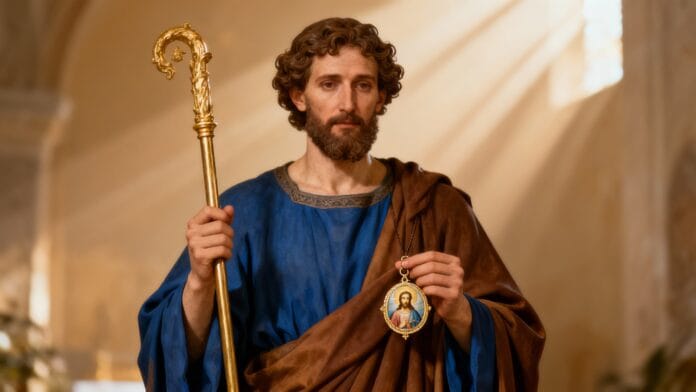
1° The person of the authorThe letter presents itself, from the very first line (1.1), as the work of "Jude, servant of Jesus Christ, brother of James" (Ἰούδας in Greek, "Judas" in Latin). This is the same name as that of the famous patriarch, son of Jacob. But it is also the name of the traitor Judas, and the intention in our language was undoubtedly to distinguish between the two. Saint Jude of the traitor (by slightly altering the ending of his name). We will justify this assertion later; here, it suffices for us to identify this character with the apostle Saint JudeIndeed, this James, whose brother the author of the letter claims to be (not without a certain emphasis, as seen from the insertion of the particle δέ, "autem"), must have been very well known in the early Church, since he is simply referred to by his name. He is in fact none other, as Origen affirms (In Ep. ad Rom.. 5, 1; of Prince, 3, 2, 1), Tertullian (De cultu fem., l, 4), Saint Epiphanius (Hær., 25, 11), Saint Jerome (In Matth. 12, 47, etc.), etc., that the apostle Saint James James the Less, cousin of Our Lord Jesus Christ (see the Introduction to his letter). Now, among the members of the apostolic college, we find a "Judas," brother of James the Less (cf. Luke 6, 18 and Acts of the Apostles 1, 13. As the ancient authors say, the phrase Ἰούδας Ἰαΰώϐου (“Judas Jacobi”) means: Judas, brother of James, and not: son of James, as has sometimes been claimed), who is no different from the latter, despite what some contemporary critics have said to the contrary: They assert that he would have assumed his titles of apostle and brother of Jesus, if he had actually held them. But Saint Paul, too, does not always present himself as an apostle at the beginning of his letters. Cf. Philippians 1:1; 1 and 2 Thessalonians 1:1, etc. The same is true of Saint James, 1, 1. He was also known by the surname Thaddeus: See Matthew 10:3b and the commentary; Mark 3:18b. In the list of apostles according to Saint Matthew, some manuscripts have Λεδδαῖος instead of Θαδδαῖος. Perhaps this was a second surname. He, too, had the great honor of being counted among the "brothers," that is, the close associates of the Savior (cf. Matthew 13:55 and Mark 5:3; Eusebius, Ecclesiastical History, 3, 18-20; 11, 14, 11).
A saying of his is quoted in the fourth gospel (cf. John 14, 22), on the occasion of the Last Supper. Nothing is known for certain about his apostolic work. According to Western tradition, he primarily evangelized Persia, and it was in this region that he suffered martyrdom. On the contrary, according to Nicephorus (Ecclesiastical History(2, 40), he is said to have preached in Palestine, in Syria and in Arabia, and is said to have died peacefully in Edessa.
2° The question of authenticity presents no serious difficulty. First, let us note that this letter is very short and deals with a very specific subject, since it is primarily directed against false doctors (see below, point 3): there were therefore far fewer opportunities to quote it. Consequently, nothing (or at least nothing very certain) is found to mention it in the writings of the Apostolic Fathers. It is known that it was initially missing from the Syriac translation. While declaring himself a supporter of authenticity, Eusebius (Ecclesiastical History, 2, 23) ranks it among the ἀντιλεγόμενα, because some doubts had been raised on this point. Saint Jerome, who also very frankly recognizes the letter as the work of Saint Jude, also points to doubts, but whose source was purely internal, without being supported by traditional data: it was claimed that the letter quotes apocryphal books (notably the Book of Enoch and the Assumption of Moses), and it was not believed that this fact could be reconciled with the composition of the text by an apostle (Saint Jerome, of Vir. ill.4. See also Saint Augustine, of Civ. Dei, 15, 23, and the commentaries on verses 9 and 14). But the Muratorian canon contains it (on line 68: "the letter of Jude is rightly considered Catholic"); which proves that it was received as authentic and canonical in the Roman Church: a very natural circumstance if Saint Peter made use of the letter, as we have said elsewhere. The Itala also contained it. We also know, from the testimony of Tertullian (De cultu fem., 1, 4), that the Churches of Africa also attributed it to Saint JudeClement of Alexandria (The Pedagogue 3, 2 ; Stromata, 3.2. He even explained the letter briefly (see Eusebius, Ecclesiastical History, 6, 14, 1), and we still possess the Latin translation of his commentary) and Origen (From Prince., (3, 2. 1, etc.) attest to the same fact with regard to the Church of Alexandria. Thus, around the year 200, our letter was accepted in most of the major local churches. All doubt disappeared in the 4th century, and from then on, the letter's authenticity was continuously believed until Luther began to deny it, followed by a number of his followers (which does not prevent many Protestant authors from accepting its authenticity).
3° The recipients are designated in the letter only by the very general formula "To those who are loved by God the Father, kept and called by Christ Jesus" (verse 1), which applies to all ChristiansIt is therefore impossible to determine precisely and with certainty where the faithful for whom the letter was directly composed lived, because no one doubts that Saint Jude had in mind a very concrete circle of Christians.
However, two main circumstances can help us resolve this difficulty. The first is that the author, in order to gain recognition from his readers, presents himself to them as the brother of the apostle. Saint James the Minor. The second lies in the nature of the heretics against whom his letter is directed. These are by no means, as is claimed in the rationalist camp in order to push back the date of the writing as far as possible, the Gnostics of the 2nd century, but, as in the letters of Saint Paul to the Philippians (cf. 3:1, 18 ff.), to Timothy (Timothy 4:1 ff.; 2 Timothy 3:1 ff.), and to Tite (1:10 ff.), and in the Second Letter of Saint Peter (2:1 ff.), the forerunners of these Gnostics. Among the commentators, some rely on the first of these two facts, and they conclude from it that Saint Jude wrote for Christians of Jerusalem and Palestine, among which Saint James enjoyed great authority. They find confirmation of their opinion in the numerous allusions the author makes to Old Testament history (see verses 5, 7, 11, etc.). Others, on the contrary, take the second fact as their basis, and suppose that Saint Jude He wrote, like the Prince of the Apostles, for the Christian communities of Asia Minor (see 1 Peter 1:1). We prefer this second view (it is the most commonly accepted), because nothing in the letter seems to indicate that the recipients were mostly of Jewish origin.
4° The opportunity and the goal clearly emerge from the very core of the letter. The heretics that Saint Jude The stigmatization in such forceful terms was a cause of great peril for the faithful; the author, in describing the errors and morals of these wicked men, therefore wanted to warn his readers against both. This is stated very clearly in verses 3-4 and 20-24.
5° The subject and the division. – Three distinct parts: the preamble, verses 1-4; the body of the letter, verses 5-23; the conclusion, verses 24-25. The body of the letter has two main subdivisions; in the first, verses 5-16, Saint Jude He predicts the exemplary condemnation of the heretics against whom he writes, and he paints their grim portrait; in the second part, verses 17-23, he exhorts the faithful not to be corrupted by these seducers, but to remain steadfast in the faith. The conclusion consists of a beautiful doxology. For a more detailed analysis, see the commentary.
6° The character and style of the letter. – We know Origen's very accurate judgment (In principle.(3:2:1): “Jude wrote a letter that has few lines, but is full of vigorous things.” This letter has been aptly compared to the writing of a prophet. The style is concise, vivid, figurative, and generally clear (much clearer than that of 2 Peter, in the passages that Saint Peter borrowed from Saint JudeThe thoughts are perfectly linked and the way they are presented is often very powerful. Saint Jude He sometimes likes to repeat them in three different forms. In his vocabulary, as in that of the sacred writers of the New Testament, there are a number of expressions that only he uses. It has been noted that he readily employs sonorous and poetic words.
7° The date and place of composition cannot be precisely determined, as certain documents are lacking. Regarding the date, we are guided by the fact, mentioned above, of the extraordinary resemblance between our letter and the second of Saint Peter. If, as is generally acknowledged, the Prince of the Apostles was familiar with the writing of Saint Jude and made considerable use of it in composing his second letter; this writing must necessarily predate the end of 66 or the beginning of 67 (for it was then that Saint Peter wrote his second letter). In any case, the circumstances that prompted the two letters present so many similarities that a long interval of time could not have elapsed between them. We can hardly go back further than 60 for the date, because of the extent to which the errors described by Saint JudeMany authors believe that the letter was not published before the death of Saint James The Minor, in 62. The year 65 would be a very suitable average date. As for the place where the letter was composed, it is best to say that we are ignorant on this point. Egypt and Palestine, and more specifically the cities of Alexandria and Jerusalem, have been mentioned, it is true, but without serious basis.
8° The letter from Saint Jude and the apocryphal books. – From ancient times, it was hypothesized that the small letter which bears the name of Saint Jude contains one or more quotations from apocryphal books. The episode recounted in verse 9 concerning the body of Moses was similarly recorded, according to Clement of Alexandria (Adumbr. in ep. Judæ), Origen (of Princip., 3, 2, 1) and Didymus (Enarrat. in ep. Judæ), in the work entitled "The Ascension of Moses." Verses 14-15 are said to be a direct borrowing from the Book of Enoch. As for the account in verse 6, concerning the angels, we have said, in explaining 2 Peter 2:4, that it has no connection whatsoever with Genesis 6:1; therefore, it is not permissible to say that it, too, is taken from apocryphal books: it is a real event, belonging to revelation. From this, it was sometimes concluded that it was neither authentic nor canonical. What should we think of this problem? Not all ecclesiastical writers were alarmed by it. Tertullian (De cultu fem., 1, 3), for example, concluded that Saint Jude thus gave his approval to the prophecy of Enoch, and Saint Augustine (De civ. Dei, 15, 23), that the patriarch Enoch wrote "certain divine things".
Moreover, it is certain that, in the very abundant apocryphal literature that existed among the Jews at the time of the birth of Jesus Christ, one found, alongside numerous legends and fictions, very serious ancient traditions, similar to those that Saint Stephen (Acts of the Apostles 7, 22, 23, 30), Saint Paul on several occasions (cf. Galatians 3:19; 2 Timothy 3:8; Hebrews 2:2 and 11:24, 37. Compare this saying of Saint Jerome, in Ephesians 1, 21: “apostolum de traditionibus Hebræorum ea quæ secreta sunt in medium protulisse”, “the apostle brought to light certain secret traditions of the Hebrews”) and Saint James (5, 17) have alleged. Nothing prevents that Saint Jude acted similarly; the two facts he cites in verses 9 and 14 of his letter were worthwhile because of their theological importance. Skillful critics, both Catholic and Protestant, maintain precisely that it was according to these ancient traditions that our author allowed himself to be guided (the authors of the Book of Enoch and the Assumption of Moses are said to have drawn from the same source). Let us note well that Saint Jude He does not directly cite any book; he mentions events without saying where he got them. Therefore, nothing compels us to believe that he took them from the apocryphal books. But we can go further. Even if we were to admit—which is certainly not the case for us personally, along with various contemporary exegetes—what several Church Fathers seem to have been the first to admit, namely, that Saint Jude If he actually cites the Assumption of Moses and the Book of Enoch, what consequence would result? We answer with Saint Jerome (in Tite 1, 12) and with Bede the Venerable (in his commentary on the letter of Saint Jude) that, even in this case, the divine origin of the letter would not be in question, since, by approving a passage from an apocryphal book, Saint Jude would not have given his approval to the entire book.
Therefore, whatever opinion one may hold, the divine authority of his writing is in no way diminished. (The writing entitled Assumption of Moses is known to us only through a few Latin fragments. Book of Enoch is often cited by the Fathers of the first four centuries. We have only known it since 1860, thanks to the discovery of an Ethiopian translation; but we also possess the Greek text, at least in considerable part (A. Lods, The Book of Enoch, Greek fragments... translated and annotated, (Paris, 1892). It is believed to be an agglomeration of several writings, originally composed in Hebrew by Jewish authors, and subsequently translated into Greek. It contains all sorts of alleged revelations made by angels, concerning secrets relating to the angelic world, the history of humanity, and that of nature, in a very confused order.
Jude
1 Jude, servant of Jesus Christ and brother of James, to the elect who have been loved in God the Father and kept for Jesus Christ 2 mercy, peace and may love be given to you in full. 3 Beloved, while I was very eager to write to you about our common salvation, I found it necessary to write to you, urging you to contend for the faith that was once for all entrusted to the saints 4 For certain men have crept in among you who were long ago marked out to be deserving of this condemnation. Ungodly men, who use the grace of our God as a pretext for sexual immorality and who deny our only Master and Lord, Jesus Christ. 5 I want to remind you of what you once learned, that Jesus, after saving his people from the land of Egypt, then destroyed those who were unbelievers. 6 and whom he reserved for the judgment of the great day, bound with eternal chains, in the midst of darkness, the angels who did not retain their principality, but who abandoned their own home. 7 Likewise, Sodom and Gomorrah and the surrounding towns, which indulged in the same kind of lewdness and abused foreign flesh, lie there as an example, suffering the punishment of eternal fire. 8 However, these men too, in their delirium, similarly defile their flesh, despise sovereignty, and insult glories. 9 Even the archangel Michael, when he disputed with the devil over the body of Moses, did not dare to pronounce a sentence of execration against him, but simply said: "May the Lord punish you."« 10 But these people blaspheme over everything they do not know, and as for what they do know naturally, like irrational beasts, they are corrupted by it. 11 Woe to them, for they have entered into the way of Cain, they have rushed headlong into the error of Balaam for reward, they have perished in the rebellion of Korah. 12 They are stumbling blocks in your feasts, where they shamelessly feast, thinking only of feeding themselves, clouds without water, carried at random by the winds, autumn trees without fruit, twice dead, uprooted, 13 furious waves of the sea, throwing up the foam of their shame, wandering stars, for whom thick darkness is reserved for eternity. 14 It was also of them that Enoch, the seventh patriarch from Adam, prophesied in these terms: «Behold, the Lord comes with the innumerable multitude of his saints.” 15 to execute judgment on all and convict all the ungodly of all the ungodly works they have committed and of all the criminal words they ungodly sinners have uttered against him.» 16 These are people who constantly murmur and complain about their lot, who live according to their desires, whose mouths are full of pompous words, and who, for their own benefit, become admirers of others. 17 Beloved, remember what was foretold to you by the apostles of our Lord Jesus Christ. 18 They told you that in the last days there would be mocking men, living according to their ungodly desires, 19 people who cause divisions, sensual men who lack wit. 20 But you, beloved, building yourselves up on the foundation of your most holy faith and praying in the Holy Spirit, 21 Keep yourselves in God's love, waiting mercy of Our Lord Jesus Christ for eternal life. 22 There are some that must be considered as already separated from you. 23 Others, save them by snatching them from the fire. For the rest, have pity on them, but with fear, hating even the tunic soiled by the flesh. 24 Now to him who is able to keep you from stumbling and to present you blameless and with great joy before the throne of his glory, to the only God, our Savior, through Jesus Christ our Lord, be glory, majesty, power, and dominion, before all time and now and forever. Amen.
Notes on the Letter of Saint Jude
1.3 To the elected officials. See Acts of the Apostles, 9, 13.
1.5 See Numbers, 14, 37.
1.6 See 2 Peter 2:4. — Demons can only leave hell by God's permission, and to tempt those whom God allows them to tempt. Their torment begins from the moment of their rebellion; they are already judged, but their sentence will then be pronounced and confirmed for all eternity.
1.7 See Genesis 19:24.
1.8 These men too ; that is to say, the false teachers against whom the apostle seeks to warn the faithful to whom he writes.
1.9 See Zechariah 3:2. May the Lord punish you strongly, that he reprimands you with threats. That is the true meaning of the text. Cf. Matthew 8, 26; Marc, 4, 39; Luke8, 24. This is not reported in Scripture; Saint Jude He knew it through tradition.
1.11 See Genesis 4:8; Numbers 22:23; 16:32.
1.12 See 2 Peter 2:17.
1.14 See Revelation 1:7. He prophesied. The prophecy reported here is not found in Scripture; the apostle knew it through tradition or through a special revelation from God.
1.16 See Psalm 16:10.
1.17 See 1 Timothy 4:1; 2 Timothy 3:1; 2 Peter 3:3.
1.19 The Spirit ; That is to say, the Spirit of God.
1.23 hating to the point of, etc.; that is, having the same horror. The apostle seems to be alluding to what is said in the Mosaic Law concerning garments soiled by leprosy or other legal impurities, from which one could be purified only by washing not only the body, but also the garment. See Leviticus, 13, verse 47 and following. He therefore means by this comparison: Flee with the greatest care even the appearances of anything that could defile your souls.