












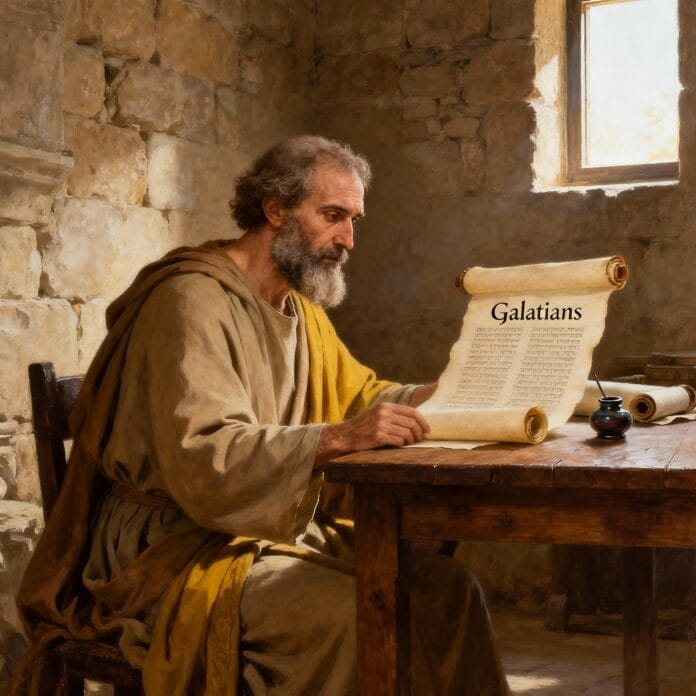
1° The recipients. Etymologically, "Galatians" (Γαλάται) is the same word as "Celts" (Κέλται or Κέλτοι). Galatia is therefore, in this respect, eastern Gaul; this is why some Roman writers refer to its inhabitants as such. Galli, just as several Greek writers called the inhabitants of ancient France Γαλάται (See Ammianus Marcellinus, 15, 9, 3; Polybius, Hist., 1, 6; Dionysius of Halicarnassus, 9, 35). Rightly so, for, according to history, the Galatians were a branch of the powerful Celtic race, which, after having begun to leave, as early as the 6th and 4th centuries BC, the distant regions of the Oxus and Turkestan where it was domiciled, gradually occupied a considerable part of central and western Europe.
The branch we are particularly concerned with came from Gaul and had attempted to invade Greece between 281 and 275 BC; but, defeated at Delphi, the bands that formed it retraced their steps, crossed the Hellespont, and invaded Asia Minor, partly at the invitation of Nicomedes I, king of Bithynia, who was then engaged in a war against his brother. As a reward for their services, this prince gave his allies, in addition to rich booty, a very fertile agricultural territory, located roughly in the center of Asia Minor on mountainous plateaus, which they began to expand by force of arms, until Attalus I, king of Pergamon, forced them to settle in the region bounded by Pontus, Cappadocia, Bithynia, Paphlagonia, Lycaonia, and Phrygia.
Such was the origin of Galatia, later also called Gallo-Greece, due to the inevitable mixing of the newcomers with the existing Greek population. In 189 BC, the Galatians, embroiled in Rome's struggle against Antiochus the Great, in whose service they had enlisted as mercenaries, were defeated by the consul E. Manlius and subjected to Roman rule. However, they were able to preserve their religion (the ancient Druidism, which gradually merged with Greek and Phrygian cults), their political organization and national laws, as well as their tetrarchs. (They were divided into three tribes: the Trocmi, THE Tolistobogii and the Tectosages, whose capital cities were Tavium, Pessinus, and Ancyra (modern-day Angora). One of these rulers, Deiotarus, who had supported Pompey against Mithridates, even received the title of king from Rome, along with an increase in territory. His successor, Amyntas, saw his dominion further extend over Pisidia, Isauria, and the districts of Pamphylia, Lycaonia, and Phrygia. But upon Amyntas' death in 25 BC, during the reign of Augustus, the entire kingdom, thus expanded, became a Roman province under the general name of Galatia (see Livy, 38.16–17; Strabo, 12.5).
From these historical details, it appears that this name had been used over time to designate two very different regions in terms of size: one smaller, corresponding to the ancient kingdom of the Galatians; the other, much larger, encompassing not only the original Galatia, but all the territory that had been successively added to it, and which ultimately formed a very important Roman province in Asia Minor. A question therefore naturally arises: to which Galatians did Saint Paul address his letter? For him, is this designation a geographical term, applicable only to the inhabitants of the original, limited Galatia, or does he treat it as simply a political and administrative division?
This second opinion, although it dates back little beyond the mid-18th century, has a considerable number of supporters. But the vast majority of exegetes adhere, and quite rightly, we believe, to the first view. Saint Luke, Acts of the Apostles 16, 6 and 18, 23, speaking of Galatia, clearly separates this region from Phrygia and the other districts where the cities of Lystra and Derbe were located (cf. Acts of the Apostles 13, 14, where the city of Antioch is formally attached to the province of Pisidia). Ancient inscriptions show that these territories were never officially and administratively attached to Galatia; thus, it would be difficult to understand why Saint Paul would have solemnly addressed men who were in reality Lycaonians and Pisidians as Galatians (cf. Galatians 3:1). Who would think of asserting that Timothy, a native of Lystra, could have claimed the title of Galatian? Furthermore, Paul reminds his readers (cf. Galatians 4:13) that "the reason for the foundation of their churches was accidental: an illness that forced the apostle to stop in their country. How could he speak in this way about the foundation of the churches of Lycaonia and Pisidia? This foundation was the express purpose of his travels," according to Acts of the Apostles 13 and 14. It is therefore to northern Galatia, to Galatia proper, that Saint Paul is addressing himself in this writing, and not to Galatia in the broader sense (cf. Galatians 1:21, where Saint Paul calls Syrianot the Roman province of that name, but the territory which Antioch had been the capital, as opposed to Judea).
The letter is addressed ecclesiis Galatiæ (ταῖς ἐϰϰλησίαις τῆς Γαλατίας, 1, 2), which gives it the character of a circular letter, which the various Churches of Galatia were to communicate to one another. This is a unique fact in Pauline literature; for all the other letters of the apostle to the Gentiles were composed for particular Churches or isolated individuals (the Letter to the Hebrews(which is an exception in a certain way, is not addressed to a group of churches, but to all Christians of Jewish origin who resided in Jerusalem and Palestine).
These churches had been founded by Saint Paul himself, as is very clear from our letter (cf. Galatians 1:6-9; 3:2-3; 4:13 ff.). The missionary had been received “like an angel of God,” and his preaching had produced swift and fruitful results. This was, according to the Acts of the Apostles (16, 6) during his second apostolic journey. About three years later, during his third journey, he again visited his dear neophytes, to strengthen them in the faith (cf. Acts of the Apostles 18, 23). These were, for the most part, converted pagans (cf. Galatians 4:8; 5:2-3; 6:12-13, etc.), since the inhabitants of Galatia largely belonged to paganism. We know, however, that the Jews had founded trading colonies even in this distant province (see Josephus, Ant., 16, 6, 2. The famous "Ancyra monument", erected in the temple of Augustus, mentions many privileges granted to the Jews of Galatia by this prince), and it is probable that a number of them had also adopted the Christian faith; but they formed only a small minority.
2° The occasion and purpose of the letter to the Galatians— The initially flourishing situation of the Galatian churches quickly gave way to turmoil, decline, and, to some extent, error (cf. 1:6; 4:9 ff.). After Paul's departure, men who are not named directly in the letter, but whom it is easy to recognize from the portrait it paints as Judaizing teachers (see Acts of the Apostles (15:1 and the commentary), had infiltrated these fledgling Christian communities, likely coming from Palestine, and had stirred up intense religious unrest by preaching a doctrine entirely contrary to that of the Apostle to the Gentiles on a crucial point. They opposed justification by faith alone with the necessity of certain Mosaic practices, particularly circumcision (cf. 2:15-16, 20; 3:2 ff., etc.). To better instill their false and subversive teaching, they had tried to diminish Paul's authority in the eyes of the Galatians (cf. 1:9; 2:1 ff.), claiming that he did not fully possess apostolic dignity, contrasting him with the great apostles Peter, James, and John, whose doctrine, they alleged, contradicted his own on the point in question. They were all too successful in winning over a number of Galatians to their cause; Saint Paul was soon informed of this, and he immediately took up his pen to fight as best he could against these perverse men.
His aim is evident in every sentence. He intends to annihilate the pernicious influence that the Judaizing leaders had gained over the Christians of Galatia, and to re-establish the threatened dogmatic truth on unshakeable foundations. To this end, he first had to defend his apostolic authority, so unjustly attacked; then he had to demonstrate, through irresistible arguments, the theory of justification by faith in Jesus Christ alone, independent of Jewish practices, and the complete freedom of the faithful from the Law of Moses.
3° The language and place of composition. The date of the Letter to the Galatians has always been the subject of intense debate, to the point that it has been placed sometimes at the beginning, sometimes in the middle, and sometimes towards the end of Saint Paul's ministry. According to some critics, this letter is the very first of the apostle's writings, which he composed around the year 49, before the Council of Jerusalem (this is the opinion of Messrs. Belser, Weber, etc.). On the other hand, several ancient authors (among others Theodoret and Saint Jerome), followed by some modern commentators (Baronius, Estius, etc.), push back the composition to the time of Saint Paul's first imprisonment in Rome. Both sides are exaggerating. As mentioned above, the author of the letter had visited the Galatians twice before writing to them (cf. Galatians 4:13, where he himself states this explicitly), and his second visit took place during his third missionary journey, between 55 and 59. The letter is therefore no earlier than 55. Furthermore, it cannot be placed much later than that date, because, according to 1:6, the painful events that prompted his letter occurred shortly after Paul's second stay in Galatia. It thus appears to have been composed in 55 or 56, as is generally accepted. Paul was then in Ephesus. The words ἐγράφη ἀπὸ Ρώμης («it was written from Rome»), which appear at the end of the letter in a number of manuscripts, are without authority. In some ancient manuscripts, the word Ῥώμης was replaced by Ἐφέσου.
4° The subject and the division. — «Jewish law and Christian law are mutually exclusive. The curse is attached to the law, just as divine blessing has been promised to faith in Jesus Christ. Choose between circumcision and the cross of Jesus!» This is the main theme treated in this letter (cf. 3, 10 ff.; 5, 3-14, etc.).
It is commonly divided into three parts: the first is personal; the second dogmatic; and the third practical and moral. After a preamble (1:1-10) containing the customary greeting and an abrupt introduction, the author demonstrates in the first part (1:11-2:21) that he is truly the apostle of Our Lord Jesus Christ, having been directly chosen by God for this glorious role, and his full authority having been recognized without question by the other apostles. The second part (3:1-4:31), comparing the law and the gospel, irrefutably proves the theory of justification by faith and, consequently, the independence of Christians with regard to legal observances. In the third part (5:1-6:10), the apostle exhorts the Galatians to practice this holy freedom, outlining its advantages and methods; then he sets forth some rules of conduct for them. In an eloquent epilogue (6, 11-18), he summarizes the arguments of the dogmatic part, and he concludes with the usual blessing.
It is easy to see from this summary that there is a very real affinity between this letter and the letter to the RomansThe dogmatic subject addressed in both writings is the same, since, in both, Saint Paul studies, and in a roughly similar manner, the crucial problem of Christian justification in contrast to Judaism. See in particular Romans 4, 3 and Galatians 3:6, where the same passage from the Old Testament is taken as the basis for an identical argument. The verbal coincidences between the two letters are quite numerous. Cf. Romans 6, 6-8 and Galatians 2, 20 ; Romans 8, 14-17 and Galatians 4, 5-7; Romans 13, 9 and Galatians 5, 14; Romans 15, 15 and Galatians 2, 7, etc. The difference lies almost entirely in the form, which is more objective, calmer, and more developed in the letter to the RomansThe tone here is personal, polemical, and at the same time more condensed (this greater brevity of the letter to the Galatians creates some difficulties for the commentator here and there). On the other hand, the apologetic and personal section recalls certain passages from the second letter to the Corinthians; on both sides, there is the same vehemence and indignation against Paul's detractors, the same tenderness for the faithful, the same abundance of biographical details, etc.
There is no need to emphasize the special importance of the Letter to the Galatians, as this is sufficiently clear from the subject matter. This letter has very aptly been called the great charter of Christian liberties. In this respect, it marks a turning point in human history; it is an extraordinarily precious document of our spiritual emancipation.
For the question of authenticity, see the General Introduction. It was only in 1850 that it was first claimed that the letter to the Galatians was not authentic; but the extrinsic testimonies are so numerous, so ancient, and this letter bears so evidently, in thoughts, feelings, and style, the seal and signature of Saint Paul, that whoever denies its authenticity pronounces against himself the sentence that he is incapable of distinguishing truth from falsehood.
5° Catholic commentators. — Besides those who have commented on all the letters of Saint Paul, we must mention the following authors: Saint Jerome, Commentariorum in letter ad Galat. book very, And Saint Augustine, Epistolæ ad Gal. expositionis liber unus.
Galatians 1
1 Paul, an apostle—not from men nor through man, but through Jesus Christ and God the Father, who raised him from the dead, 2 as well as all the brothers who are with me, to the churches of Galatia, 3 Grace and peace to all from God the Father and our Lord Jesus Christ, 4 who gave himself for our sins, to rescue us from the corruption of the present world, according to the will of our God and Father, 5 To whom be glory forever and ever. Amen. 6 I am astonished that you so quickly allow yourselves to be diverted from the one who called you to the grace of Jesus Christ, to turn to another gospel. 7 Not that there is another one, certainly, but there are people who trouble you and want to change the Gospel of Christ. 8 But even if we or an angel from heaven should preach to you a gospel other than the one we preached to you, let him be accursed. 9 We have said it before, and I repeat it now: if anyone preaches to you a gospel other than the one you received, let him be accursed. 10 At this moment, is it the favor of men, or that of God that I seek? Is my goal to please men? If I were still trying to please men, I would not be a servant of Christ. 11I tell you, brothers, the gospel I preached is not of human origin. 12 for I did not receive it from a man nor was I taught it, but I received it through a revelation from Jesus Christ. 13 Indeed, you have heard of my conduct when I was in Judaism, how I persecuted the church of God beyond measure and destroyed it. 14 and how I surpassed in Judaism many of my age and nation, being excessively zealous in upholding the traditions of my fathers. 15 But when it pleased him who had set me apart from my mother's womb and who called me by his grace, 16 to reveal his Son in me, so that I may proclaim him among the Gentiles at once, without consulting flesh and blood, 17 Without going up to Jerusalem to those who were apostles before me, I left for Arabia, then I returned again to Damascus. 18 Three years later, I went up to Jerusalem to meet Cephas and stayed with him for fifteen days. 19 But I did not see any of the other Apostles except James, the Lord's brother. 20 In everything I am writing to you, I attest to it before God; I am not lying. 21 I then went to the lands of the Syria and Cilicia. 22 But I was unknown by face to the churches of Judea which are in Christ, 23 They had only heard that the one who had once persecuted them was now proclaiming the very faith he had previously tried to destroy. 24 and they glorified God because of me.
Galatians 2
1 Then, fourteen years later, I went up again to Jerusalem with Barnabas, having also taken Tite with me. 2 It was by revelation that I went up and set forth to them the gospel which I preach among the Gentiles, I set forth privately to those who were of high standing, for fear that I was running or had run in vain. 3 But they didn't even force it Tite who was with me and who was Greek, to get circumcised. 4 And this was because of the false brothers who intruded in among us to spy on the freedom we have in Christ Jesus, in order to bring us into bondage. 5 We did not consent, even for a moment, to submit to them, so that the truth of the Gospel might be preserved among you. 6 As for those who are held in such high esteem, what they were in the past does not matter to me: God does not show favoritism between people, these highly regarded men imposed nothing more on me. 7 On the contrary, seeing that the gospel had been entrusted to me for the uncircumcised, just as it had been to Peter for the circumcised, 8 For he who worked through Peter as an apostle to the circumcised also worked through me as an apostle to the Gentiles, 9 And when James, Cephas, and John, who were considered pillars, recognized the grace that had been given me, they gave Barnabas and me their hands as a sign of fellowship, to go, we to the Gentiles, and they to the circumcised. 10 But we had to remember the poor, which I took great care to do. 11 But when Cephas came to AntiochI resisted him to his face, because he was blameworthy. 12 Indeed, before the arrival of certain people from James' entourage, he ate with the pagans, but after their arrival, he slipped away and kept to himself, for fear of the supporters of circumcision. 13 Along with him, the other Jews also used dissimulation, so that Barnabas himself was led astray. 14 For my part, when I saw that they were not walking uprightly according to the truth of the gospel, I said to Cephas in the presence of them all, «If you, being a Jew, live like the Gentiles and not like the Jews, how can you force the Gentiles to live like Jews?» 15 For us, we are Jews by birth and not of these pagan sinners. 16 However, knowing that a person is justified not by works of the law but by faith in Christ Jesus, we also have believed in Christ Jesus, in order to be justified by faith in him and not by works of the law, for by works of the law no one will be justified. 17 But if, while we seek to be justified by Christ, we ourselves are found to be sinners, would Christ then be a minister of sin? Far from it! 18 For if I rebuild what I have destroyed, I constitute myself a wrongdoer., 19 For through the law I died to the law, so that I might live to God. I was crucified with Christ 20 And if I live, it is no longer I who live, but Christ who lives in me. And the life I now live in the flesh, I live by faith in the Son of God, who loved me and gave himself for me. 21 I do not reject the grace of God, for if righteousness is obtained through the Law, then Christ died for nothing.
Galatians 3
1 O foolish Galatians, who have bewitched you, before whose eyes has been traced the image of Jesus Christ crucified. 2 This is the only thing I would like to know about you: Did you receive the Spirit by the works of the law, or by submitting to faith? 3 Are you so lacking in sense that, after starting with the mind, you end up with the flesh? 4 Did you conduct such an experiment in vain? If indeed it was in vain. 5Does he who gives you the Spirit and works miracles among you do so by works of the law, or by submission to faith? 6 As it is written: "Abraham believed God, and it was credited to him as righteousness."« 7 Therefore, recognize that these are children of Abraham, who are of faith. 8 Scripture, foreseeing that God would justify the nations by faith, announced this good news to Abraham beforehand: «All nations will be blessed through you.» 9 So that those who are of faith are blessed along with faithful Abraham. 10 Indeed, all who rely on the works of the Law are under a curse, for it is written: «Cursed is everyone who does not continue to observe everything written in the Book of the Law.» 11 Now it is evident that no one is justified before God by the Law, since "the righteous will live by faith."« 12 But the Law does not come from faith, but says, "Whoever keeps these commandments will live by them."« 13 Christ redeemed us from the curse of the Law by becoming a curse for us, for it is written: «Cursed is everyone who is hung on a tree.» 14 so that the blessing promised to Abraham might extend to the nations in Christ Jesus, so that we might receive the promised Spirit by faith. 15 Brothers, I speak according to human custom: a contract in good form, although the commitment is made by a man, is not annulled by anyone and no one adds to it. 16 But the promises were made to Abraham and to his descendants. It does not say, "And to his descendants," as if referring to many, but it says, "To your descendants," as if speaking of only one, namely Christ. 17 Here is what I mean: God having established a covenant in good standing, the law which came four hundred and thirty years later does not nullify it, so as to make the promise useless. 18 For if the inheritance were obtained through the Law, it would no longer come from a promise; but it was through a promise that God gave Abraham this gift of his grace. 19 Why then the Law? It was added because of transgressions, until the coming of the offspring to whom the promise had been made; it was promulgated by the angels, through a mediator. 20 But the mediator is not a mediator of one, and God is one. 21 Does the Law then contradict God's promises? Far from it. If a law had been given that could bring about life, then justice would truly come from the law. 22 But Scripture has imprisoned everything under sin, so that what was promised might be given to those who believe, through faith in Jesus Christ. 23 Before faith came, we were held in custody under the Law, imprisoned until the faith that was to be revealed would come. 24 So the Law was our tutor to lead us to Christ, so that we might be justified by faith. 25 But once faith has come, we are no longer under the care of a teacher. 26 For you are all children of God through faith in Christ Jesus. 27 For all of you who were baptized into Christ have clothed yourselves with Christ. 28 There is neither Jew nor Greek, there is neither slave nor free, there is neither male nor female: for you are all one in Christ Jesus. 29 And if you belong to Christ, then you are «seeds» of Abraham, heirs according to the promise.
Galatians 4
1 But I say this: As long as the heir is a child, he is no different from a slave, even though he is the master of everything 2 but he is subject to guardians and curators until the time appointed by the father. 3 Likewise, we too, when we were children, were enslaved by the forces that govern the world. 4 But when the fullness of time had come, God sent forth his Son, conceived from a woman, born under the Law, 5 to free those who are under the Law, in order to grant us adoption. 6 And because you are sons, God has sent the Spirit of his Son into your hearts, crying out: Abba. Father. 7 So you are no longer a slave, you are a son, and if you are a son, you are also an heir, thanks to God. 8 In the past, it is true, not knowing God, you served those who by their nature are not gods. 9But now that you have come to know God, or rather to be known by God, how can you turn back again to those poor and weak forces to which you again wish to be enslaved? 10 You observe the days, the months, the times, and the years. 11 I fear that my labors among you have been in vain. 12 Become like me, since I myself am like you, brothers, I beg you. You have not harmed me in any way. 13 When I first preached the gospel to you, you know the weakness of my flesh, and yet what in my flesh was a trial for you, 14 You did not despise or reject him, but you received me as an angel of God, as Christ Jesus. 15 What has become of those happy feelings? For I bear you witness that, if it had been possible, you would have torn out your eyes to give them to me. 16 So I have become your enemy because I told you the truth? 17The affection these people show you is not good; they want to detach you from us so that you will become attached to them. 18 It is beautiful to be the object of intense affection, when it is for good reasons, always and not only when I am present among you. 19 My grandchildren, for whom I am again in the pains of childbirth, until Christ is formed in you, 20 How I wish I could be with you at this hour and change my language, for I am very perplexed about you. 21 Tell me, you who want to be under the Law, do you not hear the Law? 22 For it is written that Abraham had two sons, one by the slave woman and the other by the free woman. 23 But the son of the slave woman was born according to the flesh, and the son of the free woman according to the promise. 24 These things have an allegorical meaning because these women represent two alliances. One, from Mount Sinai, bearing children for servitude: this is Hagar, 25 because Sinai is a mountain in Arabia. It corresponds to present-day Jerusalem, which is in bondage, both she and her children. 26 But the Jerusalem above is free: she is our mother 27 For it is written: «Rejoice, barren woman, you who did not bear children; burst into song and shout for joy, you who did not know the pains of childbirth. For more are the children of the desolate woman than of her who had a husband.» 28 But you, brothers, are like Isaac, children of the promise. 29 But just as then the one who was born according to the flesh persecuted the one who was born according to the Spirit, so it is now also. 30 But what does Scripture say? «Drive out the slave woman and her son, for the son of the slave woman cannot inherit with the son of the free woman.» 31 That is why, brothers, we are not children of the slave woman, but of the free woman.
Galatians 5
1 In the freedom by which Christ has set us free, stand firm and do not let yourselves be burdened again by a yoke of slavery. 2 I, Paul, tell you: If you let yourselves be circumcised, Christ will be of no value to you at all. 3 On the contrary, I declare once again to every man who lets himself be circumcised that he is obligated to fulfill the whole Law. 4 You who seek justification by the Law have fallen away from grace and no longer have any fellowship with Christ. 5 For through the Spirit we eagerly await the hope of righteousness by faith. 6 For in Christ Jesus neither circumcision nor uncircumcision has any value, but only faith that works through charity. 7 You were running so well: who stopped you, to prevent you from obeying the truth? 8 This persuasion does not come from the one who calls you. 9 A little sourdough starter will ferment the whole dough. 10 I have this confidence in you in the Lord, that you will not think otherwise, but whoever is causing trouble among you will bear the penalty. 11 For me, my brothers, if it is true that I still preach circumcision, why am I still persecuted? The scandal of the cross has therefore been removed. 12 Ah, let those who trouble you be completely mutilated instead. 13 For you, my brothers, you have been called to freedom; only do not use your freedom as an opportunity for the flesh, but surrender, by charityservants of one another. 14 For the whole Law is contained in a single word:« You shall love your neighbor as yourself. » 15 But if you bite and devour one another, beware lest you be destroyed by one another. 16 So I say, «Walk according to the Spirit and you will not gratify the desires of the flesh.” 17 For the flesh desires what is contrary to the spirit, and the spirit what is contrary to the flesh. They are opposed to each other, so that you do not do what you want. 18 But if you are led by the spirit, you are no longer under the Law. 19 Now the works of the flesh are evident: they are immorality, impurity, debauchery, 20 idolatry, witchcraft, enmity, contention, jealousy, outbursts of anger, disputes, dissensions, sects, 21 envy, drunkenness, revelry, and other such things. I warn you, as I have already warned you, that those who do such things will not inherit the kingdom of God. 22 The fruit of the Spirit, on the contrary, is charity, joy, peace, patience, gentleness, kindness, loyalty, 23 gentlenessTemperance. Against such fruits, there is no law. 24 Those who belong to Christ Jesus have crucified the flesh with its passions and desires. 25 If we live by the spirit, let us also walk by the spirit. 26Let us not seek vain glory by provoking one another, by envying one another.
Galatians 6
1 Brothers, even if someone is caught in a sin, you who are spiritual should restore that person gently. But be careful that you do not also fall into temptation. 2 Bear one another's burdens and in this way you will fulfill the word of Christ 3 For if someone believes he is something when he is nothing, he is deceiving himself. 4 Let each person examine their own works, and then they will have reason to glorify themselves alone, and not by comparing themselves to others. 5 because each person will have their own burden to bear. 6 Let the one who is taught the word share all good things with the one who teaches. 7 Make no mistake, God is not to be mocked. What you sow, you will reap. 8 He who sows to his flesh will reap from the flesh corruption; he who sows to the spirit will reap from the spirit eternal life. 9 Let us not tire of doing good, for in due time we shall reap a harvest if we do not give up. 10 Therefore, while we have opportunity, let us do good to all people, especially to those who belong to the family of believers. 11 See what letters I have traced for you with my own hand. 12 Those who want to gain the favor of men are the ones who force you to be circumcised, for the sole purpose of not being persecuted for the cross of Christ. 13For these circumcised men do not themselves observe the Law, but they want you to be circumcised so that they may boast in your flesh. 14 As for me, God forbid that I should boast except in the cross of our Lord Jesus Christ, by which the world has been crucified to me, and I to the world. 15 For circumcision is nothing, uncircumcision is nothing; what matters is being a new creation. 16 Peace and mercy be upon all who follow this rule and upon the Israel of God. 17 Furthermore, let no one cause me any more embarrassment, for I bear on my body the stigmata of Jesus. 18 Brothers, the grace of our Lord Jesus Christ be with your spirit. Amen.
Notes on the Letter to the Galatians
1.6; 1.7 Another Gospel. Saint Paul is referring here to the Gospel preached by the false teachers. It was essentially the Gospel of Jesus Christ, to which they added the practice of the Law of Moses, but this addition was sufficient, as the Apostle says, to to overturn the Gospel of Christ.
1.11 See 1 Corinthians 15:1.
1.12 See Ephesians 3:3.
1.14 Traditions from my fathers. See Matthew 15, 2.
1.17 In ArabiaPerhaps the Arabian Desert, near Damascus. The name Arabia refers to the region that stretches between Egypt, Palestine, and the Syria, Mesopotamia, Babylonia, the Persian Gulf and the Red Sea. ― In Damascus. See Acts of the Apostles, 9, 2.
1.18 Three years after his conversion.
1.19 The brother ; That is, the cousin. Since the word "cousin" does not exist in Aramaic, "brother" is used to say "cousin." See Matthew 12:46.
1.20 I attest to it before God ; that is to say, calling upon God as a witness.
1.21 Syria. See Matthew 4:24. Cilicia. See Acts of the Apostles, 5, 9 and 15, 41.
1.22 Who are in Christ that is to say, those who believed in Jesus Christ, who had converted to Christianity. ― From Judea, not including Jerusalem, the capital of Judea.
2.1 With Barnabé. See Acts of the Apostles, 4, 36. ― Having taken Tite. See 2 Corinthians 2:13. Fourteen years since my 1er trip to Jerusalem, which took place three years after my conversion. ― I went up again to attend the Council of Jerusalem (see Acts of the Apostles, 15). It was the 3rde Paul's journey to Jerusalem: the second, mentioned in Acts of the Apostles, 11, 30, has been passed over in silence here because it was only a business trip, and at that time (Easter of the year 44), Saint James The Greater had already suffered martyrdom, Saint Peter was in prison and the other Apostles were scattered.
2.2 those who were most highly regarded. See. Acts of the Apostles, 5, 36.
2.6 See Deuteronomy 10:17; Job 34:19; Wisdom 6:8; Ecclesiasticus 35:15; Acts of the Apostles10:34; Romans 2:11; Ephesians 6:9; Colossians 3:25; 1 Peter 1:17. they imposed nothing more on me, nothing that contradicted what I had explained to them.
2.7 As at the birth of the Christian Church, the Jews still retained a kind of horror for the pagans, Saint Peter and Saint Paul divided the evangelical ministry between them, so that the former was charged with preaching to the Jews, and the latter to the pagans; but this did not prevent each of them from announcing the Gospel indiscriminately to the Jews and the pagans, whenever the opportunity arose.
2.9 Cephas is the same as Saint Peter. See John 1:42. — Some authors have claimed that Cephas, with whom Saint Paul had a dispute, Antioch, was not Saint Peter; others believe this disagreement was purely fictitious; but these sentiments are inadmissible. The first point, first of all. — 1° Tradition is against him. It is true that some scholars have expressed doubt about the identity of Saint Peter and Cephas; but, as Saint Jerome remarks, this was merely conjecture on their part, and they only made it to demonstrate the weakness of the objections that were supposedly drawn from the conflict at Antioch. — 2° Cephas is indeed the same name as Peter: in Syriac, it has the same meaning as Petros in Greek. Saint Peter bore it in Judea, and it is the first name the Savior gave him. Saint Paul undoubtedly gives it to him elsewhere. — 3° It is evident that the person in question is an eminent figure, equal to, if not superior to, Saint Paul, and consequently an apostle like him. His example sways Barnabas and threatens to influence the entire Church of Antioch. Saint Paul acts courageously by sending him a representation. Besides, how could one distinguish him from Cephas mentioned earlier, between Saint James And Saint John, as being, like them, a pillar of the Church? The second view is neither more widely accepted nor more firmly established. Saint Jerome, who had initially proposed it, following Origen and Saint Chrysostom, was forced to abandon it. It is quite true that the Greek words, rendered in the Vulgate by in facie, Taken in isolation, these words could be translated as: apparently. It is also true that there is talk of dissimulation or a lack of frankness. This, however, is not enough to justify the hypothesis of a staged scene between the two apostles, or of a feigned discussion for the instruction of their disciples. Neither this interpretation nor this hypothesis is natural. It has been used only with apologetic intent, in order to cut short objections and at the same time protect the conduct of Saint Peter and Saint Paul. But the deception has been misled, and a genuine wrong, a lack of integrity in both apostles, has been substituted for a pure oversight or error of procedure on the part of Saint Peter; for the words of Saint Paul, that Peter was objectionableThis has no further consequences and no greater significance. It simply means that Saint Peter's conduct gave rise to unfortunate interpretations, that his consideration for the prejudices of his compatriots was, against his will, likely to confirm the Jews in their claims, as well as to disturb and repel the Gentiles. Nothing indicates that he had in this the least offended his conscience. God willed that on this occasion he should be warned of what he had to do, not by a vision as at Joppa, but by a colleague and subordinate, so that his humility could serve for the edification of all.
2.11 Saint Paul had reproached Saint Peter for withdrawing from the table of the Gentiles, for fear of scandalizing the converted Jews; this could lead the Gentiles to believe they were obliged to conform to the Jewish way of life, and thereby hinder Christian freedom. But this reproach in no way attacks the supremacy of the Prince of the Apostles; for, in such cases, an inferior can and sometimes should respectfully advise his superior; and, as the remarks Saint AugustineSaint Peter suffered it with a gentleness, a humility, a patience worthy of the one to whom the Savior had said: You are Peter, and on you I will build my Church.
2.16 See Romans 3:20.
2.17 Meaning: no, Jesus Christ is not a minister of sin; for it is not when we seek to be justified by faith in him, apart from the works of the Law, that we are found to be sinners, but it is when, doing the exact opposite, we want to reinstate the Law whose powerlessness we had recognized and whose practice we had abandoned.
3.4 If, however, it is in vain. That is to say, I want to hope that it will not be in vain.
3.6 See Genesis 15:6; Romans 4:3; James 2:23.
3.7 Those who are of faith. The Apostle means that it is faith that makes the true children of Abraham.
3.8 See Genesis 12:3; Ecclesiasticus 44:20.
3.10 See Deuteronomy 27:26.
3.11 See Habakkuk2:4; Romans 1:17.
3.12 See Leviticus 18:5.
3.13 See Deuteronomy 21:23.
3.14 the Promised Spirit ; that is to say, the Spirit which had been implicitly promised, see Genesis, 22, 17-18; but explicitly, see Isaiah, 44, 3; Ezekiel, 39, 29; Joel, 2, 28.
3.15 See Hebrews 9:17.
3.16 He said ; that's to say God.
3.22 The word All is for all men. We have already observed that this enallage of genre was intended to express the most complete generality. The Apostle is merely repeating here what he said previously, see Romans, 3, 9, know that THE Jews and Greeks (that is, all the pagans) were all under sin.
3.24 Our educator, Among the Greeks and Romans, guardians were usually slaves who accompanied the children entrusted to their care everywhere, watched over them, and taught them the first elements of knowledge until the child could later hear the lessons of some renowned teacher. This was precisely the role of the Law among the Jewish people.
3.25 We are no longer under the control of a pedagogue: We are sons freed from guardianship, free.
3.27 See Romans 6:3.
3.28 Greek ; that is to say, Pagan in general.
4.3 Under the yoke of the forces that govern the world, that is to say, the ceremonies of the law in use among the carnal Jews, and which were crude and figurative instructions that God gave to the world.
4.4 The fullness of time ; that is to say, the time of majority.
4.6 Abba, Father. See Mark 14:36.
4.10 The Apostle is speaking here either of the observance of happy or unhappy days, or of the Jewish festivals, to the observance of which the Jewish teachers sought to bring the Galatians.
4.13 the infirmity of my flesh ; That is, in the midst of the tribulations I was experiencing. When Paul first crossed the land of the Galatians (see Acts of the Apostles, (16:6), he was, it seems, detained among them by illness; and he took advantage of this forced stay to proclaim the Gospel to them. — a test his illness, which Paul calls the weakness of the flesh, could have harmed the success of his preaching, by attracting the contempt of the Galatians; but nothing of the sort happened.
4.22 See Genesis 16:15; 21:2. Two sons, Ishmael and Isaac, the first of the maid Egyptian, Hagar, the second, of the free woman, Sara.
4.24 Mount Sinai where the law was given to the people of Israel, in the Sinai Peninsula.
4.26 Jerusalem Above, the sky.
4.27 See Isaiah 54:1.
4.28 See Romans 9:8.
4.30 See Genesis 21:10.
5.2 See Acts of the Apostles, 15, 1.
5.9 See 1 Corinthians, 5, 6.
5.12 They should rather be completely mutilated. Since they are so keen to be circumcised, let them also be completely amputated. That is how they translated Saint Augustine, Saint Jerome, Saint Chrysostom, Theophylact, Theodoret, and most of the ancients.
5.13 Living according to the flesh, seeking to satisfy your passions even at the expense of your brothers.
5.14 See Leviticus, 19, 18; Matthew 2239; Romans 13:8.
5.16 See 1 Peter 2:11.
6.1 You who are spiritual. See 1 Corinthians 2:14.
6.5 See 1 Corinthians 3:8. Each will have their own burden to bear. This maxim is in no way opposed to that of verse 1, which relates to the present world in which men must, as good brothers, help each other with their advice, bear their mutual weaknesses and imperfections; it obviously relates to the judgment of God, where each will receive the price of his own works, good or bad, and will give an account not of what his brother would have done, but of what he himself has done, without the faults of others being able to justify his own.
6.9 See 2 Thessalonians, 3, 13.
6.10 Let's do good, etc. The Apostle exempts no one from doing good to their neighbor. Thus, difference of religion cannot be a title that exempts us from doing good to those who do not belong to our communion, although in the distribution of our charity and alms we should, as Saint Ambrose says, begin with those who are united to us by the bonds of the same law.
6.11 See which lettersetc.; that is to say, according to the Greek, what a long letter! Saint Paul usually dictated and signed his letters. That is why he points out to the Galatians that the one he is addressing to them is written in his own hand; from which they can see love every special thing he does for them.
6.12 Winning the favor of men , That is to say, to gain, through flattery and hypocritical words, the approval of men. Persecuted for the cross of Christ, as they certainly would be if they preached that the cross is the only source of our salvation.
6.13 This is not love of the Law, but the hypocrisy and pride that inspire them. ― To glorify oneself to the Jews for having circumcised you.
6.14 In the cross, as the sole foundation of salvation. ― By whom every link between the world and me is broken; the world being dead to me, I no longer have to fear it or seek its favor.
6.16 God's Israel ; the true Israel, that is, all those who are true Israelites through the spirit of faith.
6.17 I wear, etc. Formerly, certain characters were imprinted on the bodies of soldiers and servants to distinguish them. The stigmata, The marks borne by Saint Paul, servant of Jesus Christ, are the scars of the wounds, injuries, and sufferings he endured for his master. See 2 Corinthians 11:23-27.