












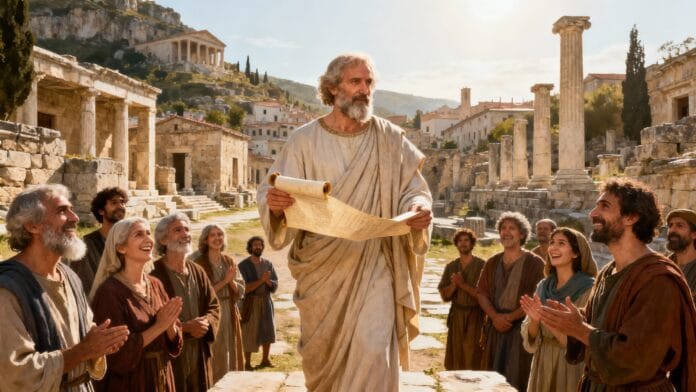
1° The City and Church of Philippi. — Both have already been presented to us in the book of Acts, 16:12 ff. Nothing is more touching than the foundation of the Christian community of Philippi, whose origin goes directly back to Saint Paul. It took place around the year 52, during his second apostolic journey. This was the first act of his ministry on European soil, an act all the more blessed by God as it was accompanied by severe trials (cf. Acts of the Apostles 16:19 ff.; Philippians 1:30; 1 Thessalonians 2:2). Saint Luke, which he left in Philippi when he himself was obliged to leave after a short stay (see Acts of the Apostles 16, 17 and the commentary), continued with zeal the work begun, so that there was soon in the city and its surroundings a flourishing Christianity, composed largely of converted pagans.
In his third missionary journey, around the year 58, the apostle returned to Macedonia, after the riot that drove him out of Ephesus (cf. Acts of the Apostles 20:1; 2 Corinthians 2:12-13), to collect alms for the poor Christians of Jerusalem, and we know from 2 Corinthians 8:1-5 that the churches of that province, and doubtless that of Philippi in particular, displayed admirable generosity. In the spring of the following year, on his way to Jerusalem, Paul spent Passover week with his beloved Philippians (Acts of the Apostles 20:5-6), and we see from the language used by the author of the Book of Acts that the separation did not take place without suffering. This is because Saint Paul loved singularly Christians of Philippi, and that he was very loved in return. “They were eager to relieve him in his laborious life; they supported him from time to time with money, and Paul, who knew their noble sentiments, did not hesitate to accept from them a service that he would have refused from other churches (cf. Philippians 4, 15-16; see also 2 Corinthians 11:9).
2° The occasion and purpose of the letter to the Philippians—Very recently (Philippians 418) The Philippians had sent one of their most zealous pastors, Epaphroditus, to their beloved father, whom they knew to be a prisoner in Rome, along with fresh financial assistance as a pledge of their filial devotion. Their messenger had given Paul news of their spiritual state. This state was generally excellent, for, as Saint John Chrysostom had already noted (In Philipp.(Praef.), there is not a trace of reproach in the letter the apostle addressed to them to thank them for their affectionate and thoughtful remembrance. Nevertheless, as has been quite rightly said, “the best-functioning Christian community always needs three warnings: Enjoy with gratitude love divine gift of which you are the object; Remain united, not allowing matters of self-love and self-interest to sow division among your hearts; Do not stop on the path of sanctification, but constantly aspire to a higher spirituality.” Always and everywhere an apostle, Saint Paul thus wished to combine these various exhortations with his feelings of personal gratitude and with the few pieces of news he himself wished to communicate to the Philippians. Some authors believe that Saint Paul addressed a first letter to the Church of Philippi prior to this one, but that it has been lost. They infer this from Philippians 3:1 (see the notes), and also from a passage by Saint Polycarp, ad Philipp., 3: Paul wrote you letters (ἐπιστολάς). But this second text does not prove the point, since the Greeks sometimes used the plural noun ἐπιστολή to mean singular. It is generally believed that Epaphroditus was entrusted with delivering this letter when he returned to Philippi.
3° The content and division of the letterOne would search in vain in this letter for a clearly defined subject, especially a dogmatic one followed by moral developments, as in the letters to the Romans, Galatians, Ephesians, Colossians, and Hebrews. Its proper purpose is an expression of thanks, to which the apostle adds, as a father would write to his family to thank them for a token of affection, news and exhortations. These last two elements alternate throughout the letter; the expression of thanks concludes it. The nature of the thoughts, like that of the style, therefore has something free, familiar, and paternal about it, even more so than in the letters to the Thessalonians; for our letter is preeminently a letter from the heart, and also the one among the writings of Saint Paul that most closely resembles an epistolary form. Despite the author's critical situation, everything breathes a holy and contagious joy. The verb χαίρω is frequently used in the letter, either to describe joy from Paul, either to invite the Philippians to rejoice in the Lord themselves. (Cf. 1, 3, 18, 19; 2, 17, 18, 20; 3, 1; 4, 4, 10).
Consequently, there is no strict logical order in the presentation of the main ideas, which are simply arranged one after the other, Saint Paul speaking sometimes of himself and his own affairs, sometimes of the Philippians, and sometimes of some of his collaborators whom he recommends to them. However, the following division can be adopted. After a fairly lengthy prologue, 1:1-11, we have the body of the letter, 1:12-4:9, which is divided as follows: 1. News concerning the apostle himself: his imprisonment has served the advancement of the gospel (1:12-26); 2. Exhortation to perseverance, to mutual unity, to...humility and to the care that each person must take for their own salvation (1:27–2:18); 3. Praise of two disciples whom Paul intends to send soon to Philippi (2:19–30); 4. The apostle warns the Philippians against Judaizing deceivers and urges them to strive for perfection (3:1–21); 5. He gives them some specific recommendations (4:1–9). The conclusion, 4:10–23, expresses feelings of deep gratitude and contains the final greetings.
Its authenticity was only challenged in the 19th century by the Tübingen school, for reasons that other, equally rationalist, critics have denied any probative value. — On the place and date of composition. It cannot be said with certainty whether the Letter to the Philippians was written before the Letters to the Ephesians, the Colossians, and to Philemon, or only after them.
Philippians 1
1 Paul and Timothy, servants of Christ Jesus, to all the saints to Philippi, to the bishops and deacons: 2 Grace and peace from God our Father and the Lord Jesus Christ. 3 I give thanks to my God every time I remember you and in all my prayers for you all, 4 It is with joy that I address my prayer to him, 5 because of your unanimous cooperation in the advancement of the Gospel, from the first day until now, 6 And I am confident that he who began a good work in you will carry it on to completion until the day of Christ. 7 It is only right that I should think this way of all of you, because I hold you in my heart, all of you who, whether in my chains or in the defense and strengthening of the Gospel, share in the same grace as I do. 8 For God is my witness how tenderly I love you all in the bosom of Jesus Christ. 9 And what I ask of him is that your charity may abound more and more in knowledge and all understanding, 10 to discern what is best, so that you may be pure and blameless until the day of Christ, 11 filled with the fruits of righteousness, through Jesus Christ, for the glory and praise of God. 12 Brothers, I want you to know that what happened to me actually turned out for the advancement of the gospel. 13 Indeed, it has become well known to those in the court and to everyone else that it is for Christ that I am in chains. 14 And most of the brothers in the Lord, encouraged by my chains, have redoubled their boldness to proclaim the word of God without fear. 15 Some, it is true, also preach Jesus Christ out of envy and a spirit of opposition, but others do so with benevolent intentions. 16 These people act out of charity, knowing that I am appointed for the defense of the Gospel., 17 while the others, driven by a spirit of contention, proclaim Christ for reasons that are not pure, with the intention of causing me additional affliction in my chains. 18 But what? However we do it, whether with ulterior motives or sincerely, Christ is proclaimed: I rejoice in it and I will rejoice in it again. 19 For I know that this will turn out for my salvation, through your prayers and the help of the Spirit of Jesus Christ: 20 according to my expectation and hope that I will have nothing to be ashamed of, but that now, as always, with the greatest confidence, Christ will be glorified in my body, whether by my life or by my death, 21 for Christ is my life and to die is gain. 22 However, if by living longer in the flesh I must reap the benefits, I do not know which to choose. 23 I am torn between two things: I long to leave and be with Christ, which is by far the best. 24 but it is more necessary that I remain in the flesh for your sake. 25 And I know it, I am certain of it, I will remain and stay with you all, for the advancement and for joy of your faith, 26 so that, through my coming back to you, you may have abundant cause to boast in me in Christ Jesus. 27 Only conduct yourselves in a manner worthy of the gospel of Christ, so that whether I come and see you, or am absent, I may hear of you that you are standing firm in one spirit, with one mind striving together for the faith of the gospel, 28 without being intimidated in any way by your opponents: this is a sign of destruction for them, but of salvation for you by the will of God, 29 For it is a grace that he has granted you on behalf of Christ, not only to believe in him, but also to suffer for him, 30 by supporting the same fight that you saw me support, and that, as you know, I still support today.
Philippians 2
1 If, therefore, there is any encouragement in Christ, if there is any consolation of love, if there is any fellowship of the spirit, if there is any tenderness and compassion, 2 Make my joy complete: be of one mind, one love, one soul, one feeling. 3 Do nothing out of selfish ambition or vain conceit, but let each one, in all humility, looks at others as if they are above you. 4 Each person taking into account, not their own interests, but those of others. 5 Have in you the same mindset that Christ Jesus had: 6 Although he was in the condition of God, he did not greedily cling to his equality with God., 7 But he emptied himself, taking the form of a slave, being made in human likeness, and being found in appearance as a man, 8 He humbled himself, becoming obedient unto death, even death on a cross. 9 That is why God exalted him to the highest place and bestowed on him the name that is above every name, 10 so that in the name of Jesus every knee should bow, in heaven and on earth and under the earth, 11 and that every tongue confess, to the glory of God the Father, that Jesus Christ is Lord. 12 Therefore, my beloved, as you have always been obedient, so now, not only as in my presence, but much more in my absence, work out your salvation with fear and trembling., 13 for it is God who works in you to will and to act in order to fulfill his good purpose. 14 Act in all things without murmuring or hesitating, 15 so that you may be blameless, pure, children of God without fault in the midst of this perverse and corrupt people, in whose midst you shine like stars in the world, 16 having received the word of life, I will be able to boast on the day of Christ that I did not run in vain, nor labor in vain. 17 And even if my blood were to serve as a libation in the sacrifice and service of your faith, I rejoice and congratulate you. 18 You too should rejoice and share in my joy. 19 I hope in the Lord Jesus to send Timothy to you soon, so that I myself may feel courageous upon hearing news of you., 20 because I have no one who is so united with me in feelings, to sincerely take to heart what concerns you. 21 Indeed, they all have their own interests in mind, not those of Jesus Christ. 22 You know that he is of proven virtue, that he has devoted himself to me, like a child to his father, in the service of the Gospel. 23 I hope to send it to you as soon as I see a resolution to my situation. 24 And I also hope in the Lord that I myself may come soon. 25 In the meantime, I thought it necessary to send you Epaphroditus, my brother, my companion in labors and battles, who had come from you to provide for my needs. 26 because he wanted to see you all again and he was very distressed that you had learned of his illness. 27 He was indeed sick to the point of death, but God had mercy on him, and not on him only, but also on me, so that I would not have sorrow upon sorrow. 28 I therefore hastened to send it to you, so that joy It came back to you when you saw him, and I myself was less sad. 29 Therefore, receive him in the Lord with full joy and honor such men. 30 for it was for the work of Christ that he came close to death, having risked his life, in order to make up for you in the service that you could not render me.
Philippians 3
1 Furthermore, my brothers, rejoice in the Lord. Writing the same things to you costs me nothing, and it is beneficial to you. 2 Beware of these dogs, beware of these bad workers, beware of these false circumcised men. 3 For we are the true circumcision, we who worship God by the Spirit, who glory in Christ Jesus, and do not trust in the flesh. 4 And yet, as for me, I too would have reason to place my trust in the flesh. If someone else believes they can do it, I can do it far more., 5 a circumcised man of the eighth day, of the race of Israel, of the tribe of Benjamin; a Hebrew, son of Hebrews; a Pharisee, as regards the Law; ; 6 a persecutor of the Church, as far as zeal and righteousness are concerned: blameless. 7 But these titles, which were precious advantages to me, I now consider a loss for the sake of Christ. 8 Yes, indeed, I still consider them a loss because of the surpassing worth of knowing Christ Jesus my Lord. For his sake I was willing to lose everything, considering everything rubbish, in order that I might gain Christ. 9 and to be found in him, not having my own righteousness, which comes from the law, but that which is born of faith in Christ, the righteousness that comes from God on the basis of faith, 10 in order to know him and the power of his resurrection, to be admitted to the communion of his sufferings, becoming conformed to him in his death, 11 to achieve, if I can, the resurrection deaths. 12 Not that I have already taken hold of it, or have already arrived at my goal, but I press on to take hold of that for which Christ took hold of me. 13 For my part, brothers, I do not consider myself to have grasped it, but I do only one thing: forgetting what is behind me and straining with all my might toward what is ahead, 14 I press on to the goal to win the prize to which God has called me from above in Christ Jesus. 15 Let this be our feelings, all of us who have reached manhood, and if on any point you have different thoughts, God will enlighten you on that also. 16 However, from the point where we have arrived, let us walk as we have already done so far. 17 You too, brothers, should imitate me and keep your eyes on those who walk according to the pattern you have in us. 18 For there are many who walk as enemies of the cross of Christ. I have often spoken to you about this, and I speak of it again now with tears: 19 Their end is destruction, for they make their belly their god and glory in their shame, having no taste for anything but earthly things. 20 For us, our citizenship is in heaven, and from there we await a Savior, the Lord Jesus Christ., 21 who will transform our wretched body, making it like his glorious body, by his powerful virtue which subjects all things to him.
Philippians 4
1 Therefore, my dear and beloved brothers, my joy and crown, stand firm in the Lord, my beloved. 2 I exhort Euodia and I urge Syntyche to be in good understanding in the Lord. 3 And you too, my faithful companion, I ask you to come to their aid, they who have fought for the Gospel with me, with Clement, and my other collaborators whose names are in the book of life. 4 Rejoice in the Lord at all times; I will say it again: Rejoice!. 5 Let your moderation be known to all men: the Lord is near. 6 Do not be anxious about anything, but in every situation, by prayer and supplication with thanksgiving, present your requests to God. 7 And peace God, who surpasses all understanding, will guard your hearts and your minds in Christ Jesus. 8 Finally, brothers, whatever is true, whatever is honorable, whatever is just, whatever is pure, whatever is lovely, whatever is highly praiseworthy—if there is any virtue or praise—think about such things. 9 What you have learned and received, what you have heard me say and seen me do, practice it and the God of peace will be with you. 10 I rejoiced greatly in the Lord that I saw your former feelings towards me bloom again; you certainly had them, but you had missed the opportunity. 11 I don't speak this way because of my needs, because I have learned to be self-sufficient with what I have. 12 I know how to live in want and I know how to live in plenty. In every situation I have learned the secret of being content and hungry, of living in plenty and of being in need. 13 I can do all things through him who strengthens me. 14 However, you did well to share in my distress. 15 Philippians, you also know that in the early days of my preaching, when I left Macedonia, no church opened an account for my salary and expenses except you alone. 16 Because you sent me to Thessaloniki, first once, then a second time, enough to provide for my needs. 17 It's not that I'm looking for donations, what I'm looking for is the increasing profit in your account. 18 Now I have plenty of everything and I am full, I am satisfied, having received from Epaphroditus the gifts from you, like a fragrant offering, an acceptable sacrifice, pleasing to God. 19 And my God will supply all your needs according to his riches in glory in Christ Jesus. 20 To our God and Father be glory forever and ever, amen. 21 Greet in Jesus Christ all the saints. The brothers who are with me greet you. 22 All the saints They greet you, and especially those from Caesar's household. 23 May the grace of the Lord Jesus Christ be with your spirit.
Notes on the Letter to the Philippians
1.1 HAS all the saints. See Acts of the Apostles, 9, 13.
1.6 an excellent work , the work of your conversion and sanctification. ― will continue its completion : will give you, by His grace, the strength to persevere until the end of your life, or until the glorious return of Christ, which was thought to be more or less imminent.
1.13 The Greek Fathers and most commentators understand here by courtroom, The emperor's palace, which at the time was that of Nero. It is certain that this name was given to the residence of the provincial governors, where the emperor himself stayed during his travels. It could therefore also have been given to the palace where he resided while in Rome.
1.22 The Apostle means that although dying for Jesus Christ is a gain for him, by putting him immediately in possession of heaven, he nevertheless doubts what he would choose, because by remaining longer in the flesh, that is to say in his body, he could still be useful for the salvation of his brothers.
1.27 See Ephesians 4:1; Colossians 1:10; 1 Thessalonians 2:12. For the faith of the Gospel, so that it may spread among those who are strangers to it.
2.6 in the condition of God, the being, the nature of God.
2.8 See Hebrews 2:9.
2.10 See Isaiah 45:24; Romans 14:11.
2.12 work towards your salvation, etc.; that is to say, distrust yourselves, and await all help from heaven, from divine protection.
2.14 See 1 Peter 4:9.
2.14-15 without whispers or hesitations against God, because of the severity of his commandments, the trials to which he subjected the first Christians, etc.
2.19 See Acts of the Apostles, 16, 1.
2.21 See 1 Corinthians 13:5.
2.25 Epaphroditus He was a Philippian whom his compatriots had sent to Rome to bring alms to Saint Paul, who was imprisoned. There he had been very ill. After his recovery, he was entrusted by the Apostle to deliver this letter to Philippi.
3.2 These dogs. Jesus Christ called the pagans dogs because of the corruption of their morals (see Matthew 10, 26); Saint Paul thus calls the false apostles, either because of the impudence and the relentlessness with which they tore apart the true apostles of Jesus Christ with their slander, or because after having left Judaism to become Christians, they returned to it, in a way, by wanting to preserve circumcision and the other practices of the law, imitating in this the dogs, who return to what they have vomited, as it is said in Proverbs, 26, 11.
3.5 See Acts of the Apostles, 23, 6. ― Hebrew, son of Hebrews ; that is to say, of fathers who were not Hellenists, or who had not mixed with the Greeks, had preserved the very language of their fathers. Cf. Acts of the Apostles, 6, 1.
3.10 Virtue, the power of his Resurrection In relation to the faithful: it gives them the certainty of their reconciliation with God, and the pledge of their own resurrection. Communion, etc. To suffer for Jesus Christ is to drink from his cup, to participate in his sufferings, and to merit to have a part in his glorious resurrection.
3.12 I myself was seized by ChristThe Apostle is alluding to what happened to him on the road to Damascus. See Acts of the Apostles, 9, verse 2 and following.
3.18 See Romans 16:17. There are many, etc., no longer the Judaizing doctors of verse 2, but Christians who led a soft life full of moral weaknesses.
3.20 Our city is in the heavens ; we already live in heaven in spirit, through our feelings and our hope.
3.21 Compare with Romans 8:19-23.
4.2 Euodia and Syntyche. They were either two deaconesses or two high-ranking women whom Saint Paul exhorts to harmony. The nature of their divisions is unknown.
4.3 My faithful companion. Companion and in Greek syzyge, which, according to several sources, should be taken as a proper name. In any case, we don't know who he is. ― With ClementOrigen and Saint Jerome tell us that this Clement is the one who became the pope Saint Clement. It is believed that he was born in Rome around the year 30 AD, and that he was the second successor, though some say the immediate successor, of Saint Peter on the See of Rome. During his pontificate, he wrote a famous letter to the Corinthians. He suffered martyrdom under the Emperor Trajan.
4.4 Rejoice!, was the common greeting formula among the Greeks.
4.10 You missed the opportunity, You were kept so busy that you were unable to give me proof of these feelings; that is to say, you were prevented from doing so.
4.15 a salary and expense account, No church, except yours, has given me any of its temporal goods for the spiritual goods it received from me. From Macedonia. See Acts of the Apostles, 16, 9.
4.16 In Thessaloniki. See Acts of the Apostles, 17, 1.
4.18 See Romans 12:1. Epaphroditus. See Philippians 2:25.
4.21-22 All the saints. See Acts of the Apostles, 9, 13.
4.22 From Caesar ; That is to say, of Nero, in whose court the Apostle had made conversions. From Caesar's house. These were Christians in the service of the emperor, but it is unknown who they were.