












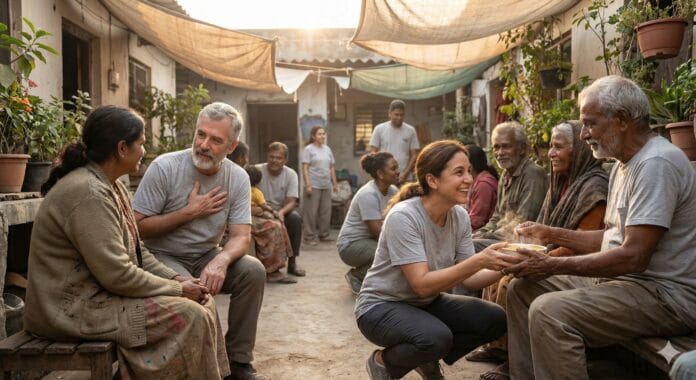
Let's face it: our society has a problem with poverty. We look away when we pass a homeless person, we cross the street to avoid being approached, we tell ourselves we don't have time or that it's not our responsibility. This indifference, the pope Leo XIV he denounces it in his exhortation« Dilexi te »"(which means "I have loved you"). He offers us a seven-step spiritual journey to learn to see Christ in the poorest of the poor.
This isn't a course in abstract theology, but a true manual for personal transformation. Because ultimately, it's about learning to love. the poor, It means accepting to be evangelized by them, changing our perspective on the world, and discovering that God is hidden where we least expect him. Pierre Durieux, general secretary of the Village Saint-Joseph federation, identified these seven steps in the papal text. Let's explore them together.
The first steps: stepping outside our comfort zones
Breaking down the wall of indifference
The first step is undoubtedly the most difficult: recognizing that we live in a culture that rejects others without even realizing it. We all have our little avoidance strategies. We look at our phone when someone asks us for help, we quicken our pace, we pretend to search for something in our bag. These reflexes become so automatic that we no longer even question them.
THE pope Leo XIV raises a disturbing question: why do we continue to exclude the poor Why should we be concerned when the Scriptures are absolutely clear on this subject? He doesn't say it's easy; on the contrary. He openly acknowledges the difficulty of this undertaking. But acknowledging a difficulty is not an excuse for inaction.
In practical terms, this first step begins with an exercise in self-honesty. The next time you encounter someone in need, observe your inner reaction. Is it embarrassment? Fear? Contempt disguised as rationalization ("they're just going to buy alcohol with my money")? This awareness is essential. We cannot change what we refuse to see.
Moving from theory to practice
The second step invites us to take care of the youngest ones. But be careful, the pope Leo XIV This exposes two traps into which many Catholics fall.
The first trap is thinking that charity It's purely a personal matter. You know, this idea that we can do our little good deed from time to time, give a few euros to a charity, and tell ourselves we've done our part. Meanwhile, we let the liberal economic system "regulate" injustices as it sees fit. The pope reminds us that a global conversion is needed, a structural change in society. Charity Individual alone is not enough if social structures continue to produce poverty.
The second trap is the opposite: thinking that charity It's purely political, a responsibility of the state. We tell ourselves that it's up to politicians to solve the problem, that we already pay our taxes, and that should be enough. But Leo XIV It calls for personal encounter. We must stop, look the poor person in the face, touch them, share something of ourselves with them.
The preferred option for the poor This is not a recent invention or a theological fad. It is the choice of God himself, as evidenced by entire sections of Church history. Think of Saint Francis From Assisi embracing the leper, to Saint Mother Teresa gathering the dying in the streets of Calcutta, to Saint Vincent de Paul organizing charity systematically. They did not choose between personal action and structural change. They did both.
To become friends and brothers
The third stage completely overturns our understanding of the relationship with the poor. We must abandon the idea of a vertical relationship, where a generous rich person condescendingly looks down on a poor person who is expected to be grateful. This vision is deeply toxic, even when it disguises itself as generosity.
THE pope Leo XIV, influenced by the Latin American tradition which it shares with the pope François, He speaks of friendship. The word appears twenty times in his text. And here we find the intuition of the bishops gathered in Aparecida in 2007: it is only by spending time with the poor that we become their friends.
Friendship, by definition, implies a relationship of equality and reciprocity. We don't choose to be friends with someone out of pity, but because we recognize their intrinsic value, because they bring something to our lives. This perspective changes everything. The poor person is no longer an object of charity, but a subject with whom one enters into a relationship.
But the pope It goes even further: it's not just about becoming friends, but brothers. The word "brother" appears twenty-six times in the exhortation. What's the difference? We choose our friends, but we receive our brothers. The poor They are not a problem to be solved, but brothers and sisters to be welcomed. That is what François he reminded us during lunch that he had offered to 1300 poor people in the gardens of Vatican in November 2025:« Brotherhood, Yes… that’s life!»
Radically transform our perspective
The poor as spiritual masters
The fourth step brings about a complete reversal of perspective. Not only must we abandon the top-down, vertical relationship, but we must actually lower ourselves, acknowledge that the poor have something to teach us.
Of course, we must proclaim Christ to the poorest. pope Leo XIV He puts it clearly: the worst discrimination they suffer the poor is the lack of spiritual attention. It is not enough to give them food or shelter. They also need to hear the Good News. But herein lies the magnificent paradox of the Gospel: they are precisely the poor who evangelize us.
This statement may seem shocking or paternalistic at first glance, but it is attested to by the entire Christian tradition. It is a surprising experience that becomes a real turning point in our personal lives: when we truly date the poor, we discover that they teach us the essentials about God, about faith, on what really matters in life.
How is this possible? The pope This provides a key: reality is more clearly seen from the margins. When we are comfortably ensconced at the center, we tend to mistake our own perspectives for universal truth. But from the margins, from the existential peripheries, we see things that we cannot see from the center. The poor are endowed with a special intelligence, indispensable to the Church and to humanity.
Consider these concrete examples. How many people who have lived through difficult experiences demonstrate spiritual depth, an ability to distinguish the essential from the superficial, a paradoxical generosity? We've all heard stories of impoverished people who share what little they have with more generosity than wealthy people. This isn't folklore or naiveté. It's a profound spiritual reality.
Recognizing the flesh of Christ
The fifth step leads us to the heart of the Christian mystery. The poor They are not a sociological category, a statistic, or a public policy issue. They are the very flesh of Christ.
This statement is not a poetic metaphor. It is a theological reality. Saint John Chrysostom already expressed it forcefully: "Do you wish to honor the body of Christ? Do not despise it when it is naked, while here you honor it with silken garments."«
There is something profoundly hypocritical about venerating the Christ present in the Eucharist, to decorate our churches magnificently, to kneel before the Blessed Sacrament, if we pass by a poor person in the street without stopping. The same Christ is present in both. It is the ongoing realization of the Gospel of Matthew, chapter 25: «I was hungry and thirsty, I was sick or in need.” prison, "Naked or a stranger... And it was me!"»
THE pope Leo XIV makes a striking parallel. Jesus promised us: «I am with you always, to the very end of the age.» And he also said:« The poor, "You'll always have them with you." These two sentences are linked. If the poor are always with us, it is because Christ is always with us, hidden in their flesh.
This perspective should completely transform our approach the poor. We should approach them with our hearts on our knees, as we would before the Blessed Sacrament. Not with condescending pity, but with the profound respect we accord to a sacred presence.
In practical terms, what does this change? It changes our perspective. When you see a homeless person on the subway, try saying to yourself, "Perhaps this is Christ." Not "It's as if this is Christ," but "This is Christ." See how this simple shift in perspective transforms your perception, your attitude, your openness.
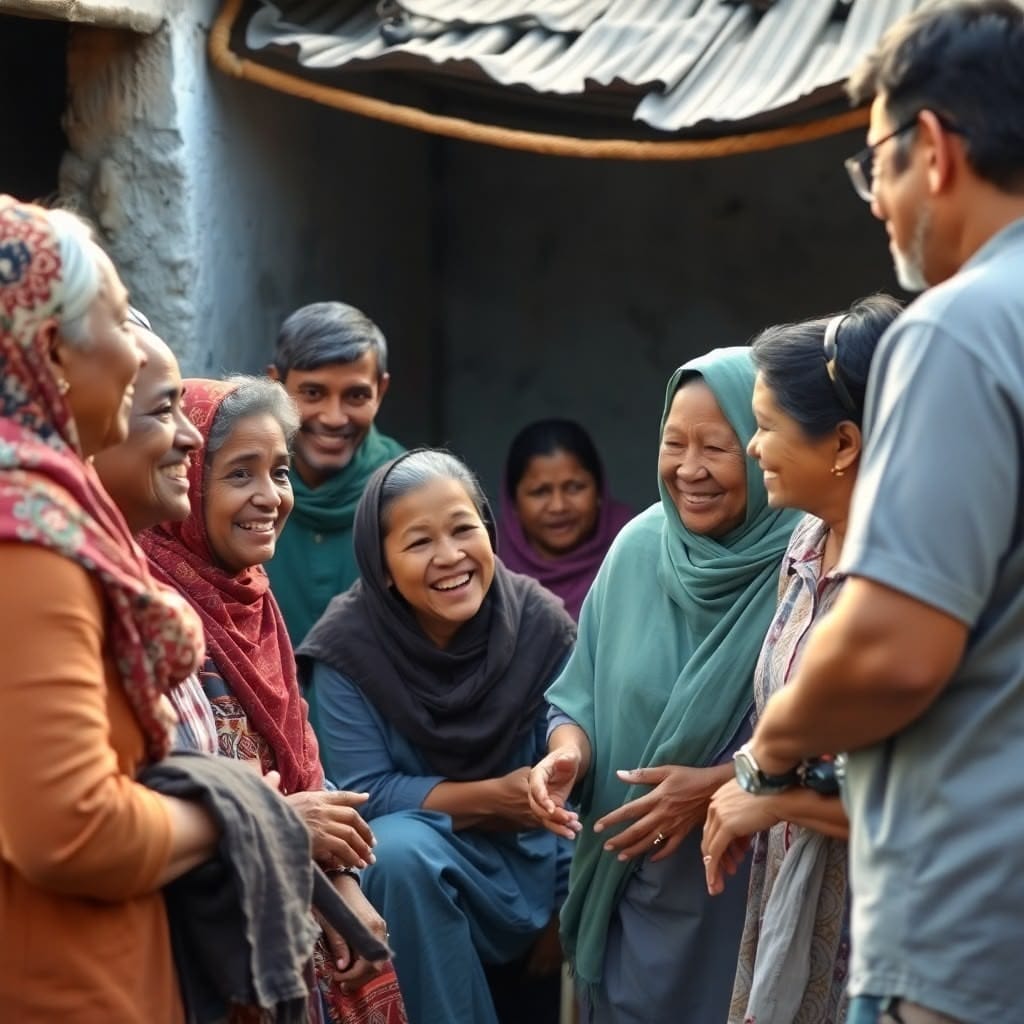
Moving to concrete action
Almsgiving as an act of justice
The sixth stage brings us back down to earth. The pope Leo XIV It doesn't leave us in a disembodied mysticism, all fine sentiments and spiritual fervor. He concludes with almsgiving. And there, we touch on something essential: the truth of your commitment is perhaps measured by what you give to the poorest.
Almsgiving has a bad reputation in our modern society. It's seen as a paternalistic, archaic gesture that perpetuates dependency. But this view is superficial and ignores the depth of the Christian tradition on this subject.
Saint Augustine As he already stated, almsgiving is a restoration of justice, not a paternalistic gesture. What does this mean? That the goods of this world are meant for everyone. If some have more than they need while others lack the necessities, there is an objective injustice. Almsgiving does not create a debt of gratitude from the poor to the rich. It simply restores a balance that should never have been broken.
Moreover, almsgiving has a profound spiritual dimension. It can "destroy the sins of the past," the papal text tells us. Saint John Chrysostom used a magnificent image: almsgiving is "the wing of prayer. If you do not give your prayer a wing, it will not fly."«
Think about it for a moment. You can pray all you want, attend church, participate in every prayer group, but if you give nothing to the poor, your prayer remains rooted to the ground. It doesn't reach the heart of God. Why? Because it's disconnected from the concrete reality of love, which always involves self-giving.
But be warned, almsgiving isn't just about giving a few coins now and then to ease your conscience. pope He speaks of "personal, frequent, and sincere gestures." Remaining in the world of ideas and discussions, without these concrete actions, will ruin our most precious dreams.
How can you put this into practice? Here are a few concrete suggestions. First, regularly carry cash. Yes, even in the age of contactless payments. Always have some euros on you so you can give when the opportunity arises. Don't worry about what the person will do with the money. That's not your problem. Your responsibility is to give.
Next, look at your monthly expenses and decide on a percentage to give regularly. It could be 1%, 5%, 10%, depending on your means. But it needs to be regular, systematic, not just when you think of it or when you feel generous.
Finally, give your time, not just your money. Get involved with a charity, a soup kitchen, or a shelter. Your presence counts as much as material aid. Sometimes even more. Many people living in poverty suffer most from invisibility, from the feeling of no longer mattering to anyone. Your regular presence, even just one hour a week, can transform a life.
The secret of "I loved you"«
The seventh and final step reveals the secret of this entire process. pope concludes his letter by returning to its title: "« Dilexi te »"I loved you." And there, he makes us understand something profoundly moving about our role in God's plan.
All these steps we have taken, all these efforts to change our perspective, to meet the poor, Giving them our time and resources has only one purpose: to allow these people to feel that Jesus' words are addressed to them: "I have loved you."«
THE pope specifies: "Whether it is through your work, your struggle to change unjust social structures, or even through this simple, very personal and close gesture of help..." In other words, whatever form your commitment takes, the objective remains the same.
And here's the final twist: it's not so much about declaring our love for God, or even for the poor. Our actions for the poor These are the path God takes to tell them, "I love you."«
Let this truth sink in. You are not a generous benefactor performing a good deed. You are the instrument through which God expresses his love for the most vulnerable. When you stop to talk with a homeless person, it is God saying to them, «You matter to me.» When you volunteer your time with a charity, it is God saying to those people, «You are not alone.» When you fight for more social justice, It is God who cries out to the world: "These lives have value!"«
That's the secret of "« Dilexi te »"God declares his love for the poorest, through us." And the pope Leo XIV He concluded forcefully: "It has to burn!"«
This image of fire is not insignificant. God's love for the poor It is not lukewarm, polite, or proper. It is a consuming fire. And we are called to be the wood that fuels this fire, to let ourselves be consumed by this divine passion for the least among us.
A path that transforms us as much as it transforms them.
At the end of this seven-step journey, one thing should be clear: this path transforms both the one who walks it and those it is meant to help. This may even be the deepest paradox of the Gospel. By learning to love the poor, It is we who become rich. By placing ourselves at their service, it is they who evangelize us. By giving to them, it is we who receive.
This process is not easy. The pope Leo XIV She recognized this from the start. She asks us to step outside our comfort zones, to question our prejudices, to confront our fears and our indifference. She calls us to concrete commitment, not just to fine sentiments. She demands that we give not only of our surplus, but of ourselves.
But it is precisely in this difficulty that the promise of transformation lies. Saint John of the Cross He said, «Where there is no love, sow love, and you will reap love.» This is exactly what happens when we commit ourselves to the poor. We bring love where indifference and rejection reign, and we reap not only their love, but also a deeper understanding of God’s love.
So, where do you begin? Don't put pressure on yourself to complete all seven steps at once. Just start with the first: breaking free from indifference. The next time you see someone in need, stop. Really look at them. Say hello. Ask their name. It's a small step, but it's a start.
Next, find a concrete way to get involved, according to your means. This could mean joining an association, donating regularly to a charity, or simply making a habit of chatting with people you meet on the street. The important thing isn't the scale of your action, but its regularity and sincerity.
Remember that on this path, you are not alone. You are walking in the footsteps of thousands of saints who discovered the face of Christ in the poor. And above all, you are sustained by the very love of God, who wants to use your hands, your voice, your presence, to say to every person in need: "I have loved you."«
It must burn brightly. So, are you ready to be consumed by God's passion for the least among us? Are you ready to become the instrument through which divine love is manifested concretely in our world? It is a demanding calling, but it is also the surest path to our own sanctification. For in the end, by loving the poor, It is ourselves that we save.