













Gospel of Jesus Christ according to Saint Matthew
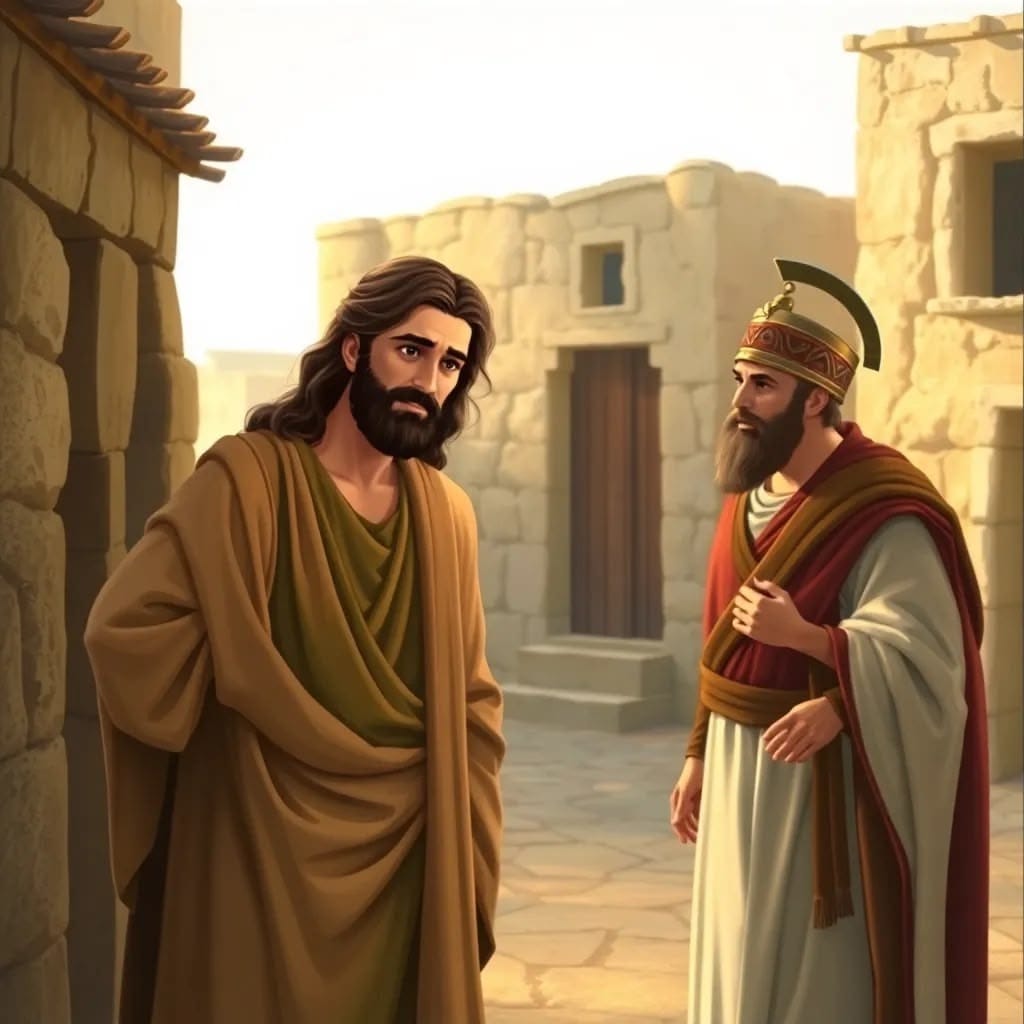
At that time, when Jesus had entered Capernaum, a centurion approached him and pleaded with him, «Lord, my servant is confined to his bed at home, paralyzed, and suffering terribly.»
Jesus said to him, "I will go and heal him myself."«
The centurion replied, «Lord, I am not worthy to have you come under my roof, but just say the word and my servant will be healed. For I myself am a man under authority, with soldiers under me. I tell this one, «Go,» and he goes; and that one, «Come,» and he comes; and to my servant, «Do this,» and he does it.»
When Jesus heard this, he was filled with amazement and said to those who followed him, «Truly I tell you, I have not found anyone in Israel with such great faith. Therefore I tell you, many will come from the east and the west, and will sit down with Abraham, Isaac and Jacob at the banquet in the kingdom of heaven.»
When faith transcends all borders: the centurion who amazed Jesus
How a Roman officer teaches us that radical trust in God opens wide the gates of the Kingdom to all, without exception.
Today's Gospel presents us with a disturbing scene: Jesus is filled with wonder. Not at the priests of the Temple, nor at his disciples, but at a pagan soldier commanding occupying troops. This Roman centurion reveals to us that true faith belongs to no people, no tradition, no religious elite. It arises where it is least expected and overturns all our certainties about who deserves to enter the Kingdom.
We will first explore the explosive context of this encounter in Capernaum, then analyze the unique nature of the faith that fascinates Jesus. Next, we will see how this scene foreshadows the radical universality of salvation, before examining its implications for our spiritual and ecclesial lives today. Finally, we will discover how to live out in concrete terms this openness that the centurion teaches us.
The shock of the encounter: when the occupier becomes a model
The political and religious context
Imagine the scene. Capernaum, a small fishing town on the shores of the Sea of Galilee, a commercial crossroads where Jews, Greeks, and Romans mingle. Jesus has established his headquarters there after leaving Nazareth. Crowds have followed him everywhere since he healed the leper in the previous chapter. The atmosphere is electric.
And then a centurion appeared. Not just any centurion: a Roman officer commanding about a hundred men, a direct representative of the occupying power. For the Jews of that time, he was the enemy. These soldiers collected taxes, maintained order by force, and constantly reminded everyone that the chosen people lived under foreign rule. Some centurions were brutal, corrupt, and contemptuous of Jewish customs.
Matthew doesn't tell us if this man was among the "good" centurions mentioned elsewhere in the Gospels. Luke specifies that he built a synagogue, but Matthew remains discreet. What matters is the contrast: this man should be an outcast, unclean, unworthy to approach a Jewish rabbi. Yet, he comes to plead with Jesus for his paralyzed servant who is suffering terribly.
The revealing narrative structure
Matthew constructs his narrative with an economy of words that makes every detail significant. The centurion "approaches" (a technical verb for worship in the New Testament) and "pleads" with Jesus. Two verbs that mark the«humility, the recognition of a higher authority. No military speech, no arrogantly issued order: just a prayer, direct, focused on the suffering of another.
Jesus' response was immediate: "I will go and heal him myself." This was an extraordinary offer, considering that for a devout Jew, entering the house of a Gentile meant contracting ritual impurity. Jesus imposed no conditions, did not verify the religious credentials of the person seeking help, and asked for no guarantees. He simply set out.
It was then that the centurion uttered the words that would change our understanding of the Kingdom: «Lord, I am not worthy to have you come under my roof, but only say the word and my servant will be healed.» We repeat this phrase at every Mass before Communion, often mechanically. But do we truly grasp its audacity?
The faith that earns God's admiration: an anatomy of total trust
L'humility as a foundation
«I am not worthy»: that is the foundation. The centurion does not compare himself to others, claims no merit, or boasts of his past good deeds. He simply stands before Jesus in the truth of his condition. Paradoxically, it is this humility which makes him "worthy" of receiving.
We live in a culture obsessed with performance, degrees, CVs, and proof of our worth. The Roman man reminds us that before God, all these titles crumble. What matters is recognizing that we receive everything by grace, that we can demand nothing, that even our unworthiness becomes the place of encounter.
This humility This is not unhealthy belittling, psychological devaluation. It is spiritual realism that sees clearly: I am a creature, limited, marked by sin, and yet infinitely loved. The centurion does not say "I am worthless trash," but "I recognize the infinite distance between you and me, and I entrust myself completely to your goodness.".
Understanding spiritual authority
The following passage is brilliant: «I myself am subject to authority, yet I have soldiers under my command…» The centurion draws a military analogy. In the Roman army, the chain of command was absolute. When a superior officer gave an order, it was executed without question. The centurion didn't even need to be physically present: his word was enough.
He transposed this principle to the spiritual realm with a flash of intuition: if he, a mere mortal, could command by his word in the military, how much more could Jesus, invested with divine authority, command sickness, paralysis, and all the forces that enslave humanity? A single word from Jesus was enough. No need for complicated rituals, magical gestures, or physical presence.
This understanding reveals a faith that has grasped the essential point: Jesus is not simply another healer, a miracle worker manipulating occult forces. He is the one who commands creation itself, because he comes from God. The centurion sees further than many of the disciples who, even after months of following Jesus, still doubt his authority over the storm, over death, over evil.
Faith without seeing
Another crucial element: the centurion believes without having witnessed a miracle. He didn't attend the wedding at Cana, didn't see Jesus turn water into wine. He probably wasn't present at the healing of the leper. He heard about it, no doubt, but he had no personal proof. And yet, he trusted him completely, immediately.
This is precisely the faith that Jesus would later celebrate at Thomas's house: "Blessed are those who have not seen and yet have believed." The centurion belongs to this category. His faith is not based on empirical evidence but on the profound intuition that Jesus speaks the truth, that his word is reliable, that we can entrust to him what is most precious to us.
We, living twenty centuries after the events, find ourselves in precisely this position. We did not see Jesus walk on water, multiply the loaves, or raise Lazarus from the dead. We have testimonies, a tradition, perhaps a personal spiritual experience, but no irrefutable proof. The centurion shows us the way: to believe based on consistency and kindness of the person speaking, not on displays of force.
The universality of salvation: when God overturns our borders
Jesus' Prophetic Declaration
«Truly I tell you, I have not found anyone in Israel with such great faith.» Imagine the effect this statement had on the Jewish disciples surrounding Jesus. Their master had just declared that a Gentile, a Roman soldier, displayed a faith superior to anything he had encountered among the chosen people. It was a complete reversal of the religious categories of the time.
The Pharisees taught that salvation belonged to Israel by virtue of the Covenant made with Abraham. Certainly, some righteous people among the nations could be saved, but this was the exception. The centurion would have to convert, accept circumcision, and observe the Torah to be included. Jesus bypasses this entire process: this man is already in the Kingdom through his faith, without having gone through any of the prescribed ritual steps.
This statement prepares the way for the entire subsequent development of the early Church. When Peter goes to Cornelius (another centurion!), when Paul opens the mission to the Gentiles, when the Council of Jerusalem decides not to impose Mosaic Law on non-Jewish converts, they will only be putting into practice what Jesus affirmed here: faith takes precedence over ethnic or religious affiliation.
The Feast of the Kingdom: An Image of Radical Inclusion
«Many will come from the east and the west and will take their places with Abraham, Isaac, and Jacob at the feast in the kingdom of heaven.» The image is powerful. Matthew, writing for Jewish Christians, uses the traditional symbol of the messianic banquet, the great feast that God will offer to the righteous at the end of time.
But he radically transforms it. It will no longer be only the biological descendants of Abraham who take their place there, but people from everywhere: the East (Persia, Mesopotamia), the West (Rome, Spain), all directions. The Kingdom has no geographical, cultural, or ethnic boundaries. The only condition for entry is the faith and trust that the centurion has demonstrated.
The image of the feast is itself significant. A meal is about sharing, conviviality, and a momentary equality among the guests. Around the table of the Kingdom, the Roman centurion will sit with the patriarchs of Israel. The repentant sinner will stand beside the saint. The outcast will share bread with the notable. All earthly privileges are abolished in this final communion.
This vision has dizzying implications for our ecclesiology. The Church is not a closed club where one enters by co-optation or inheritance. It is this universal assembly convened by God, where grace always precedes our merits, where the Spirit blows where it wills, where we are constantly surprised to discover whom God calls and how he transforms them.
The sons of the Kingdom called into question
Matthew does not include the phrase in our reading for today, but it immediately follows: «The children of the kingdom will be thrown into outer darkness.» A stark warning: belonging to the chosen people guarantees nothing. One can inherit the tradition, know the Scriptures by heart, practice all the rites, and yet remain outside the Kingdom if one refuses to believe, if one closes oneself off to grace.
Jesus belongs to the long line of prophets who denounced superficial religiosity. Isaiah already condemned those who honor God with their lips while their hearts are far away. Jeremiah announced a new Covenant written on hearts, not just engraved on tablets of stone. John the Baptist cried out to the Pharisees: «Do not presume to say, »We have Abraham as our father!’”
For us Christians today, baptized in childhood and accustomed to the sacraments, the message is the same: our faith must be alive, personal, and renewed. We cannot live by the faith of our parents or grandparents. Each person is called to this personal encounter with Christ, to this trust that transforms existence. Otherwise, we become those "children of the Kingdom" who are excluded from it by their own hardening of heart.
Implications for our lives: learning from the centurion
In our personal prayer
The centurion first teaches us an attitude of prayer. When we address God, do we come with our demands, our list of claims, our feeling of deserving certain answers? Or do we adopt this posture of’humility Confident: "I am not worthy, but just say the word"?
Many of us carry crushing burdens: illness, grief, failure, loneliness, guilt. We pray, sometimes for years, without seeing any apparent change. The centurion reminds us that our role is not to dictate to God how and when He should intervene. Our role is to present our sufferings with confidence, to believe that His word is effective, and to wait in hope.
This prayer is not passive or resigned. It is an ardent supplication (the centurion "pleads"), but devoid of any pretense of controlling God. It acknowledges that we do not always know what is good for us, that God's ways are not our own, and that his answer may come in an unexpected way.
In our ecclesial relations
If Jesus admires the faith of a foreigner, a pagan, a soldier, how does that change our view of those who are not part of our community? Too often, Christians behave as if they are the exclusive owners of grace, looking down on those who do not share their faith or practice.
The centurion compels us to recognize that God also acts outside our structures, that the Spirit breathes in hearts we would never have imagined, that holiness can flourish in lives far removed from our ecclesiastical norms. This does not diminish the importance of the Church, the sacraments, or visible communion. But it does keep us in the’humility, open to surprises.
In practical terms, this means welcoming each person who crosses the threshold of our church not as a conversion project to be molded, but as someone in whom God is already at work. Our role is not to judge the quality of their faith, but to accompany them in their encounter with Christ. The centurion came to Jesus freely and authentically. We must create the conditions so that everyone can do the same.
In our compassion for those who are suffering
The centurion does not come for himself, but for his servant. In the Roman hierarchy, a slave was property, an asset that could be replaced. Yet, this man is deeply concerned about the suffering of his subordinate, to the point of publicly humbling himself for him.
We live in a society that celebrates individual autonomy and personal fulfillment. The centurion reminds us that true greatness lies in bearing the burdens of others, interceding for those who suffer, putting ourselves at risk for their good. Who are the "paralyzed servants" in our lives? Our sick loved ones, our struggling colleagues, the migrants, The destitute, all those who are trapped in situations of powerlessness?
Intercession is not an optional pious practice. It is the very expression of charity which unites us to one another in the Body of Christ. When we pray for someone, we perform the same function as the centurion: we present to Jesus a suffering that is not our own, confident that he can transform this situation by his word.
Echoes in tradition: a foundational text
Patristic and Theological Reading
Saint Augustine He comments at length on this episode in his sermons. He sees in the centurion a figure of the Church, originating from the Gentiles, who enters into salvation through faith, while Israel, the first people called, risks rejecting it through unbelief. This typological reading has sometimes led to anti-Jewish interpretations that must absolutely be avoided today.
What Augustine rightly emphasizes is the universality of salvation and the primacy of faith. «Faith,» he writes, «is not the preserve of one people, but the gift of God offered to all.» The centurion foreshadows the multitudes who will come from all nations to take their places at the feast. His “military” faith, which includes authority and obedience, becomes the model for the Christian faith that submits to the Word.
Saint John Chrysostom, in his homilies on Matthew, insists on the’humility From the centurion: «He doesn’t say, »Come and heal,’ but, ‘Just say the word.’ He thus acknowledges that he is not worthy to receive the Lord into his home.” For Chrysostom, this humility is the key that opens the Kingdom. So many rich, powerful, educated people remain outside because they believe themselves worthy, while the centurion enters through the gate of his acknowledged unworthiness.
Thomas Aquinas, in his commentary on Matthew, analyzes the three dimensions of the centurion's faith: humility (I am not worthy), trust (just say the word), and theological understanding (understanding of divine authority). These three elements constitute perfect faith, which brings about healing. For Thomas, faith is not merely a feeling, but includes an intellectual dimension: understanding who God is and how he acts.
Liturgical and spiritual use
«Lord, I am not worthy to receive you, but only say the word and I shall be healed»: this prayer has preceded communion in the Eucharistic liturgy for centuries. The parallel is clear: just as the centurion acknowledges his unworthiness before Jesus enters «under his roof,» we acknowledge our own before receiving the Body of Christ.
But the phrase also contains a profession of Eucharistic faith: we believe that under the appearance of bread, it is truly Jesus who comes to us. His words («This is my body») are enough to effect this mysterious transformation. We do not need to understand how, only to believe that. The centurion's faith thus becomes the model for our Eucharistic faith.
Saint Ignatius of Loyola, In his Spiritual Exercises, he suggests meditating on this episode within the context of contemplating the mysteries of Christ's life. He invites us to put ourselves in the centurion's place: to feel his anguish for the sick servant, his humble approach to Jesus, his wonder at the response. This meditation should lead to a threefold dialogue: asking for’humility, confident faith, and effective love of neighbor.
In the monastic tradition, particularly among the Desert Fathers, L'’humility The centurion's prayer became a constant reference. Abba Macarius is said to have remarked, "If you wish to enter the Kingdom, become like the centurion who said, 'I am not worthy.' For he who humbles himself will be exalted." The "Centurion's Prayer" was recited at the beginning of each service, reminding the monks that even after years of consecrated life, they remained unworthy and dependent on grace alone.
Meditate with the centurion
Step 1: Locating oneself in the scene
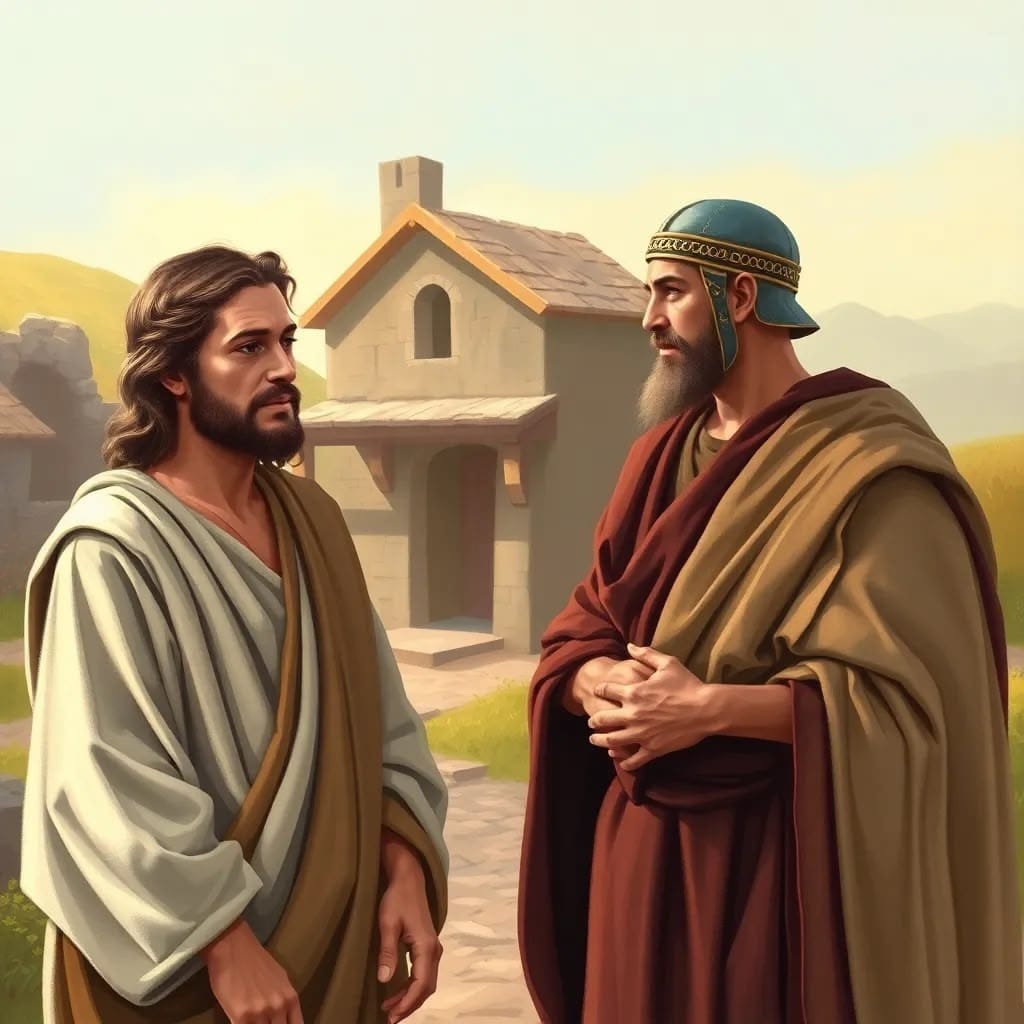
Take a moment of silence. Close your eyes and imagine yourself in Capernaum. You are in the crowd following Jesus. You see this Roman centurion approaching, a man used to commanding, yet now pleading. Observe his face, his gait, the tone of his voice. What do you feel? Mistrust because he is Roman? Curiosity? compassion for his sick servant?
Step 2: Identify your own "paralysis"«
What is paralyzed within you? What part of your life is blocked, hindered, or causing you pain? It could be a broken relationship, a paralyzing fear, a destructive habit you can't seem to break, or a loss that's holding you back. Name it silently, without judgment.
Step 3: Acknowledge your unworthiness
Slowly repeat: «Lord, I am not worthy.» Not as a learned phrase, but as a truth that dwells within you. You have nothing to prove, nothing to earn. You stand before God in your poverty radical. Drop your defenses, your justifications, your comparisons with others. Breathe in this poverty recognized.
Step 4: Take an act of faith in his word
Now add: «But just say the word and I shall be healed.» Do you truly believe that God’s word can transform this situation? Or do you think it’s too serious, too deeply rooted, too complicated? Explicitly entrust it to Jesus, without dictating the solution, but with complete trust in Him.
Step 5: Waiting in hope
The text doesn't say that the servant was healed instantly in front of the crowd. Matthew simply states: "And the servant was healed at that very hour." The healing took place at a distance, out of the centurion's sight. Your prayer, too, can be answered in ways you don't immediately see. Remain in faith, like the centurion who left without any visible proof, certain that Jesus' word had worked.
Universality put to the test
Religious pluralism
Our era is marked by a keen awareness of religious diversity. If the pagan centurion can have a faith that amazes Jesus, what about Muslims, Buddhists, Hindus, and well-intentioned agnostics? Are we condemned to choose between a narrow exclusivism (only Christians are saved) and a relativism where all beliefs are equal?
The Gospel shows us a narrow path. On the one hand, Jesus clearly states that salvation comes through him:« I am the way, "The truth, the life. No one comes to the Father except through me." On the other hand, he recognizes and celebrates the faith of those who are not part of Israel, who do not yet fully know him. The centurion believes in Jesus, but he does not yet have the complete Trinitarian faith; he does not know the Pascal's mystery.
Catholic tradition has developed the notion of "anonymous Christians" (Karl Rahner) or "seeds of the Word" (Vatican II) to think about this reality. Wherever there is true faith, humility, Love of neighbor, a sincere search for truth—God is at work, even if the person does not explicitly name Christ. Our role is not to judge who is saved or not, but to bear witness to what we have received and to humbly acknowledge that the Spirit acts far beyond the visible boundaries of the Church.
The inclusion of marginalized people
The centurion was a religious outsider, an outcast from the perspective of Jewish Law. Who are the outcasts today in our Christian communities? Divorced and remarried people, LGBT+ people, migrants undocumented, the poor whose disorderly life does not correspond to our standards of respectability? The welcome that Jesus gives to the centurion challenges us.
Certainly, welcoming others does not mean abolishing all moral or doctrinal norms. The Church has a mission of truth to fulfill, sacraments to protect. But the question is: how do we accompany these people? With the disdainful distance of the Pharisees who believe themselves pure? Or with the recognition that God acts in their lives in ways we may not even suspect?
THE pope Francis has often emphasized that the Church must be a "field hospital," welcoming the wounded first and foremost without asking for their papers. The centurion comes as he is, with his violent profession, his status as an occupier, his life that in no way conforms to Jewish standards of holiness. Jesus doesn't lecture him, doesn't impose any preconditions. He responds to his faith. This is the attitude we must rediscover: trusting that the Spirit is at work in the hearts of those who approach him, and respectfully accompanying them on their journey.
The temptation of faithless religiosity
Another challenge: we may be "sons of the Kingdom" in name, regular churchgoers, involved in our parishes, and yet lack that living faith that characterizes the centurion. We know the prayers by heart, we participate in the sacraments, but does our heart truly remain turned towards God with childlike trust?
The risk, for Christians Traditionally, it's a spiritual routine. We go through the motions without putting our hearts into it. We recite "I am not worthy" before each communion, but do we truly believe it? Or are we simply behaving like regulars who have their own little access to God?
The centurion shakes us up. He reminds us that every encounter with Jesus must be new, personal, and risky. He invites us to regularly examine ourselves: Is my faith alive, or has it become rigid and empty? Do I truly trust the word of God, or do I rely on my own strength, my own merits, my own strategies?
Prayer inspired by the centurion
Lord Jesus Christ, You who admired the faith of the centurion and proclaimed the universal opening of your Kingdom, we come to you with our paralysis and our burdens.
We are not worthy to have you enter our lives, marked as they are by sin, selfishness, and doubt. We acknowledge our limitations, our closed-offness to others, our tendency to believe we own your grace.
But we believe in your word, a word that heals, that liberates, that lifts up. Just say the word, and our hardened hearts will become welcoming, our paralyzing fears will transform into confidence, our judgments of others will give way to compassion.
Teach us the’humility of the centurion, who knew how to stand before you without pretension, in the truth of his station. Grant us his intelligent faith, which understands that your authority is exercised through love, that your word creates what it proclaims, that you can transform everything by your mere presence.
Open our hearts to the universality of your call. Help us to recognize your disciples in those we would never have imagined: the strangers who disturb us, the fishermen who scandalize us, the sincere researchers who do not yet bear your name.
May we, like the centurion, bear the burdens of our brothers and sisters, intercede for those who suffer, and expose ourselves for their good.
Make our Christian communities images of the feast of the Kingdom where all are welcomed without distinction, where grace always precedes our merits, where your wonder keeps us in awe.
And when the time comes for us to sit at your eternal table, with Abraham, Isaac, and Jacob, with all the saints Coming from the east and the west, may we recognize around us many faces that we did not expect, and give thanks for your mercy which surpasses all measure.
You who reign with the Father and the Holy Spirit, now and forever.
Amen.
Faith without borders that changes everything
The centurion of Capernaum disturbs us as much as he disturbed Jesus' contemporaries. He challenges our certainties about who deserves to enter the Kingdom, about what it truly means to believe, about the scandalous universality of divine grace. This man, whom everything should exclude, becomes the very model of faith for all ages to come.
His lesson is crystal clear: what matters before God is neither our religious background, nor our spiritual achievements, nor our conformity to external standards. It is this radical, humble, and intelligent trust that recognizes the absolute authority of the divine word and surrenders to it completely. A faith that doesn't calculate, doesn't bargain, doesn't compare itself, but simply believes and lets God act.
For us today, the call is threefold. First, to examine the quality of our own faith: is it alive, personal, renewed, or has it become fossilized into empty habits? Second, to broaden our perspective on those whom God calls: to cease judging, to welcome the surprise of seeing the Spirit at work in lives we would never have imagined. Finally, to cultivate the’humility radical, which alone opens the door to the Kingdom: recognizing our unworthiness and receiving everything by grace.
The feast of the Kingdom is already set. Multitudes throng to it, coming from all corners of the world. The choice is ours: will we remain outside, frozen in our certainties and our supposed privileges? Or will we enter, following the centurion, into this joyous universal assembly where only faith, which acts through love, matters?
Practical advice: seven attitudes to cultivate
Repeat the Centurion's Prayer daily upon waking and before sleeping, not as a magic formula, but as a conscious act of faith and surrender to the divine will.
Identify one personal "paralysis" each week (fear, blockage, harmful habit) and explicitly entrust it to Jesus in prayer, trusting him to transform it in his own way and in his own time.
Practicing concrete intercession by choosing each day a suffering person from our circle and taking a few minutes to present them to God with faith, like the centurion for his servant.
Examine our judgments on those who do not share our faith or religious practice, and ask for the grace to recognize God's action in their lives rather than mentally excluding them.
Truly welcoming into our communities by identifying who the "centurions" of today are (the excluded, the marginalized, the different) and by taking a concrete step of openness towards them.
Cultivating’humility spiritual by regularly acknowledging our unworthiness before God, not to devalue ourselves, but to receive everything from his grace without pretension.
To deepen our Eucharistic faith by meditating on the link between the centurion's prayer and communion, truly believing that the word of Christ transforms the bread into his Body and transforms us ourselves.
References for further reading
Related biblical texts Luke 7:1-10 (parallel account with variants); Acts 10:1-48 (Cornelius, another believing centurion); Romans 10:9-13 (faith as the gateway to universal salvation); ; Ephesians 2,11-22 (the unity of Jews and Gentiles in Christ).
Patristic : Saint Augustine, Sermons 62-65 on the centurion; Saint John Chrysostom, Homilies on Matthew No. 26; Origen, Comment on Matthew 8,5-13.
Contemporary Theology Karl Rahner, "« Christians anonymous», in Theological writings (1966); Hans Urs von Balthasar, The Divine Drama Volume III, on the universality of salvation; Joseph Ratzinger/Benedict XVI, Jesus of Nazareth Volume 1, Chapter on miracles.
Ecclesial Magisterium Council Vatican II, Lumen Gentium §16 on the salvation of those who do not know Christ; ; Gaudium et Spes §22 on the universal action of the Spirit; ; Pope François, Evangelii Gaudium §24-28 on the Church going out to the peripheries.
Spirituality : Ignatius of Loyola, Spiritual exercises (contemplation of the mysteries of the life of Christ); Thérèse of Lisieux, Autobiographical manuscripts (on the little way of spiritual childhood); Charles de Foucauld, Meditations on the Gospels (on the faith of the humble).