










Solemnity of the’Immaculate Conception : when divine grace precedes all human history.
This solemnity celebrates the unique privilege granted to Married from the moment of her conception in the womb of Saint Anne. Defined as dogma by Pius IX in 1854 after centuries of theological debate, this mystery affirms that Married was preserved from all stain of original sin by an anticipated grace through the merits of her Son. Far from being an abstraction, this dogma reveals how God prepares humanity to receive his incarnate Word. Rooted in Eastern traditions from the earliest centuries, and gradually adopted by the West despite the resistance of Bernard, Bonaventure, and Thomas Aquinas, this truth of faith illuminates our own vocation to the holiness.
December 8th marks one of the most controversial Marian solemnities in Christian history. For eight centuries, theologians and popes have clashed on this issue: Married Could she escape the original sin that has marked all of humanity since Adam? In 1854, Pius IX definitively settled the matter by proclaiming the’Immaculate Conception as a dogma of faith. Four years later, in Lourdes, a young shepherdess would hear a mysterious Lady tell her: "I am the«Immaculate Conception."This unique privilege reveals the power of divine grace that precedes us all.".
Genesis of a thousand-year-old dogma
Celebrate the’Immaculate Conception, it is to honor a mystery that has its roots in the early centuries of the Christianity. The Eastern Churches established a feast of "the Conception of the Holy Mother of God" on December 9th as early as the 8th century. This celebration, centered on the conception of Married in the womb of Saint Anne, expresses a profound theological intuition: the mother of the Savior had to be prepared in an exceptional way.
The West gradually adopted this devotion from the 10th century onwards, particularly in England and Normandy. But the 12th century saw the emergence of major opposition. Saint Bernard of Clairvaux railed against this novelty, which he considered to have no scriptural basis. For him, only Christ escaped original sin. Recognizing this privilege to Married would risk placing her outside of humanity, requiring Redemption.
This resistance was echoed by the greatest theologians of the 13th century. Saint Bonaventure and Saint Thomas Aquinas refused to admit the’Immaculate Conception. Their reasoning encounters a seemingly insurmountable difficulty: if Married Since she escaped original sin, how could she need to be redeemed by her Son? The dogma of Universal Redemption seemed incompatible with this Marian privilege.
The decisive breakthrough came from a Scottish Franciscan, John Duns Scotus, around 1300. His genius lay in reformulating the problem: Married was indeed redeemed by Christ, but in anticipation, from the moment of her conception. It is a "preservative redemption" rather than a "liberating" one. God, foreseeing the merits of the Passion, preserves Married of original sin at the very moment his soul is created. This brilliant solution reconciles Marian privilege and universal Redemption.
The Sorbonne in Paris adopted this view in the 15th century. Popes regularly intervened to quell the disputes without imposing a definitive position. Sixtus IV authorized the festival in 1476. The Council of Trent (1545-1563) explicitly excluded it. Married of his decree on original sin, leaving the question open. Clement XI extends the feast to the’Universal Church in 1708.
The 19th century saw a massive popular movement in favor of’Immaculate Conception. Millions of faithful petitioned Rome for a dogmatic definition. Pius IX consulted bishops from around the world: 546 voted in favor, only 4 expressed reservations. On December 8, 1854, in the bull Ineffabilis Deus, THE pope solemnly proclaims: "The Blessed Virgin Married was, at the first instant of her conception, by a singular grace and favor of Almighty God, in view of the merits of Jesus Christ, Savior of humankind, preserved immaculate from all stain of original sin.»
This definition carefully clarifies several essential points. First, the privilege concerns the first moment of his conception, when his soul was created in Anne's womb. Second, it is a unique grace, not a natural right. Third, this grace is based on the merits of Christ, confirming that Married remains fully redeemed. Fourth, it is preserved from all defilement, including the consequences of original sin.
The apparitions at Lourdes in 1858 provided unexpected confirmation. When Bernadette Soubirous asked the Lady who appeared to her to name herself, the latter replied in Béarnese dialect: "Que soy era Immaculada Councepciou" – "I am the«Immaculate Conception. » This singular formulation, incomprehensible to the young illiterate shepherdess, resonates like a celestial echo to the dogmatic definition of four years earlier.
The development of this dogma reveals how the Church deepened its understanding of the revealed mysteries. The truth was present from the very beginning, like a seed. It germinated slowly through debates, oppositions, and theological syntheses. The 1854 definition did not create a new dogma but made explicit what the Church had always obscurely believed.
Between tradition and symbols
L'Immaculate Conception It is rooted in several biblical and patristic traditions that must be carefully distinguished. The established fact remains the dogmatic definition of 1854: Married She was preserved from original sin from the moment of her conception. This truth of faith engages papal infallibility and requires the assent of all Catholics.
The scriptural foundations, though not explicit, nourish theological reflection. The Gospel of Luke presents the angel Gabriel greeting Married as "« full of grace » (Luke 1,28). The Greek translation kecharitōmenē suggests a permanent state of grace that precedes the Annunciation. The Greek Fathers see in it a holiness original. Elizabeth proclaims it "blessed among all women » (Luke 1,42), a formula which evokes a unique election in the history of salvation.
Genesis offers another avenue with the Protoevangelium (Gn 3,15): God announces an "enmity" between the woman and the serpent. Tradition sees in Married This new Eve crushes the serpent's head. This radical hostility to sin implies that she was never touched by it. The Apocalypse (12.1) presents "a woman clothed with the sun, with the moon under her feet," an image of cosmic purity that the Church applies to Married.
Pious legends enrich this mystery without claiming the status of dogmatic truth. Protoevangelium of James, apocryphal text from the 2nd century, recounts that Joachim and Anne, parents of Married, They miraculously obtained this daughter after years of infertility. An angel is said to have announced her birth to them, foreshadowing the Annunciation. This tradition anchors the’Immaculate Conception in a divine intervention even before conception Married.
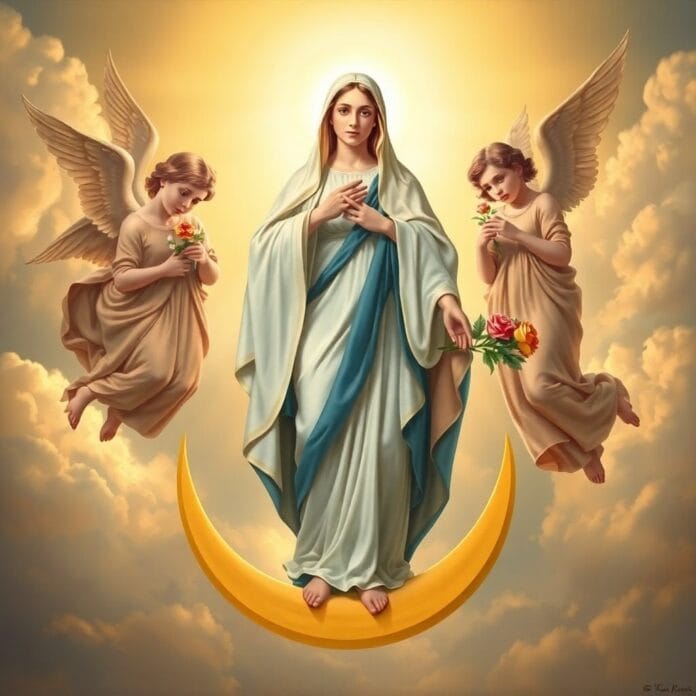
The iconography develops powerful symbols. Married She often appears standing on a crescent moon, crushing a serpent, surrounded by twelve stars. These attributes refer to the Apocalypse and signify his victory over evil. The color white dominates, evoking original purity. The lily, the quintessential white flower, becomes his favored attribute in Western art.
Some local traditions deserve more critical scrutiny. The idea that Married The idea that she never experienced the slightest temptation or spiritual weariness is a matter of pious speculation. Dogma affirms that she was preserved from original sin and its consequences, not that she lived a paradisiacal life disconnected from human struggles. Even if immaculate, Married had to exercise his faith, his trust, his courage in the face of trials.
The symbolic significance of’Immaculate Conception It goes far beyond the Marian privilege. It reveals that divine grace always precedes our response. God warns us, prepares us, and sanctifies us even before we are aware of it. Married embodies this absolute priority of divine initiative in the work of salvation. It also shows that the holiness Perfection remains possible, even in a world marked by sin.
This mystery also sheds light on the original creative design. Before the fall of Adam, God wanted humanity to be holy, immaculate, and in perfect communion with him. Married realizes this initial project. It is "the glory of our sinful nature," according to the liturgical expression, because it reveals what we are called to become through grace. The«Immaculate Conception don't move away Married of us: it anticipates our own final transfiguration.
Modern Marian apparitions, from Lourdes to Fatima, regularly revive this mystery. At Lourdes, the Lady presents herself as "the«Immaculate Conception »", a theological formula in the mouth of an uneducated young peasant girl. This prodigious sign authenticates the recent dogmatic definition. The miraculous healings of Lourdes manifest the power of this original purity over the ravages of sin and death.
The distinction between revealed dogma and devotional enrichments remains essential. A Catholic must believe that Married She was preserved from original sin from the moment of her conception. He can venerate traditional images, meditate on scriptural symbols, and pray in Marian shrines without necessarily subscribing to all the pious interpretations that circulate. Faith seeks understanding, not credulity.
The grace that precedes us
L'Immaculate Conception It reveals a shocking truth about how God works in our lives. He doesn't cleanse us afterward, like cleaning a stain. He precedes us, enveloping us in his grace before we are even aware of it. Married manifests at its culminating point this divine priority that we all experience obscurely.
Think about your own faith story. You didn't begin by seeking God on your own. Someone baptized you as a child, or providential encounters led you to him. Behind your desire to believe, there is always a prior initiative from God. "You did not choose me, but I chose you" (John 15:16).«Immaculate Conception illustrates this universal spiritual law in a unique way.
This truth combats two opposing temptations. First, despair in the face of our sins. If Married She was preserved from original sin by grace, not merit. The same grace is offered to us every day to help us rise again, begin anew, and move forward. No fall can exhaust her. mercy Divine grace, which always warns us. Then, the pride of our spiritual efforts. We do not sanctify ourselves by our own strength alone. Divine grace initiates, sustains, and completes every progression toward... holiness.
Married «"« full of grace »This teaches us a fundamental attitude: receptivity. It welcomes the divine work without resistance, says "yes" to the impossible, and allows itself to be inhabited by a holiness which surpasses her. This radical openness does not negate her freedom; on the contrary. It is by fully consenting to grace that Married becomes the freest, the most herself. Our own freedom is fulfilled in welcoming what God works in us.
In concrete terms, this mystery transforms our view of evil and purity.’Immaculate Conception This proves that a life without sin remains possible, not through stoicism or willpower, but through surrender to grace. Each time we resist a temptation, let us celebrate a small victory of the Spirit within us. Each sacrament of reconciliation reactivates this loving grace that seeks to restore us. Purity is not primarily an absence, but a fullness: the fullness of divine love that dispels sin as light dispels darkness.
Prayer
Virgin Married, Immaculate Conception, You, whom divine grace preserved from all defilement from the first moment of your existence, teach us to recognize this same grace that precedes us each morning. You were filled with grace even before you could say "yes": may this truth comfort us when we doubt God's love for us.
You who remained without sin in the midst of a world marked by evil, obtain for us the strength to resist daily temptations. Not by our own strength alone, but by relying on the grace that desires to sanctify us. May each sacrament, each prayer, each effort to love rekindle within us that original purity which sin has obscured but which baptism has restored.
Mother of hope, you who show that the holiness Remain accessible, accompany us in our falls and our rises. When discouragement grips us in the face of our repeated weaknesses, remind us that mercy Divine intervention always warns us. You who crushed the serpent's head, intercede so that we may resist the suggestions of the evil one with the same radical trust in God.
Grant us that profound openness that was yours at the Annunciation: an open heart, a flexible will, a humble understanding before the divine mysteries. May we learn, like you, to let God work within us rather than trying to control everything by our own means. Make us docile recipients of transforming grace.
Through your powerful intercession, may all those who doubt their ability to progress spiritually rediscover this liberating truth: God loves us before we love Him, sanctifies us before we seek Him, forgives us even before we ask for forgiveness. Immaculate Conception, Pray for us who have recourse to you. Amen.
To live
- Meditate Luke 1,26-38 for ten minutes contemplating the availability of Married faced with the impossible that God offers him, then identify an area of your life where you resist grace out of fear or control.
- To perform an act of relational purity : asking for forgiveness for a recent hurtful word, refusing to speak ill of someone, or sincerely encouraging someone you tend to criticize.
- Recite the rosary (at least ten) by entrusting to Married a situation where you feel powerless, recognizing that divine grace can do in you what your efforts cannot achieve.
Memory and places of the Immaculate Conception
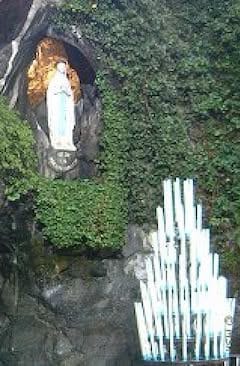
Lourdes remains the quintessential sanctuary of the’Immaculate Conception Since 1858, the grotto of Massabielle, where Bernadette saw "the Lady" appear, welcomes six million pilgrims each year. On December 8, a torchlit procession gathers tens of thousands of faithful in the Pyrenean night. The words "I am the«Immaculate Conception »" are engraved in gold letters at the exact location of the sixteenth apparition. The miraculous springs continue to flow, offering physical healings and spiritual conversions.
Rome still has several remarkable sites. The Basilica of Saint Mary Major houses a chapel dedicated to the’Immaculate Conception since 1854. Plaza de España, the column of the’Immaculate Conception erected in 1857, it bears a statue of Married crushing the snake. Every December 8th, the pope He goes there to lay a wreath of flowers, a tradition maintained since Pius IX. The Roman firefighters install a wreath at the top of the column during a spectacular ceremony.
In France, the Notre-Dame des Victoires church in Paris remains a major site of Marian devotion linked to the’Immaculate Conception. Thousands of votive offerings cover its walls, testifying to graces obtained through the intercession of Married. The Autun Cathedral houses a remarkable statue of the’Immaculate Conception from the 15th century, prior to the dogmatic definition but already expressing this intuition of faith.
Spain celebrates the’Immaculate Conception As the patron saint of the country since 1644, Seville boasts a centuries-old tradition of devotion to "La Inmaculada" (The Immaculate Conception). The cathedral houses Murillo's monumental altarpiece of the Immaculate Conception. Every December 8th, the people of Seville hold a grand procession in which the image of the Immaculate Virgin is carried in triumph. Granada, Cordoba, and Toledo also boast impressive Marian devotion on this date.
Portugal venerates the’Immaculate Conception at Fatima, where she appeared in 1917. Although the apparitions were centered on the message of penance and conversion, the Virgin presented herself as "the Lady of the Rosary »The title refers to her immaculate purity. The Chapel of the Apparitions, erected on the exact spot of the visions, attracts millions of pilgrims annually. December 8th is a particularly solemn day there.
Latin America, evangelized by the Spanish, inherited this intense devotion. The Mexico City Cathedral houses a splendid chapel dedicated to the’Immaculate Conception. In Brazil, the Basilica of Aparecida, the world's largest Marian shrine, celebrates Our Lady of the Apparition, patron saint of the country. Argentina, Chile, and Peru have countless shrines dedicated to her.
In the United States, the National Basilica of the’Immaculate Conception in Washington, completed in 1959, impresses with its size and artistic richness. The principal patron saint of the United States since 1846, the’Immaculate Conception It inspires a particular devotion in this country. The crypt and the upper church welcome pilgrims and visitors all year round.
Christian art is full of representations of the’Immaculate Conception. Murillo practically made it his specialty in the 17th century, painting more than twenty versions where Married She appears young, with clasped hands, raised on clouds, surrounded by angels. Tiepolo, Ribera, and Zurbarán offer their interpretations. The iconography becomes fixed: Married standing on a crescent moon, crushing a serpent, dressed in white and blue, crowned with stars.
Relics linked to the’Immaculate Conception These relics primarily concern the sites of authenticated apparitions. In Lourdes, the spring water holds a special place, even though it is not a relic in the strict sense. Bernadette's clothing, kept in Nevers, constitutes a second-class relic linked to the mystery of Lourdes. Some churches possess fragments of rock from the grotto of Massabielle, enshrined in reliquaries.
Liturgy of the Solemnity
Liturgical color White, a symbol of purity and glory
Readings from the Mass :
- First reading: Genesis 3,9-15.20 (The Protoevangelium announcing the victory of the woman over the serpent)
- Psalm: Psalm 97 – «Sing to the Lord a new song, for he has done marvelous things»
- Second reading: Ephesians 1,3-6, 11-12 (Chosen in Christ before the foundation of the world to be holy and blameless)
- Gospel: Luke 1,26-38 (The Annunciation to Married, « full of grace »)
Appropriate songs :