












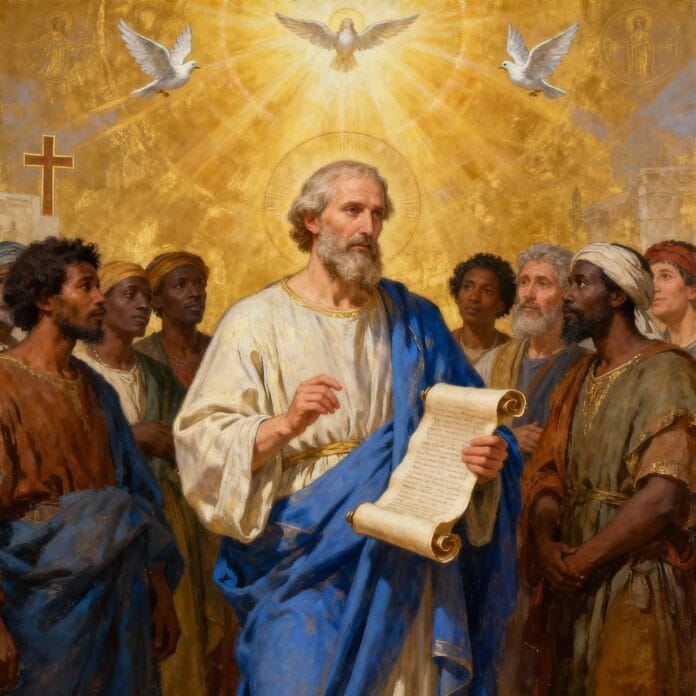
Reading from the Letter of Saint Paul the Apostle to the Romans
I myself am convinced, my brothers, that you yourselves are filled with goodness, filled with all the knowledge of God, and also able to correct one another.
However, I have written to you with some boldness, as if to remind you of certain things, and this by virtue of the grace that God has given me. This grace is to be a servant of Christ Jesus to the Gentiles, exercising the sacred duty of proclaiming the gospel of God, so that the offering of the Gentiles may be acceptable to God, consecrated by the Holy Spirit.
Therefore, I boast in Christ Jesus in my service to God. For I will not presume to speak of anything except what Christ accomplished through me in leading the Gentiles to the obedience that comes by faith, by word and deed, by the power of signs and wonders, by the power of the Spirit of God.
Thus, from Jerusalem and radiating out into Dalmatia, I fully accomplished the proclamation of the Gospel of Christ. I did so making it a point of honor to evangelize only where the name of Christ had not yet been proclaimed, for I did not want to build on foundations laid by another.
Rather, I acted in accordance with what is written: Those who were not told will see; those who have not heard will understand.
Minister of Christ for the nations: welcoming the offering of the world
Serving the universality of grace in the Spirit.
Paul, in his letter to the Romans (Romans 15:14-21), presents himself as a minister in service to the nations, dedicated to proclaiming the Gospel. He claims a unique ministry: to offer the world to God. This dense and inspiring passage invites the modern reader to reflect on their own mission—how, today, people and women Can those who follow Christ, in turn, sanctify their commitments, cultures, and communities? This article is for those who seek to unite faith, commitment, and openness to the world according to Paul's missionary spirit.
- The context of the letter to the Romans and Paul's unique role
- The mystery of a universal offering: spiritual meaning and vocation
- Three dynamics: the grace received, the mission given, joy shared
- The light of tradition: from Saint Irenaeus to Vatican II
- Concrete paths of missionary conversion
- Synthesis and spiritual practices for today
Context
The chosen passage is part of the grand conclusion of the letter to the Romans. The apostle Paul addresses a community that he did not found himself, but for which he feels a deep concern. The Romans, Christians from both Judaism and the pagan world, live in the imperial capital, at the heart of a vibrant society where cultural diversity challenges traditional religious boundaries.
Paul wrote from Greece, at the end of his missionary journeys, around the years 57-58. He reflects on his vocation and presents his accomplished work: proclaiming Christ “from Jerusalem to Dalmatia.” This vast geographical area is as much a concrete reality as a symbol of universality: the reach of the Gospel knows no bounds.
The section (Romans 15:14-21) summarizes his mission and inner motivation. He calls himself “a minister of Christ Jesus to the Gentiles.” The Greek term used, leitourgos, This refers to a liturgical role: Paul sees himself as a priest whose altar is not made of stone but of the peoples he leads to God. The offering he prepares is not material; it is the nations themselves, sanctified in the Holy Spirit.
Thus, the Christian mission is not human proselytism, but a spiritual liturgy where the whole world is oriented toward its Creator. Paul adds: “I boast in Christ Jesus in my service to God.” His glory is not personal; it resides in the work accomplished by Christ through him. The verb “to sanctify” marks this total dependence: without the Spirit, without grace, nothing can become an offering pleasing to God.
Finally, he quotes Isaiah: “Those who were not told will see; those who have not heard will understand.” The prophetic text illuminates Paul’s intention: the salvation promised to Israel now extends to all humanity. The universality of the call to faith is rooted in biblical revelation itself; it does not contradict it, but fulfills it.
This passage thus forms a pivotal point: it unites the memory of the Old Testament and the openness to the future of the Gospel. The nascent Church draws from it its awareness of "going out," of going towards the cultural and spiritual peripheries, not to conquer but to offer.
Analysis
The central idea of this text can be summed up in one word: offering. Paul is not speaking of an administrative service or a simple evangelistic activity. He is speaking of a spiritual transformation of the world.
This offering is not a vertical gesture where humanity hands something over to God by obligation, But there is also a return movement: God himself acts in the mission to make his people holy. Paul thus describes a Trinitarian dynamic:
- THE Father accepts the offering,
- THE Christ accomplished this through his minister,
- L'’Spirit sanctifies what is presented.
The heart of the message is that the apostolic life is an act of worship. The missionary celebrates God's work in history, just as a priest celebrates in the liturgy love redeemer. Paul recognizes himself as a priest of a universal temple, where all cultures can become a space of grace.
This highlights a tension: Paul wants to proclaim a universal message without erasing the uniqueness of each people. Faith does not homogenize; it transfigures. To be “Christ’s minister to the nations” does not mean colonizing but revealing, in each culture, the trace of the divine plan. Christ does not abolish languages and differences; he makes them channels of communion.
The existential significance of this passage is profound. It reminds us that every believer is called to practice an inner liturgy in their daily life. Working, loving, educating, and serving become acts of self-offering. The Christian mission is lived at the heart of the world, not on its margins.
Finally, Paul emphasizes “pride in Christ.” This is joy to know oneself as an instrument and not a master, a channel and not a source. To be a “minister” of Christ is to consent to a radical decentralization of the self: the power of grace flows through a life given. It is there that the mission becomes fruitful.
The grace received: the foundation of all mission
Paul did not invent his calling; he received it. “It is because of the grace God has given me.” This simple sentence contains the entire Christian theology of mission. Without grace, apostolic zeal quickly turns into activism, and pride into arrogance.
In Pauline thought, grace precedes all human choice. God calls, stirs, and compels. Paul, a former persecutor, discovers he has been chosen not through merit but through pure mercy. This foundational reversal still inspires all Church action today.
In practice, this means that serving God begins with receiving his gift. The minister of Christ is not a manager of the sacred; he is first and foremost a person filled with grace. Through him, grace flows, not because he speaks well or acts better, but because he remains open.
This can be transposed into the life of the believer Ordinary. Every act of faith is ministerium: offering one's time, listening ear, and skills to others, in a spirit of selflessness. When grace becomes the driving force, the fruits seem unexpected: patience, inner peace, and above all, the joy of simply being where God is at work.
For Paul, grace is not a vague energy; it is the living presence of Christ. To be a minister of Christ to the nations is therefore to bear this Presence. More than a message, it is a contagion of love, discreet and tenacious.
The mission given: to build on what is left unsaid
“I did not want to build on someone else’s foundations.” Paul expresses here an essential point: mission is not a competition. Each apostle has their field, each believer their spiritual territory. Paul feels the call to open new paths; this is his way of being faithful.
Proclaiming the Gospel “where the name of Christ has not been spoken” also means daring to go where faith has not yet found a voice. Today, these boundaries are not always geographical; they can be cultural, technological, or social. To be a minister of Christ in the 21st century is to bear witness in worlds that are often indifferent or saturated with noise.
Paul speaks of the “power of signs and wonders, the power of the Spirit of God”. These are not primarily visible miracles; they are inner transformations, silent conversions. In the most remote environments, faith makes its way through beauty, solidarity, and truth.
In practical terms, each Christian can reflect: where is the name of Christ not yet spoken in my life? In what areas could my words, my actions, my decisions bear more witness? The mission begins precisely there: in the still untouched areas of our hearts.
Shared joy: the offering of nations today
Paul does not conceive of mission as a conquest but as a festive offering. The image of the cosmic altar, where nations become an offering, evokes joy of a banquet. It is not one people dominating another, but the symphony of differences made harmonious by the Spirit.
In the contemporary world, this vision translates into a spirituality of encounter. Making one's life an offering means learning to see others not as an obstacle but as a gift. Every culture, every person carries within them a still unexplored fragment of the Gospel.
The offering of nations is therefore not the dilution of faith in a global relativism; it is the concrete universality of love. God does not accept disembodied peoples; he sanctifies faces, stories, memories.
This perspective also transforms social engagement. Working for justice, Dialogue between religions and the safeguarding of creation become participations in this same offering. When an act is performed in the light of Christ, however discreet, it becomes spiritual worship.
So, joy Paul's enthusiasm is not that of an adventurer, but the certainty of an ongoing transformation. The world is already in God's hands; the apostle is merely revealing what the Spirit is silently working at.
The imprint of tradition
Patristic tradition has often commented on this passage. Saint Irenaeus sees in Paul the prototype of the New Testament priest: not the one who offers animals but the one who presents peoples to God. Saint Augustine He reads in it the sign of future unity: all nations as one body of Christ.
In the Middle Ages, the theology of “spiritual sacrifice” developed among Saint Thomas AquinasMan offers God his noblest gift: his will. Paul is a living witness to this. In the liturgy, this dimension is reflected each time the priest says, “Let us pray together, as we offer the sacrifice of the whole Church.” This sacrifice is the offering of the nations.
The contemporary Church, in particular by Vatican He rediscovered the missionary scope of this vision. The universal call to holiness echoes that of Paul: every baptized person participates in the sanctification of the world. The most ordinary gestures can become a place of offering when performed in love.
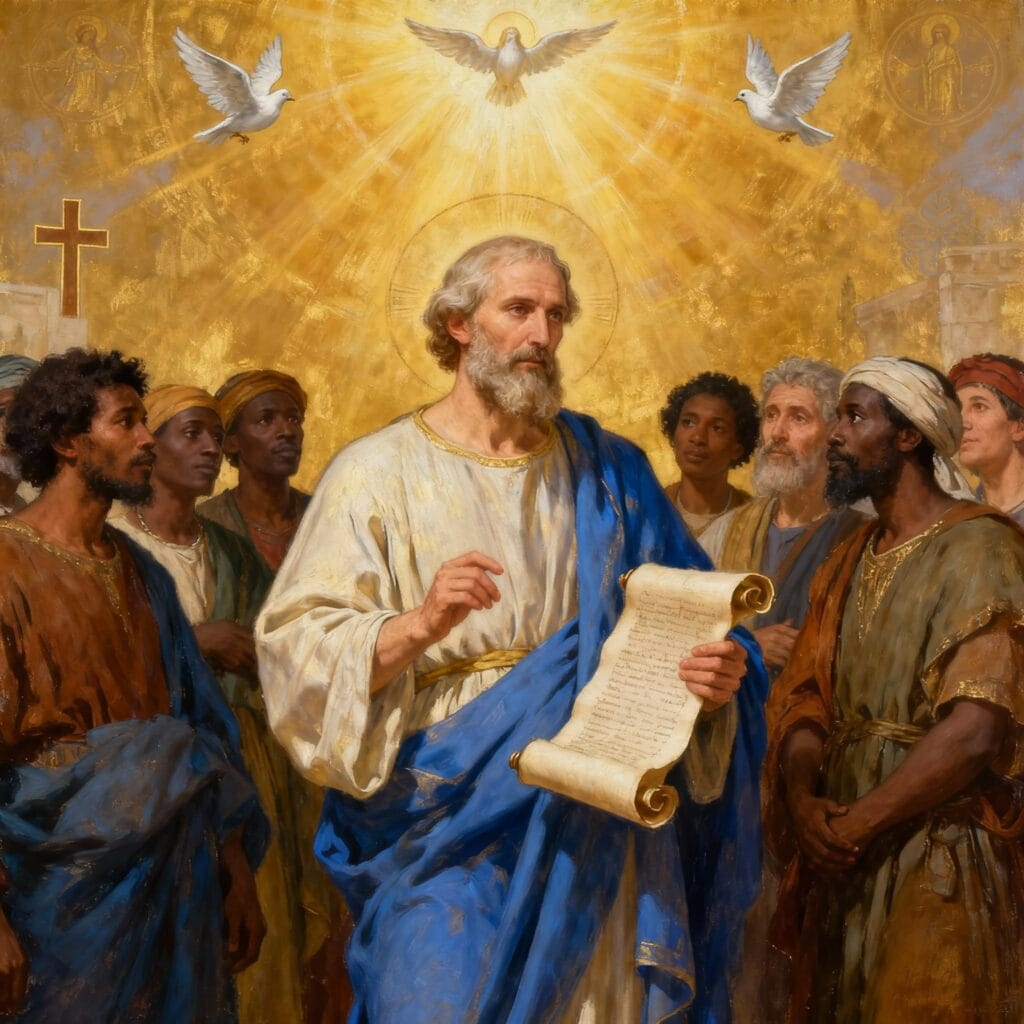
Path of prayer: embodying the mission
- To welcome: to reread one's own history as a place where God has given a special grace.
- Offering: each morning, present to God one's activities of the day as a living altar.
- Listen: discern the places “where the name of Christ has not yet been spoken” around you.
- To serve: to take concrete actions of justice and peace, even small ones.
- To praise: to give thanks for the diversity of peoples, cultures, and talents.
- Contemplating: recognizing the presence of the Spirit at work in others.
- Send: pray for those in the world who carry the Gospel to the margins.
Conclusion
To be a minister of Christ Jesus to the nations, according to Paul, is to live the faith as a liturgy of the world. Every encounter, every word, every act of service becomes a sacred act. The offering of the nations is not the utopia of a perfect world; it is the invisible weaving of gestures that, day after day, transform the earth into a Kingdom.
This vision reverses perspectives. The Gospel is no longer reserved for a select few; it is good news for all, even those “to whom it had not been proclaimed.” The believer called to serve becomes a sign of this universality.
Paul's text thus invites us to think of evangelization not as an external duty, but as an inner transformation: to offer the world is first and foremost to offer oneself. And in this offering, to discover joy inexhaustible from a God who receives what he himself has inspired.
In practice
- Read a passage from the following each week: letter to the Romans.
- Linking one's daily prayer to a universal intention (people at war, migrants, disinherited).
- To offer one's work or care as a service rendered to Christ.
- Discovering another culture to broaden one's perspective of faith.
- Participating in the liturgy with awareness of its universal dimension.
- Keep an offering book: note the moments when God acts discreetly.
- End each day with a “thank you for the nations”.
References
– Letter from Paul To the Romans, chapters 9 to 15
– Prophet Isaiah, 52-53
– Saint Irenaeus of Lyon, Adversus Haeres
– Saint Augustine, The City of God
– Saint Thomas Aquinas, Summa Theologica, IIIa, q.83
– Council Vatican II, Lumen Gentium, Ad Gentes
– Liturgy of the Offertory, Roman Missal