












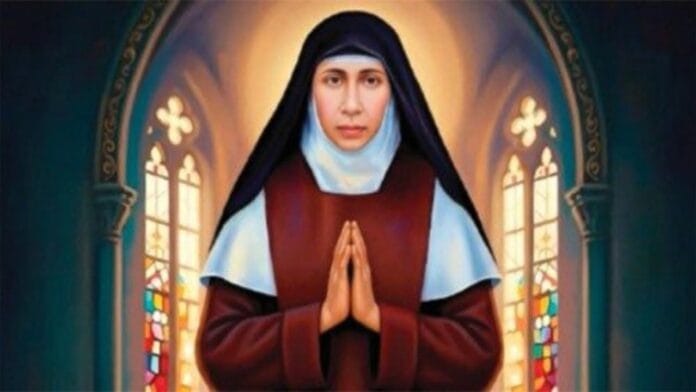
Saturday, November 8, 2025, will remain etched in the spiritual history of India. In Kochi, in the heart of Kerala, thousands of faithful gathered in the courtyard of the Basilica Sanctuary of Our Lady of Redemption in Vallarpadam for the beatification of an extraordinary woman: Mother Eliswa Vakayil.
That day, faces reflected joy profound gratitude from a people towards the one who, more than a century ago, dared to forge a new path for women consecrated — a path of freedom rooted in prayer, compassion and education.
A woman at the heart of a spiritual renewal
An ordinary life, transfigured by faith
Born in 1831 into a Catholic family in Kerala, Eliswa Vakayil grew up in an India still marked by British rule and social divisions. Married very young, she became the mother of a daughter before being struck by widowhood—a condition that, at the time, often relegated women to the margins of society. women on the margins of society.
But for Eliswa, it was not the end, rather a beginning. Her heart turned towards God, she discovered a new mission in daily prayer and Eucharistic contemplation: to give oneself totally to Christ, while remaining close to the women left in the shadows.
The courage to invent a new path
It was in 1866 that she founded, in Koonammavu, the first indigenous female religious community in Catholic India: the Third Order of Discalced Carmelites (TOCD) for women.
This pioneering gesture would change the face of religious life in Asia. Until then, consecrated female life largely depended on models imported from Europe. Eliswa dared to embrace an Indian way of living the Carmelite order—faithful to the spirituality of Teresa of Avila, but deeply rooted in local culture, simplicity and hospitality.
A vision of communion before its time
Long before the Church spoke of synodality, Mother Eliswa lived it. With humility And, in common sense, she brought together under one roof women of different rites — Latin and Syro-Malabar — to praying together.
This gesture of inclusion, now celebrated as prophetic, was not merely organizational: it reflected the conviction that Christ unites beyond liturgical, cultural or social differences. As Cardinal Sebastian Francis recalled in Kochi, "walking together in faith was for her the heart of Christian life.".
The maternal face of Christian love
A wife, a mother, a consecrated woman
Before becoming a nun, Eliswa was a wife and mother. This experience profoundly shaped her: she knew the joys, sorrows, and expectations of an Indian woman of her time.
It was from this that her spiritual tenderness sprang. By becoming "the bride of Christ," she remained a mother—but of an expanded motherhood, open to all the children of suffering and of povertyHer convent became a refuge for rejected widows, helpless orphans, and young girls seeking meaning in their lives.
A pedagogy of dignity
For Mother Eliswa, education was an instrument of emancipation. She founded a school, an orphanage, and later a girls' college: places where women They not only learn to read, but also discover that they are loved by God.
These institutions, modest in their beginnings, became the roots of a vast network of Carmelite Teresian schools across India. Thousands of young girls found there the confidence necessary to become teachers, doctors, nuns, or committed mothers.
Compassion without borders
A nun from her order testifies: "At Mother Eliswa's, charity "It wasn't a duty, it was a breath of fresh air."
She was visiting the sick, served the poorShe shared her meals with the marginalized. She prayed at length before the Blessed Sacrament before rising to act. It is this alliance between contemplation and service to others that gives her character its inner strength—a deeply inculturated spirituality, where God draws near through the simple gestures of daily life.
A life's message for today
A role model for all women
The beatification of Eliswa is not merely an ecclesiastical recognition: it is a a message addressed to every woman today.
In a world where success often seems linked to performance, Mother Eliswa reminds us that true greatness lies in loyalty of the heart. Every wife, every mother, every consecrated woman can recognize herself in her journey: saying "yes" to God in the concrete circumstances of life, without fanfare but with perseverance.
The discreet radiance of holiness
Cardinal Francis emphasized this in his homily: "The story of Mother Eliswa reflects the journey of every saint: a concrete, constant and consistent yes.".
This consistency — in prayer, in service, in patience — is what Christ magnified in her. Holiness, for Eliswa, is measured not by spectacular miracles, but by the miracle of daily loyalty, experienced in joy to give.
A light for the synodal Church
At a time whenUniversal Church strives to walk together, and the figure of Eliswa illuminates this process. She shows that synodality is not a method, but a way of loving: to listen, to discern, to walk alongside the other.
In her community decisions, she always prioritized communion. Her example today invites priests, lay people, and religious to build a Church where every voice has its place.
A beatification, a sign of hope
The miracle of a birth
The recognition of the miracle attributed to her intercession — the healing of a baby girl still in her mother's womb — paved the way for beatification.
This subtle yet profound sign goes to the very heart of Eliswa's mission: protect life from its beginning, To love fragility, and to entrust to God what men deem impossible. Many see in this miracle a way for her to say: "Life is sacred, whether it is that of a child still hidden or of a poor forgotten widow.".
A universal celebration
The ceremony in Kochi was at once Indian and Catholic, local and universal. The chants in Malayalam, the Carmelite vespers, the liturgical dances created a tableau of profound joy.
Monsignor Leopoldo Girelli, representative of the Holy See, recalled in his message that "Mother Eliswa transcends borders: she speaks to every Indian, every believer, every human being in search of love and truth.".
A spiritual mother for our time
Today, the Carmelite nuns of St. Teresa (CTC), direct heirs of her work, are present on several continents.
Their mission extends Eliswa's dream: to pray and serve in close proximity, to live the simplicity of Carmel in the heart of the modern world.
The young nuns see this as a concrete inspiration: to pray intensely without losing touch with reality, to teach others to love God.
What Mother Eliswa still teaches us
The art of uniting prayer and action
Eliswa never opposed contemplation and the work. She saw in the service to the poor an extension of Eucharistic adoration.
For her, God can also be found in the alley, in the classroom, in a child's smile. This simple yet revolutionary attitude remains a very relevant spiritual pedagogy: learning to love God through the faces of others.
The power of women in the Church
Her journey proves that a woman can be both humble and bold, obedient and reformist. In an often patriarchal church context, she opened a space where women's voices could flourish. loyalty.
Today, as the Church debates the role of lay people and consecrated women, the figure of Eliswa reminds us that Feminine sanctity is a silent engine of transformation.
A call for gratitude and trust
Finally, Mother Eliswa invites us to an art of living: that of gratitude. Everything in her life — her motherhood, her suffering, her commitment — became an offering.
It teaches us to welcome each step as an encounter with God. Perhaps this is the secret of its fruitfulness: having trusted in everything.
The radiance of a soft light
The beatification of Mother Eliswa Vakayil is not simply a tribute to the past. It is the living recognition that a woman, in the silence of a convent in Kerala, changed the spiritual history of a people.
His message transcends borders: to love God, to love others, to walk together.
Today, in a fractured world, the voice of this blessed woman resonates sweetly: "Do not be afraid to love to the end. Love "Only one person can transform everything."