







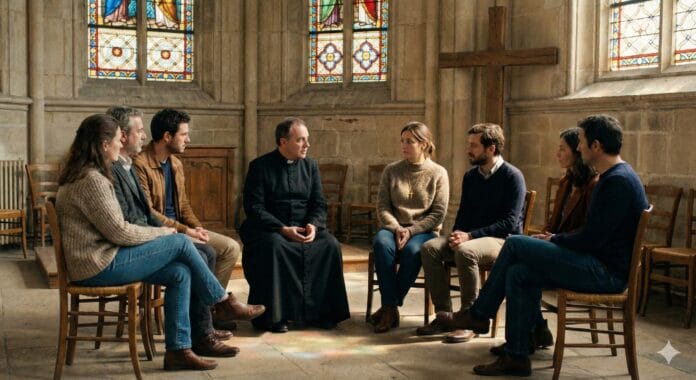
Imagine Julie, seat In a Parisian parish hall, preparing for her child's baptism, she stares at the cross around her neighbor's neck and suddenly feels uneasy: should she have been wearing her baptismal medal as a visible sign of her faith? This scene illustrates a reality often overlooked: that of the millions of French Catholics who believe deeply but only cross the threshold of church a few times a year.
They represent 24% of the "occasional churchgoers" according to recent studies. Neither atheists nor regular churchgoers, they navigate a gray area that the institution sometimes struggles to understand. Yet, their faith is very real. It is simply expressed differently, far from church pews and weekly rituals.
Understanding occasional Catholics: between living faith and institutional distance
The profile of discreet believers
Occasional Catholics form a heterogeneous group found in all social classes. Some grew up in practicing families and then gradually spaced out their church visits. Others discovered faith adults but have never adopted the rhythm of regular practice.
What unites them? A genuine spiritual conviction coupled with a detached relationship with the Church. They believe in God, identify with Gospel values, but do not feel the need for Sunday Mass to nourish their relationship with the divine.
Let's take the example of Thomas, an executive in a Marseille company. Baptized and confirmed, he even served as an altar boy as a teenager. Now, at 38, he only attends Mass three or four times a year: Christmas, Easter, perhaps. All Saints' Day. «I don’t feel any less Catholic for it,» he affirms. «My faith is part of who I am, even if I don’t practice it like my parents.»
The reasons for spaced-out practice
Several factors explain this distance from regular practice. The pace of modern life comes first: between professional and family constraints and the legitimate need for rest on weekends, Sunday services become difficult to reconcile with daily life.
Married, A night nurse and mother of two, she puts it simply: "Sunday is my only day when I can truly relax. I need this time for my family, to recharge my batteries. God understands, I'm sure of it."«
Beyond the time factor, there is also a perceived disconnect with certain positions of the Church. Many casual Catholics adhere to the fundamental values of the Gospel – love of neighbor, forgiveness, justice – but do not recognize themselves in all institutional positions, particularly on social issues.
Finally, some people have a more personal, less ritualized form of spirituality. They prefer silent prayer in their room to the Sunday homily, solitary meditation facing a landscape to the collective liturgy.
The weight of other people's opinions
Julie's anecdote at the beginning of this article reveals a deep-seated unease: the fear of not being "Catholic enough" in the eyes of regular churchgoers. This fear of judgment runs through the accounts of many occasional churchgoers.
«When I go to Christmas Mass, I feel like everyone recognizes me as someone who only comes once a year,» confides Sophie, a teacher from Lyon. «The stares, the slightly condescending smiles… I feel like a tourist in my own parish.»
This feeling of being a "second-class" believer paradoxically pushes some to distance themselves even further. Why return to a place where one doesn't feel fully welcome? A vicious cycle ensues: the less one comes, the harder it becomes to return.
Yet, faith This occasional practice is not superficial. It is expressed differently, in other spaces, according to other modalities than the traditional Sunday practice.
Living one's faith daily: alternative expressions of Catholic spirituality
Personal prayer as a spiritual pillar
For many occasional Catholics, daily prayer replaces the weekly service. Far from being a substitute, it constitutes the heart of their spiritual life.
Antoine, an entrepreneur in the digital, has established a morning ritual: ten minutes of prayer before starting his day. «I sit down, I make the sign of the cross, I recite an Our Father and a Greetings Married, Then I remain silent to connect with God. It's my personal church.»
This prayer takes various forms depending on individual sensitivities. Some rely on the rosary, others on the lectio divina (prayerful reading (from the Bible), others still on silent meditation. What matters is not the form but the regularity and sincerity of the approach.
Prayer apps and Christian websites facilitate this personal practice. Many casual worshippers thus follow the daily readings, listen to homilies online, or participate in virtual prayer times. Technology creates new spaces for spiritual communion, outside the walls of the church.
Concrete commitment to serving others
«I am a believer every moment,» affirms Julien, a volunteer with a homeless shelter. «When I distribute hot meals in the winter, when I listen to someone’s distress, I live my Christianity. For me, that's what being Catholic is all about: putting my hands where Christ would put his.»
This practical dimension of faith This resonates particularly with those who attend Mass only occasionally. Rather than attending Mass, they often prefer to dedicate their free time to charitable work, volunteering, and supporting people in difficulty.
Their cathedral is the street, the hospital, the school, the office. They embody the Gospel in their professional relationships by refusing to participate in questionable practices, in their family life by transmitting values of respect and sharing, and in their civic life by committing to greater [quality/responsibility]. social justice.
This approach echoes the words of Jean Vanier, founder of L'Arche: "We are not called to be extraordinary, but to be ordinary with an extraordinary heart." Occasional Catholics often live this evangelical ordinariness without even realizing it.
The key events that punctuate the year
While Sunday Mass is not part of their routine, the major liturgical feasts still hold a central place. Christmas, Easter, All Saints' Day : these annual meetings are eagerly anticipated and carefully prepared.
«Christmas without midnight mass wouldn’t be Christmas,» explains Isabelle, the marketing manager. «It’s a time when the whole family comes together, when we reconnect with something greater than ourselves. It’s something I hold dear.»
These exceptional celebrations take on a special dimension for those who attend only occasionally. They concentrate in a few hours all the spiritual intensity that is lacking the rest of the year. Emotion is amplified tenfold, prayer more fervent, and the sense of belonging to the Christian community stronger.
Life events – baptisms, weddings, funerals – also constitute important spiritual milestones. These moments of transition are an opportunity to reconnect with the institutional dimension of faith, to reconnect with the parish community, to publicly reaffirm its Catholic identity.
The family transmission of faith
A paradox runs through the experience of occasional Catholic parents: how to transmit a faith that one rarely practices oneself?
Claire and Sébastien, parents of three children, have chosen the path of honesty. "We explain to them what we believe, why we find Christian values important, but also why we don't go to Mass every Sunday," says Claire. "We want them to build their own relationship with faith, "Without hypocrisy."»
This transmission often takes place through simple gestures: a prayer before meals, reading a children's Bible, visiting churches while traveling, discussing moral issues in the light of the Gospel. Catechism too, even if the parents don't attend regularly.
«I want them to have the basics, to know the story of Jesus, to understand the meaning of the major holidays,» explains Marc, father of two teenagers. «Then they will decide. But at least they will have the tools to make an informed choice.»
Reinventing the relationship with the Church: towards a new form of belonging
The challenge of welcoming parishes
Faced with these occasional Catholics, parish communities are confronted with a challenge of welcome. How can they make day visitors feel that they have their place, that they are not being judged, that they remain full members of the Catholic family?
Some parishes are innovating. At Paris, A church in the 15th arrondissement has created "open Sundays" where the emphasis is on welcoming newcomers and occasional attendees. There's a coffee corner after Mass, familiar parishioners spontaneously approach strangers, and the homily is accessible and doesn't presuppose in-depth knowledge of doctrine.
«We have come to understand that our role is not to judge the frequency of attendance, but to open our doors and our hearts wide,» testifies Father Michel, parish priest. «A Catholic who comes once a year but lives the Gospel daily is just as precious as one who attends weekly.»
This shift in attitudes is crucial. It requires training for reception teams, homilies that speak to everyone and not just regulars, and simple but meaningful gestures of inclusion.
Towards a fully embraced "à la carte" approach
The diversification of forms of religious practice is gradually becoming an unavoidable reality. Occasional Catholics no longer want to be forced to choose between intensive practice or the complete abandonment of their faith.
New forms of engagement are thus emerging: Bible study groups outside of Mass, occasional spiritual retreats, pilgrimages, times of praise, and themed celebrations. These are all alternative ways to experience one's faith in community without the traditional weekly commitment.
Benoît, 45, participates once a month in a theological discussion group at a Parisian café. "We meet with Catholics from all walks of life to discuss a passage from the Gospel or a contemporary moral issue. It's intellectually stimulating and spiritually nourishing, without the formal setting of Mass."«
This "à la carte" approach challenges traditional patterns but responds to a deep aspiration: that of a personalized faith, adapted to one's lifestyle and... spiritual sensitivity own.
The legitimacy of each path of faith
At the heart of these reflections lies a fundamental question: what makes someone Catholic? Is it regular attendance at Mass or sincerity of faith Conformity to institutional practices or adherence to evangelical values?
Theologians themselves are not unanimous. Some insist on the community dimension of the Eucharist as the heart of the Christian life. Others point out that the Spirit blows where it wills and that there are many paths to God.
«Christ never asked for a certificate of attendance,» recalls Sister Emmanuelle, a theologian. «He welcomed all who came to him, regardless of their history, their past, or their spiritual regularity. The Church should draw inspiration from this radical approach to welcome.»
This perspective opens up a space of legitimacy for occasional Catholics. Their faith is authentic, even if it is not expressed according to expected norms. Their belonging to the Church is real, even if it is discreet.
Practical advice for embracing your occasional faith
If you recognize yourself in this portrait of the occasional Catholic, here are some suggestions for living your faith peacefully:
Define your own practice. Instead of feeling guilty about not going to Mass, create a spiritual ritual that suits you: daily prayer, Bible reading, meditation, time for silence. Regularity matters more than form.
Identify your key moments. Consciously choose when you will join the community: major festivals, special celebrations, occasional retreats. Prepare for these occasions to make them true times of spiritual renewal.
Find your tribe. Seek out other Catholics who share your approach. Discussion groups, online communities, informal prayer circles. You are not alone in this way of living your faith.
Take ownership of your journey. If you are asked about your practice, simply answer without justifying yourself: "I live my faith in my own way, which may not be the most traditional, but it is sincere." Your authenticity is worth more than any speech.
Remain open to change. Your relationship to faith And the Church can change over time. Without forcing it, leave the door open to new forms of involvement if they arise naturally.
Transmit with confidence. If you have children, share your beliefs without imposing them. Show them that being Catholic can take many forms and that the most important thing is sincerity of heart.
Casual Catholics are outlining the contours of a Christianity contemporary, adapted to the realities of our time. Their faith, though far removed from church pews, is nonetheless alive. It is embodied in daily life, in ethical choices, in the personal prayer, in commitment to others.
The Church has everything to gain by recognizing and valuing these alternative paths of faith. Rather than lamenting the absence of these believers at Sunday Mass, it could celebrate the countless ways in which they live the Gospel in their everyday lives.
Because ultimately, isn't that the essence of the Christian message? Not so much about being present in a building at a specific time, but about embodying love, justice, and... in everyday life. compassion taught by Christ. "I am a believer every moment," said this volunteer. Perhaps this is the most authentic definition of a living faith, whether one is sitting in the front row of church or walking the city streets, heart turned towards God.