





Mysterious martyr of the 3rd century, who became the universal patron saint of all those who face danger.

Barbara has fascinated people for seventeen centuries. This young woman from Nicomedia has traversed the ages under many names and a thousand legends. Her veneration united East and West as early as the 5th century. Artillerymen, miners, and firefighters still invoke her today. Between fragmented history and powerful symbols, she embodies faith that endures, even in the face of fire. Her example challenges our own courage when the pressure mounts. What do we risk for what we truly believe in?
An identity forged in the arena
Deciphering Barbara's life is a historical challenge. No contemporary document mentions her directly. The earliest accounts date from the 5th century, three hundred years after her presumed death around 235. This temporal distance explains why legend and fact are inextricably intertwined.
The setting is Nicomedia, capital of Bithynia, a prosperous Roman province in Asia Minor. The city was among the major cities of the Empire. The persecutions against Christians They raged there in waves. Under Emperor Maximinus Thrax, public executions served as a warning. The circus became a theater of death.
Here is what ancient sources cautiously report. A young woman appeared in the arena of Nicomedia. The spectators, many of whom were Christians, did not know her name. The judge ordered her one last time to burn incense before the imperial statue. She flatly refused. The execution followed immediately.
After the torture, Christians demanded the body for a proper burial. The problem: no one knew her identity. They simply referred to her as "the young barbarian," barbara in Latin. This term then designated anyone foreign to Greco-Roman culture. The proper name Barbara thus originated from a circumstantial description.
This explanation seems plausible. Other saints bear names born of similar circumstances. René means "regenerated by baptism." Christian means "the Christian." Christopher translates as "Christ-bearer." These names reflect less a civil identity than a communal recognition.
Tradition places Barbara's martyrdom around 235, during the reign of Maximinus Thrax. This dating remains uncertain. Persecutions truly intensified under Decius (250) and then Diocletian (303-305). Some historians favor the latter period. In any case, the 3rd century marks the peak of Christian martyrdom in the Eastern Roman Empire.
Why did her cult spread so quickly? By the 5th century, churches and monasteries were dedicated to her. The Byzantine East widely venerated her. The Latin West quickly followed suit. This rapid spread suggests a prominent figure, perhaps linked to a dramatic event during her martyrdom.
The Acts of Saint Barbara, written between the 5th and 7th centuries, add romantic details. Her father, Dioscorus, was said to be a wealthy pagan from Nicomedia. He supposedly had a tower built to preserve his daughter's exceptional beauty. Barbara discovers the Christianity. She refused all suitors. Furious, Dioscorus denounced her to the authorities. Faced with her obstinacy, he executed her himself by beheading.
Immediately afterward, lightning struck Dioscorus. He died instantly. This detail became central to iconography and popular devotion. The vengeful lightning transformed Barbe into a protector against sudden death, particularly from fire or electricity.
These Acts likely blend several traditions. The tower evokes the seclusion of young girls in certain wealthy pagan families. The discovery of the Christianity The secretive nature of these conversions reflects the reality of clandestine conversions. The father's anger reflects the real family tensions that a member experienced when adopting the new faith.
The detail of the lightning could originate from a separate event, grafted onto the original narrative. Or it could symbolize immediate divine justice. In the Bible, lightning often manifests God's power. It strikes those who oppose his will. Think of Sodom, the enemies of Israel, the forces of evil in the Apocalypse.
Historians thus distinguish two levels. First, a probable core: a young woman martyred in Nicomedia, whose identity remains unclear. Second, a narrative elaboration that enriches this core with symbols and spiritual lessons. This distinction does not diminish the value of the cult. It anchors it in a pedagogy of faith.
Over the centuries, Barbe has become multifaceted. Its tower symbolizes inner life, contemplation, and the withdrawal necessary for spiritual growth. Its three windows represent the Trinity. The ciborium and the host evoke the Eucharist. The cannons and gunpowder are reminders of her role as protector of dangerous professions.
This polysemy explains its enduring success. Every era, every profession finds in it a relevant model. Medieval mystics saw in its tower the image of the cloister. Modern soldiers recognize in it their exposure to danger. Miners read in it their daily descent into the depths.
Barbara therefore belongs to that category of saints whose memory rests more on reception than on verifiable biography. This is not a theological problem. The Church honors in her radical witness, loyalty until death. Historical details matter less than the spiritual example passed down from generation to generation.
When the symbol illuminates faith
The legend of Barbara exists in several versions. All revolve around the same motifs: beauty, a tower, conversion, family persecution, and lightning. Let's explore how these elements construct a coherent spiritual teaching.
The most widespread version in the West. Dioscorus, a wealthy pagan merchant from Nicomedia, has a daughter of extraordinary beauty. He fears that suitors will disturb his peace. He has a secluded tower built where Barbara grows up, served by carefully chosen servants. Only her father is allowed to visit her.
Barbe is bored. She observes the world from her window. The seasons pass. She reflects on the meaning of life. One day, a Christian tutor disguised as a doctor enters the tower. He speaks to her about Christ, about universal love, of the coming Kingdom. Barbara hangs on his every word. She asks for baptism, administered secretly.
During Dioscorus's absence, workmen enlarged the tower. Dioscorus had ordered two windows. Barbara demanded three. Upon her return, she explained: three windows for the Trinity, three openings so that the divine light could fully penetrate. Dioscorus understood immediately. His daughter had become a Christian.
Anger erupts. Dioscorus first tries persuasion, then threats, and finally violence. Barbara stands firm. She declares that she now belongs to Christ alone. No earthly marriage will turn her away. Dioscorus drags her before the governor. Torture, flogging—nothing breaks her resolve.
Finally, the judge allows Dioscorus to execute his daughter himself. He beheads her on a nearby hill. As her head rolls, the sky darkens. A flash of lightning splits the clouds. The thunderbolt strikes Dioscorus. When the soldiers approach, only a pile of ashes remains.
This version conveys several messages. The tower represents the barriers the world erects against the truth. Barbe's beauty symbolizes the human soul created in the image of God. The tyrannical father embodies the powers that would keep us captive. The secret conversion shows that grace works even in isolation.
The three windows have become Barbara's principal iconographic attribute. They teach the Trinitarian doctrine in a simple way. Three distinct openings, one tower. Three divine persons, one God. The light that enters through these windows represents inner illumination, the transformative revelation.
Lightning plays a dual role. First, it manifests divine justice. God does not leave the murder of an innocent unpunished. Second, it establishes Barbara as a mediator against the dangers of celestial fire. Medieval belief saw lightning as a sign of divine judgment. To invoke Barbara was to ask for protection against a death without spiritual preparation.
Another, more Eastern version tells of Barbara, who is Lebanese, originally from Baalbek. Her father also imprisoned her. She escaped and hid in the wheat fields. The ears of wheat miraculously closed around her. Her pursuers passed by without seeing her. Finally captured, she suffered martyrdom. Lightning would avenge her innocence.
This variation explains a still-living Lebanese tradition. On December 4th, Lebanese families prepare kamhiyeh, a sweetened cooked wheat dish mixed with dried fruit, spices, and sugar. This dish commemorates Barbara's refuge in the wheat fields. Children dress up and go door-to-door asking for treats, like an autumnal Halloween.
Wheat here carries a rich biblical symbolism. Jesus compares himself to the grain that dies to bear fruit. Wheat evokes the Eucharist, Bread of life. The fields where Barbe hides become an image of the Church protecting the persecuted. The kamhiyeh transforms this protection into shared food.
The local legends complete this picture. During the construction of the Channel Tunnel, December 4th was the only day off work all year. French and British miners honored Saint Barbara together. Statues adorn the underground galleries. Dedicated chapels dot the mining sites.
Artillerymen invoke Barbara before each shot. Ordnance makers pray to her while handling explosives. Firefighters consider her their heavenly protector. This universality of fire-related professions dates back to the 16th century. Florentine arquebusiers venerated her as early as 1529. Gunners quickly followed suit.
Why this association? Because Barbe faced fire. The fire of torture, the fire of lightning, the symbolic fire of ordeal. She emerged victorious. Those who work with fire recognize her as an ally. She understands their daily fear. She intercedes so that they may escape the sudden death that awaits them.
The Marian dimension of Barbe deserves attention. As Married, She said yes to God against human evidence. Like Married, It becomes a tower, Turris davidica, a refuge for sinners. As Married, She gives birth spiritually, not through the flesh but through witness. The three windows echo the virginal womb from which the Light springs forth.
Let's be clear. Historians agree: a martyr named Barbe or Barbara truly existed in Nicomedia. Her ancient and widespread cult attests to this. But the biographical details largely stem from hagiographic embellishment. The tower, the lightning bolt, the murderous father are probably symbolic additions.
Does this distinction matter to the believer? Yes and no. Yes, because intellectual honesty demands that we not confuse an edifying story with a historical account. No, because the spiritual value of a legend does not depend on its factual accuracy. It resides in its ability to convey a deeper truth.
Barbe, through her legend, teaches that authentic faith resists familial and social pressures. That solitude can become a place of encounter with God. That symbols sometimes speak louder than words. That God mysteriously defends those who confide in him. These truths transcend the centuries, independent of historical debates.
Resisting under pressure
Barbe speaks to us first of all about spiritual courage. She refuses to sacrifice her conscience to buy peace. His father represents all the forces that would silence us. Family, society, employer, sometimes even the church community: conformist pressures are exerted everywhere.
Resisting doesn't necessarily mean rebelling. Barbe isn't seeking confrontation. She's simply pursuing her inner path. But when conflict becomes unavoidable, she doesn't back down. She states her convictions clearly. This quiet firmness is more impressive than militant aggression.
Jesus said, «Do not think that I have come to bring peace on earth; I did not come to bring peace, "But the sword" (Mt 10:34). The sword separates those who welcome the Gospel from those who reject it. Barbara experiences this separation in her own flesh. She foreshadows all the disciples who must choose between comfort and consistency.
His tower then teaches us the value of withdrawal. Our era overvalues hyperactivity, constant connectivity, and perpetual noise. Barbe reminds us that no profound spiritual life can be built without silence. The tower becomes an icon of the monastic cell, the prayer corner, and the necessary pause.
The three windows add a layer of clarity. Withdrawal is not an autistic closure. It opens one to the threefold light: Father the Creator, Son the Redeemer, and the Holy Spirit the Sanctifier. Christian solitude does not isolate; it connects to the Source. It prepares one for a return to the world, enriched, centered, and able to bear witness.
Barbara's fire ultimately symbolizes purification. Gold is refined in the furnace. Faith is tested in adversity. Peter writes: "The genuineness of your faith—of greater worth than gold, which perishes even though refined by fire—must result in praise" (1 Peter 1:7). Barbara passes through the fire and emerges radiant.
Today, few Western Christians risk physical martyrdom. But moral martyrdom exists. Losing one's reputation for speaking the truth. Turning down a promotion because it requires ethical compromises. Facing family scorn for living according to one's values. These trials forge character.
Barbe also teaches us to distinguish legitimate solitude from toxic prisons. Some forms of solitude heal. Others isolate us dangerously. How can we tell the difference? True, fruitful solitude bears fruit: inner peace, mental clarity, and increased love for others. False solitude breeds bitterness, judgment, and emotional aridity.
His patronage of dangerous professions contains a universal lesson. We all live with risks. Accident, illness, failure, betrayal: no one escapes vulnerability. Barbe invites us to recognize this fragility without paralyzing anxiety. We can face danger with confidence when we know that physical death is not the end.
Prayer: By fire, towards the Light
Saint Barbara, luminous martyr of Nicomedia, you who chose Christ despite opposition, teach us peaceful courage. When pressure mounts, when our loved ones misunderstand us, when comfort tempts us to betray our convictions, grant us your quiet steadfastness. We do not seek conflict, but we desire consistency. Help us to stand firm.
You who lived in the tower, teach us the value of silence. Our noisy world scatters our attention. The multitude of demands fragment our focus. We run without knowing where. Bring us back to what is essential. May we know how to regularly retreat to the inner tower. There, in secret, the Father sees us and restores us.
You whose tower bore three windows, open our eyes to the Trinity. We confess the Father, Creator, source of all good. We adore the Son, Redeemer, who redeems us through his cross. We invoke the Sanctifying Spirit, who transforms us day by day. Three persons, one God. Luminous mystery that illuminates our whole life.
Saint Barbara, protector against lightning, keep us from sudden death. Not that we should fear death itself, for Christ has conquered it. But preserve us from an end that would catch us far from God. May each day prepare us for the final encounter. May our lamp remain lit like those of the wise virgins. May we live in a state of perpetual grace.
You who intercede for artillerymen, miners, firefighters, and all who face danger, watch over them. Protect their physical lives when it is God's will. Strengthen their courage when they must endure hardship. May they carry out their mission with competence and dedication. May their service to others become a silent prayer.
Patron saint of my country, my region, my profession, look upon me with kindness. You know my particular struggles. You see my vulnerabilities. You know where the fire threatens me. Intercede so that I may receive the grace necessary for each trial. Nothing more, nothing less. Just what I need to move forward.
Consecrated Virgin, you who preferred Christ to all earthly suitors, rekindle in us the love of our first love. Our hearts are scattered. Our desires multiply. We seek to fill our voids with a thousand substitutes. Refocus us on what is truly necessary. May Christ be our treasure, our joy, our rest.
Victorious martyr, you whom lightning could not destroy, grant us unwavering hope. The storms of life shake us. The flashes of adversity frighten us. But you show us that after the storm comes the light. After the trial, the crown. After the cross, the resurrection. Support our journey towards the heavenly Jerusalem.
Through your intercession, may our families find harmony in faith. May our churches be faithful to the Gospel. May our society rediscover the values that uplift. May our world find peace in justice. Amen.
To live
Create an interior tower
Identify a place and time for ten minutes of daily silence. Turn off your phone, close the door. Three mental windows: thank the Father, contemplate the Son in the Gospel, invoke the Spirit. Nothing complicated, just breathe in the presence.
Supporting those at risk
Think of someone in a dangerous profession: firefighter, soldier, rescuer, worker at heights. Send them a message of appreciation today. Mention Saint Barbara. Your thoughtfulness means more than you realize.
Examine your compromises
Ask yourself honestly: where have I recently sacrificed my convictions to avoid conflict? A conversation avoided, an injustice tolerated, a truth silenced? Call upon the strength of Barbe to correct this this week. Start small, but start.
Memorials and places of devotion
The cult of Barbara first took root in the East. Nicomedia, now Izmit in Türkiye, Few material traces remain. Centuries of successive conquests have erased ancient sanctuaries. But Constantinople venerated Barbara as early as the 5th century. A church was dedicated to her. Byzantine liturgies mention her feast day.
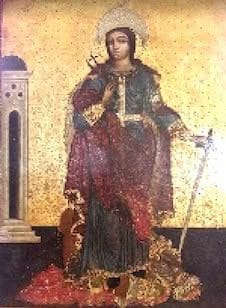
THE Lebanon Barbe proudly proclaims her name. Baalbek preserves a magnificent icon in its Maronite cathedral. Local tradition holds that she was born there. Every December 4th, family and public celebrations honor their compatriot. Sweet baked wheat is generously shared. Costumes create a festive atmosphere.
This Lebanese festival blends the sacred and the secular with ease. Children, dressed in costumes, knock on doors. They sing traditional songs. Families offer sweets and coins. In the evening, communal meals bring neighbors and friends together. The kamhiyeh is passed from house to house. This conviviality reflects a joyful, embodied faith.
France has many shrines dedicated to Saint Barbara. In the mining regions of the North and Lorraine, chapels and statues abound. Miners would go down into the mine with her medal. Firedamp explosions, cave-ins, and fatal accidents punctuated their daily lives. Saint Barbara represented their spiritual life insurance.
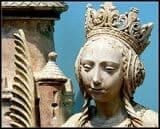
In Villeloup, in the Aube region, stands a splendid polychrome limestone statue dating from 1520-1530. Barbara holds her tower with three windows. Her face expresses serenity. The original colors, partially preserved, demonstrate the care taken in its creation. This work testifies to the popular devotion during the reign of Francis I.
Le Creusot boasts a remarkable stained-glass window in the Church of Saint-Henri. It depicts Saint Barbara surrounded by the tools of miners and metalworkers. A listed statue of her can be found in Chagny, and another stained-glass window in Saint-Léger-sur-Dheune. The Burgundy mining basin thus honors its patron saint. Every December 4th, solemn masses once brought together hundreds of workers.
Metz recognizes her as the city's patron saint. This devotion dates back to the Middle Ages. Several churches in Metz bear her name. The artisans' guilds celebrated her with great pomp. Processions, banquets, and theatrical mystery plays punctuated the day. These traditions died out in the 20th century, but the memory remains.
Modern tunnel boring machines perpetuate the cult of Saint Barbara. The AFTES, the French Association for Underground Works, celebrates his feast day every year. During the construction of the Channel Tunnel, December 4th was sacred. French and British, Catholics and Protestants, believers and agnostics shared this day of rest. Saint Barbara transcended divisions.
The French army solemnly honors Saint Barbara. Artillerymen, artillerymen, combat engineers, Paris firefighters, and Marseille naval firefighters all venerate her. Each regiment organizes its own Saint Barbara's Day celebration: Mass, parade, banquet. Veterans pass on the history to young recruits. This continuity forges esprit de corps.
The Paris Fire Brigade, a military unit, celebrated Barbe's Day in grand style. The mass at Notre-Dame Cathedral (before the fire) brought together the entire force. This was followed by the presentation of decorations, a parade of vehicles, and technical demonstrations. In the evening, a grand dinner was held at the barracks. The chaplain blessed both the firefighters and their equipment. Barbe protects those who protect us.
In Brittany, Roscoff celebrates Saint Barbara on the third Monday of July. She is the patron saint of the Johnnies, the onion sellers who crossed the English Channel from 1825 onwards. Equipped with their bicycles and strings of pink onions, they traveled throughout England. Saint Barbara watched over their maritime journeys. Today, the commercial tradition is declining, but the festival lives on.
Relics of Barbara are venerated in Venice, in the church of San Martino, and also in Mantua. These medieval translations spread her cult throughout Italy. Florence adopted her early on. Florentine arquebusiers chose her as their patron saint as early as 1529. They organized jousts and exhibition shooting in her honor.
Barbara's iconography is easily recognizable. The three-windowed tower is her principal attribute. She holds it in her hand or appears in the background. Artists sometimes add a ciborium and a host, emphasizing her Eucharistic role. Or cannons and powder kegs, a reference to her military patronage.
Medieval stained glass windows often depict her alongside Catherine of Alexandria and Margaret of Antioch. These three virgin martyrs formed a popular trio. They embodied different facets of Christian female courage. Together, they adorned lordly chapels and parish churches.
Liturgy
Today's reading
First reading: 1 Corinthians 1:26-31 (God chooses the weak to shame the strong)
Psalm: Psalm 31 (In you, Lord, I have my refuge)
Gospel: Matthew 10:34-39 (I did not come to bring peace but the sword)
Entrance chant
«Witnesses of God» or «We will sing for you, Lord» – Theme of radical witness
Preface
Preface of the Martyrs – «They followed Christ to the point of giving their lives»
Universal Prayer
For those professionally exposed to danger; for families divided by matters of faith; for the courage of persecuted Christians
Communion hymn
«Bread of God for our earth» – Evocation of the Eucharist and the grain that dies
Final blessing
May Saint Barbara grant you strength in times of trial., peace in conflicts, and loyalty Go all the way. peace of Christ.