












Gospel of Jesus Christ according to Saint Luke
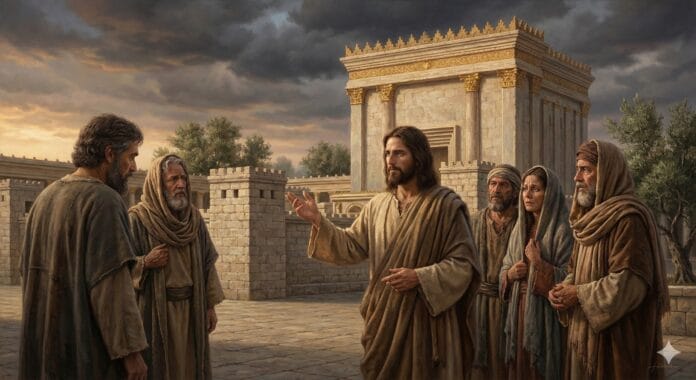
At that time, when some were talking about the Temple, its magnificent stones and the offerings that adorned it, Jesus said to them:
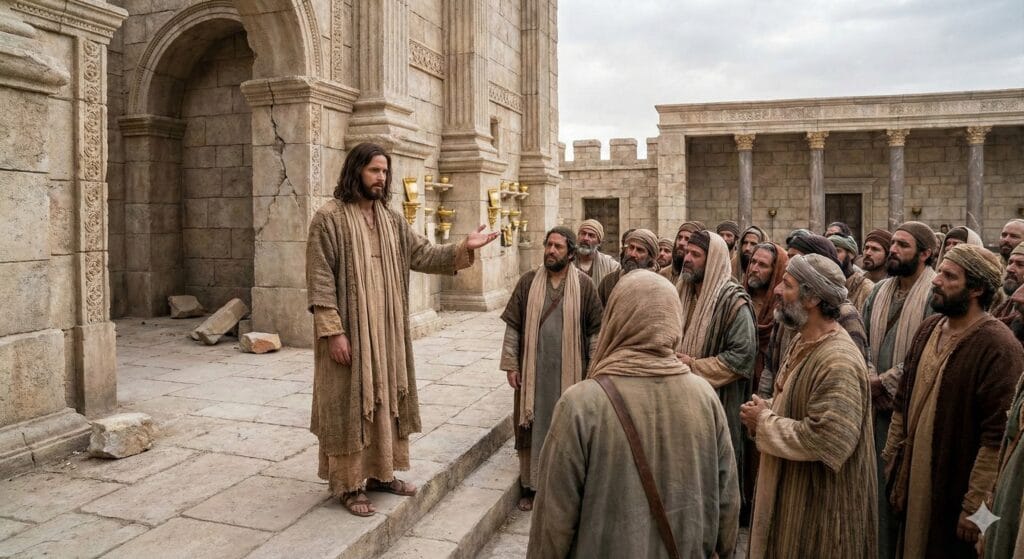
«"What you admire, the days will come when not one stone will remain upon another: everything will be demolished."»
They asked him, "Teacher, when will this happen? And what will be the sign that it is about to happen?"«
Jesus replied, «Be careful not to be deceived, for many will come claiming to be in my name, saying, «I am he,» or, «The time is near.» Do not follow them! When you hear of conflicts and uprisings, do not be alarmed. These things must happen first, but the end will not come immediately.»
Then Jesus continued: «Nations will fight among themselves, kingdoms will fight against kingdoms. There will be violent earthquakes, and in various places famines and diseases; terrifying events will occur, as well as great signs from heaven.»
Acting in response to Jesus' prophecy: not one stone will be left upon another (Lk 21:5-11)
Understanding, meditating on, and applying the biblical message about the end times and the Christian fidelity on a daily basis.
In the Gospel of Luke (21:5-11), Jesus announces the impending destruction of the Temple, a solemn warning to his disciples. This text, rich in meaning for Christian theology, invites reflection on the end times, perseverance in faith, and spiritual vigilance. This article is addressed to any believer wishing to delve deeper into this biblical passage, grasp its theological significance, and draw concrete applications from it in their spiritual and communal life.
- Contextualization and source text: the Temple prophecy and its implications
- Analysis: The theological meaning of the announced destruction
- Thematic areas: vigilance, loyalty and the signs of the times
- Practical applications: faith, daily life and community
- Spiritual and traditional resonances
- Guided meditation
- Responses to contemporary challenges
- Liturgical prayer for loyalty
- Conclusion and call to action
Contextualizing the prophecy: the message of the destroyed Temple
The passage from the Gospel of Luke (21:5-11) is set against a backdrop of great tension and messianic expectation. Jesus is in Jerusalem, where the Temple, the center of Jewish religious life, impresses with its architectural splendor, a symbol of the divine presence among his people. His disciples admire the beautiful stones and the votive offerings, testaments to the piety and richness of the worship. Yet, Jesus announces that this sacred monument will be destroyed, that "not one stone will be left upon another." This prophecy thus connects a historical event to a spiritual significance.
This announcement has a dual dimension: it has an immediate impact, since in 70 AD the Temple was destroyed by the Romans, and an eschatological one, referring to the end times when trials and tribulations will precede the glorious return of Christ. The text warns against false prophets, false promises, global upheavals, but also earthquakes, famines, and frightening signs. These events serve as reminders that the Kingdom of God is attained through trials, faith, and hope in its final triumph.
The disciples' question about "when" and "the sign" reveals the human need to understand and control the future. However, Jesus calls for a vigilance detached from all anxious speculation: we must not be led astray. This passage thus illuminates the necessity of a solid faith, centered not on events but on the word of God. loyalty to his promise.
Understanding the prophecy: reading destruction through the lens of faith
At the heart of this passage, the idea of destruction "stone upon stone" symbolizes not only the physical ruin of a holy place, but also the questioning of human securities. Indeed, the Temple represented the covenant, the presence, and the glory of God among Israel. Its destruction heralds a time of purification in which material appearances, often sources of idolatry or misplaced trust, are abandoned.
Yet, this loss is not an ultimate end, but a new beginning. The destruction of the Temple opens the way to a new way of experiencing the divine presence, no longer in a geographical place but in inner faith, the Holy Spirit, and the community of believers. Through these words, Jesus announces the advent of a renewed covenant, more intimate and more universal.
The text also warns against illusions: «Do not follow them.» This is a call to discern deceptive appearances, whether religious or political, and to keep a cool head despite signs of terror and chaos—wars, famines, epidemics. These signs highlight the fragility of the world, but they must not lead to despair. The Christian faith rests on the certainty that God is in control of history and that, despite trials, his loving plan is fulfilled.
Living spiritual vigilance
The prophecy calls above all for active vigilance, not paralyzing fear. Vigilance, in the Bible, is the attitude of the believer who keeps their faith alert in the face of temptations and deceptions. This implies daily discernment of what leads away from Christ, whether it be false teachings, seductive ideologies, or superficial distractions. This spiritual watchfulness is practiced through prayer, Bible reading, and community participation.
Cultivating loyalty to the very end
Loyalty The promise made in Revelation (Rev 2:10) echoes this Lucan call. To be faithful unto death is to remain rooted in Christ even in trials. This faithfulness is manifested in obedience to God., patience in suffering, and trust in its justice. It is rich in concrete applications: fidelity to one's vocation, fidelity in relationships, fidelity in solidarity with the most vulnerable.
Hope in the final promise
The signs of the end times are calls to hope, not to fear. Christian hope transcends the temporal realm, resting on the certainty of the resurrection and of the Kingdom to come. This hope strengthens the believer against discouragement, and motivates him to bear witness to love even in adversity, and directs his engagement in the world towards peace and justice. In this way, it transforms fear into an invitation to trust.
Words turned into action
This prophetic statement, despite its gravity, sheds light on different areas of life for the contemporary Christian.
- Spiritual Life : practice daily prayer, be attentive to voices that seek to distort the faith, deepen the knowledge of Scriptures to better discern.
- Relationship life : maintain loving and forgiving relationships, avoid divisions due to fears or ideologies, remain faithful to family and friendly commitments.
- Social and community life : to engage in actions of solidarity and justice, to support the weak and marginalized, to promote peace despite the apparent conflicts.
- Church life : encourage loyalty to the Church and its teachings, to welcome changes in the way of living the faith, especially in a context of crisis.
Traditional resonances
The destruction of the Temple is a theme extensively addressed in the Christian tradition, particularly by the Church Fathers. Saint Augustine It is seen as a figure of the end times, a necessary purification before the return of Christ. Biblical theology interprets this prophecy as a call for the coming of an inner spiritual Temple, inhabited by the Spirit (1 Corinthians 3,16).
In the liturgy, this passage resonates in the readings of Advent and Lent, times of waiting and conversion. Spiritually, it calls us to detach ourselves from material security in order to anchor ourselves in the invisible presence of God. The Church thus invites its faithful to active trust, despite the trials of the world.
Meditation prompts
- Read the passage slowly again Luke 21, 5-11, noting the keywords (stone, sign, faithful).
- Becoming aware of one's own material and spiritual security.
- Meditating on vigilance: what can lead me astray? How can I remain faithful?
- Reflecting on the fears associated with current changes and crises.
- To reflect in silence, asking for the strength to hope in God despite everything.
Current challenges
In a world marked by political instability, ecological crises, and pandemics, this passage seems tragically relevant. The temptation is great to succumb to fear, isolationism, or radical ideologies. The biblical response is to offer a transcendent perspective that liberates us from anguish through trust in God.
However, this confidence does not excuse us from acting wisely: recognizing difficulties, staying informed, protecting the most vulnerable, and bearing witness to a living faith. The challenge is to combine hope and realism, prayer and commitment, inner fidelity and outward responsibility.
Prayer
Lord God, in the tumult of times,
You call us to vigilance and faith.
May your word light our steps.,
May your strength sustain our loyalty.
Teach us to discern the truth,
Do not give in to false promises.
Strengthen our hearts in hope,
So that we persevere to the end.
Amen.
Conclusion
This saying of Jesus about the destroyed Temple is a call to live the faith fully in all circumstances. It invites us to cultivate enlightened vigilance, to remain faithful in times of trial, and to hope in God's promise. By applying these teachings to daily life, every Christian can become a light in a world of light. world in crisis, bearer of peace and witness of love unwavering in God's faith.
Practical
- Read regularly Luke 21, 5-11 in meditation.
- Keep a journal of your spiritual observations.
- Practice the night prayer every evening.
- Participate in local community life.
- Cultivating active solidarity towards the vulnerable.
- Avoid indiscriminately consuming anxiety-inducing information.
- To bear witness to faith through concrete acts of love.
Bibliographic references
- Gospel according to Saint Luke, chapter 21, verses 5-11
- Revelation 2:10
- Augustine of Hippo, "The City of God" (Book XX)
- Michael Lawrence, "A Practical Guide to Biblical Theology" (2022)
- Paris Bible Institute, "Principles of Bible Interpretation"«
- Liturgical and catechetical documents of the Catholic Church
- biblical commentaries of the Catholic tradition
- Contemporary studies on biblical theology and eschatology