












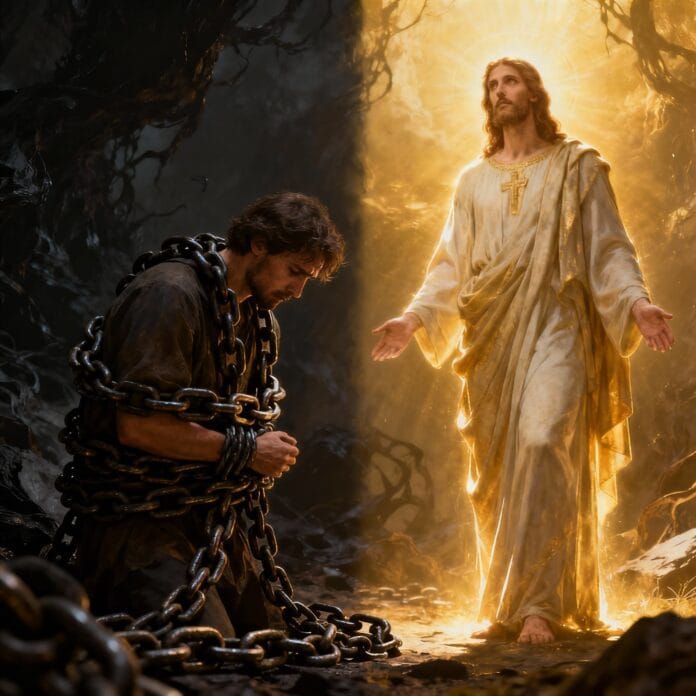
Reading from the Letter of Saint Paul the Apostle to the Romans
Brothers,
I am speaking in human terms, adapted to your weakness. You had put the members of your body at the service of impurity and debauchery, which leads to debauchery; in the same way, put them now at the service of righteousness, which leads to holiness.
When you were slaves to sin, you were free from all obligation to righteousness. What did you gain then from the things you are now ashamed of? For those things lead to death.
But now that you have been set free from sin and have become servants of God, you are reaping what leads to holiness, and this results in eternal life.
For the wages of sin is death, but the free gift of God is eternal life in Christ Jesus our Lord.
Freed from sin, slaves of God: the promise of a fully transfigured life
How to seize new freedom what Saint Paul proposes in his letter to the RomansWhat practical, ethical, and spiritual revolution lies in this call to break free from the chains of evil and freely consent to loyalty And to holiness, “slaves of God,” in paradoxical terms? This audacious text is addressed first and foremost to those who, even today, seek to give meaning to their existence, struggling against mortifying habits, desiring to live upright and in peace. What does this shift mean, and how can it transform our history?
This letter will guide you through the radical context of Paul's exhortation, unfold its profound dynamic, and then outline concrete paths to "reap what leads to holiness." After an immersion in the tradition, you will be offered steps for meditation and practical recommendations: enough to make this call resonate in every detail of your days.

Highlighting the context: from slaves to offered freedom
The verses from Romans Epistles 6:19-23 form part of a pivotal letter, fundamental to Paul's reflection on the human condition, grace, and salvation. Probably written between 56 and 58 AD, before the apostle had visited Rome, this epistle is addressed to a cosmopolitan community of Jews and converted Gentiles. All are familiar with the grip of the law and sin, and all yearn for a renewed life.
In the Greco-Roman world, servitude and freedom were concrete realities, integral to the social order. To speak of the "slavery of sin" is, according to Paul, to designate a state of inner subjugation: it is not a matter of an isolated fault, but of a destructive power expressed through misguided passions, degrading habits, and a general orientation of life toward death. It is within this context that Paul uses "human language, adapted to your weakness": he speaks the language of the time to reach consciences and bodies.
The cited section is part of a discussion on baptism as participation in death and in the resurrection From Christ's teaching: the liberation of the "old self" implies a duty of conversion in the flesh, even in the members of the body. Far from being a simple change of moral or social label, it is a passage from servitude to true freedom: "to put [the members] now at the service of righteousness, which leads to holiness."
Paul then ventures a paradoxical, almost provocative statement: freed from sin, we have “become slaves of God.” The stark image is striking: behind it, the apostle invites us to a new radicalism, to loyalty chosen, to trusting obedience. The wages of sin: death; the gift of God: eternal life. The picture is stark, but the promise immense: freedom is not a return to anomie, it is realized in flourishing under grace, in service that liberates, rather than in slavery that kills.
At the heart of the text: the dynamics of Christian liberation
At first glance, using the term "slavery" to talk about God seems shocking and contradicts the ideal of Christian freedom. Yet, here Paul leads us to grasp the true nature of the liberation offered by Christ. It is not simply a lightening of the burden, nor an unregulated autonomy, but rather a shift in the center of gravity of existence. To be freed from sin is to be placed under a new dependence, a source of growth and life.
The key to understanding this lies in Paul's phrase, "God's free gift." Breaking with sin opens the way to receiving grace, not earning it. This is a reversal of perspective: where sin confines us to shame and death, God offers far more than a promise: he offers eternal life, received in Christ. The passage is thus a call to understand holiness as a relational dynamic: becoming "a slave of God" means consenting to be grasped, transformed, and guided by Him. It means entrusting the very use of one's body ("your members") to a service that uplifts.
This paradox structures all of Paul's thought: on the one hand, the human being left to their own devices—or to their passions—ultimately becomes empty, loses their humanity. On the other hand, there is chosen dependence, consented to in loveThis opens up a space of fruitfulness. The radical nature of the gift then becomes the locus of authentic freedom. It is here that the text rejoins the great biblical tradition, which sees freedom as a journey, not a given: the exodus from slavery in Egypt is always followed by the gift of a Law, a Covenant, the promise of a land. Here again, it is a matter of leaving behind subjugation for responsibility, a destructive attachment for a life-giving fidelity.
Freedom, the stake in conversion
This passage does not invite anxious moralizing or exhaustion through effort; it proposes a reinterpretation of the very concept of freedom. Paul exposes a deeply ingrained illusion—that being free simply means "doing whatever one wants," escaping all rules. He shows how this supposed autonomy leads to closure, isolation, and a cycle of shame. Conversely, embracing liberation from sin requires consenting to "serving righteousness": an orientation toward others, toward goodness, toward holiness.
This inner conversion is not instantaneous, but gradual. It takes shape in the education of gestures, in vigilance over the small choices of daily life. To place one's limbs "at the service of justice" is to ritualize. kindnessto gradually integrate the concern for Christ into all spheres of life: relationships, work, leisure. Christian freedom is therefore not understood "against" the Law, but in the fulfillment of its meaning: to love God and one's neighbor as oneself.
History shows how spiritual liberation is not achieved without struggle: pilgrims, saints, and converts bear witness to this often lengthy "second birth," which involves renunciations and new commitments. Paul thus places each person before a responsibility: freedom, received as a gift, is tested in the direction of one's life. It is built through repeated choices, sometimes against the grain, but which gradually reveal the face of Christ within the individual.

The fruitful paradox of God's "slavery"
The figure of the slave, provocative as it is, is striking in its radical nature. In antiquity, the slave was not master of himself: he was entirely dependent on another. Paul, however, reverses this perspective. The slavery of sin is dehumanizing because it deprives one of freedom and dignity: it leaves the human being "in shame" and leads to death, in other words, to a diminished, lost, and barren life. Conversely, the "slavery" of God does not stem from alienation: it is the fruit of a trusting commitment and the choice to place one's life in the hands of the One who desires one's good.
This fruitful paradox is illustrated throughout the Bible: Abraham accepts uprooting for a promise, Moses leads his people out of Egypt towards freedom, the prophets recall the call to loyaltyJesus himself, in obedience unto the cross, testifies that true power lies in self-giving. To say "I am a slave of God" is ultimately to recognize that belonging to God is not crippling, but rather the foundation of all dignity. Far from confining, it liberates: it makes possible the acceptance of eternal life, here and now.
This service, far from being servility, becomes participation in holiness: "you reap what leads to holiness." It is therefore a dynamic process: consenting to God's will does not limit, but rather expands, heals, and reorients existence. This dependence is none other than true freedom, for it allows one to escape the tyranny of one's own passions and to embrace a new identity.
Concrete implications and practical application
To live as a “slave of God” is first and foremost to accept that every aspect of one’s life can be transfigured by grace. Paul does not confine his readers to abstract rules: he proposes a renewed way of life, a “holiness” that manifests itself in the simplest acts. To place one’s actions, habits, even one’s body “at the service of righteousness” is to re-evaluate one’s priorities, adopt personal discipline, and experience… joy of an existence focused on good.
This commitment is neither instantaneous nor magical. It requires perseverance, learning gratitude, and...humility to acknowledge being a beneficiary of a donation. It also opens up forgivenessthe ability to welcome one's falls not as defeats, but as opportunities to reconnect with loyaltyPutting this Pauline passage into practice means betting that true freedom resides in loyalty and giving, not self-affirmation at all costs.
In the contemporary societyIn a world where the notion of freedom is often distorted or reduced to mere consumption, this "slavery to God" appears as a path of resistance: it is about daring to desire something other than the immediacy of personal gratification. It is also about choosing to commit for the long term: building stable relationships, honoring one's commitments, cultivating the work To do well is to serve the weakest. It is in these concrete acts of faithfulness that the holiness promoted by Paul is rooted.

Roots and echoes in tradition: from patristics to today's liturgy
The reception of this passage among the Church Fathers shows the depth of its significance: Saint AugustineIn particular, he emphasizes the distinction between the "freedom to do evil"—which is a fall, not progress—and true freedom, the freedom to love and serve God. For him, "the more one loves God, the freer one is, because love "He commands what he asks." The entire medieval tradition takes up this motif, insisting that grace does not destroy human freedom, but elevates it to its fullness.
In the liturgy, this passage often resonates during baptismal celebrations: it recalls the radical nature of the "yes" pronounced to evil and the "yes" to new life. Monastic spirituality, of Saint Benedict To Charles de Foucauld, this chosen dependence became the secret of a deep, stable joy despite trials.
Even today, the "servitude of God" remains an inspiration: in many spiritual movements, accompaniment, spiritual direction, and religious life offer varied ways of living this openness, even to the point of total self-giving. The act of consecrating one's life to God, whether in celibacy or marriage, is seen not as a deprivation, but as a liberation—because it directs all choices toward a new fruitfulness.
Paths to freedom: suggestions for meditation and action
- Take a moment each morning to consciously return to the service of God in prayer.
- Re-examine your daily actions and ask yourself: do they serve justice? peaceOr are they likely to cause disorder?
- Identify a habit that enslaves (addictionnegative attitude, hurtful words) and seek concretely to entrust it to Christ.
- To regularly engage in free, selfless action for the benefit of others.
- Practice self-examination: see where the freedom received has withered, where it has grown.
- Read a complementary passage from the Bible (Galatians 5, John 8…) and meditate on Christian freedom.
- Opening oneself to spiritual guidance to increase one's openness to God.

Dare to embrace fruitful fidelity
This short passage from the letter to the Romans proposes a true revolution: Christian freedom is not reduced to independence, but is verified in giving, obedience, loyalty Freely chosen. Leaving the slavery of sin to become a "slave of God" means accepting the invitation to holiness, experiencing in every fiber of one's being the possibility of a transfigured life. This text, in its radical nature, reminds us that the death promised by sin is not inevitable: Christ's call invites each person to traverse their inner prisons, to move toward a fruitfulness whose source remains the freely given grace received.
Living this call, in deed and in truth, requires unwavering trust, a choice repeated daily: to place one's limbs, body, and words at the service of justice. It is there—in this concrete availability—that the freedom offered by God is revealed: a freedom that is not exhausted by consumerism or selfishness, but that builds up the individual, the community, and society. For Paul, true life begins when we accept no longer possessing ourselves, but being seized by God. Love, to become, in turn, a source of life and peace.
Toolbox for moving forward
- Taking daily time for silence to welcome God's presence and offer one's freedom.
- Read the Epistle to the Romans prayerfully, especially chapter 6, and note its resonances.
- To engage in a concrete act of justice: reconciliation, helping a vulnerable person, volunteering.
- To confide in a friend or spiritual guide one's chronic struggles or mortifying habits.
- Write an "act of offering" inspired by the prayer of Charles de Foucauld.
- Meditate each evening on the fruits of the day: which actions have served life, which have had the opposite effect?
- Exploring a path of conversion: retreat, accompaniment, service.
References
- Paul of Tarsus, Letter to the Romans, chapters 6–8
- Augustine of HippoSermons on the Letter to the Romans
- Thomas Aquinas, Summa Theologica, Ia-IIae, treatise on grace and freedom
- Catechism of the Catholic Church, articles 1730-1748 (liberty)
- R. Cantalamessa, Homilies on the Holy Spirit and Christian freedom
- John Cassian, Conferences on the Spiritual Life
- Didache (teaching of the Apostles), and baptismal liturgical practices
- Contemporary works: François Cassingena-Trévedy, The Passion for Freedom; Fabrice Hadjadj, Freedom in Obedience