













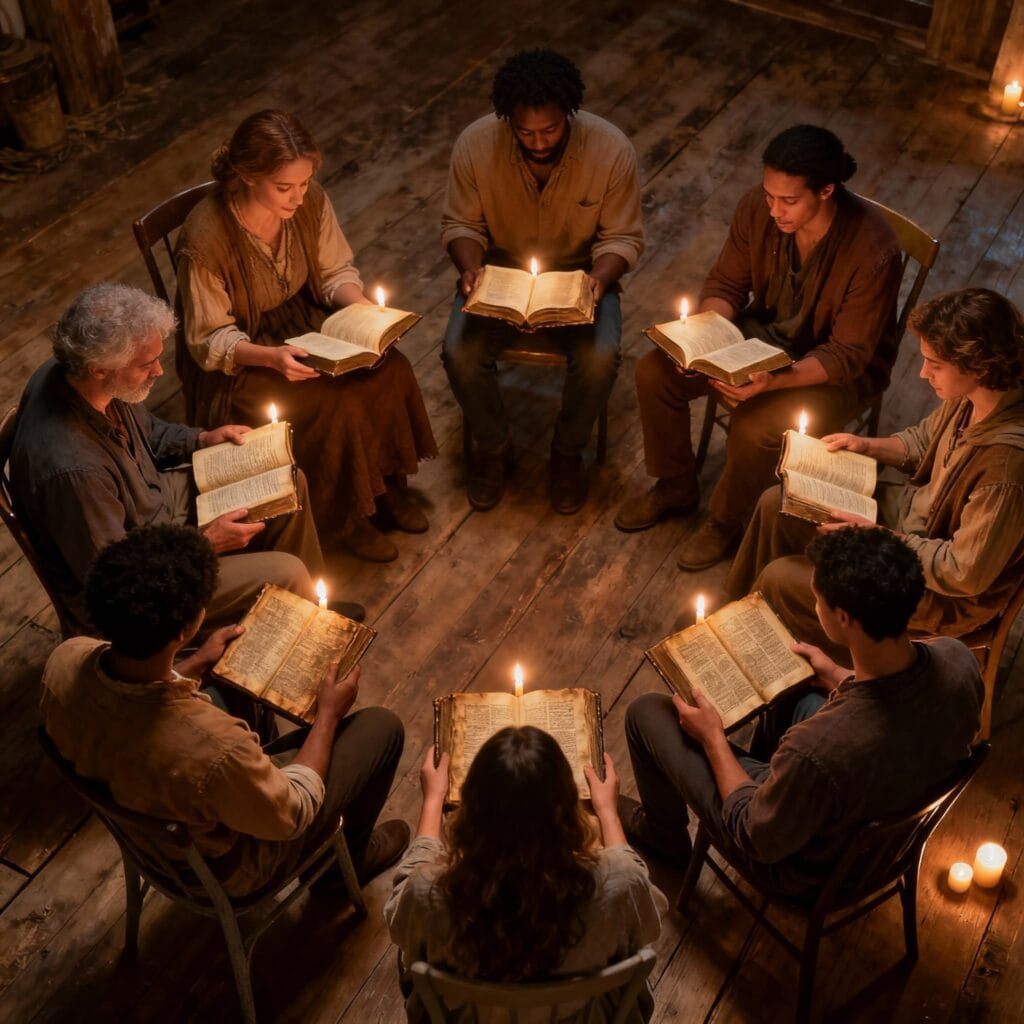
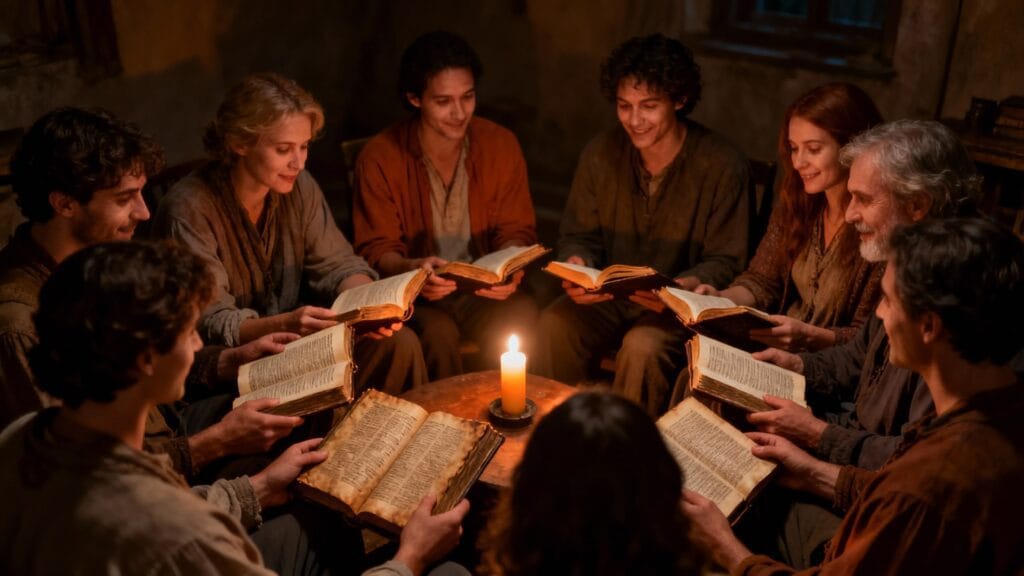
Imagine a circle of faces illuminated by the soft glow of a candle, each person holding the same ancient text, yet discovering profoundly personal truths in each verse. This scene, far from being a spiritual utopia, represents the transformative power of collective reading of the Bible as it was rediscovered by grassroots communities in Latin America. Today, you too can create this sacred space for sharing and discovery.
Individual Bible reading, while enriching, cannot match the revelatory depth that emerges when different life experiences converge around the same text. Each participant brings their own understanding, questions, and personal trials, illuminating the Scriptures from a new perspective. This approach, known as’popular exegesis, radically transforms our relationship to sacred texts and to the community spirituality.
The foundations of an authentic spiritual community
The creation of a spiritual community authentic rests on basic principles which transcend simple animation techniques. At the heart of this approach lies the profound conviction that every person, regardless of their level of religious education, possesses a unique wisdom to share. This philosophy completely revolutionizes the traditional approach to’Bible study.
From this perspective, the facilitator is no longer the one who holds the absolute truth, but rather a guide who encourages the emergence of collective insights. This stance requires genuine surrender and deep trust in the group's ability to discover the richness of the text together.’humility then becomes the first virtue necessary for anyone who wishes to lead a collective reading of the Bible transformative.
The physical and emotional environment plays a crucial role in establishing this dynamic. The circular arrangement, for example, symbolizes the fundamental equality between all participants and naturally fosters authentic exchanges. This configuration allows each voice to be heard with equal attention and respect, thus creating the optimal conditions for genuine dialogue. Bible reading method participatory.
Concrete steps to organize your first group
Defining the framework and vision
The success of your initiative largely depends on the clarity of your initial vision. Before even contacting potential participants, take the time to reflect deeply on your intentions. Is it to create a space for open questioning, a place of mutual support, or rather a laboratory for spiritual exploration? This clarification will influence all the practical decisions that follow.
The formulation of this vision must remain open enough to accommodate diverse expectations while being specific enough to attract the right people. For example, presenting your group as a space where "everyone can discover how biblical texts resonate with their personal experience" naturally attracts participants ready to engage in a genuine process of sharing.
Choosing the optimal environment
The physical space you choose immediately conveys the spirit of your approach. A warm lounge fosters intimacy and confidences, while a parish hall can reassure those seeking a more traditional setting. The key is to create an atmosphere where everyone feels free to express themselves without judgment.
The regularity and predictability of the venue also contribute to creating a sense of psychological security essential for the group's well-being. When participants know exactly where and when they will meet, they can prepare themselves mentally and emotionally for this shared experience. This practical stability becomes the fertile ground in which the mutual trust necessary for genuine connection can flourish. basic community.
The art of participatory animation
Create a climate of trust
L'Bible group animation The transformative process begins long before the first book is opened. It starts with the patient creation of a climate where each participant feels truly welcomed in their uniqueness. This approach requires particular attention to the first moments of each meeting, crucial moments where the quality of the entire session is determined.
An effective facilitator develops a keen sensitivity to non-verbal cues that reveal each person's state of mind. A fleeting glance can betray discomfort, a prolonged silence can conceal deep thought or a reluctance to share. This capacity for empathetic observation allows the facilitator to adapt their approach in real time to maintain the engagement of all participants.
Managing speaking time is a delicate art requiring tact and experience. It involves allowing everyone to fully express themselves while ensuring that no single voice dominates the discussion. This regulation is achieved more through attentive listening and prompts than through directive interventions that could disrupt the group's natural dynamic.
Advanced Facilitation Techniques
Mastering certain facilitation techniques can significantly enrich the group experience. The art of silence, for example, allows reflections to mature and the deepest insights to emerge. Too often, the novice facilitator feels the need to fill every pause, thus depriving the group of those precious moments when collective contemplation takes its course.
Compassionate reformulation constitutes Another powerful tool for deepening discussions is the facilitator's ability to capture the essence of a personal reflection while simultaneously opening up new perspectives, which significantly enriches collective understanding. When a participant shares a personal thought, this technique requires high-quality active listening and a natural empathy for the emotional nuances of the discourse.
Collaborative Textual Exploration Methods
The "See, Judge, Act" approach«
This Bible reading method This proven method naturally structures collective reflection into three distinct but interdependent stages. The "Seeing" phase invites participants to carefully observe the text without hasty interpretation, simply noting what strikes, intrigues, or raises questions for them. This seemingly simple step actually requires considerable intellectual discipline to resist the temptation of drawing hasty conclusions.
The "Judging" phase then allows these observations to be compared with the group's personal and collective experience. It is here that the richness of diverse life paths takes on its full meaning. The same parable will resonate differently with a mother, a student, or a retiree, and these multiple perspectives reveal unsuspected dimensions of the biblical text.
The "Act" phase transforms this exploration into concrete action, questioning each participant about the practical implications of their renewed understanding. This transformative dimension fundamentally distinguishes the collective reading from a mere intellectual exercise, turning it into a genuine spiritual experience.
Contextualized reading
One of the strengths of’popular exegesis Its strength lies in its ability to build bridges between the biblical world and contemporary realities. This contextualization does not mean a superficial adaptation of the texts to current concerns, but rather a profound exploration of the anthropological continuities that link all eras.
This approach requires participants to become attentive explorers of their own time, developing a critical perspective on social structures, persistent injustices, and universal human aspirations. The biblical text then becomes a mirror that reveals both our era and ancient times, creating a particularly rich dynamic of mutual understanding.
Navigating challenges and resistance
Managing the diversity of spiritual levels
Any group of collective reading of the Bible naturally brings together people with spiritual journeys very diverse. This heterogeneity, far from being an obstacle, actually constitutes an extraordinary asset if it is properly managed. The art lies in valuing each level of experience while maintaining a level of exchange accessible to all.
The most experienced participants may sometimes tend to dominate discussions with their theological knowledge. A skilled facilitator will know how to channel this expertise while protecting the space for speech less experienced individuals. This delicate regulation requires great psychological finesse and a deep understanding of group dynamics.
Conversely, some participants may feel intimidated by the apparent depth of the discussions and hesitate to share their spontaneous intuitions. Creating specific opportunities for these quieter voices then becomes a priority to maintain the richness of diverse perspectives.
Turning disagreements into enrichment
Differences in interpretation, inevitable in any group of community spirituality, These situations can become particularly fruitful if they are well supported. Rather than avoiding them or resolving them quickly, the experienced facilitator learns to explore them as invitations to deepen collective understanding.
This approach requires developing a genuine culture of respectful dialogue where every position can be expressed without fear of judgment. The goal is not to reach an artificial consensus, but rather to enrich everyone's understanding through exposure to authentic alternative perspectives.
Maintaining the group's commitment and growth
Create meaningful rituals
Sustainable groups naturally develop rituals that reinforce their collective identity and underscore the importance of their gatherings. These rituals can be as simple as an initial moment of silence or as elaborate as a collective prayer specially created by the group. The key lies in their authenticity and their ability to foster a sense of belonging.
Celebrating important milestones in participants' lives also strengthens community bonds. Taking the time to acknowledge each other's joys, challenges, and transformations gradually transforms the study group into a genuine basic community where people support each other beyond just scheduled meetings.
Evaluate and adapt continuously
The vitality of a reading group largely depends on its ability to adapt to the evolving needs of its members. This flexibility requires constant attention to subtle signals that may indicate a decline in interest or, conversely, a desire for deeper exploration.
Establishing regular evaluation sessions, where everyone can express their satisfaction and expectations, becomes a valuable tool for maintaining everyone's engagement. These review sessions also allow for celebrating observed changes and readjusting the pace or methods according to the group's needs.
The transformative impact on participants
Testimonies from those who have lived through the experience of collective reading of the Bible Authentic experiences reveal profound transformations that extend far beyond mere theological knowledge. Many discover a renewed confidence in their ability to understand sacred texts without the exclusive mediation of experts. This intellectual and spiritual emancipation often generates a sense of empowerment that resonates in other areas of their lives.
There community dimension This experience also creates lasting bonds that support each participant on their personal journey. Spiritual isolation, so common in our individualistic society, gives way to a sense of belonging to a community of meaning-seekers who share similar concerns.
This transformation is not limited to the direct participants but often radiates into their family and social circles. Many report a renewed ability to discuss existential questions with their loved ones, thus enriching their relationships with a more authentic spiritual dimension.
Develop your spiritual leadership
Leading a group of collective reading of the Bible naturally develops spiritual leadership skills which can transform your perception of your own journey. This responsibility invites you to deepen your own relationship with sacred texts while developing a particular sensitivity to the spiritual needs of others.
This experience often reveals unsuspected talents for guidance and empathetic listening. Many discover a vocation for spiritual leadership they never would have imagined before. This realization can open new horizons in community engagement and contributing to the collective well-being.
The leadership that emerges from this practice is distinguished by its servant rather than dominant nature. It is less about directing than supporting, less about teaching than facilitating mutual learning. This form of leadership, particularly well-suited to our times, can significantly enrich your contribution in other professional or community settings.
Your first step towards transformation
There collective reading of the Bible Transformative wisdom is not a distant utopia but a reality accessible to anyone willing to trust in collective wisdom and the power of sacred texts to illuminate our times. Your role is not to be a perfect expert but rather a benevolent catalyst who facilitates the emergence of shared understanding.
Start small, perhaps with a few close friends who share your spiritual curiosity. The important thing is not the size of the group, but the quality of the intention and the authenticity of the approach. Each meeting will teach you something new about leading discussions, about biblical texts, and above all, about the unsuspected richness of those around you.
This adventure of the community spirituality This can become one of the most enriching experiences of your personal journey. It will connect you not only to a millennia-old tradition of wisdom but also to the spiritual vitality of our time., creating valuable bridges between the old and the new, the individual and the collective.
Your first meeting could take place as early as next week. Who in your circle would be interested in this shared exploration? What space could you transform into a sharing circle? These practical questions are the first concrete steps towards creating your own basic community, a space where personal and collective transformation can truly take root.