









Married mixed-race woman from Tepeyac, star of the new evangelization.
On December 12, 1531, on Tepeyac Hill near Mexico City, Married appears at Juan Diego, a recently converted Nahua Indian. She asks him to build a shrine on this site. What might seem like a local legend becomes one of the founding events of the’evangelization of the Americas. Even today, millions of pilgrims ascend Tepeyac to entrust their distress and hopes to Our Lady of Guadalupe. This Married His mixed-race features remind us that God draws near to every culture.
An appearance that changes the course of New World history
Juan Diego He was born around 1474 in Cuauhtitlan, twenty kilometers north of Tenochtitlan, the Aztec capital. He belonged to the Nahua people. The Spanish conquest turned his world upside down in 1521. Hernán Cortés destroyed Tenochtitlan and imposed colonial rule. The Indigenous people suffered massacres, epidemics, and enslavement. Their ancestral religion was forbidden. In 1524, twelve Franciscan friars arrived to evangelize. Juan Diego He received baptism around 1525 and took a Christian name.
On Saturday, December 9, 1531, Juan Diego He walks toward Mexico City to attend Mass. At dawn, he passes Tepeyac Hill, an ancient place of worship for the goddess Tonantzin. He hears an extraordinary birdsong, then a woman's voice calls him by name. He climbs the hill and discovers a radiant young woman. She introduces herself as the Mother of the true God. She asks him to tell Bishop Juan de Zumárraga that she wants a temple built on this hill, where she will listen to the cries and console the suffering of her people.
Juan Diego goes to see the bishop. Zumárraga listens politely but doesn't believe him. On Sunday, December 10th, Juan Diego return to Tepeyac. Married He sends him back to the bishop. This time, Zumárraga asks for a sign. On Monday, December 11, Juan Diego He cannot return: his uncle Juan Bernardino falls seriously ill. On Tuesday, December 12, Juan Diego He went to find a priest for the last rites. To avoid the Lady, he went around the hill. But she came to meet him. She told him not to worry, that his uncle was already cured. She sent him to pick flowers at the summit of Tepeyac.
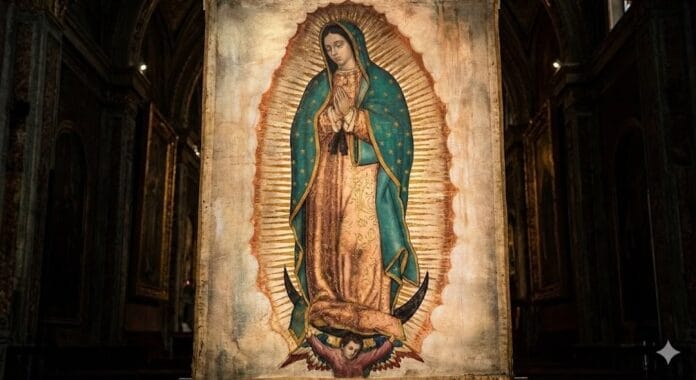
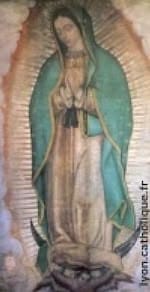
It's winter, the earth is dry and cold. Juan Diego However, Castilian roses are found in full bloom, a species unknown to Mexico. He gathers them in his tilma, a cloak made of agave fiber. Married He arranged the flowers and told her to show them only to the bishop. Juan Diego He arrives at Zumárraga's house and opens his tilma. The roses fall. But on the fabric appears the image of Married : mixed-race face, blue starry coat, pink dress, hands clasped, standing on a crescent moon carried by an angel.
The bishop fell to his knees. He had a first chapel built at Tepeyac. The image of Our Lady of Guadalupe was carried there in a solemn procession on December 26, 1531. Conversions of Indigenous people multiplied. Between 1531 and 1541, nine million Indigenous people requested baptism. The historian deserves a nuance: conversions were rarely voluntary under colonization. But the Marian image offered the Indigenous people a symbolic means of entering into faith Christian without totally denying their identity.
Juan Diego He devoted the rest of his life to the service of the sanctuary. He lived in a small house near the chapel, welcomed pilgrims, and bore witness to his encounter. He died on May 30, 1548, at the age of seventy-four. His uncle, Juan Bernardino, confirmed that he had been miraculously healed on December 12, 1531, and had seen Married, which reveals her name to her: she wants to be invoked under the title of Guadalupe.
The Church is studying these events with caution. A canonical inquiry is held in 1666. John Paul II beatified Juan Diego in 1990 and canonized him in 2002. Our Lady of Guadalupe is proclaimed patron saint of Mexico in 1737, in Latin America in 1910, and throughout the Americas in 1945 by Pius XII. December 12th became a mandatory liturgical feast day across the continent. American in 1999. John Paul II visit the sanctuary five times and leave your apostolic exhortation Ecclesia in America in 1999. François celebrates the holiday in 2013 and emphasizes that Married She became close to her children with a mixed-race face and clothing with indigenous patterns.
The miraculous tilma and the Aztec codes
Historians identify three layers in the Guadalupe narrative: established facts, symbolic additions, and theological significance. The tradition rests on the Nican Mopohua, a Nahuatl narrative written around 1556 by Antonio Valeriano, an Indian scholar trained by the Franciscans. This text presents the apparitions according to a narrative structure typical of Aztec codices: ternary repetitions, formal dialogues, cosmic symbols.
The tilma of Juan Diego It still exists. It is on display in the modern Basilica of Guadalupe. This ordinary plant material, agave fiber, should decompose in twenty years. It is over four hundred and ninety years old. The image has never been retouched or restored. Scientific analyses were conducted in 1751, 1787, 1946, and 1979. No trace of a brush, preparatory sketch, or binder was detected. In 1936, the chemist Richard Kuhn, future Nobel laureate, examined the fibers: no known dye. In 1979, researchers discovered in the eyes of Married miniature human reflections, as if the image captured the scene from December 1531.
These elements feed faith Popular but still debated. Experts point out that the analytical techniques of the time did not allow for all identifications. Others note that the tilma was varnished in the eighteenth century, which complicates the studies. The Church does not officially pronounce on the miraculous nature of the fabric. It affirms the reality of the apparitions without taking a position on the material details.
The symbolism of the image resonates with the Aztecs. The turquoise cloak is the color of the god Ometeotl. The stars follow the constellations of the December 1531 sky. The pink robe represents fertile land. The crescent moon recalls the god Quetzalcoatl. The angel carrying the cloak evokes the intermediate deities of the Nahua pantheon. The clasped hands are a gesture of Christian prayer, but also an Aztec posture of offering. Married She is not pregnant: a black knotted belt indicates pregnancy according to Nahua dress codes. This image is a visual catechism that integrates Christian signs and indigenous symbols.
The name "Guadalupe" is intriguing. No Guadalupe exists in Mexico before 1531. The prevailing hypothesis proposes a deformation of Coatlaxopeuh, The Nahuatl word meaning "she who crushes the serpent." When Juan Bernardino recounted his vision, the Spanish supposedly heard "Guadalupe," the famous Marian shrine in Extremadura. This identification created a bridge: the conquistadors recognized their Spanish Virgin, and the Indigenous people heard a name that resonated with their language and evoked victory over the forces of evil.
Historians debate the origin of the image. Some suggest that an Indian artist, trained by missionaries, painted the tilma to promote...’evangelization. Others maintain the miraculous origin. What remains indisputable is that this image facilitated dialogue between two worlds after a bloody conquest. It offered the vanquished symbolic dignity. It showed that Married adopted the characteristics of each people.
The legend is enriched by miracles. In 1791, a worker spilled nitric acid on the tilma while cleaning the frame. The fabric should have burned. Only a yellow stain appeared, which faded over the years. In 1921, an anarchist hid a bomb in a bouquet placed before the image. The explosion destroyed the altar, bent a bronze crucifix, and shattered the stained-glass windows. The tilma remained intact. These events are documented and fuel the veneration popular.
The Catholic Church accepts these accounts as part of pious tradition without elevating them to dogma. It encourages distinguishing the reliable historical core – apparitions to Juan Diego, impact on the’evangelization, centuries-old devotion – legendary embellishments that express faith of the people. What matters: Married She reveals herself as the mother of the poor, defender of the oppressed, a star that guides towards Christ.
Marie becomes close to all cultures
Our Lady of Guadalupe reveals an essential aspect of the Marian mystery: Married It accompanies the Gospel in every culture. It does not impose European piety. It adopts the dress codes, symbols, and landscape of the Nahua people. Its mixed-race face says that God respects the identity of every people.
This closeness combats two opposing temptations. First, the contempt for local cultures in the name of a single faith. Second, the relativism that dissolves the Gospel into traditions without transformation. Married The Virgin of Guadalupe shows the way: she is embodied in a specific culture but points towards the universal Christ. She consoles the Indigenous people without confining them to their past. She honors their symbols while guiding them towards the newness of Christianity.
John Paul II This attitude is called "inculturation." The Gospel must take root in every civilization. It respects what is good in human traditions. It purifies what opposes the dignity of the person. Married This model of inculturation is that she speaks Nahuatl. Juan Diego, She chose Castilian roses unknown to Mexico, It combines an Aztec azure cloak and Christian prayer.
This lesson transcends sixteenth-century Mexico. Today, migrations blend cultures. Identities fragment. Fear of the other fuels isolation and conflict. Our Lady of Guadalupe invites us to recognize the value of each cultural heritage without absolutizing any. She encourages cultural mixing, which enriches without erasing. She reminds us that the Church is Catholic, that is to say, universal: no people can claim to monopolize it. faith.
The mixed-race face of Married It also announces the vocation of the poor. Sixteenth-century Indians suffer exploitation, humiliation, and death. Married It does not bring them wealth or power. It offers them dignity and hope. It tells them that they matter in God's eyes. It makes a simple man, Juan Diego, the messenger of a divine plan. This preference for the lowly runs throughout the Gospel. «My soul magnifies the Lord; he brings down the mighty and lifts up the lowly» (Luke 1, 46.52).
Prayer
Married Our Lady of Guadalupe, Mother of the true God, you came to the hill of Tepeyac to comfort a people broken by conquest and suffering. You spoke the language of the poor, you took on their features, you called them your beloved children. Teach us to recognize your presence in cultures different from our own, in the faces we encounter each day that challenge us.
Give us your maternal gaze to welcome the stranger without fear, to respect traditions without judging them hastily, to seek in every encounter an opportunity to discover kindness of God. You who made roses bloom in the middle of winter, awaken hope in us when everything seems barren, confidence when the future worries us, generosity when selfishness tempts us.
Keep us from despising the lowly, the excluded, those who do not speak our language or share our customs. Remind us that Jesus chose to be born poor. Bethlehem, to live hidden in Nazareth, to die abandoned on the cross. Help us to defend the dignity of every person, especially that of migrants, the natives, all those whom the powerful ignore.
Star of the new evangelization, Show us how to proclaim the Gospel without violence or contempt. May our faith respect freedom, engage in intelligent dialogue, and serve with humility. As you sent Juan Diego Take your message to the bishop, send us to bear witness to your Son in our families, our neighborhoods, our workplaces.
Grant us the grace of unity in diversity. Christians People from the Americas, Europe, Africa, Asia, and Oceania form one people despite their differences in language, rites, and culture. May your starry mantle remind us that we are all children of the same Father, called to live as brothers and sisters under your maternal protection.
Today, as so many people suffer from injustice, violence, and exclusion, intercede for us. May your presence at Tepeyac in 1531 continue to inspire all those who struggle for peace, justice and reconciliation. Married Our Lady of Guadalupe, guide us to your Son Jesus, who came so that all may have life in abundance. Amen.
To live
- Pray a "« Greetings Married » thinking of a person from a different culture, to ask Married to bless his path and to help us understand it better.
- Take a concrete step towards welcoming : invite a migrant neighbor to share a coffee, support an association that helps refugees, learn a few words of a foreign language.
- Read Luke 1, 46-55 (the Magnificat) for ten minutes and note down a phrase that relates to our personal situation, in particular God's attention to the humble.
Tepeyac and the sanctuaries of the world
The Basilica of Our Lady of Guadalupe in Mexico City welcomes twenty million pilgrims a year. It is the most visited Marian shrine in the world after Lourdes. The old basilica, built in 1709, is sunk into the marshy ground. A new, modern basilica was inaugurated in 1976. Designed by the architect Pedro Ramírez Vázquez, it can accommodate ten thousand people. The tilma of Juan Diego It is displayed behind bulletproof glass, above the high altar. Moving walkways allow worshippers to pass in front of the image without stopping the flow of worship.
Tepeyac overlooks Mexico City from its 130-meter height. Before 1531, the Aztecs worshipped Tonantzin, the mother goddess, there. Archaeological excavations have revealed the remains of pre-Columbian temples. This continuity of sacred sites facilitates the symbolic transition from one religious tradition to another. The Indigenous people continue to climb the hill, but to honor Married.
A chapel in Cerrito marks the exact spot where Married It is said to have appeared. Pilgrims climb it on their knees on December 12th. Merchants sell medals, images, and candles. The atmosphere blends fervor and folklore. Aztec dancers perform pre-Hispanic rituals in front of the churchyard, with drums and parrot feathers, in homage to the Virgin. This syncretism baffles some observers but testifies to the deep popular roots of the cult.
Associated relics are rare. The body of Juan Diego rests beneath the altar of the old basilica. No relics have been in contact with Married No claim is made: the tilma is sufficient. Replicas of the image circulate throughout Latin America. Many Mexican families own a reproduction. The iconography of Our Lady of Guadalupe inspires paintings, sculptures, and frescoes. Diego Rivera, an atheist muralist, depicts her in his works as a symbol of Mexican identity.
The cult is spreading beyond the Mexico from the eighteenth century onwards. Shrines dedicated to Our Lady of Guadalupe appeared in the United States, in Canada, in South America. Latin American immigration to Europe brought devotion. A statue of Our Lady of Guadalupe stands in the Basilica of Fourvière in Lyon, a gift from the Mexican community in France. This presence demonstrates the universality of Married.
The popes regularly visit Tepeyac. John Paul II goes there in 1979, 1990, 1999, 2002. Benedict XVI in 2002. François plans to return but postpones due to health reasons. These papal pilgrimages underscore the importance of the shrine for the’Universal Church. THE Mexico Ninety percent of the population is Catholic, a proportion that is decreasing but still high. Our Lady of Guadalupe shapes the national religious identity.
The Feast of December 12th mobilizes the entire country. Processions set out from distant villages and converge on Mexico City. Some pilgrims walk for several days. Masses are held day and night. Marian hymns in Nahuatl resound. Civil authorities close roads. The event transcends its religious sphere and becomes a cultural and social phenomenon.
In 1999, John Paul II He established that December 12th would be a mandatory liturgical feast throughout the Americas. He deposited the apostolic exhortation at Tepeyac. Ecclesia in America, a product of the 1997 continental synod. It presents Our Lady of Guadalupe as "the star of the first and the new evangelization »This formula summarizes the historical and current role of Married in the transmission of faith on the continent American.
Liturgy
- Readings Zechariah 2:14-17 (God comes to dwell in the midst of his people); Psalm 44 (the king's wedding song); ; Luke 1, 26-38 (Annunciation) or Luke 1, 39-47 (Visitation).
- Entrance chant : The Guadalupe (traditional Mexican hymn) or Married, tender Mother (theme of maternal proximity).
- Universal Prayer : Intentions for the American people, the migrants, Indigenous peoples, the unity of the Church in the diversity of cultures.
- Offertory Symbols linked to indigenous cultures (corn, weaving) can be presented to signify the offering of all creation.
- Communion hymn : Ave Maria de Guadalupe or a Marian hymn in the local language.
- Final blessing Invocation to Married so that she may protect and guide the faithful to her Son Jesus.