












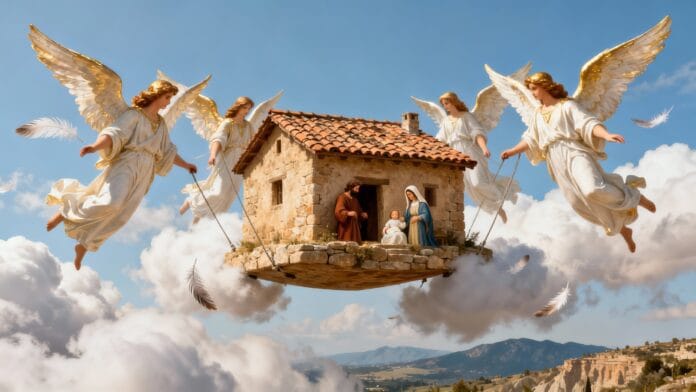
When the Holy House takes flight to Italy. On December 10, the Church celebrates Our Lady of Loreto, patron saint of aviation since 1920. This liturgical memorial, recently added to the Roman calendar, honors the Italian sanctuary where, according to tradition, the birthplace of Married. A thousand-year-old pilgrimage that unites earth and sky, history and legend, Marian prayer and technological modernity. Aviators from all over the world place themselves under its protection.
Angels They crossed the Adriatic carrying a house. On December 10, 1294, according to legend, the Holy Family's dwelling landed in Loreto after a miraculous flight from Nazareth. This tradition has inspired one of the greatest Marian shrines in Europe for seven centuries. In 2019, the Vatican This devotion is formalized by its inclusion in the universal calendar. Patron saint of aviators for a century, Our Lady of Loreto links biblical Galilee to modern squadrons in a single movement of elevation.
History of the sanctuary and historical foundations
Loreto stands on a hill in the Italian Marche region, five kilometers from the Adriatic Sea. The present sanctuary protects a small stone structure, 9.5 meters by 4.5 meters, venerated as the Holy House of Nazareth. 20th-century archaeological excavations revealed stones consistent with 1st-century Palestinian architecture. Three walls remain; the fourth, now missing, is believed to correspond to the natural wall of the Grotto of the Annunciation in Nazareth.
Written accounts date back to the 13th century. Notarial acts from Recanati mention the sudden appearance of an unusual structure in the local forest in 1294. Crusaders reported as early as 1263 the gradual dismantling of Christian sanctuaries in the Holy Land in the face of the Muslim advance. The Angeli family, a noble Byzantine lineage, is said to have organized the maritime transfer of sacred stones to save them from destruction. The very name Angeli is believed to have fueled the legend. angels carriers.
Recent studies favor the hypothesis of a deliberate human transfer. The stones would have traveled by boat from the port of Tarsus, then overland to Recanati. Carbon-14 dating confirms the Eastern origin of the materials. The graffiti discovered on the walls reproduce Judeo-Christian symbols from the 1st century. The absence of the fourth wall corresponds exactly to the configuration of the cave-house of Nazareth, built against the rock.
The pilgrimage exploded in the 14th century. Popes Urban V and Clement V granted indulgences to visitors. In 1469, Paul II financed the construction of a basilica to protect the Holy House. Julius II commissioned Bramante to create a sculpted marble facade that transformed the site into a monumental setting. More than 50 popes visited Loreto between 1294 and 2019. Records show four million pilgrims annually in the 17th century.
The French Revolution destroyed part of the treasure in 1797. Napoleon had the miraculous statue transferred to Paris, then returned it in 1801. The bombings of 1943-1944 damaged the basilica without affecting the Holy House. John XXIII came to pray in 1962 before the opening of Vatican II. John Paul II visited in 1979, 1995 and 2004. Benedict XVI It celebrated the Youth Agora there in 2007.
The decree of October 31, 2019, elevating the commemoration to the status of a universal liturgical feast, responds to centuries of popular devotion. The Congregation for Divine Worship sets the date as December 10, the traditional anniversary of the translation. This official recognition places Loreto on par with major Marian shrines such as Lourdes and Fatima. The liturgical wording emphasizes the mystery of the Incarnation rather than the details of the transfer.
The legend of the angels and its symbolic significance
The traditional account describes the house's aerial relocation in three stages. On May 10, 1291, angels They took her from Nazareth, which was threatened by the Saracens. She first landed in Dalmatia, near Tersatto (now Trsat in Croatia). Three years later, on December 10, 1294, she crossed the Adriatic and landed in a laurel grove near Recanati. This double journey was reportedly confirmed by Marian apparitions to local witnesses.
The legend incorporates precise architectural details. The inhabitants discover a structure without foundations, resting on the ground like a cube. The stone altar bears Hebrew inscriptions. A cedarwood statue of Lebanon represents Married holding the Child. Local iconography features numerous depictions of angels carrying the house on their shoulders or guiding it through the clouds. These images became the emblem of the sanctuary from the 15th century onwards.
The symbolic dimension transcends the wondrous event. The miraculous flight represents the spiritual elevation of Married, a new Ark of the Covenant crossing the waters. The house becomes the mobile temple of the divine presence, foreshadowing the’Universal Church which knows no borders. The passage from East to West evokes the transmission of the Apostles' faith to the whole world. The laurels at the landing site recall Christ's victory over death.
This tradition inspires a theology of the concrete Incarnation. God does not despise matter; he inhabits a human dwelling. The Holy House testifies that Jesus lived in the ordinary life of a working-class family, within four stone walls. The miraculous transfer affirms that nothing that touches Married It cannot perish. Divine Providence protects the places where the mystery of salvation was forged.
The Church distinguishes the historical core from the legendary embellishment without disqualifying the spiritual significance. Popes visit Loreto as a place of authentic Marian memory, without making pronouncements on the angels Carriers. Popular piety finds in them a figurative language to express heavenly protection. Artists draw from them an inexhaustible motif for representing the supernatural manifested in everyday life.
Air patronage logically stems from this legend. If angels can blow up a house, Married It can protect those who take to the skies. The decree of March 24, 1920, responded to the demands of pilots during the Great War. The nascent military aviation sought specific protection against the new dangers of the skies. Italian squadrons adopted the image of the Flying House on their insignia.
When faith takes flight
Our Lady of Loreto teaches the audacity of trust. Married She consents to the impossible when the angel Gabriel announces that she will give birth to the Son of God. She accepts becoming the living dwelling place of the divine Presence. This radical openness creates the space where God can accomplish his work of salvation. The Holy House symbolizes our own vocation to become a temple of the Spirit.
The mobility of the house evokes the freedom of the Gospel. Jesus affirms that the Son of Man has no stone on which to lay his head. Christian rootedness is not synonymous with immobility. Faith sometimes requires leaving everything to follow the call. The medieval crusaders carrying the sacred stones foreshadow the Church on its journey toward the Kingdom. Our hearts must remain open to the movement of grace.
The ascent to heaven represents theological hope. Paul writes that our true city is in heaven. Our earthly roots should never make us forget our ultimate destination. Married, Embraced body and soul in glory, it paves the way. Devotion to Our Lady of Loreto reminds us that we are made for spiritual flight, called to join the Father's dwelling place.
The protection of aviators reveals universal Marian concern. Married She accompanies all those who face danger in the course of their work. Her intercession covers both everyday risks and exceptional perils. To invoke Our Lady of Loreto is to acknowledge our need for divine guidance to stay the course through life's turbulent times.
Prayer
Married, You whose house has crossed the seas, teach us to let ourselves be carried by the Holy Spirit. Give us the courage to consent to God's movements in our lives. When our certainties waver, when our bearings crumble, may your trust become our compass. You said yes without knowing all the details of the divine plan. Inspire in us this same openness to the surprises of grace.
Our Lady of Loreto, patron saint of those who soar through the air, watch over all civilian and military aviators. Protect the pilots, mechanics, and air traffic controllers who ensure the safety of travelers. Guide the hands that maneuver the controls in the storm. Keep the minds alert of those who make vital decisions in seconds. May your heavenly mantle cover every takeoff and every landing.
Holy House where the Word became flesh, remind us that God dwells in our ordinary places. Transform our homes into sanctuaries of his presence. May our homes become spaces of peace where love reigns. Teach us to welcome Christ in the simplicity of everyday life, within four ordinary walls that become holy through prayer. Make our hearts a dwelling worthy of your Son.
Virgin of the Incarnation, intercede for the Church on its journey to the Kingdom. Support the missionaries who leave their homeland to proclaim the Gospel. Strengthen the refugees torn from their homes by the war or persecution. Comfort those who have lost everything and are seeking a new beginning. Give them hope that you will never abandon them, wherever they may be on this earth.
Our Lady of Loreto, we entrust to you our plans and aspirations. Help us to aim high without losing our feet on the ground. May our spiritual life soar towards God while remaining rooted in charity concrete. Grant us the grace to live mystical elevation and daily commitment as two wings of the same vocation. Through Jesus Christ, our Lord. Amen.
To live
- Examine my spiritual grounding Take 10 minutes to proofread Luke 1,26-38 and meditate on the availability of Married who transforms his home into a sanctuary.
- Protective gesture : To entrust to Our Lady of Lorette a person exposed to occupational danger (pilot, firefighter, emergency caregiver).
- Sanctifying the Ordinary : Choose a place in my house and place an icon or a cross there to make it a corner for daily prayer.
A sanctuary between heaven and earth
The Santuario Pontificio della Santa Casa has dominated the town of Loreto for seven centuries. The current basilica, built between 1468 and 1587, blends Gothic and Renaissance styles. Luigi Vanvitelli's octagonal dome reaches a height of 75 meters. Four bell towers mark the corners of the sanctuary. Giovanni Boccalini's Baroque façade dates from 1587. The Porta Regia, the main entrance, features statues of prophets and sibyls.
The heart of the sanctuary remains the Holy House, encased in a white marble shell. Bramante designed this cladding between 1509 and 1510. Bas-reliefs depict scenes from the life of Married sculpted by Andrea Sansovino, Ranieri Nerucci, and other Renaissance masters. The interior ceiling retains frescoes blackened by centuries of candle smoke. The original stone altar bears an inscription attesting to its origin in Nazareth.
The miraculous statue of Married throne above the altar. The cedar wood sculpture measures 127 centimeters. The Infant Jesus blesses with his right hand, holding a globe in his left. Married She wears a gold crown given by the popes. The faithful touch the wall of Palestinian stones while praying. Hundreds of thousands of ribbons, medals, and votive offerings testify to the graces received.
The Treasury displays the offerings of famous pilgrims. The kings of France, Spain, and Portugal enriched the sanctuary with chalices, monstrances, and reliquaries. The French Revolution dispersed some of these treasures. What remains includes exceptional pieces of goldsmithing from the 15th to the 18th centuries. The archived records detail miracles recognized since 1295.
Piazza della Madonna hosts the grand celebrations. Every December 10th, the patron saint's feast day draws tens of thousands of worshippers. Aerobatic displays fly over the sanctuary in formation. The Italian Frecce Tricolori traditionally lead the parade with a display of smoke trails in the national colors. Squadrons from France, Spain, and other European countries follow. Uniformed aviators then march past to have their ceremonial weapons blessed.
The tradition was established after 1920. On March 24 of that year, Benedict XV officially proclaimed Our Lady of Loreto patron saint of aviation. The first solemn blessing of aircraft took place in 1921. Fighter pilots of the Great War, survivors of deadly aerial combat, attributed their survival to Marian intercession. General Giulio Douhet, theorist of Italian air power, participated in the inaugural ceremonies.
In France, several places perpetuate this devotion. The Notre-Dame-de-Lorette Basilica in Ablain-Saint-Nazaire, Pas-de-Calais, houses the largest French military cemetery. The sanctuary overlooks the Artois plain where the battles of 1914-1915 took place. Thirty-five ossuaries contain the remains of 20,000 soldiers. The 52-meter lantern tower features a monumental statue of the Virgin and Child. The inscription "To Our Dead" welcomes visitors.
The church in Sancé, near Mâcon, houses a Baroque altarpiece depicting the aerial transport of the Holy House. This 17th-century work testifies to the popularity of the legend in the French countryside. The angels carry the house above the waves while Married appears in the clouds. This type of representation can be found in hundreds of European churches between the 15th and 18th centuries.
Marian pilgrimages often include a stop at Loreto. The Loreto Way connects Seated The shrine stretches for 130 kilometers. Thousands of young people walk it every summer. The shrine also offers a contemporary spiritual journey with multimedia exhibits on the Incarnation. Recent popes have encouraged families to visit Loreto as a school of evangelical life.
Liturgy
- First reading : Isaiah 7,10-14 (the sign of Emmanuel) or Genesis 3,9-15 (the protoevangelium)
- Psalm Psalm 87 (The Lord loves the gates of Zion)
- Second reading Hebrews 2:14-18 (the Son shares our humanity) or Galatians 4:4-7 (born of a woman)
- Gospel : Luke 1,26-38 (The Annunciation)
- Entrance chant : Ave Maris Stella Or Queen of Heaven, rejoice!
- Acclamation : Hallelujah. Rejoice!, Married Full of grace, the Lord is with you