












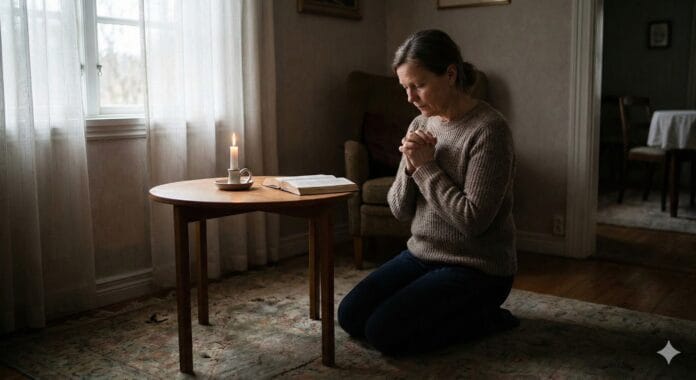
Imagine. You wake up on a Monday morning. Before even checking your phone, you take a few minutes of silence. You light a candle. You open your Bible. This is how the day begins for millions of Catholics in France.
Personal prayer is not a spiritual luxury reserved for monks. It is the beating heart of faith for the vast majority of practicing Catholics. Eight out of ten Catholics who regularly attend Mass also pray at home. This figure reveals something profound: Christian life extends far beyond the parish setting to permeate every moment of daily life.
But what really happens behind the closed doors of these moments of prayer? How do these men and women experience this personal relationship with God? And above all, what concrete changes does it make in their lives?
Personal prayer, the heart of living faith
A daily practice rooted in reality
Personal prayer is not abstract. For the vast majority of practicing Catholics, it literally structures their day. Some pray upon waking, others before meals, and many in the evening before going to sleep. It is not a burdensome moral obligation, but rather a felt need.
Let's take the example of Married, 42 years old, mother of three and marketing manager. She gets up fifteen minutes earlier every morning to have this time before the house comes alive. "It's my oxygen," she confides. "Without these minutes of silence with God, I start my day feeling unbalanced."«
This regularity creates a rhythm. Just as breathing takes on a life of its own, these believers establish prayer rituals that become points of reference. rosary Evening for Paul. Reading a psalm for Sophie. A few minutes in front of an icon for Jean.
Personal prayer also adapts to the seasons of life. When children are young, it becomes shorter but more frequent. In retirement, it can deepen and lengthen. During difficult times, it becomes a refuge. In moments of joy, it becomes an act of thanksgiving.
More than a tradition, a personal relationship with God
Here's the crucial point. For nearly four out of ten practicing Catholics, being Catholic means first and foremost living an intimate relationship with Jesus. Not simply adhering to a doctrine. Not just participating in rituals. But maintaining a living relationship with someone.
This nuance changes everything. A relationship requires dialogue, not a monologue. It involves listening as much as speaking. It thrives on time spent together. It creates a closeness that transcends words.
Jesus himself taught this clearly. «When you pray, go into your room, close the door, and pray to your Father who is unseen.» This invitation to intimacy is not an option for the most zealous. It is the normal way of living the Christian life.
Think about friendship. You don't become friends with someone by seeing them for only an hour a week in a group. You need special moments, personal conversations, and confidences. That's exactly what these Catholics experience in their personal prayer: they cultivate their friendship with God.
This relationship transforms the very identity of the believer. We no longer pray out of duty but out of desire. We no longer recite formulas but share our lives. We no longer observe a religious rule but respond to a call of love.
The secret of a faith that transforms everyday life
Personal prayer is not an escape from the world. On the contrary, it anchors us more firmly in reality. It sharpens our perception. It heightens our awareness of details. It opens us to a sense of presence.
«I see signs of God in my day,» many practitioners testify. This statement might seem naive or mystical. But it describes a very concrete experience: that of a spiritual awareness that transfigures the ordinary.
How does it work? Imagine starting your day by confiding your worries to God. You tell him about that important meeting, that family conflict, that decision you have to make. Then you go about your business.
During the day, you receive an unexpected message that unlocks a situation. You meet someone who tells you exactly what you needed to hear. An obvious solution suddenly presents itself to this problem that has been troubling you. Coincidence? Perhaps. But for someone who prays, it is also an answer.
This sensitivity to signs is not a matter of magical thinking. It stems from an inner openness. When we pray regularly, we become more attentive to the subtle movements of grace. We more easily recognize opportunities for good. We better perceive the discreet promptings of the Spirit.
Thomas, a 35-year-old teacher, says: "Before, I went through my days on autopilot. Since I started praying every morning, it's like I'm using a spiritual GPS. I pick up on things I would never have noticed otherwise."«
How Catholics integrate prayer into their lives
Special moments during the day
Personal prayer does not fall from the sky. It is built methodically. Catholics who pray regularly at home have generally identified the times that suit them best.
The morning remains the preferred time for many. Why? Because the mind is fresh, the house is still quiet, and the whole day unfolds before you like a blank page to offer to God. Some even get up before the rest of the family to ensure this sacred time.
Morning prayer often feels like a spiritual preparation. We read the day's passage of Scripture. We meditate for a few minutes. We entrust to God our appointments, challenges, and the people we will meet. It's like setting off on a journey with a well-oriented compass.
The evening is better suited to others. After the tumult of the day, they seek a moment of reflection. Evening prayer then takes on a different tone: rereading, gratitude, asking for forgiveness, trusting surrender before sleep.
Claire, a night nurse, had to invent her own rhythm. "I pray in the afternoon before going to work," she explains. "And I finish with a time of prayer when I get home at dawn. My day is reversed, and so is my prayer. But it remains the guiding thread."«
Some are increasing the number of short prayer sessions. A short invocation while commuting. An Our Father before a delicate meeting. A Hail Mary while preparing a meal. These short prayers act as reminders, spiritual breaths that maintain the connection with God.
What matters is not so much the duration as the regularity. Ten faithful minutes each day are better than a sporadic hour once a month. Personal prayer thrives on consistency.
Various forms of personal prayer
There is not just one way to pray. Catholics draw upon a spiritual treasure accumulated over two thousand years to find what nourishes their personal relationship with God.
There lectio divina, or prayerful reading of the Bible, occupies a central place. The principle is simple: you read a passage of Scripture slowly, meditate on it, let a word or phrase resonate with you, and respond in prayer. It's a conversation with God through his Word.
Many use the readings from the Mass of the day. Others follow a biblical reading plan. Some return repeatedly to the same passages that particularly nourish them. The essential thing is that the Bible not remain a closed book but become a love letter to be deciphered.
THE rosary remains an extremely popular prayer. Far from being a mechanical repetition, it offers a soothing setting in which to meditate on the mysteries of Christ's life while reciting the Hail Marys. It is a prayer of the body as much as of the mind, its rhythm set by the beads slipping between the fingers.
Silent prayer is attracting more and more practitioners. Influenced by contemplative traditions or even by certain adapted Eastern practices, Catholics are discovering the power of silence. Simply sitting in God's presence, without words, just being there. "At first, it's disconcerting," Marc admits. "But gradually, this silence becomes imbued with meaning."«
Liturgical prayers also structure the day. Some pray Lauds in the morning and Vespers in the evening, using prayer books or apps. In this way, they connect with the prayer of the’Universal Church. Others recite the Angelus at noon, perpetuating a centuries-old tradition.
Spontaneous prayer also has its place. Speaking to God in one's own words, recounting one's day, expressing doubts, shouting joy or sorrow. No set formula, just an open heart. "Sometimes I pray like I would call my best friend," says Lucie. "I say whatever comes to mind."«
The importance of the place and the ritual
The place of prayer matters more than we think. Jesus spoke of "the most secluded room." He was pointing to a principle: having a dedicated space helps with concentration and regularity.
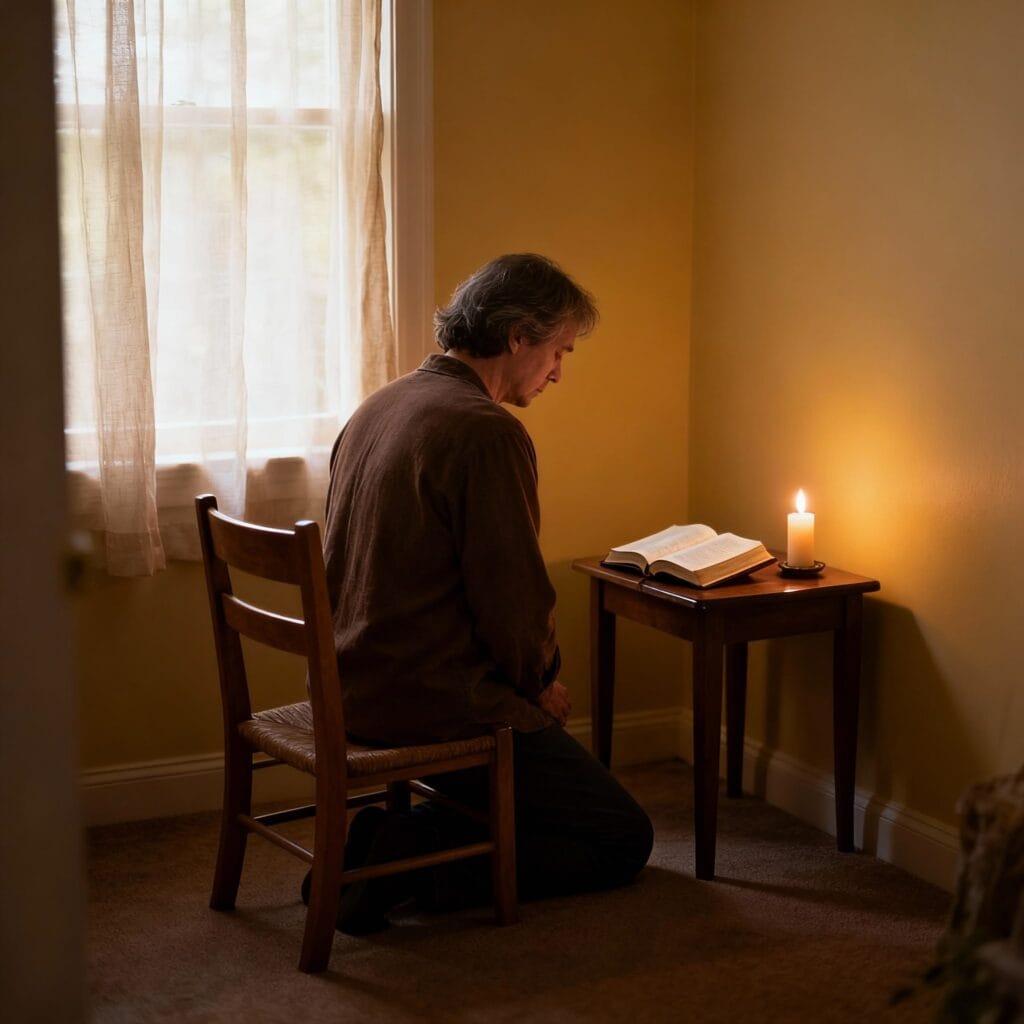
Many Catholics set up a prayer corner in their homes. There's no need for an elaborate home chapel. Sometimes it's just an armchair facing a window. Or a small table with a cross, a candle, an icon. The important thing is that this place is associated with prayer.
When you always sit in the same place, your body and mind recognize the signal. You enter into prayer more quickly. The place becomes charged with all the previous prayers, creating a conducive atmosphere.
Rituals facilitate entry into prayer. Light a candle. Make the sign of the cross. Open the Bible to a marked page. Put on some background music. These simple gestures act as decompression chambers between the daily hustle and bustle and moments of quiet reflection.
However, be careful not to confuse ritual with rigidity. Ritual serves prayer, it does not replace it. Some days, we break with our routines. We pray while walking in nature. We transform a household chore into a time of prayer. We improvise.
Material aids support prayer. A crucifix that evokes Christ. An icon that opens a window onto mystery. A rosary Something to occupy your hands. Candles that create ambiance. These objects aren't magic, but they help to focus attention and create an atmosphere.
Many Catholics also use prayer apps. These offer daily readings, guided meditations, and prayer reminders. Technology It places itself at the service of spiritual life, without replacing it.
The most important thing is freedom. There is no perfect method, no ideal duration, no magic formula. Each person gradually discovers what nourishes their personal relationship with God. And this can evolve over the years.
Seeing the signs of God in everyday life
A spiritual awareness that transforms one's perspective
Seeing signs from God in one's day is not reserved for mystics. It is a capacity that develops in anyone who cultivates a life of prayer. But what does this mean in concrete terms?
It's not about looking for the supernatural everywhere. A sign from God is not necessarily a spectacular miracle. Rather, it is an awakened awareness that recognizes God's discreet presence in the ordinary.
Consider the difference between looking and seeing. You can look at a landscape distractedly. Or you can truly see it, capturing its beauty, its nuances, its details. Regular prayer trains you to "see" your life, not just look at it.
This spiritual vigilance operates on several levels. First, we become more sensitive to positive synchronicities. That encounter at the right time. That idea that arises exactly when we need it. That book that falls into our hands and answers our question.
Then, we develop a heightened gratitude for the little things. A child's smile. A ray of sunshine after the rain. The taste of a good meal shared. These simple realities become messengers of kindness of God.
But beware of potential abuses. Seeing signs from God does not mean interpreting every event as a coded message. Nor does it mean inventing a God who is constantly sending us clues to decipher.
The difference lies in the inner attitude. It is not a superstition that seeks omens, but a faith that recognizes that God truly accompanies us in our lives and manifests himself in a thousand discreet ways.
Testimonies of divine presence
Let's listen to some voices. These testimonies illustrate the diversity of experiences while revealing a common point: personal prayer refines spiritual perception.
Sandrine, 50, was going through a difficult period of mourning. «One morning, during my prayers, I felt the need to go for a walk in a park I never frequented. On a bench, I found a forgotten book. Opening it at random, I came across a text that spoke exactly to my grief and brought me incredible comfort. Coincidence? Perhaps. But for me, it was God meeting me in my sadness.»
Julien, a young entrepreneur, was desperately seeking funding. «I had prayed for weeks. One evening, completely discouraged, I turned on the TV to take my mind off things. A news report was about a support program for entrepreneurs that I didn't even know existed. I applied and got the funding. It wasn't a miracle, but the timing was so perfect that I saw it as the hand of God.»
These signs do not magically solve all problems. They simply remind us that we are not alone. They demonstrate a caring presence. They restore confidence in moments of doubt.
Some signs are even more subtle. An inexplicable feeling of peace in a stressful situation. An unexpected strength to face an ordeal. An intuition that proves correct. The ability to forgive when one believed oneself incapable of doing so.
«Prayer has taught me to live with a dual perspective,” he explains François, "I'm a doctor. I see reality as it is: sometimes harsh, often complex. But I also perceive an additional dimension, a spiritual depth. It's as if I'm looking at life in 3D."»
Cultivate this spiritual sensitivity
How can we develop this attentiveness to the signs of God? Several practices can help, all rooted in regular personal prayer.
First, keep a spiritual journal. Each evening, note down one or two moments when you felt God's presence. A comforting conversation. An obstacle avoided. A beautiful sight that touched your heart. Over time, you'll build a treasure trove of memories that attest to loyalty of God.
Next, practice the Ignatian examination of conscience. Saint Ignatius of Loyola Each evening, I suggested reviewing my day in God's presence. What were the moments of consolation? The moments of desolation? Where did I feel God close? Where did I seek Him without finding Him?
This daily review gradually refines the spiritual discernment. We learn to recognize inner movements, to distinguish what comes from God and what comes from elsewhere.
Thirdly, cultivate inner silence. In our world saturated with noise and information, silence becomes revolutionary. God's signs are often subtle. If our minds are constantly agitated, we miss them.
A few minutes of silence after the prayer. Moments without music, No podcasts, no phone. Empty spaces where God can slip in. "Silence taught me to listen differently," testifies Elise. "Not just with my ears, but with my heart."«
Fourth, share with others. A spiritual director, a prayer group, a friend in faith. Sharing how one perceives God's action. Hearing about the experiences of others. This prevents getting stuck in one's own interpretations and broadens one's perspective.
Finally, keep the’humility. Recognize that you can be wrong. Accept that God remains mysterious even when He reveals Himself. Do not elevate your experiences to a universal model. Prayer is not an exact science but a living relationship, therefore unpredictable.
The personal prayer of Catholics reveals something fundamental. The Christian faith is not primarily a philosophy or a moral code. It is a relationship of love that is nurtured daily.
When eight out of ten practicing Catholics pray at home in addition to Sunday Mass, they demonstrate a vital need: to remain connected to the source of their spiritual life. They are not content with a social or cultural faith. They seek a personal encounter with Christ.
This prayer transforms their view of the world. They see signs from God not out of naivety but through attentiveness. They cultivate a spiritual sensitivity which transforms the ordinary without denying the difficulties.
And this practice is not reserved for a spiritual elite. Anyone who desires to deepen their relationship with God can begin tomorrow. Ten minutes in the morning. A reading from the Gospel. A few words shared with God. It's as simple and as demanding as that.
The real question isn't "How do I find the time?" but rather "Do I want to cultivate this relationship?" Because ultimately, we always find time for what truly matters. Catholics who pray daily have simply decided that God matters enough for them to set aside time in their schedules for Him.
The secret to their perseverance? They discovered that this prayer is not a sacrifice but a gift. Not a constraint but a freedom. Not an escape from reality but a plunge into its depths.
«I could no longer live without this daily encounter with God,» confides Anne-Marie. “Not out of religious obligation, but simply because it has become my lifeblood. The day I forget it, I feel like I’m missing something essential.”
Perhaps this is the best definition of personal prayer: a spiritual breath. As natural as it is necessary. As discreet as it is essential. A breath that permeates the days and gives them meaning, depth, and beauty.