













The prayer of the heart spiritual practice Ancient and deeply rooted in Christian tradition, it consists of a repeated, inner invocation of the name of Jesus, seeking to establish an intimate and continuous relationship with God. This form of prayer is distinguished by its apparent simplicity, yet it reveals a mystical and theological richness that has developed over the centuries.
In the Christian tradition, prayer of the heart holds a central place. It embodies a path toward inner silence, spiritual vigilance, and the transformation of the human heart. Its ascetic dimension invites us to transcend distractions in order to reach a state of profound peace and union with the divine.
This article aims to explore The prayer of the heart: history and practice in the Christian tradition from several angles:
- The historical origins of this prayer in the Christian deserts
- The tradition of Hesychasm and its theological foundations
- The concrete practice and its physical and spiritual modalities
- The mystical and spiritual dimensions that it opens up
- His influence on the contemporary Catholic tradition
- Its relevance today in a modern, often turbulent world
You will discover how this ancient form of spirituality remains alive, accessible and profoundly transformative.
Historical Origins of the Prayer of the Heart
There prayer of the heart draws its roots from a historical context marked by the emergence of Christian monasticism, particularly in the deserts of Egypt, Palestine and Syria in the 4th and 5th centuries. This period saw the emergence of an intense spiritual quest, where solitude and silence became privileged conditions for achieving a profound union with God.
The first monks, called desert fathers, They embody this ascetic quest. They develop a form of prayer centered on inner repetition, aiming to calm the tumult of thoughts in order to access a silent divine presence. This practice finds its expression in the short, repetitive formula that would later become the prayer of the heart: "Lord Jesus Christ, Son of God, have mercy on me.".
The Christian desert thus becomes the cradle of a new spirituality where the’hesychasm — a Greek word meaning "tranquility" or "silence" — emerges as a major principle. Hesychasm emphasizes inner vigilance (nepsis) and the control of thoughts in order to erect a barrier against external and internal distractions.
The role of the first monks is fundamental in the development of this prayer. Figures like Saint Anthony the Great or Saint Pachomius contribute to structuring the monastic life centered around this contemplative practice. Their teaching values the constant repetition of a humble invocation that sustains spiritual attention, thus preparing the ground for later theological developments.
This historical origin sheds light on how the prayer of the heart fits into a history of Christian prayer shaped by the concrete experience of the desert, a space that is both physical and spiritual, where a mystical heritage was born that is still alive today.
The tradition of Hesychasm and its theological foundations
L'’hesychasm, a term derived from the Greek meaning "silence" or "tranquility", refers to a spiritual practice centered on the silent contemplation and inner prayer. This tradition aims to establish a state of profound peace, where the soul withdraws from external distractions to unite intimately with God. The fundamental principles of hesychasm rest on the ceaseless repetition of a short prayer, often the prayer of the heart, accompanying this invocation with constant vigilance.
This inner vigilance has a specific name: the nepsis. It consists of sustained attention to one's thoughts and emotions in order to prevent any mental intrusion that could disturb prayer. Nepsis is not simply a mental exercise, but a form of spiritual discipline that prepares the monk or believer to receive the divine presence without distractions.
The 14th century marked a decisive stage in the theological development of this tradition thanks to Gregory Palamas, Archbishop of Thessaloniki. He vigorously defended Hesychasm against philosophical and theological criticisms that questioned its validity. Palamas emphasized the distinction between the inaccessible essence of God and His divine energies, accessible through prayer of the heart. This distinction allowed him to affirm that Hesychast mystics truly experienced divine light, not as a creation but as an authentic manifestation of God.
Gregory Palamas thus laid the foundations of an Orthodox theology emphasizing the direct experience of God through silent prayer. His work helped protect the practice from accusations of heresy or mystical exaggeration in the 14th century, thereby legitimizing the spiritual importance of hesychasm in the Christianity Oriental.
«"The uncreated light perceived by the Hesychasts is the same as that which illuminated Mount Tabor during the Transfiguration of Christ," Palamas affirmed, thus emphasizing the divine and authentic nature of this mystical experience.
This theological defense still retains a major influence in Orthodox Churches today and still illuminates contemplative practices centered on prayer of the heart.
The practical practice of the prayer of the heart
The prayer of the heart is based on a simple, yet profoundly meaningful formula:
«"Lord Jesus Christ, Son of God, have mercy on me, a sinner.".
This invocation of the name of Jesus is repeated inwardly, without interruption. This incessant repetition plays a central role in the practice. It is not simply about saying words, but about anchoring attention in the present, gradually fostering inner silence—what the monks call Hesychia. This silence is not a passive mental emptiness, but an active and vigilant calm of the soul.
The link between body and mind
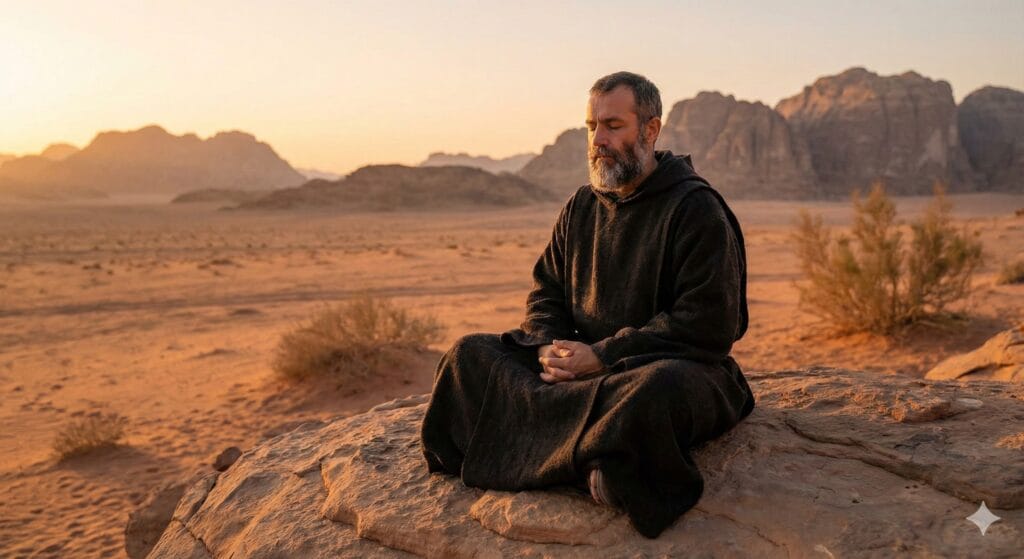
The body's posture accompanies this inner repetition. The postures are moderate and respectful of the body: gentle prostrations, head tilts, or hands crossed on the chest serve to support concentration. These gestures help to unite body and mind in a single, humble, and sincere prayer. The physical dimension is not secondary; it outwardly manifests the inner quest.
A profound change
The ultimate spiritual goal is a profound transformation: moving from a "heart of stone— hardened by passions and distractions — to a »heart of flesh,« receptive to divine grace. This metaphor reveals the very essence of the prayer of the heart: it seeks to dismantle spiritual insensitivity in order to open the believer to a living communion with God. Each invocation renews this inner openness.
A continuous breath
In this subtle dynamic, the repetition of the name of Jesus becomes a continuous breath that purifies the heart and calms the mind. Prayer ceases to be a mere one-off action and becomes a constant presence that dwells within the whole being. This age-old practice thus retains all its power, inviting everyone to experience this intimate union beyond words. To deepen your understanding of this spiritual method, you can explore the orthodox method of prayer proposed by Jean-Yves Leloup.
Spiritual and mystical dimensions of the prayer of the heart
The prayer of the heart aims at a intimate and continuous union with God. This union is not merely a theological concept, but a lived experience for those who engage in this practice. It seeks to transcend simple recitation to reach a state where the divine presence becomes palpable in the heart.
The importance of asceticism
Asceticism plays a fundamental role in this approach. It consists of a rigorous spiritual discipline that promotes the Mental calm and inner peace. Through this discipline, you learn to master your thoughts, reduce distractions, and cultivate constant vigilance — called nepsis — which prepares the soul to fully embrace prayer. Asceticism is not limited to external practices; it gradually transforms the inner being, bringing serenity and depth.
The direct experience of the divine presence
An essential aspect of the prayer of the heart is the’direct and personal experience of the divine presence. This experience transcends words and intellectual concepts. It manifests as a profound sense of peace, divine love, and inner light. This personal contact with God is often described as a form of pure prayer where the heart is united with the divine in silence, without excessive mental effort.
«"The prayer of the heart is a path to inner transformation, where the believer becomes one with God in a silent and living communion."»
This mystical dimension strengthens faith by making the invisible tangible. The ceaseless repetition of the sacred formula directs your entire being toward this intimate encounter, making each invocation a step toward this profound union. You then experience not only peace exterior but above all an peace of mind, a direct reflection of the divine presence that dwells within the one who prays sincerely.
A daily commitment
This ongoing union thus becomes the center of your spiritual life, renewing your relationship with God daily through a humble but powerful commitment.

Echoes and adaptations in the contemporary Catholic tradition
The prayer of the heart, although rooted in Orthodox tradition, exerts a notable influence on the contemplative Catholic spirituality inspired by the prayer of the heart. This resonance is manifested by a rediscovery and increasing appreciation of this simple yet profound form of invocation.
A tangible influence on contemporary Catholicism
- The prayer of the heart acts as a bridge between Eastern and Western traditions, inviting a spiritual experience centered on the continuous presence of God.
- It is adopted not only in monastic circles, but also among lay people seeking to deepen their inner life.
- This practice encourages a return to the essentials: the humble and repeated invocation of the name of Jesus to nourish the personal relationship with God.
Committed contemporary religious figures
Several contemporary Catholic figures have greatly contributed to popularizing this method:
- Thomas Merton, Trappist monk, emphasized the importance of silent and repetitive prayer, which directly connects to the spirit of prayer from the heart.
- Jean-Marie Petitclerc, educator and Christian writer, values this simple form of prayer to accompany those who wish to live a spirituality rooted in everyday life.
- Some contemporary priests and theologians also encourage this practice as an accessible way for everyone to experience a soothing divine presence.
Practical application in everyday life
Modern life often imposes a frenetic pace, making prolonged meditation difficult. The prayer of the heart responds to this challenge with its simplicity and flexibility:
- It can be practiced in any circumstance: during a break at work, during a journey or before sleep.
- Continuous repetition allows one to create an inner space even amidst distractions.
- By cultivating this practice, you can maintain a deep spiritual life despite multiple occupations.
This adaptability shows that the prayer of the heart is not confined to a strict monastic setting. It becomes a valuable tool for living a vibrant and active faith in the contemporary world.
Prayer from the heart today: a living practice in a modern world
There modern Christian spirituality Inspired by Hesychasm, it retains a surprising richness, even in the face of the frenetic pace of contemporary life. The prayer of the heart stands as an accessible and profound practice, capable of responding to a universal need: that of finding calm and inner presence. This direct link with the ancient mystical tradition shows that this form of prayer is not frozen in the past, but that it adapts and continues to resonate.
Integrating heartfelt prayer into daily life presents several challenges:
- Limited time Finding time for silent rehearsal in the middle of a busy schedule requires discipline and organization.
- The concentration : Staying vigilant against mental distractions is difficult, especially in an information-saturated environment.
- Perseverance : this practice requires a regularity that is often disrupted by the vagaries of modern life.
Believers testify that these obstacles can be overcome through simple methods:
- Establish a short but regular routine — for example, a few minutes of heartfelt prayer upon waking or before going to bed become a spiritual anchor.
- Use physical or digital reminders — a bracelet, an app or a simple sticky note can encourage people not to forget this practice.
- To appeal to the conscious breathing — gently synchronizing the repetition with the breath helps to maintain focus.
- Adopting a comfortable and stable posture — this supports the body without generating tension that would disrupt concentration.
A common testimony expresses how these simple gestures gradually transform "the heart of stone" into a "heart of flesh", opening up a renewed experience of inner peace despite daily turmoil.
The current vitality of this prayer reveals that it responds to a profound spiritual quest, firmly rooted in history but resolutely turned towards the present. It invites each person to discover an inner sacred space where the name of Christ becomes a continuous source of peace and divine union.
Conclusion
The prayer of the heart stands out as a precious Christian spiritual heritage through the invocation of the sacred name. This simple yet profound form of prayer offers an accessible path to establishing a personal and ongoing relationship with God. By adopting this practice, you enter into a millennia-old tradition that has nourished the inner lives of countless believers.
- Discover The prayer of the heart is opening a door to a fertile inner silence, where the tumult of the world gives way to peace of the soul.
- To delve deeper This prayer is about allowing oneself to be transformed little by little, passing from a "heart of stone" to a "heart of flesh", receptive to divine grace.
- The humble and constant repetition of the name of Jesus then becomes a powerful spiritual anchor, fostering vigilance and presence.
The rich historical and theological significance of this practice testifies to a vibrant spirituality. It invites everyone to experience it according to their own abilities, with trust and patience. The prayer of the heart: its history and practice within the Christian tradition encourages a rediscovery of this art of prayer that transcends time to nourish your spiritual quest even today.
Frequently Asked Questions
What is the prayer of the heart in the Christian tradition?
The prayer of the heart spiritual practice ancient in the Christian tradition, centered on the inner repetition of the invocation of the name of Jesus in order to achieve a deep inner silence and an intimate union with God.
What are the historical origins of the prayer of the heart?
The prayer of the heart finds its origins in the Christian desert and early monasticism, where the first monks developed this form of contemplative prayer, notably through the tradition of Hesychasm.
What are the theological foundations of hesychasm related to the prayer of the heart?
Hesychasm is based on principles such as nepsis (inner vigilance) and silent contemplation. Gregory Palamas championed this practice in the 14th century, emphasizing its importance for a mystical union with God.
How can we practically practice the prayer of the heart?
The practice involves the incessant inner repetition of the formula "Lord Jesus Christ, Son of God, have mercy on me, a sinner," accompanied by moderate bodily attitudes such as prostrations, aimed at transforming the "heart of stone" into a "heart of flesh.".
What is the spiritual and mystical dimension of the prayer of the heart?
The prayer of the heart aims for an intimate and continuous union with God, fostering mental calm through spiritual asceticism., peace inner and direct experience of the divine presence.
How is the prayer of the heart integrated into contemporary Catholic spirituality?
This ancient form of simple yet profound invocation influences contemplative Catholic spirituality today, with religious figures valuing its practice to maintain a deep spiritual life despite daily occupations.