












ALEXIS MAILLARD
Sacrosancta Romana biblia dedicata est Immaculato Corde Sanctissimae Virginis Mariae
Copyleft
The Rome Bible This work is placed under the legal framework of copyleft so that everyone can freely and legally read, publish (in whole or in part), distribute (in whole or in part), and print (in whole or in part). Its free distribution is therefore authorized on all media. However, if your publication, edition, adaptation, or distribution generates money, directly or indirectly, you must pay 10% of the public price or the amount of wealth created to Alexis Maillard each year. Contact him. via its website or through official networks The Rome Bible, of The Bible Explained by Catholic Saints or by those of jesusmarie.com
Copyleft prevents the text of the Rome Bible from being copyrighted after it has been updated or modified. You have the right to modify it, but all files resulting from a modification must be placed under the legal framework of copyleft. The A4 layout format, for both PDF and text files, was chosen to allow for printing by photocopier or printer. Our intention is to promote knowledge and appreciation of the Holy Bible.
The Bible of Rome was deposited in the records of a French notary to protect its intellectual property because the revision of a translation constitutes a new work of the mind, just like the creation of a new written work even if it was made from works that had fallen into the public domain, reworked, lightened, updated, modified and enriched.
Copyleft Alexis Maillard, author-publisher from The New Crampon Bible (2022)
of The Bible of Rome (2023) and The Bible Explained by Catholic Saints (in progress)
Alexis Maillard created and manages the site JesusMarie.com
PARIS – FRANCE
ISBN 978-2-493832-12-2 EAN 9782493832122
Publisher's Preface
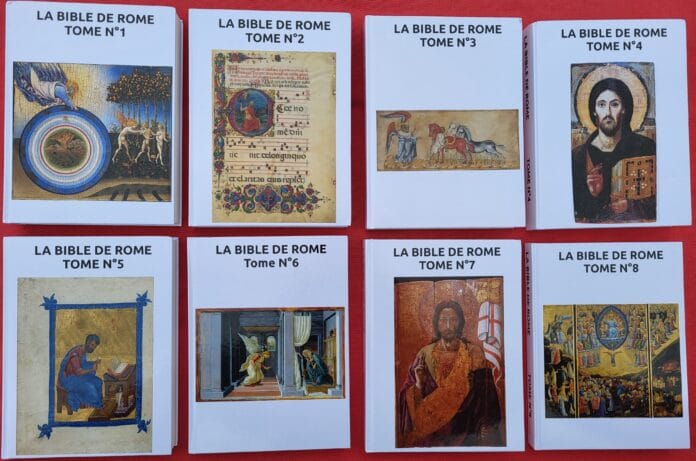
The Rome Bible is composed of five elements:
1) the translation of Father Augustin Crampon (1826-1894), revised in 2023. Originally published a century ago, in 1923: The Holy Bible, translated from the original texts by Abbot A. Crampon, Canon of Amiens. Edition revised by Fathers of the Society of Jesus with the collaboration of Professors of St. Sulpice. Paris – Tournai – Rome: Society of St. John the Evangelist, Desclée and Co. Publishers, Pont. 1923. Imprimatur : Tournai, 1er September 1928. V. Cantineau, Vicar General.
2) the introductions of Father Louis-Claude Fillion (1843-1927), priest of the Company of Saint Sulpice, professor of Sacred Scripture and Hebrew at the Catholic Institute of Paris, member of the Pontifical Biblical Commission, originally published in: The Holy Bible, Latin text and French translation, with commentary based on the Vulgate and the original texts, for use in seminaries and... clergy. Paris: Letouzey et Ané, 8 volumes, 3th edition, 1899-1904. Imprimatur for the Old Testament: Lyon, February 20, 1888, Joseph, Archbishop of Lyon; Imprimatur for the New Testament: Paris, May 11, 1901, François, Cardinal RICHARD, Archbishop of Paris.
3) Two thousand pages of verse-by-verse commentary on the four Gospels (Matthew, Mark, Luke, John) by the same author Abbot Louis-Claude Fillion ; originally published in: The Holy Bible, Vulgate text, French translation alongside theological, moral, philological, historical, etc. commentaries, compiled from the best ancient and contemporary works, and a geographical and archaeological atlas. Paris: P. Lethielleux, Bookseller-Publisher, 40 volumes, 1871-1889. Imprimatur Commentary on the Gospel according to St. Matthew: Lyon, June 11, 1878, Cardinal Louis-Marie Caverot, Archbishop of Lyon. Imprimatur Commentary on the Gospel according to St. Mark: Paris, July 3, 1879, Cardinal Joseph-Hippolyte Guibert, Archbishop of Paris. Imprimatur Commentary on the Gospel according to St. Luke: Paris, 1er January 1882, Cardinal Joseph-Hippolyte Guibert, Archbishop of Paris. Imprimatur Commentary on the Gospel according to St. John: Paris, November 11, 1886, François, Cardinal RICHARD, Archbishop of Paris.
4) a verse-by-verse commentary on the Psalms by Father Joseph-Franz von Allioli (1793-1873), originally published in: New Literal, Critical and Theological Commentary with relation to the Primitive Texts on all the Books of the Divine Scriptures. Translation from German into French by Abbé Louis-Philibert Gimarey (1808-1861), Paris: Louis Vivès, 10 volumes, 1853-1854. Imprimatur : La Rochelle, February 24, 1854, Clément, Bishop of La Rochelle and Saintes.
5) The explanatory notes of Abbot Fulcran Vigouroux annotator (1837-1915) on the 68 other books of the Bible: originally published in: The Holy Bible. Paris: R. Roger and F. Chernoviz, 5 volumes, 1917. Imprimatur Paris, September 19, 1916, H. Odelin, vg. Numerous explanatory notes on the Abbots Louis Bacuez And A. Crampon They are included in volume 8.
The introductions, notes and comments have been modified and updated by Alexis Maillard.
A very readable Bible, even the explanatory notes are easy to understand.
The Rome Bible is printed in Calibri typeface, chosen for its excellent legibility; the font size is 12, including the notes, for more comfortable reading. This sets us apart from other Bibles and their notes that are difficult to read because they are printed in too small a font.
Do cease the abuse of translating the sacred letters: «YHWH» by Yahweh, Yahweh Or Jehovah
One of the qualities of The Rome Bible is its conformity with the request of the Holy See to the Conferences of Bishops, presented on June 29, 2008, by Cardinal Francis ARINZE, Prefect of the Congregation for Divine Worship and the Discipline of the Sacraments (cf. Notitiae from June 2008 and the French newspaper The Cross of April 9, 2013) to put an end to the abuse of translating the sacred tetragrammaton, YHWH, the name of God (cf. Exodus 3, 13-14), by "Yahweh", "Yahwè", "Jahweh", "Jahwè", "Jave", "Jehovah". Indeed, the Congregation for Divine Worship and the Discipline of the Sacraments has noted that "When it comes to the holy name of God himself, translators must demonstrate, to the highest degree, fidelity and respect. In particular, as stated in paragraph 41 of the Instruction Liturgiam authenticam, «in accordance with an immemorial tradition, already evident in the Septuagint [Bible], the name of Almighty God, expressed in Hebrew in the Tetragrammaton and translated into Latin as »Dominus,« must be rendered in each vernacular language by a word of the same meaning.» (…) «In the Greek translation of the Old Testament, called the »Septuagint,« which dates from the last centuries before the Christian era, it had become customary to render the Hebrew Tetragrammaton with the Greek word Kyrios, which means »Lord.« Since the Septuagint text constituted the Bible for the first generations of Greek-speaking Christians, and since all the books of the New Testament were also written in Greek, these early Christians never pronounced the divine Tetragrammaton. The same was true, in a similar way, for Christians of the Latin language, whose earliest writings date from the end of the 2nd century, as evidenced, first of all, by the Vetus latina, then the Vulgate From Saint Jerome: in these translations, the Tetragrammaton was also usually substituted by the Latin word "Dominus," which corresponds either to the Hebrew Adonai or the Greek Kyrios. What has just been stated also applies to the recent Nova Vulgata, which the [Catholic] Church uses in the liturgy. (…) »The sacred tetragrammaton has never been pronounced in a Christian context, nor translated into any of the languages into which the Bible has been translated.« (…) »To establish liturgical translations of texts where either the Hebrew word Adonai or the tetragrammaton YHWH appears one after the other, Adonai must be translated as «Lord,« and the tetragrammaton as »God,« as in the Greek Septuagint and the Latin Vulgate.».
Thus in The Rome Bible, in order to comply with the request of the Holy See, we have replaced: «Yahweh» with «the Lord»; «Yahweh God» with «the Lord God»; «Yahweh Sabaoth» with «the Lord of hosts».
Did God divide the Bible into chapters and verses?
The division of the books of the Bible into chapters and verses is an invention that came after the first writing down of the 73 books inspired by God that constitute the Bible.
The division into chapters was invented by Monsignor Stephen Langton, Archbishop of Canterbury and High Chancellor of the University of Paris around the year 1226.
The division into verses was invented by Father Santes Pagnino (+1541), a Jew who became a Catholic, a Dominican friar: born in Lucca (in Italy), Santes Pagnino devoted 25 years of his life to the translation into Italian of the Bible, which he published in 1527. He was therefore the first to divide the biblical text into numbered verses.
Inventions adopted by the Catholic printer Robert Estienne, then by all printers, including Protestants.
Therefore, it was not God who decided to place the division between chapter 1 and chapter 2, or between chapter 2 and chapter 3, etc. We should not, therefore, attach too much importance to these divisions. They do not come from God, although they often contribute to a better reading and understanding of the sacred text inspired by God.
Nor should we sacralize verse numbers as if it were God who had given such a number to such a verse, thus fixing the beginning and end of the verse or sentence: this is not the case: the division is not covered by the divine inspiration of the Holy Scriptures, it is a human choice.
These divisions into chapters and verses are a good thing, but they are not found in the oldest manuscripts of the Holy Bible. In those manuscripts, the text is in capital letters, the words are joined together without any punctuation; punctuation is added by editors and printers, but it does not come from God either. Therefore, we should not consider these useful but non-essential elements of the divine text as sacred. These divisions into chapters and verses are thus of Catholic origin: Bishop Langton, Father Pagnino, and Robert Estienne.
Thanks
Laurent Collet
Jean-Marie Weber
Father René Lapointe
CG.
Bertrand Couderc de evangelizo.org
Eric Basillais