












Gospel of Jesus Christ according to Saint Matthew
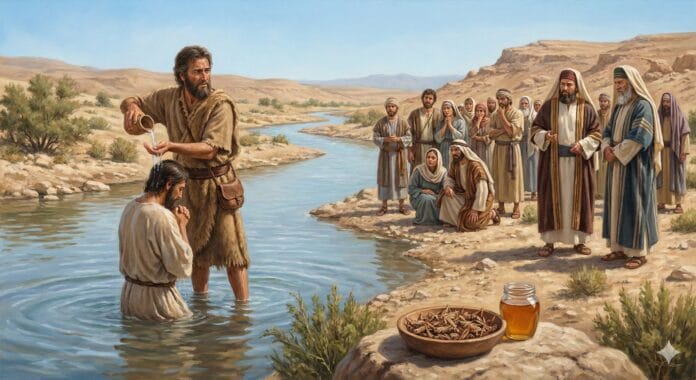
In those days, John the Baptist appeared, proclaiming in the Judean wilderness: «Repent, for the kingdom of heaven is at hand.» John is the one spoken of by the prophet Isaiah: “A voice of one calling in the wilderness: ‘Prepare the way of the Lord, make his paths straight.’”.
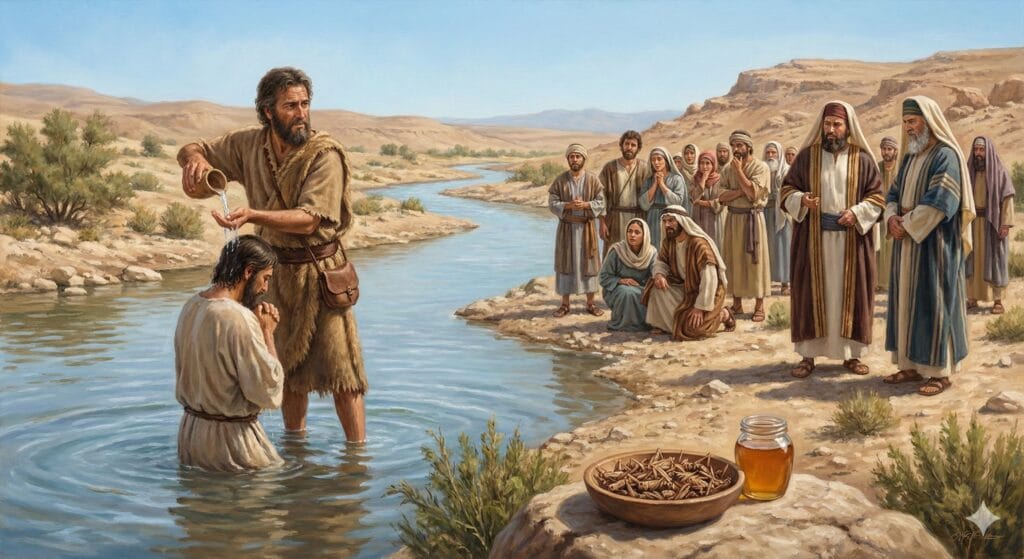
John himself was clothed in camel's hair, with a leather belt around his waist, and he ate locusts and wild honey. Then Jerusalem, all Judea, and the whole region around the Jordan went out to him, and they were baptized by him in the Jordan, confessing their sins. When he saw many of the Pharisees and Sadducees coming to his baptism, he said to them, «You brood of vipers! Who has told you how to escape the coming wrath? Bear fruit in keeping with repentance. Do not say to yourselves, ‘We have Abraham as our father,’ for I tell you, God is able to raise up offspring to Abraham from these stones. Even now the ax is laid to the root of the trees, and every tree that does not bear good fruit is cut down and thrown into the fire.”.
»I baptize you with water for repentance. But after me comes one who is more powerful than I, whose sandals I am not worthy to untie. He will baptize you with the Holy Spirit and fire. His winnowing fork is in his hand, and he will clear his threshing floor and gather his wheat into the barn, but the chaff he will burn with unquenchable fire.”
Embracing radical conversion: when John the Baptist challenges our certainties
Rediscovering the spiritual urgency of Advent through the prophetic preaching of the desert.
In the Judean desert, a cry resounds, echoing through the ages: «Repent!» This is not a polite suggestion, but a vibrant call that shakes the foundations of our spiritual comfort. John the Baptist confronts us with a disturbing truth: the kingdom of God is knocking at the door, and we may not be ready. This message, far from being a dusty relic of the past, pulses with a burning relevance for our lives today.
We will begin by exploring the explosive context of John's preaching, then delve into his message of conversion, which rejects all complacency. Next, we will discover how this call concretely shapes our daily lives, before grasping its profound theological significance. Finally, we will confront contemporary resistance to this radical demand, concluding with prayer and action.
The prophet appears: John the Baptist in his stark setting
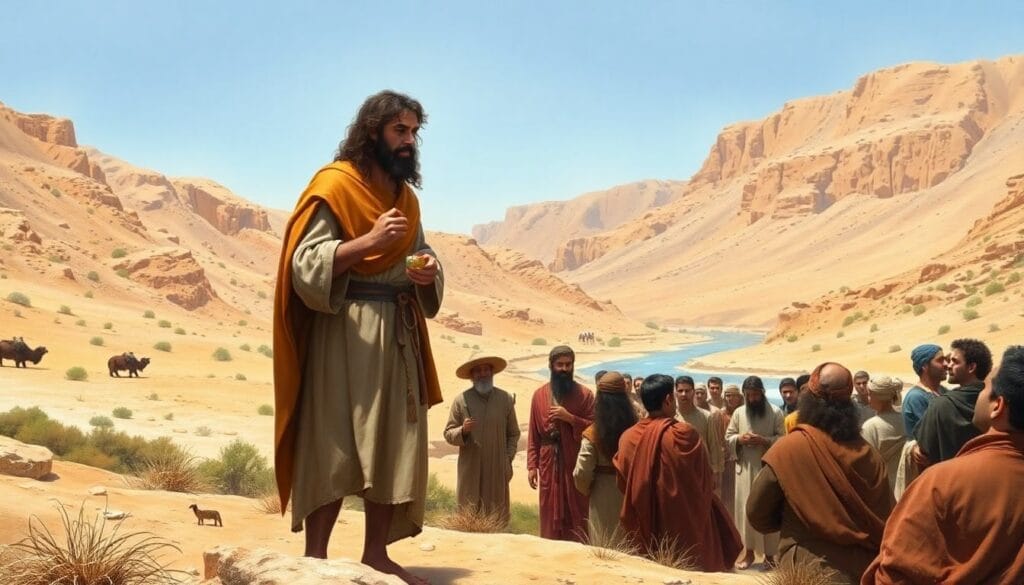
John the Baptist did not appear just anywhere or at any time. The Judean Desert, this arid expanse a few kilometers from Jerusalem, became the stage for a spiritual revolution. Matthew places this event "in those days," a deliberately vague phrase that creates a bridge between ancient times and our own. The desert was not a random choice: in Jewish memory, it is the place of the encounter with God, the site of the Exodus where Israel was forged into a people.
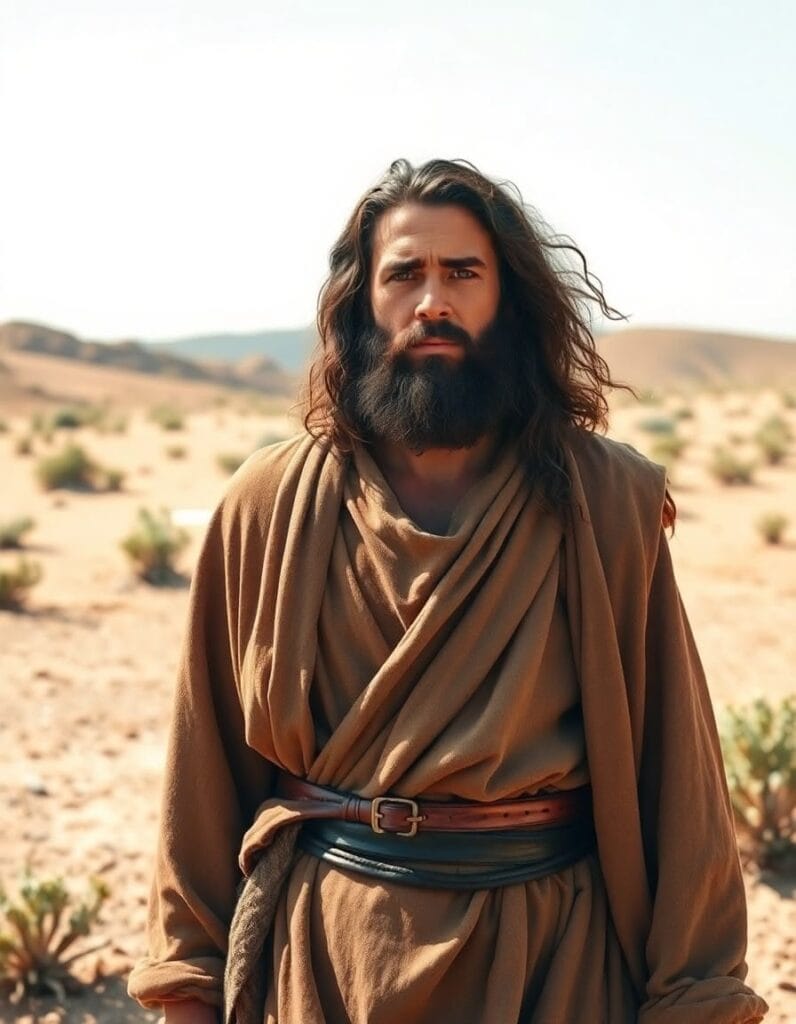
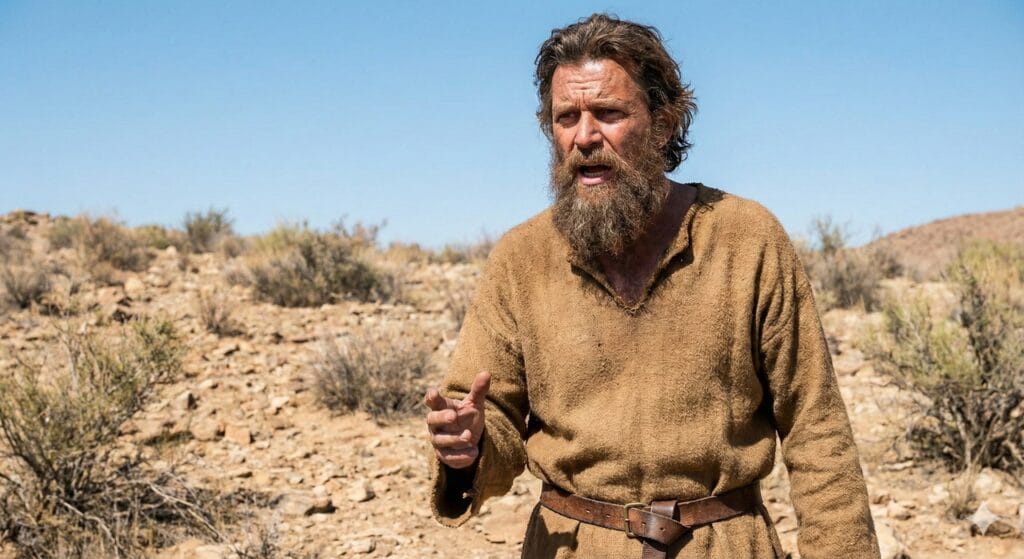
John embodies a complete break with established religious structures. Unlike the Temple priests with their sumptuous garments, he wears camel hair and a leather belt, just like the prophet Elijah (2 Kings 1:8). This is no coincidence: John deliberately places himself within the prophetic lineage. His diet—locusts and wild honey—underscores his radical detachment from social conventions. He lives off what the desert provides, completely free from the constraints of the system.
The quote from’Isaiah 40, The point Matthew makes regarding John, 3, is fundamental. In its original context, this passage foretold the return from exile in Babylon, when God would lead his people back to Jerusalem. Matthew reuses this prophecy to signal a new exodus, a new liberation. John prepares the way not for an earthly king, but for the Lord himself who comes to visit his people. «Preparing the way» evokes the roadwork undertaken before the royal visit: obstacles must be leveled, ravines filled, and curves straightened.
The crowds flocking to John were astounding: «Jerusalem, all Judea, and the whole region of the Jordan» rushed to him. This Matthean hyperbole underscores the extraordinary impact of his preaching. People did not come out of mere curiosity, but as penitents: they were baptized «confessing their sins.» John’s baptism is not the Christian baptism we know; it is a prophetic act of purification that publicly expresses a desire for change. The water of the Jordan, a river laden with symbolism since Joshua, becomes the place where Israel begins its history anew.
But then the atmosphere hardens. The Pharisees and the Sadducees—two religious groups opposed on almost everything but united in their ambition—appear. John doesn't mince words: "Brood of vipers!" The expression is brutal, visceral. It refers to venomous, dangerous beings whose very nature is corrupt. These religious leaders may think they can escape the coming judgment with a simple ritual, but John exposes their hypocrisy.
Conversion or catastrophe: the urgency of the decisive choice
John's message is contained in one explosive sentence: "Repent, for the kingdom of heaven is at hand." Let's unpack this theological bombshell. The verb "repent" translates the Greek metanoeite, which literally means "change your intelligence," "transform your way of thinking." This is not a superficial regret or a cosmetic improvement; it is an inner revolution, a complete reversal of perspective.
The "car" (gar (in Greek) establishes a logical causality: conversion is not optional, it is made necessary by the proximity of the kingdom. And indeed, "the kingdom of Heaven is very near" (eggikenThe perfect tense of the Greek verb indicates a past action whose effects continue. The kingdom has drawn near and remains close. It is imminent, pressing, urgent. There is no more time to lose in procrastination.
This urgency explains the violence of the imagery John uses. «The axe is at the root of the trees»: this is not a distant threat, but an ongoing action. The woodcutter is already there, the axe is raised. The tree that does not bear fruit will be cut down «and thrown into the fire.» John is not speaking of a gentle, purifying fire, but of a destructive one. The agricultural image is clear: barren trees have no place in God’s orchard.
But what does it mean to "produce fruit worthy of repentance"? John demands concrete actions, visible transformations. It is not enough to say "I repent"; one's entire life must bear witness to it. It is here that John undermines the religious security of the Jews of his time: "Do not presume to say to yourselves, 'We have Abraham as our father.'" Ethnic or religious affiliation, however legitimate, guarantees nothing. God can raise up children for Abraham "from these stones.".
This declaration is revolutionary. John announces that the criterion for belonging to the people of God will change. It will no longer be biological descent but the conformity of heart and life to the divine will. The "stones"—perhaps an allusion to the Gentiles, considered hard and insensitive—can become children of Abraham through faith and conversion. Paul will masterfully develop this theology in Romans 4 and Galatians 3.
The contrast between John's baptism and that which the Messiah will administer is striking. "I baptize you with water for repentance": John presents himself as a simple servant whose ritual gesture calls for change. But "the one who comes after me is more powerful than I, whose sandals I am not worthy to carry."«humility Jean reached his peak. Removing the sandals was the work of a slave, and Jean even considers himself unworthy of this minimal service.
«He will baptize you with the Holy Spirit and fire»: this is the tremendous promise. Messianic baptism will not be a mere external symbolic gesture, but a total immersion in the transforming power of the Spirit. The «fire» here has a dual function: purification and judgment. The Spirit-fire consumes what is impure and illuminates what is true. This promise will be fulfilled at Pentecost, when tongues of fire descend upon the disciples.
The final image of the winnower completes the picture. The peasant uses a shovel to toss the threshed grain into the air: the wind carries away the light chaff while the heavy grain falls back down. The Messiah will accomplish this ultimate sorting: the grain—those who have borne fruit—will be «gathered into the barn,» while the chaff—the barren, the hypocrites—will be «burned in the unquenchable fire.» This terrible expression evokes the final, irrevocable judgment.
The three pillars of authentic transformation
To honestly acknowledge our true spiritual condition
The first step in any true conversion is to overcome denial. The Pharisees and Sadducees whom John addresses perfectly illustrate this religious self-satisfaction that hinders all spiritual progress. They come to baptism, perhaps out of social conformity or superstition, but without genuinely recognizing their need. John exposes their deception: they believe they can negotiate with God, presenting their titles (descendants of Abraham) as a safe passage.
We constantly repeat this pattern. How often do we rely on our Christian heritage, our childhood baptism, our regular attendance at Mass, our financial generosity, as if these things exempted us from an honest confrontation with our dark sides? John forces us to face our compromises, our hypocrisies, our hardness of heart. Acknowledging our sins, as those who came to the baptism in the Jordan did, means accepting the vulnerability of a clear-sightedness without evasion.
This recognition cannot be superficial. It requires what the Desert Fathers They called it the "gift of tears," this capacity to weep for our condition and the harm we have caused. This is not morbid masochism; it is a fruitful suffering that opens the way to healing. As long as we minimize our sin, we cannot receive grace. As he said Saint Augustine "God gives where he finds empty hands."«
Honestly acknowledging our condition also means abandoning our comforting comparisons. «At least I’m not like so-and-so» is a classic Pharisaical strategy. John leaves no room for this moral relativism. Before God, we are all called to the same standard of holiness. The barometer is not the average of social behaviors but the perfection of divine love.
In practical terms, this could translate into a regular examination of conscience that doesn't simply list isolated acts but questions our deepest convictions. Where does my heart truly lead? What am I actually idolizing, even if I profess to serve God? What relationships have I poisoned through my selfishness? In what areas am I a prisoner of others' opinions? These questions, posed in prayer, tear away the veil of illusion.
To produce tangible results that attest to inner change
John doesn't simply urge emotional repentance; he calls for "fruit worthy of conversion." The singular is significant: it refers to a comprehensive fruit that encompasses our entire lives, not isolated actions. This fruit manifests itself in how we treat our spouse, manage our money, speak about those who have hurt us, react to injustice, and consider the poor.
The Gospels are full of examples of concrete fruits. Zacchaeus, who returned four times what he had stolen (Luke 19). The sinful woman who washes Jesus' feet with her tears (Luke 7). The Prodigal Son who returns to his father (Luke 15). These accounts show that authentic conversion is expressed through costly gestures, real renunciations, and effective reconciliations.
Our fruits are particularly evident in horizontal relationships. We can have an impressive prayer life but treat our domestic staff with contempt. We can be generous to the Church but merciless to a debtor. John exposes these inconsistencies. Authentic fruit is holistic: it colors every aspect of our existence. As he said Saint James «Faith without works is dead» (James 2:17).
Producing fruit also involves patience And perseverance. A tree doesn't become fruitful overnight. There are seasons of invisible growth, times of painful pruning, periods of drought. Our culture of instant gratification makes us impatient with our own processes of transformation. But God, the patient vinedresser, works for the long term. The essential thing is that the overall trajectory of our lives moves toward greater conformity to Christ.
Practically speaking, let's identify a concrete area where our conversion needs to materialize. Perhaps it's forgiveness to give to someone who has deeply hurt us. Perhaps it's a change in our financial management to be more generous. Perhaps it's the decision to break with a toxic relationship that is distancing us from God. Perhaps it's the commitment to dedicate time to the poor. The fruit of conversion has a name and a specific address.
To receive baptism in the Spirit and the fire that transfigures
John announces that the Messiah will baptize «with the Holy Spirit and fire.» This promise infinitely surpasses what we can achieve through our own efforts. Conversion, to be complete, must culminate in a transforming encounter with the living Spirit of God. It is not we who are transformed through moral willpower, but the Spirit who reconfigures us from within.
Baptism in the Spirit refers to the event of Pentecost, where the disciples, huddled in the Upper Room, are suddenly filled with a power that propels them into the streets of Jerusalem to proclaim the risen Christ. Peter, who had cowardly denied Jesus, now boldly proclaims before the crowds. This transformation is not the result of a personal development program; it is the work of the Spirit, setting them ablaze.
The word "fire" in this expression has several resonances. First, it is the purifying fire that consumes our impurities, just as gold is purified in the crucible. Second, it is the fire of passion and zeal for God that replaces our lukewarmness. Finally, it is the fire of judgment that definitively separates what belongs to God from what resists Him. Accepting this baptism therefore requires total availability, an acceptance of dying to oneself in order to be reborn to a new life.
In the Christian tradition, this baptism in the Spirit is received sacramentally at confirmation, but it must also become a continuous experiential reality. We must regularly ask to be filled anew with the Spirit, for we are constantly leaking, like leaky vessels. The prayer of the "Veni Creator Spiritus" or the "Veni Sancte Spiritus" is not a luxury for mystics; it is a vital necessity for every Christian who wants to live beyond their meager resources.
In practical terms, how do we prepare ourselves for this baptism in the Spirit? Through humble and persistent prayer of invocation. the sacramentsparticularly the Eucharist which is always a new Pentecost. Through docility to the inner promptings we perceive. Through frequenting the Word of God which is "inspired" (theopneustos, (literally "breathed by God"). The Spirit does not give itself to those who manipulate it but to those who implore it with faith.
When conversion shapes our daily choices
John's call to conversion resonates in every sphere of our existence. It is not a superficial adjustment but a complete overhaul of our priorities, our values, and our relationships. Let us examine concretely how this demand manifests itself.
In our relationships, conversion manifests itself in the active pursuit of reconciliation with those we have hurt or who have hurt us. John calls for fruit: perhaps the first fruit is this humble step of asking for forgiveness, of acknowledging our wrongs without justification. It is also learning to forgive not once, but "seventy times seven," that is, without limit. Resentment held in stead is the barren tree John speaks of.
In our relationship with money and material possessions, conversion requires liberation from greed and an openness to generosity. "Do not presume to say to yourselves, 'We have Abraham as our father'" resonates with our tendency to find comfort in our possessions. Conversion compels us to ask ourselves: What do I truly need? What could I share? How does my lifestyle reflect the coming Kingdom? The rich young man in the Gospel (Matthew 19) tragically illustrates the refusal to bear this fruit.
In our professional lives, conversion transforms our ethics. It renders us incapable of compromising with dishonesty, however "petty." It sensitizes us to justice toward our colleagues or employees. It guides our ambitions: do we seek to serve or to dominate? Is the money we earn the result of a genuine contribution to society or the exploitation of an unjust system? These questions are unsettling, but that is precisely the role of prophetic preaching.
In our church life, conversion frees us from the hypocrisy that John denounces in the Pharisees. Let us stop playing a role on Sundays and live differently during the week. Let us stop hiding behind titles ("I am an altar server," "I am on the parish council") to avoid examining our hearts. True piety is that which shines through in our entire lives, not that which is reduced to ritual gestures.
Finally, in our civic and political lives, conversion makes us prophetic. John did not hesitate to denounce the injustice and hypocrisy of the religious authorities of his time. Are we ready to take a clear stand against structures of oppression, even at the cost of our comfort or popularity? Complacent neutrality is not an option for those who have welcomed the coming kingdom. Our commitment to the social justice, for the dignity of migrants, For the preservation of creation, all of this is part of the "fruits worthy of conversion".
Echoes in tradition
The figure of John the Baptist has fascinated Church Fathers and theologians of all eras. Saint Augustine, in his sermons on Advent, John is presented as the "voice" that disappears when the "Word" appears. John is entirely oriented toward another. His greatness lies precisely in his self-effacement before Christ. This theology of kenosis (emptiness) makes John the model for every minister of God: diminishing so that Christ may increase.
The Greek Fathers, particularly John Chrysostom, insist on the radical nature of conversion (metanoiaFor them, it is not simply an ethical change but an ontological transformation. The converted human being becomes a "new creation" (2 Corinthians 5:17). Baptism in the Spirit and fire accomplishes what Jewish purification rites could only sketch: a total regeneration.
Monastic tradition has deeply reflected on John's desert experience. Fourth-century monks, fleeing to the Egyptian wilderness, saw themselves as imitators of the Baptist. The desert becomes the place of confrontation with oneself and with God, far from the distractions and compromises of society. It is there, in the aridity, that the human heart is purified and the voice of God can finally be heard. Saint Benedict, In his Rule, he encourages his monks to consider Lent as a spiritual «return to the desert».
Saint Thomas Aquinas, in his Summa Theologica, Thomas meticulously analyzes the baptism of John. He explains that this baptism was not a sacrament in the Christian sense—it did not confer grace—but a prophetic sign that prepared hearts. Its value lay in the inner disposition it aroused. Thomas emphasizes that Christian baptism, on the other hand, operates ex opere operato : it truly communicates divine life. This theological distinction does not detract from the importance of Johannine baptism as a pedagogy of conversion.
Reformed theology, with Luther and Calvin, particularly valued John's call not to rely on religious titles. "We have Abraham as our father" resonates with the Protestant critique of human merit before God. Only faith justifies, not institutional affiliation or moral performance. John proclaims this gratuitousness by exposing all self-justification. However, as the Reformers themselves emphasize, authentic faith necessarily bears fruit—precisely what John calls for.
Latin American liberation theology has rediscovered the social dimension of John the Baptist's preaching. His denunciation of corrupt religious authorities, his call for a radical change of life, his closeness to the marginalized (he lived in the desert, outside the system)—all of this resonates with the preferential option for the poor. Gustavo Gutiérrez and Leonardo Boff have emphasized that biblical conversion is never purely internal: it is embodied in concrete political and economic choices.
Hans Urs von Balthasar, a contemporary Catholic theologian, reflects on the "kenotic holiness" of John. He sees in him the archetype of the witness who effaces himself completely before the testimony he bears. This absolute self-denial, far from being self-destruction, is the royal road to true fulfillment. By losing his life for Christ, John gains it fully. This is the quintessential Gospel paradox.
Meditation track
To existentially integrate John's message, I propose a meditative approach in several stages, to be followed over several days or weeks.
First step: Entering the inner desert. Choose a moment and a place of silence. Read slowly through Matthew 3:1-12. Imagine yourself in the crowd rushing towards John. What draws you to him? What inner cry sets you in motion? Remain with this question without seeking a quick answer.
Second step: Listen to the screaming voice. Focus on the call: «Repent.» Let this word resonate within you. What exactly are you being called to convert to at this moment in your life? Don't generalize; be specific. Perhaps a name, a situation, or a habit will emerge.
Third step: Acknowledge your sins. Like the crowds who confessed their sins at baptism, humbly name before God your blind spots, your resistance, your hardness. Don't settle for generic phrases. Speak the truth from your heart. Weep if tears come.
Fourth step: Identify the fake shelters. What in your life plays the role of "we have Abraham as our father"? What do you falsely rely on to reassure yourself before God? Your seniority in the parish? Your financial generosity? Your theological knowledge? Let John shake these false securities.
Fifth step: Imagine a concrete fruit. If your tree were to bear fruit worthy of conversion, what would it look like? Be specific. Perhaps it's a reconciliation to undertake, a restitution to make, a commitment to take, a break with an unhealthy situation. Decide on a tangible action.
Sixth step: Implore baptism in the Spirit. Acknowledge your inability to transform yourself. Humbly and fervently ask the Holy Spirit to come and baptize you, set you ablaze, and purify you. Use the traditional prayer: «Come, Holy Spirit, fill the hearts of your faithful and kindle in them the fire of your love.»
Seventh step: Decide and act. Meditation that doesn't lead to action remains sterile. Take concrete steps, then, the action you identified in step five. Is it difficult? That's normal. Ask for grace, but take the step. The kingdom of God is near; there's no more time to hesitate.
Current challenges in the face of the Johannine call
Our era presents several specific forms of resistance to the message of John the Baptist. Let us identify them and outline some possible responses.
The prevailing moral relativism This makes it difficult to assert that certain behaviors are objectively wrong and deserve conversion. John speaks of "vipers," of barren trees thrown into the fire, of scorched straw. This language sounds unbearably harsh in a culture that values absolute tolerance. How should we respond? By distinguishing the person from their actions. Loving someone does not imply approving of all their choices. Truth is an act of love, even when it is unsettling. As Benedict XVI said, "Love without truth becomes sentimentality.".
Contemporary individualism It resists the idea of collective judgment. «To each their own truth, to each their own path» is the modern mantra. But John announces a kingdom that is coming for all, with objective criteria: bear fruit or be cut down. How can we uphold this universality without falling into authoritarianism? By remembering that the natural moral law, inscribed in the human heart, transcends cultures. Some things are true for all not through arbitrary imposition but because they correspond to our deepest nature, created by God.
Spiritual comfort This is perhaps the major obstacle. We're happy to have a little religion to enrich our lives, but not a radical conversion that turns everything upside down. John appears in the desert, not in a cozy living room. His preaching is harsh, demanding. It calls for total change. Faced with this resistance, we must dare to proclaim that the Christianity Authentic spirituality is not a supplementary spirituality but a total dominion of Christ over our existence. It is all or nothing. As Jesus said: "Whoever wants to save their life will lose it" (Matthew 16:25).
Therapeutic culture It transforms sin into a mere psychological dysfunction. We no longer speak of conversion but of "personal development," "inner healing," and "self-realization." These realities have their place, but they do not replace biblical metanoia. How can we reintegrate the dimension of sin without becoming morbidly guilty? By understanding that acknowledging one's sin is not self-hatred but seeing oneself as one is, with lucidity and from the perspective of God's merciful love. Sin does not have the last word; grace does.
The consumerist emergency It paralyzes the urgency of the Gospel. We are pressured by a thousand superficial demands, but the urgency of the Kingdom leaves us indifferent. «The Kingdom of Heaven is at hand,» proclaims John, but we live as if it will never arrive. How can we rediscover this eschatological tension? Through regular meditation on our mortality. We will die, perhaps soon. Are we ready? This perspective, far from being morbid, is liberating. It puts our anxieties into perspective and refocuses us on what is essential.
Prayer of conversion and consecration
Lord God of our fathers, you who sent John into the desert to prepare the way for your Son, here we are before you, with troubled hearts and searching souls.
We acknowledge our slowness to convert, our attachment to our certainties, our fear of the radical change you demand. Like the Pharisees and Sadducees, we have often sought to negotiate compromises with you, to present our titles rather than our hearts.
Forgive us for having placed our trust in our spiritual heritages, in our religious practices, in our good works, as if all this could exempt us from the humble recognition of our wretchedness. We said to ourselves: "We are baptized, we are believers," thinking that this was enough.
We confess before you our barren trees: those relationships we have poisoned with our selfishness, those hurtful words we have spoken without repentance, those injustices we have condoned with our silence, those poor people we have ignored, those pardons we have refused.
We recognize our false refuges: money that reassures us more than your providence, the opinion of others that concerns us more than your judgment, comfort that holds us more than your will.
Lord, as your servant John cried out in the wilderness, let your Word cry out in our inner deserts. Awaken us from our spiritual slumber. Shake off our false securities. Set us ablaze with your purifying fire.
We implore you: baptize us in your Holy Spirit and in your fire. Come and consume in us all that is not of you. Come and kindle in us the ardent desire for your holiness. Come and transform our hearts of stone into hearts of flesh.
Give us the courage to produce fruits worthy of conversion. Help us to take concrete actions that will bear witness to our change: this reconciliation that we fear, this forgiveness that we refuse, this generosity that costs us, this commitment that frightens us.
Make us like John: totally free from human approvals, radically oriented towards you, able to decrease so that Christ may increase, ready to bear witness to the truth whatever the cost.
May your axe cut through all that is dead, barren, and rotten within us. May your fire consume our chaff—our pretensions, our hypocrisies, our lukewarmness. May your shovel winnow our existence to separate the wheat from the chaff.
*Today we dedicate to you these specific areas of our lives where you call us to conversion: (silence so that each person can name it internally).
Strengthen our wavering will. Support our fragile resolutions. Accompany our first hesitant steps. And when we fall—for we will fall—raise us up in your infinite mercy.
Make us voices crying out in the wilderness of this world: «Prepare the way of the Lord!» Make us prophetic in our words and in our lives. May people, by seeing us live, recognize that the kingdom of God is truly near.
Through Christ our Lord, who comes and baptizes with the Holy Spirit and fire. Amen.
The kingdom is knocking at the door, let's open it!
We have reached the end of our journey with John the Baptist, but in reality, we are at the beginning of a path of conversion that never ends on this side of eternity. The message of the desert prophet resonates with renewed urgency in our contemporary world. «Repent, for the kingdom of heaven is at hand» is not an archaeological relic but a burning call for today.
We have seen that authentic conversion requires three inseparable movements: honestly recognizing our real spiritual condition without hiding behind our titles or religious performances; producing tangible fruits that attest to the inner change in all spheres of our existence; welcoming baptism in the Spirit and the fire that alone can transfigure us beyond our limited capacities.
This conversion is not a one-time event but a continuous process. Every day, we are called to choose the kingdom of God anew, to turn away from our idols, to allow ourselves to be purified by the fire of the Spirit. The obstacles are many—relativism, individualism, spiritual comfort, therapeutic culture—but the grace of God is stronger than all our resistance.
The kingdom of Heaven remains "very near." This nearness is both a promise and a threat. A promise because God comes to save us, liberate us, and transform us. A threat because his arrival confronts our compromises, judges our barrenness, and consumes our hypocrisies. We cannot remain neutral or lukewarm. Either we actively welcome this kingdom through radical conversion, or we passively reject it through our inertia, and then we risk being cut down like the barren tree.
The time of Advent The moment we enter with this text is precisely the liturgical season when the Church invites us to prepare the way, to straighten our paths, to make ourselves ready for the coming of the Lord. Let us not miss this opportunity of grace. Let us identify a specific area of our lives that requires conversion and take decisive action in the coming days.
The final call is simple yet demanding: let us open the door of our hearts to the coming King. Let us sweep away our burdens and resistances before him. Let us light lamps in his path through our works of charity and justice. And when he arrives, may we be found watchful, fruitful, and ablaze with his Spirit.
Immediate action: seven concrete steps
- Dedicate thirty minutes this week to a thorough examination of conscience in the presence of the Lord, precisely identifying an area requiring radical conversion in your current life.
- You will undertake a reconciliation process with a person you have hurt or who has hurt you, even if it costs you humanly, because the fruit of conversion is manifested first in our relationships.
- Identify a "false refuge"« on which you unduly rely to reassure yourself before God, and decide on a symbolic act that manifests your renunciation of this illusory security.
- Pray daily during Advent the «Veni Sancte Spiritus» sequence to implore baptism in the Spirit and the fire that transforms our hearts beyond our natural capabilities.
- Choose a concrete commitment to charity or justice For the weeks leading up to Christmas: visiting an isolated sick person, making a significant donation to a charity, volunteering with the needy, participating in an advocacy campaign.
- Practice the "inner desert"« by voluntarily cutting yourself off from certain superfluous stimuli (social networks, television, compulsive consumption) to create a space of silence where the voice of God can be heard.
- Share with at least one person your conversion process and ask him to accompany you in prayer and fraternal encouragement, because we never convert alone but always in the Church.
References
Scriptures : Isaiah 40, 1-11 (consolation and preparation for the return); Luke 3, 1-18 (Lucan version of John's preaching); ; John 1, 19-34 (John's testimony about Christ); ; Act 2, 1-13 (fulfillment of the promise of baptism in the Spirit at Pentecost).
Fathers of the Church : Saint Augustine, Sermons on Advent ; Saint John Chrysostom, Homilies on Matthew ; Saint Gregory of Nazianzus, Speech on baptism.
Classical Theology : Saint Thomas Aquinas, Summa Theologica, III, questions 38-39 (on John the Baptist and his baptism); Hans Urs von Balthasar, The Gospel as the standard and critique of all spirituality in the Church.
Spiritual Literature Charles de Foucauld, Meditations on the Holy Gospels ; Dietrich Bonhoeffer, The Price of Grace (on costly conversion vs. cheap grace); Thomas Merton, Seeds of contemplation (on the inner desert).
Contemporary Magisterium Benedict XVI, Apostolic Exhortation Verbum Domini (2010), paragraphs on conversion to the Word; Francis, Apostolic Exhortation Evangelii Gaudium (2013), chapters on the missionary transformation of the Church.
Contemporary works Romano Guardini, The Lord, Meditations on the figure of Christ; Timothy Keller, The reason belongs to God (dialogue with contemporary skepticism on the themes of judgment and conversion).