











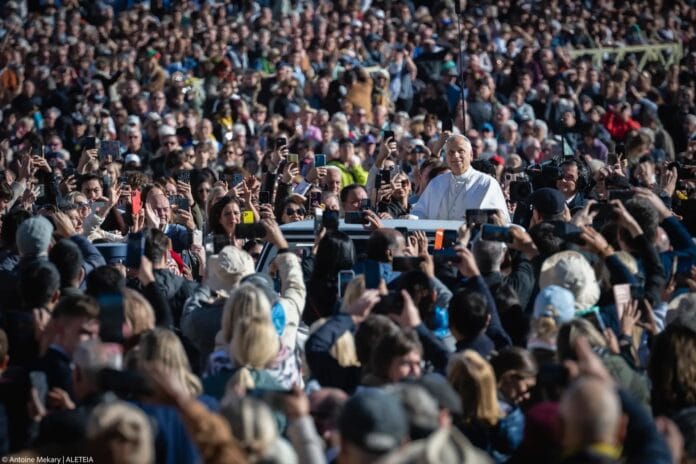
St. Peter's Square, November 5, 2025. Under the autumn sun of Rome, Leo XIV, pope Having come from America, he addresses thousands of worshippers. But that day, his message is not intended to stir emotions: it aims to awaken. With his characteristic direct simplicity, he declares:
«"The Resurrection of Christ? It is not an idea, nor a theory: it is the founding Event of the faith.".
These words leave a deep mark. They compel us to return to the essentials—to that driving force that runs through the Christian faith: without the Resurrection, everything collapses. Paul had said it with his usual clarity: «If Christ has not been raised, our faith is futile.»
But what does that mean? Leo XIV When he speaks of "the Event"? And why, in the 21st century, does this message take on renewed force?
Words rooted in reality
THE pope He is not talking about a “Christian ideology.” He is not proposing a doctrine disconnected from reality—he is talking about a fact. For him, the resurrected Christ is not a symbolic construct but the cornerstone of human history.
Leo XIV knows he is in front of men and women afflicted by the tired of livingUnemployment, wars, loneliness, illness, broken families. He knows that the words “hope,” “rescue,” “new life” risk ringing hollow. So he swallows these abstractions whole and resurrects them himself:
«"Easter does not eliminate the cross," he said, "but it overcomes it in the prodigious duel that changed human history.".
In other words: God does not eliminate suffering; He transfigures it. And this transfiguration, this passage from death to life, is not relegated to a mythical past — it acts in the daily lives of believers.
The Easter mystery in rhythm with the days
THE pope it stops at a simple observation: human life, in its mixture of pain and joy, takes up at every moment the dynamic of the paschal mystery.
Each grief overcome, each forgiveness granted, each new beginning humbly lived becomes a place where the Resurrection is experienced.
Leo XIV He then cites Saint Edith Stein, a Jewish philosopher who became a Carmelite nun., dead At Auschwitz: “The moment gives to us and takes away, but we are made to transcend the limit.”
That's exactly it, said the pope, that the encounter between the cross and the light takes place: in this passage from “all is lost” to “all is possible”.
The North Star of the Human Heart
In his catechesis, Leo XIV uses a magnificent image: Christ as the “North Star””"of our seemingly chaotic life.
This formula, deeply biblical, joins our disoriented generation. At a time when so many men and women are losing their way, the Gospel reminds us that God does not promise the absence of darkness but a light that guides even in the heart of the night.
The Pope links this hope to “inner work”: discerning, listening, choosing. He invites each person to recognize in their own chaos a possibility of encountering the Living.
This “inner movement straining towards a beyond,” in his words, is not an escape: it is the very intuition of what Saint Augustine he called it “the desire for eternity planted in the heart of man”.
Faith as care and healing
At a time when the world is trembling under wars, ecological crises, and extreme political polarization, the voice of pope it almost sounds like a remedy: “The Easter announcement becomes care and healing.”
The concept is powerful: the Resurrection is not only a spiritual event, but a medicine for the soul and the world.
A woman who forgives her brother after years of silence, a doctor who stays at the bedside of a dying man, a young man who renounces revenge: all, in these tiny gestures, already manifest the Resurrection at work.
Without theories, without grand demonstrations, Leo XIV returns faith to its center: love that gives life when all seems lost.
A pope rooted in modernity
Leo XIV He does not escape his time; he plunges into it. His pontificate, marked by calls for ecological justice and political reconciliation, is accompanied by an emphasis on contemplative prayer.
During this audience on November 5, he linked the “crosses of our time” — pandemic, uprooting, throwaway culture, forgotten wars — to this single light: the Resurrection as “dawn of Easter hope”.
This synthesis between contemplation and action is reminiscent of the theology of Saint Francis of Assisito whom Leo XIV borrows the words from the “Song of the Sun”: in the face of death, Brother Sun does not tremble, he sings.
The Resurrection: event or metaphor?
Perhaps this is where the heart of the message lies: the Resurrection, for the pope, It is not a symbol of moral renewal, but an act of creation. The body of Jesus, truly dead, is truly alive.
However, for modern man, believing in such a miracle is almost an intellectual challenge. That is why Leo XIV insists: faith is not the abdication of reason, but its expansion.
He often quotes the great Italian Benedictine Romano Guardini: “Faith does not replace thought; it opens it to infinity.”
To believe in the Resurrection is to reject fatalism. It is to affirm that reality does not stop at the visible, that the truth of the world includes the invisible, and that life has the last word.
The experience of the saints
“We are all called to be saints,” he declares. Leo XIV at the end of his catechism.
This reminder is not merely decorative: it is part of a very concrete vision of holiness. For him, the saint is not the one who hovers above men, but the one who lives the Resurrection at the heart of reality.
The comforting mother, the righteous man who resists corruption, the old man who gently prays for humanity — all prolong the Paschal mystery.
All Saints' Day, which the Church had just celebrated, becomes for Leo XIV a celebration of reconciled humanity: the Resurrection spreads into the flesh of men.
Hope in the face of the world's suffering
At the end of the hearing, the pope He broadens his perspective to include Burma, which has been at war for years. He prays for those suffering from forgotten conflicts and asks the international community not to turn a blind eye.
This prayer is not a digression: it conveys the essence of the Easter message. The Resurrection does not eliminate the suffering of the world; it transcends it, it gives it meaning: that of a passage.
When he calls peace, Leo XIV He acts as a shepherd of the Resurrection: he testifies that the living Christ acts even in the most wounded history.
The Founding Event revisited today
Why is the Resurrection not a theory? Because it is experienced, rather than explained.
An old monk once said, “The Resurrection is not a concept to be understood, but an encounter to be experienced.” That is what Leo XIV wants to reiterate: the Christian faith is not a system, but a living relationship.
In the catecheses he dedicates to Jesus Christ, he emphasizes that the Resurrection is both the alpha and the omega of the Christianity: the starting point and the final horizon. Without it, the history of salvation is nothing but tragedy. With it, everything becomes promise.
Living with resurrection every day
How can we live this truth in concrete terms? Leo XIV provides several leads:
- To welcome each day as a gift, even when it feels heavy.
- To seek in prayer the strength to hope against all hope.
- To see in failures not the end, but the possibility of a beginning.
- Testimony of joy Pascal in ordinary gestures — a smile, a visit, a word of reconciliation.
He often repeats that faith grows in loyalty to the little things: “The Gospel is God making himself present in the dust of human paths.”
A mystery that speaks to everyone
This message touches even those who do not believe. The Resurrection, in its symbolic language, poses to each of us the question of meaning: what do we do with our wounds? Can we still believe that life triumphs?
For believers, it is certainty. For seekers of truth, it remains a promise.
And Leo XIV, In a calm voice, he continues to testify: "Man is limited, but created for eternal life." This tension, far from being a contradiction, becomes the very breath of hope.
In conclusion: the Easter fire
To those seeking answers, Leo XIV It offers not a theory, but an encounter. The Resurrection has nothing conceptual about it; it is fire.
It still burns in the hearts of those who refuse to despair. It illuminates war-torn Burma, a hospital room, a family table, a rural altar. It passes through the centuries, silent but invincible.
And that is the whole point of the words of popeAs long as Christ is alive, nothing is lost.
In St. Peter's Square, on November 5, 2025, thousands of faces understood: the Resurrection is not a memory; it is the future already begun.