












The Rosary is a meditative Christian prayer of major importance in the Catholic faith. It invites contemplation of essential moments in the lives of Christ and the Virgin Mary. Married, allowing for a profound spiritual journey. This practice is distinguished by its accessibility: you don't need to know how to read to recite the Rosary. The beads of the rosary guide your prayers and meditations, making this prayer open to all, regardless of your level of knowledge or education.
You will discover in this article The Rosary Explained for Beginners: History, Structure, Effective Meditation. The goal is clear: to guide you step by step in understanding the historical origins of this prayer, its precise composition, and how to effectively meditate on each mystery. Whether you are a beginner or simply curious to deepen your spirituality, this guide offers concrete tools to integrate the Rosary into your daily life.
A simple practice, rich in meaning, The Rosary is a powerful spiritual tool that deserves to be known and experienced by everyone. You are invited to explore this ancient tradition with confidence and simplicity.
History and origins of the Rosary
The Rosary draws its roots from the Christian spirituality of 12th century, This was an era marked by a profound desire for meditative prayer accessible to all. This form of devotion developed gradually, rooted in the repetition of prayers and the contemplation of the mysteries of the life of Christ and the Virgin Mary. Married.
Historical roots in the 12th century
At that time, the faithful often lacked access to sacred texts, nor the time for lengthy reading. The Rosary thus emerged as a simple method for repeatedly reciting short prayers—essentially Greetings Married — interspersed with moments of reflection. This practice allowed everyone to enter into a deep spiritual meditation without requiring constant reading.
The role of Saint Bernard in its spread
Saint Bernard of Clairvaux, a major figure of 12th century, contributed significantly to popularizing this form of prayer. Through his influence among Cistercian monks and the faithful, he encouraged the repeated use of the Greetings Married as a means of deepening faith. His writings praised this simple yet powerful prayer, which helped to unite the soul with God through gentleness and consistency.
«"Repeated prayer is a path to the divine heart," he affirmed, thus promoting an accessible meditative approach.
Evolution over the centuries
The Rosary has not remained static over time. It has undergone several transformations:
- In the 13th century, Saint Dominic is said to have received a vision instructing him to use this rosary to combat heresies.
- The current structure with five tens became more formalized in the 15th century.
- In 1569, the pope Pius V published a papal bull officially recognizing the Rosary as an essential Catholic devotion.
This official recognition by the Catholic Church strengthened its status and promoted its spread throughout the world. Since then, the Rosary has been considered not only as an individual prayer but also as a powerful instrument for communal spiritual life.
The development of Rosary Teams The 20th century still bears witness to this living heritage today, where every believer can find a place to exchange ideas about this thousand-year-old tradition.
The precise structure of the Rosary now deserves closer examination in order to understand how its various material and spiritual elements combine to support this rich meditation.
Structure and composition of the Rosary
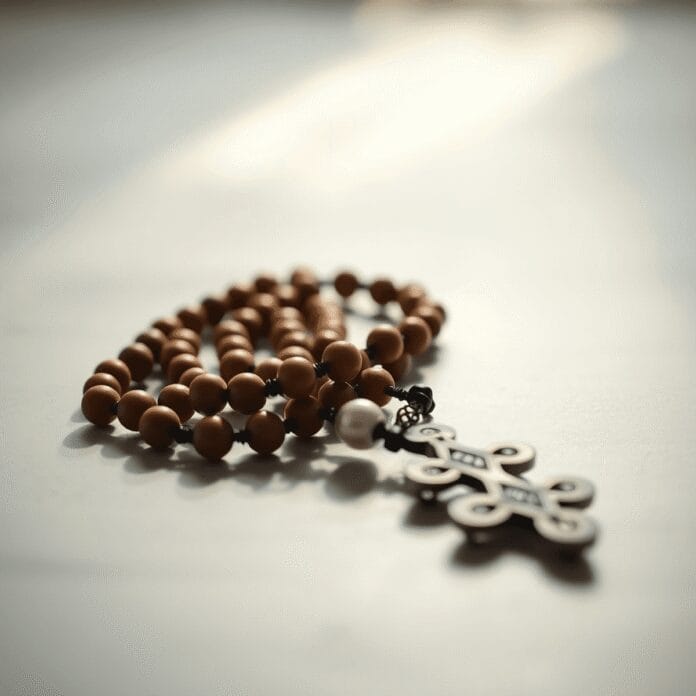
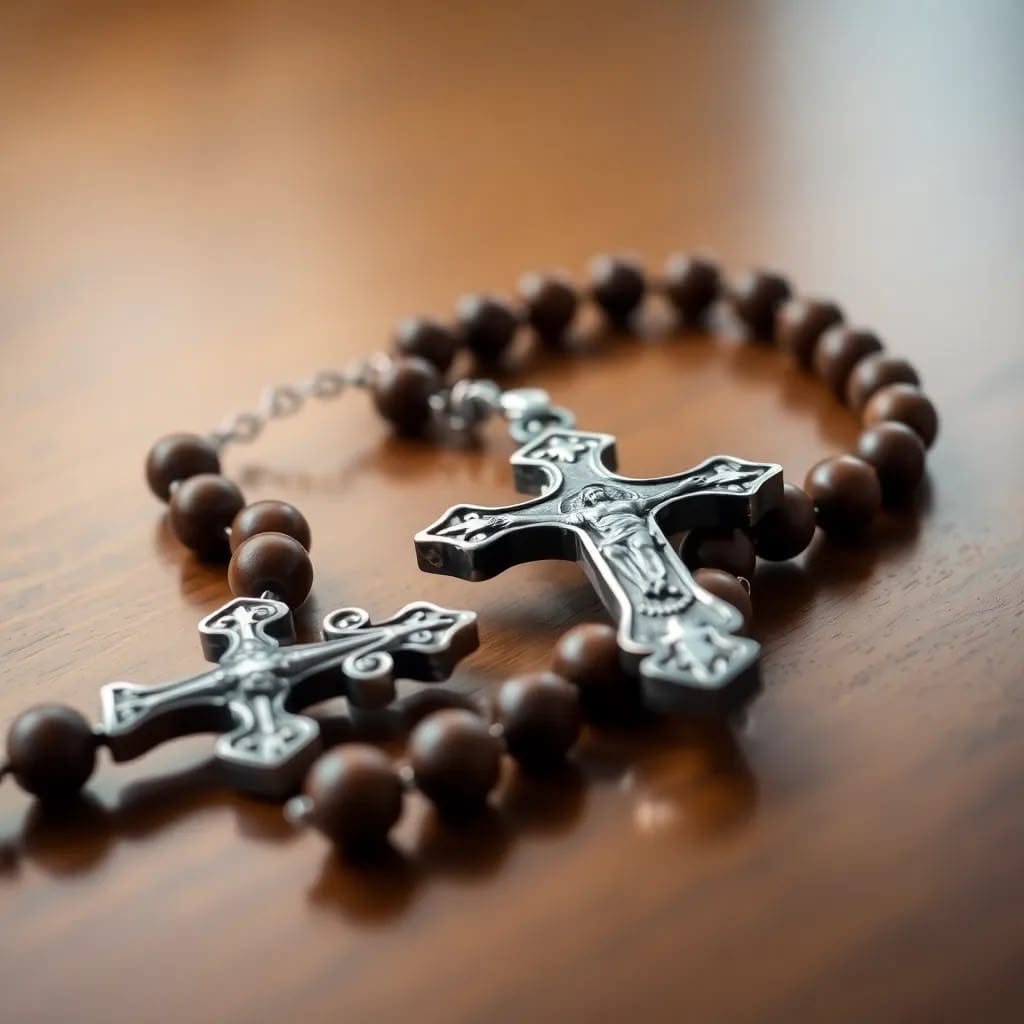
The Rosary takes the form of a rosary, a simple object but rich in symbols, designed to accompany and give rhythm to prayer. The structure of the Rosary it is based on specific physical elements that you will find systematically: a cross, main grains and secondary grains.
Physical composition of a rosary
- The cross It marks the starting point of the prayer. This is where you make the Sign of the Cross, a fundamental symbol of the Christian faith.
- Five isolated grains : located immediately after the cross, these five beads allow the first introductory prayers to be recited.
- The fifty grains divided into five tens Each decade corresponds to a set of ten closely spaced beads, separated by a single isolated bead. These groups facilitate repetitive recitation while also promoting meditation on a specific mystery.
THE Rosary beads are therefore organized into:
- A single grain (starting every ten)
- Ten tightly packed grains (the ten itself)
- Then another isolated grain before the next ten, until five tens are formed.
Typical order of a complete prayer
The traditional process relies on the various component prayers that punctuate the meditation:
- Sign of the Cross : begin with this sacred gesture that affirms your faith.
- Creed ("I believe in God"): professing the great Christian truths.
- Our Father (a single grain): prayers taught by Jesus himself.
- Three Greetings Married (three isolated grains): invoking Married for its principal virtues – faith, hope and charity.
- Glory to the Father : Praise to the Holy Trinity.
Each decade begins with an Our Father followed by ten Greetings Married and ends with a Glory Be to the Father. During this recitation, you meditate on one of the mysteries of the Rosary.
This meticulous organization, alternating between short and long prayers and between single beads and decades, facilitates guided spiritual progress. rosary It serves not only as a memory aid but also as a tool to immerse the mind in deep contemplation.
The Rosary combines material simplicity and spiritual complexity in its structure, making it accessible to all while offering unparalleled richness for meditation.
The Mysteries of the Rosary: A Meditative Foundation
THE mysteries of the Rosary They are at the heart of the Christian meditation that accompanies this prayer. They represent significant episodes in the life of Christ and the Virgin Mary. Married, allowing the one who prays to enter into deep contemplation. Each dozen beads offer an opportunity to reflect on a particular mystery, helping to nourish faith and better understand the divine message.
What is a mystery?
A mystery, in this context, is a sacred event imbued with spiritual significance. By reciting the Greetings Married While meditating on these key moments, the faithful connect their prayer to a living experience of faith. These meditations facilitate an inner encounter with God through essential Gospel events.
Three traditional series
The Rosary traditionally comprises three main sets of mysteries, each containing five distinct events. These sets structure the prayer according to the different facets of Christian life.
- The Joyful Mysteries
- These mysteries invite us to contemplate the luminous beginnings of salvation: the’Annunciation, The Visitation, the Nativity, the Presentation in the Temple, and the Finding of Jesus in the Temple. They evoke joy and the hope linked to the incarnation of Christ.
- The painful mysteries
- This series delves into the sufferings of Christ for the salvation of humanity: the Agony in the Garden, the Scourging at the Pillar, the Crowning with Thorns, the Carrying of the Cross, and the Crucifixion. They call for meditation on sacrifice and love Redeemer.
- The glorious mysteries
- They celebrate divine triumphs: the Resurrection, the Ascension, Pentecost, the Assumption of Married and her Coronation as Queen of Heaven. These mysteries strengthen hope in eternal life and victory over death.
An accessible spiritual deepening
Meditating on these mysteries allows you to ground your prayer in an ancient tradition while remaining accessible even to beginners. By taking the time to imagine each sacred scene from a personal perspective, you engage your mind and heart in a rich spiritual journey. The Rosary explained for beginners—its history, structure, and effective meditation—then takes on its full meaning thanks to this essential contemplative dimension.
The regular practice of the mysteries offers a path to a more intimate connection with the founding events of the Christianity. It also encourages the development of patience and attention — essential qualities for any successful meditation.
Meditating effectively on the rosary
Effective rosary meditation is based on a deep and focused contemplation of each mystery. Meditative prayer is not limited to the mechanical recitation of formulas. It invites an inner commitment, a spiritual connection with the events of Christ's life and of Married.
Practical tips for deep meditation
- Choose a quiet place
- A peaceful environment facilitates concentration. Remove yourself from auditory and visual distractions. Tranquility helps you enter into the inner silence conducive to prayer.
- Adopt a comfortable posture
- Whether sitting or kneeling, find a position that allows you to remain attentive without physical fatigue. A stable posture supports better mental presence.
- Breathe slowly and deeply
- Controlling your breathing stabilizes your attention. Inhale silently, exhale slowly; this prepares the heart and mind to welcome meditation.
- Visualize the mystery
- Imagine the scenes described: joy of the Annunciation, the pain of the Crucifixion, or the glory of the Resurrection. This visualization transforms words into living experiences.
- Use key phrases
- During each decade, mentally repeat a short summary of the mystery, for example, "The Annunciation: God becomes incarnate in Married »This guides your mind towards what is essential.
- Dedicate time to each prayer
- Don't rush the "« Greetings Married »Let each repetition resonate in your heart like a personal offering.
- Silence between prayers
- This moment of silence is precious for allowing the reflections prompted by the mystery to mature. It opens a space where the Holy Spirit can act.
Managing distractions
It is common for the mind to wander. Rather than violently fighting these thoughts, gently acknowledge them and bring your attention back to the mystery and the prayers. The rhythmic repetition of the rosary naturally helps to refocus the mind. For improve concentration, Consider incorporating techniques such as breathing exercises or regular breaks to refresh your mind.
Deepening meditative prayer
You can enrich your practice by:
- Reading a biblical passage related to the chosen mystery; ;
- Reflection on an extract from the writings of the Church Fathers or saints; ;
- Writing a short spiritual journal after each rosary to note what you felt or understood.
The effectiveness of meditation rests on this alliance between faithful recitation and sincere contemplation. The rosary thus becomes a path where your faith is nourished day after day by an intimate encounter with Jesus and Married in their essential moments.
The rosary as a personal and communal spiritual practice
The Rosary is not limited to individual practice. It also takes on its full meaning within a Catholic community prayer, where the strength of the group enriches personal meditation. This collective dimension is embodied in particular in the Rosary teams, created in 1955. These teams bring together believers desiring praying together, to share their spiritual experiences and receive mutual support.
The Rosary Teams: Origin and Mission
- Founded in 1955, the Rosary teams have been officially recognized by the Catholic Church.
- Their main objective is to promote collective prayer around the Rosary.
- They encourage a regular exchange of sharing meditations, allowing each member to nurture their faith through the reflections of others.
- Team dynamics create an environment conducive to shared spiritual growth.
Each team functions like a small support group where individual prayer is combined with Christian solidarity. Members meet regularly, often once a month, to recite the Rosary together and deepen their understanding of the mysteries through guided meditations.
A structured communal prayer
Group prayer generally follows a specific framework:
- Welcome and introduction by a facilitator or manager.
- A short lecture or presentation on a particular mystery.
- Collective recitation of decades of the Rosary, alternating between recitation and silent meditation.
- Free sharing of spiritual reflections or personal experiences related to the mystery being meditated upon.
- Final joint prayer to strengthen unity and mutual support.
This organization promotes active participation and allows everyone to fully immerse themselves in prayer.
Accessible spiritual enrichment
The Rosary teams also offer easy access to theological teachings, often led by Dominicans or specialized instructors. This helps both new and experienced believers to better understand the profound meaning of each mystery, making meditation richer and more engaging.
«"The strength of community prayer lies in sincere sharing and attentive listening" – a fundamental principle of the Rosary teams.
Collective practice reveals another essential facet of the Rosary: communion in faith. Beyond the intimate dialogue with God, it invites us to live a fraternal experience where each member supports the others in their spiritual journey.
The Rosary thus becomes a living bond between individuals, weaving a web of shared prayers that grows and deepens over time. This dual dimension—personal and communal—constitutes its richness and power within the contemporary Christian tradition.
Integrating the rosary into one's daily spiritual life
The Rosary lends itself perfectly to a spiritual practice sustainable, Accessible to all, regardless of age or level of knowledge. For effective integration of the daily rosary, it is essential to adopt a regular and sincere approach.
Here are some tips to achieve this:
- Choose a specific time each day Whether it is in the morning upon waking, during a break or in the evening before sleeping, consistency promotes the anchoring of this habit.
- Create a space conducive to meditation a quiet corner, with your rosary Having it at hand helps you to refocus and fully enter into prayer.
- Start gradually : if five tens seems too long at first, start with one ten and increase at your own pace.
- Use the mysteries to nourish your meditation : reflecting on the key events in the life of Christ and Married It enriches the relationship with God and gives meaning to every prayer.
- Incorporate the Rosary into your daily activities : Reciting prayers mentally while traveling or waiting makes the practice smoother.
Practicing the Rosary regularly not only deepens your faith but also offers a rich and peaceful spiritual experience. You gradually discover how this meditative prayer can become a true source of support in the face of daily challenges.
The Rosary Explained for Beginners: History, Structure, Effective Meditation It thus becomes a living guide that accompanies you every step on your spiritual path.
Frequently Asked Questions
What is the Rosary and why is it important in the Christian faith?
The Rosary is a meditative Christian prayer that consists of the repeated recitation of specific prayers while meditating on key events in the life of Jesus and Married. It is important in the Christian faith because it allows the faithful to contemplate the mysteries of their faith, thus strengthening their spiritual relationship with God.
What is the historical origin of the Rosary and what role did Saint Bernard play?
The Rosary has its roots in the 12th century, with a gradual evolution of the practice over the centuries. Saint Bernard played a significant role in its spread, contributing to its official recognition by the Catholic Church.
How is the Rosary prayer structured?
The Rosary is composed of a rosary consisting of beads arranged in five groups of ten, each separated by a single bead. The complete prayer includes the Sign of the Cross, the Creed, the Our Father, the Greetings Married and the Glory be to the Father, recited in a specific order.
What are the mysteries of the Rosary and how do they contribute to Christian meditation?
The mysteries of the Rosary are spiritual events grouped into three traditional series: joyful, sorrowful, and glorious. They serve as a meditative foundation, allowing believers to contemplate these key moments deeply and enrich their prayer and faith.
What advice is there for meditating effectively on the Rosary?
For effective meditation on the Rosary, it is advisable to focus fully on each mystery, practicing deep contemplation and meditative prayer. This helps to strengthen spiritual awareness and to fully experience prayer.
How to integrate the Rosary into one's daily spiritual life?
Integrating the Rosary into daily life involves regular and sustained practice, which allows one to deepen their faith and relationship with God. The Rosary is accessible to everyone, even beginners or non-readers, which facilitates its adoption as a practice. spiritual practice personal or community-based.