











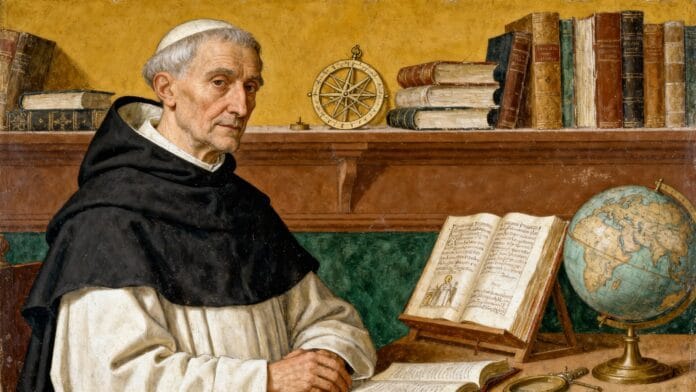
Between science and faith, a 13th-century Dominican friar still sheds light today on the quest to unite intelligence and prayer.
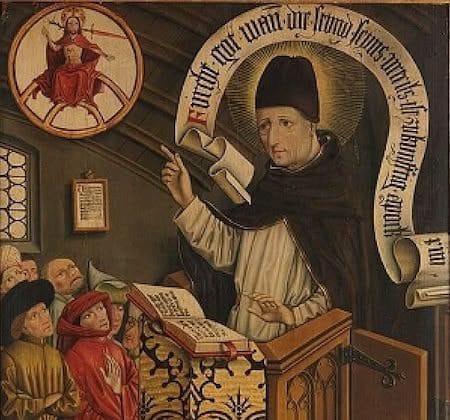
Born around 1200 in Lauingen, on the banks of the Danube, Albertus Magnus transformed Christian thought by opening science to the light of faith. A Dominican friar, professor in Paris, and bishop against his will, he linked intellectual dialogue and humility spiritual. In a time of great discoveries and heated controversies, he affirmed that understanding the world was already a step towards God. His memory today inspires researchers, teachers, and believers to unite reason and contemplation.
Wisdom on the move
Albert was born into Bavarian nobility at the beginning of the 13th century. Few sources tell us about his childhood in Lauingen, but his curiosity already had a taste for reality. A student in Padua, he entered the Dominican order in 1223, drawn to their ideal of contemplation and preaching.
Sent to Paris, he taught philosophy and theology, translating and commenting on Aristotle, whose thought, rediscovered by the Arabs, was revolutionizing medieval culture. His work aimed to show that human intelligence, far from opposing God and the world, could reveal the coherence of creation.
In Paris, he trained Saint Thomas Aquinas, who became his traveling companion and faithful disciple. Together, they embodied a Church open to knowledge. When Thomas was unjustly accused of heresy, Albert traveled throughout Germany to defend him. This loyalty marked his sense of truth linked to charity.
Appointed Bishop of Regensburg in 1260, he served for two years before resigning. His simple life contrasted sharply with the episcopal pomp. He preferred to return to his studies in Cologne, where he wrote well into old age on nature, minerals, animals, astronomy, and theology. His almost encyclopedic knowledge earned him the title of “Universal Doctor.”.
Always on foot, he traveled to settle disputes and preach. peace. He died in Cologne in 1280, surrounded by his family, leaving behind a vast body of work in which every scientific question leads to praise of the Creator. In 1931, Pius XI proclaimed him a Doctor of the Church and patron saint of researchers.
The master who listened to nature
According to tradition, Albert once made a dry branch bloom in the dead of winter to illustrate God's power over matter. This miracle, more spiritual than physical, symbolizes his conviction that nature speaks to the believing heart.
Historical accounts portray a patient scholar, a meticulous observer, who noted the colors of birds and the shapes of stones. Legend translates his intuition into images: creation is not an obstacle, but a language. By studying the laws of the world, humankind discovers divine wisdom.
Spiritual message
Albert invites us to unite faith and intelligence without mutual mistrust. His life reminds us that seeking the truth is already an act of loving God. His implicit motto could be: “Look closely without ceasing to hope.”
This attitude remains relevant for anyone exploring a complex field—science, art, or theology. It teaches patience in research, modesty in the face of mystery, and joy to learn. Like him, we can contemplate the world not as a problem to be solved, but as a book to be read with gratitude.
Prayer
Lord of wisdom,
sheds light on our research.
Gives a spirit ofhumility to those who teach
and perseverance to those who learn.
Through the intercession of Saint Albert,
Make our intelligence a place of prayer.,
where every piece of knowledge becomes praise.
Amen.
To live
- Read a passage from the Gospel with a scientific or current affairs question in mind.
- To offer a service to a student, teacher, or researcher.
- Meditate for ten minutes on the phrase: “The truth will set you free.” (John 8:32)
Memory and places
The relics of Saint Albert rest in St. Andrew's Church in Cologne. Every November 15th, the city celebrates his feast day with the Dominican community. In Regensburg, a chapel preserves his memory as a humble and peaceful bishop.
A fresco by the painter Thomas of Modena (1352) in Treviso depicts him, compass in hand, contemplating the cosmos. These places embody his work: linking contemplation, study, and fraternity. Several universities bear his name, affirming that science without ethics or praise loses its soul.
Liturgy
- Readings/psalm: Sg 7,7‑14; Ps 18; Mt 13:10-17.
- Song/hymn: Veni Creator Spiritus — to implore the Spirit of light.