










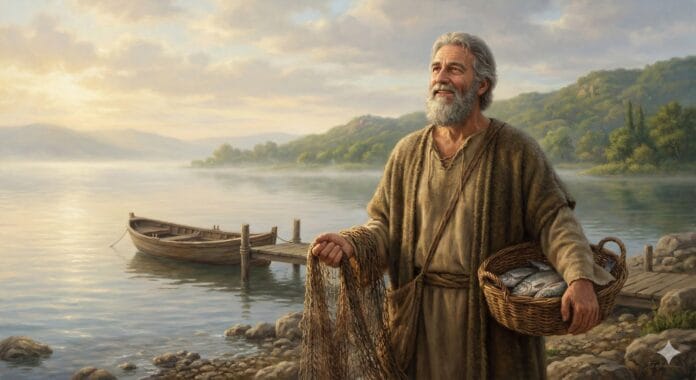
A Galilean fisherman who became an apostle of Christ, Andrew embodies the art of leading others to God. From Bethsaida to Patras, his life traces a path of listening, availability, and witness. The first disciple called by Jesus, he remains the one who introduces, who connects, who opens doors. His feast day, November 30, unites East and West in a shared memory. His story challenges us: do we still know how to be guides?
Leaving his nets to follow a voice. Andrew of Bethsaida made this choice on the banks of the Jordan River, around the year 27. A disciple of John the Baptist, he recognized Jesus as the Lamb of God. He then became the first one called. This Galilean fisherman of the first century still speaks to us. He shows us how to listen, discern, and then act. His figure connects two worlds: the Church of Rome and the Eastern patriarchates. Today, his example invites us to become bearers of light ourselves.
A fisherman becomes a ferryman of souls
The Galilean origins
Andrew was born in Bethsaida, a small fishing village on the northern shore of the Sea of Galilee. His name, of Greek origin, means "manly" or "courageous." This etymology already hinted at his temperament. He grew up in a modest family. His father's name was Jonah. His older brother, Simon, would become Peter. Both brothers were fishermen. They knew the waters of the lake, its fish, and its storms. This work forged their endurance. It taught them patience and the’humility facing the elements.
First-century Galilee was a melting pot of cultures. Greek and Jewish cultures mingled there. Trade routes crisscrossed it. Andrew grew up in this open environment. He likely spoke Aramaic and Greek. This dual cultural background prepared him for his future mission. He would be able to communicate with both Jews and pagans.
The meeting with Jean-Baptiste
Andrew is a man on a quest. He is not content with the religion of his ancestors. He seeks a living word. This thirst leads him to John the Baptist. The prophet preaches on the banks of the Jordan. He announces the coming of the Messiah. He calls for conversion. Andrew receives his baptism of repentance. He becomes one of his disciples. This period shapes his discernment. John the Baptist teaches him to recognize the signs. He teaches him active waiting.
One day, John pointed out Jesus as he passed by: «Behold, the Lamb of God!» These words changed everything. Andrew understood immediately. He followed Jesus. He spent a day with him. The Gospel of John specifies the time: the tenth hour, or four o'clock in the afternoon. This detail reveals the importance of the moment. Andrew would never forget this encounter. It shaped his entire life.
The first one called
Andrew thus became the first disciple called by Jesus. Eastern tradition gives him the title of "Protoclet," the first-called. This rank is not hierarchical. It indicates a readiness. Andrew was ready. He was waiting. He knew the moment. This primacy in the calling establishes his particular role. Andrew is the one who opens the way.
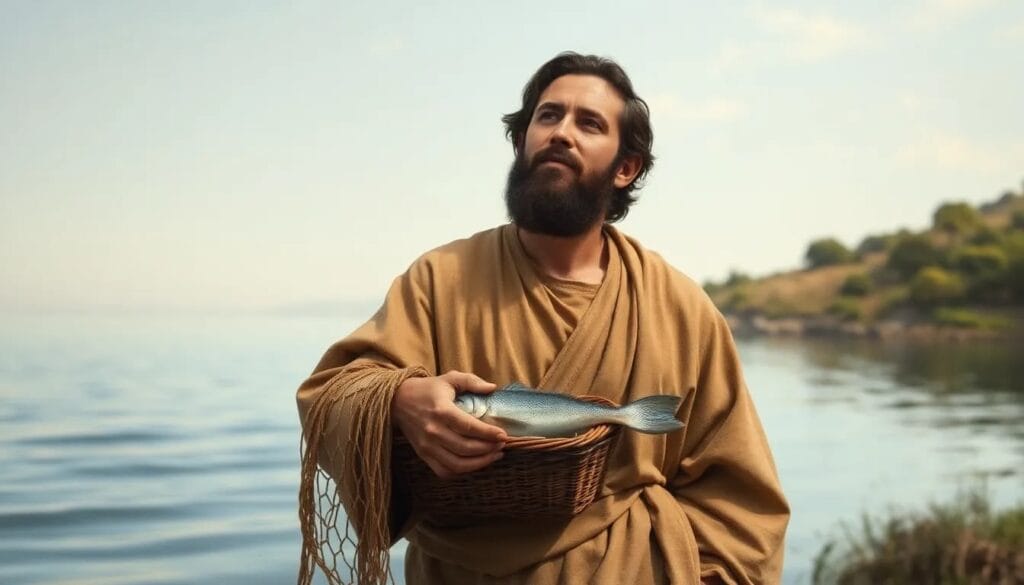
His first act as an apostle was to go and find his brother Simon. «We have found the Messiah,» he told him. Then he brought him to Jesus. This act defined Andrew. He didn't keep the good news to himself. He shared it. He led others to Christ. This mission of sharing the news characterized his entire apostolate.
At the heart of the group of Twelve
Andrew was one of the first four disciples, along with Peter, James, and John. These four men formed Jesus' closest circle. Andrew accompanied the Master on his travels. He listened to his teachings. He witnessed the miracles. He shared meals, hardships, and joys.
The Gospels mention Andrew at key moments. During the multiplication of the loaves, it is he who spots the young boy carrying five loaves and two fish. He points him out to Jesus. He plays his role as a mediator. He connects the one who has little with the one who can do anything. Another episode reveals his function. Some Greeks want to meet Jesus. They first approach Philip. Philip consults Andrew. Together, they lead these foreigners to the Master. Andrew knows how to make connections. He breaks down barriers.
On the Mount of Olives, Andrew is one of the four disciples who question Jesus about the end times. This scene demonstrates his close relationship with the Master. It also reveals his desire to understand. Andrew does not follow blindly. He asks questions. He wants to grasp the meaning of events.
After Pentecost
The Acts of the Apostles They mention Andrew among the Eleven gathered in the Upper Room after the Ascension. He received the Holy Spirit at Pentecost. Then he went on a mission. Canonical sources do not specify his destination. Apostolic traditions fill in the gaps.
According to these traditions, Andrew evangelized the regions around the Black Sea. He traveled through Scythia, Thrace, and Epirus. Some accounts place him in Byzantium, the future Constantinople. Others place him in Ukraine. Kyiv claims him as its own. These traditions, even if belated, testify to his influence. They demonstrate the importance of his figure for the Eastern Churches.
Martyrdom in Patras
Later sources place Andrew's death in Patras, Greece, the former Roman province of Achaea. According to tradition, he was crucified under the proconsul Aegeus. The approximate date is 62 AD, during the reign of Nero. Andrew is said to have requested a cross different from that of Christ, believing himself unworthy of the same punishment. He is therefore depicted with an X-shaped cross, which now bears his name: the Cross of Saint Andrew.
The account of his martyrdom emphasizes his joy. Andrew is said to have greeted the cross as a friend. He remained chained to it for several days, preaching until the very end. This glorious death crowns a life of witness. It seals his total dedication to Christ, whom he had followed from the very first day.
An immense posterity
The figure of Andrew transcends centuries. Scotland has chosen him as its national patron saint. Its flag bears the white cross of St. Andrew on a blue background. Russia, Greece, and Romania also venerate him. Constantinople has made him its patron saint. Ukraine claims him as its evangelizing force. This spiritual geography demonstrates the extent of his influence. Andrew unites peoples in a shared devotion.
The X-shaped cross and the paths of memory
The established facts
Reliable historical sources about Andrew remain limited. The Gospels and the Acts of the Apostles These documents form our documentary basis. They attest to his Galilean origins, his profession as a fisherman, and his connection to John the Baptist. They confirm his status as the first man called up. They mention his role in several key episodes. This data is solid. It paints the portrait of a discreet but essential man.
Beyond the New Testament, certainty diminishes. Historians agree on his apostolic mission. They accept his martyrdom. But the details elude verification. The time, the exact place, the precise circumstances remain unclear. This uncertainty does not detract from Andrew's stature. It simply invites us to distinguish between what is certain and what is probable.
The legend of the cross
The tradition of the X-shaped cross appeared late. The earliest accounts of the martyrdom do not mention it. It developed during the Middle Ages. According to this legend, Andrew asked to be crucified differently. He did not consider himself worthy to perfectly imitate Christ. The proconsul Aegeus agreed. Andrew was tied to an X-shaped cross. He remained suspended on it for two days. He continued to preach. A heavenly light surrounded him at the moment of his death.
This legend carries a strong symbolic weight. The X-shaped cross evokes the’humility. Andrew positions himself beneath Christ. He acknowledges his role as a servant. The very shape of the cross suggests openness. His outstretched arms convey a sense of welcome. Even in his dying moments, Andrew continues to embrace the world.
The St. Andrew's Cross became a heraldic symbol. It appeared on numerous flags. Scotland, Russia, and Burgundy adopted it. It adorned coats of arms and orders of chivalry. This success testifies to the power of the image. A well-constructed legend left its mark on people's memories.
Apostolic Journeys
Traditions about Andrew's travels abound. The apocryphal Acts of Andrew, written around the third century, recount his wanderings. They show him traveling through Asia Minor, Pontus, and Bithynia. He founded communities, ordained bishops, and performed miracles. These accounts blend edification and the miraculous. Their historical value is limited. Their spiritual value remains intact.
Byzantine tradition holds Andrew to be the founder of the Church of Byzantium. He is said to have established the first bishop of what would become Constantinople. This claim serves political purposes, allowing Constantinople to rival Rome. Peter founded Rome; Andrew founded Byzantium. The two brothers symbolize the two Churches. This skillful theological construction reinforces the link between apostle and city.
Ukraine developed its own tradition. Andrew is said to have traveled up the Dnieper River to Kyiv. He is said to have blessed the hills where the city would rise. He is said to have planted a cross. This story appears in the Chronicle of Times Past, in the twelfth century. It forms the basis of Ukrainian Christian identity. Andrew became the spiritual father of the country. This legend remains alive today.
The traveling relics
Andrew's body had a turbulent history. According to tradition, it was initially laid to rest in Patras. In the fourth century, Emperor Constantius II ordered the transfer of his relics. They arrived in Constantinople in 357 and were placed in the Church of the Holy Apostles. This transfer enhanced the prestige of the imperial capital.
In 1208, during the Fourth Crusade, the Latin crusaders captured Constantinople. The relics were dispersed. Cardinal Peter of Capua took the skull to Amalfi, Italy. Other fragments were sent to various destinations. Edinburgh Cathedral received a bone. Patras kept some pieces. This dispersal created a network of shrines. Each place became a point of pilgrimage.
In 1462, the Despot of Morea, Thomas Palaiologos, fled the Ottomans. He took Andrew's head with him to Rome. pope Pius II received it solemnly. The relic was deposited in St. Peter's Basilica. It remained there for five centuries. In 1964, the pope Paul VI decided on its return. He wanted to signal closer ties with the East. In 1966, Cardinal Bea officially handed the relic over to the Metropolitan of Patras. This ecumenical gesture was a landmark. It symbolized the desire for communion between the Churches.
Symbolic significance
Andrew embodies the passage. He passes from John the Baptist to Jesus. He leads his brother Peter. He leads the Greeks to the Master. His relics travel from East to West, then back to the East. This constant movement defines his figure. Andrew is a bridge. He connects the shores. He unites what seemed separate.
The legend amplifies this dimension. The miraculous journeys, the founding of churches, the distinctive cross: everything converges on the idea of connection. Andrew weaves networks. He creates connections. His numerous patronages confirm this. Scotland, Russia, Greece, Ukraine Different nations recognize themselves in him. He transcends borders.
This universal reach rests on a solid Gospel foundation. Andrew is indeed the first called. He does indeed bring his brother to Jesus. He does indeed point out the young boy with the loaves. These simple actions contain his entire mission. The legend merely extends them. It projects them into space and time. It gives them a cosmic dimension. But the core remains the same: a man who leads others toward the light.
Spiritual message: becoming bearers of light
André teaches us the art of transition. His entire life illustrates this vocation. He himself moves from seeking to encountering. He leads others from ignorance to knowledge. This dynamic is the foundation of the Christian mission. We are all called to become guides.
Listening as a first step
Andrew was first and foremost a man who listened. He listened to John the Baptist. He discerned in his words the announcement of the Messiah. This active listening prepared him. When Jesus appeared, Andrew was ready. He recognized the one he had been waiting for. Without this preparation, the encounter would not have taken place.
We can cultivate this listening. It begins with silence. It is nourished by prayer. It deepens through reading Scripture. To listen is to make space. It is to open ourselves to a word that transcends us. André shows us that this openness opens unexpected doors.
Immediate sharing
Andrew doesn't keep his discovery to himself. He runs to find his brother. "We have found the Messiah!" This phrase springs forth spontaneously. It doesn't calculate. It doesn't question whether Peter is ready. It simply shares a joy. This natural impulse characterizes authentic evangelization.
Sharing doesn't mean imposing. Andrew brings Peter to Jesus. He doesn't give him a speech. He simply places him in Jesus' presence. Then Peter will find his own way. Andrew respects this freedom. He opens the door. He doesn't force anyone to enter. This gentleness inspires our witness. We can lead people toward the light without forcing their eyes.
L'humility of the servant
Andrew remains in his brother's shadow. Peter becomes the leader of the apostles. Peter receives the keys. Peter is the foundation stone. Andrew accepts this withdrawal. He makes no demands. His primacy in the calling gives him no privileges. He simply serves wherever he is.
This humility It liberates us. We don't need to be first. We don't need to be recognized. Authentic service needs no recognition. It finds its reward within itself. André teaches us this selflessness. He shows us that selflessness can be a form of greatness.
An image for today
Think of the river ferryman. He knows the currents. He knows where to cross. He guides those who want to reach the other side. Then he comes back to fetch other travelers. He doesn't stay on the arrival bank. He returns to the starting point. His mission is the crossing itself.
André is that ferryman. All his life, he helped people cross over. He led souls to Christ. He continues to do so throughout the centuries. Today, he invites us to take up the oar. It is our turn to become ferrymen. To lead those who seek in the darkness toward the light.
Prayer
Lord Jesus, you who called Andrew on the banks of the Jordan, grant us the grace to listen. Like him, we want to discern your presence in our daily lives. Open our ears to your Word. Make our hearts attentive to the signs you give us. May the noise of the world not drown out your voice.
Andrew recognized you in John the Baptist's proclamation. He followed you without hesitation. Grant us this promptness in faith. When you call us, may we know how to respond without delay. Free us from our calculations and our fears. Grant us the confidence of one who knows he is loved.
André ran to find his brother. He didn't keep the good news to himself. Grant us this generosity of sharing. May our faith overflow in witness. May our encounter with you radiate around us. Make us bearers of light in a world searching for its path.
Andrew led the Greeks to you. He knew how to make connections, how to build bridges. Grant us this spirit of openness. May we know how to welcome those who are different. May we dare to cross the barriers of language, culture, and prejudice. Make us architects of encounter.
André remained in Pierre's shadow. He served without seeking first place. Grant us this humility True. Deliver us from the need for recognition. May our service be free, our gift without expectation of return. Teach us joy of the one who steps aside so that others may grow.
André gave his life to the very end. On the cross, he still preached your glory. Give us loyalty In times of trial. When difficulties arise, may our faith not waver. When bearing witness is costly, may we remain steadfast. Grant us the grace of perseverance.
We entrust to you those we love. As Andrew led Peter to you, we want to lead our loved ones. Bless our families, our friends, our communities. May your light reach them through our humble witness.
We also pray for you.’unity of Christians. Andrew unites East and West in a single veneration. May her intercession hasten the day of full communion. May the separated Churches regain the visible unity you desire.
Through the intercession of Saint Andrew, apostle and martyr, hear our prayer. You who live and reign with the Father and the Holy Spirit, now and forever.
Amen.
To live
- Becoming a smuggler Today, recommend a book, podcast, or spiritual testimony to someone you know. Like Andrew leading Peter to Jesus, bridge the gap between a person and a resource that could nourish their quest.
- Practice active listening Take ten minutes to truly listen to someone. Without interrupting, without preparing your response. Welcome their words as Andrew welcomed the words of John the Baptist. This kind of listening can open doors.
- Meditate John 1, 35-42 Read slowly the account of André's call. Imagine the scene. Feel the emotion of discovery. Ask yourself: what am I looking for? Who can I lead someone to today?
Memory and places: in the footsteps of André
Patras, city of martyrdom
The city of Patras, on the northern coast of the Peloponnese, vividly preserves the memory of Saint Andrew. According to tradition, it was there that he was martyred around the year 62. The Basilica of Saint Andrew, built in the 20th century, dominates the city. It is one of the largest churches in Greece. It was consecrated in 1974. Its Neo-Byzantine architecture is impressive in its scale. The central dome reaches a height of 46 meters.
Inside, a precious reliquary contains the head of the apostle. This relic, returned by Rome in 1964, is the basilica's treasure. Pilgrims flock to venerate it. Every November 30th, a grand festival draws thousands of the faithful. The procession winds through the city streets. Patras then lives to the rhythm of its patron saint.
The older, more modest church of Saint Andrew stands nearby. It marks the traditional site of the martyrdom. A miraculous spring is said to have flowed there since the apostle's death. The faithful come to draw water reputed to have healing properties. This more intimate place fosters contemplation.
Constantinople and Byzantine memory
The former imperial capital maintains a strong connection with Andrew. Tradition holds him to be the founder of the Church of Byzantium. The Ecumenical Patriarchate venerates him as its illustrious patron saint. Every November 30th, the Patriarch solemnly celebrates the feast day. A Roman delegation attends the liturgy. This annual gesture demonstrates the dialogue between the two Churches.
The Church of the Holy Apostles, now gone, once housed the relics. The crusaders pillaged it in 1204. But the memory of Andrew remains alive in the city. Istanbul, The heir to Constantinople, perpetuates this devotion. Orthodox faithful gather there to honor the first one called.
Amalfi and Italy
Amalfi Cathedral, on the Amalfi Coast, houses important relics of Saint Andrew. Cardinal Peter of Capua brought them back from Constantinople in 1208. The cathedral's crypt contains the apostle's body. A mysterious liquid, known as "Saint Andrew's manna," is said to sometimes seep from the tomb. This phenomenon fuels popular devotion.
Amalfi celebrates Andrew with fervor. On June 27th, a festival commemorates the arrival of his relics. On November 30th, the liturgical feast day brings the population together. The fishermen of the coast take him as their patron saint. They recognize him as one of their own. The figure of the Galilean fisherman speaks to these men of the sea.
Scotland and the national flag
Scotland has a unique relationship with Saint Andrew. He has been the country's patron saint since the eighth century. According to legend, relics were brought to St Andrews by a monk named Regulus. The town is named after the apostle. Its cathedral, now in ruins, was for a long time a major pilgrimage site.
The Scottish flag features the St. Andrew's Cross. The white X-shaped cross stands out against a blue background. This symbol dates back to at least the ninth century. It is now also found on the British Union Jack. St. Andrew's Day, November 30th, has been a public holiday in Scotland since 2006. Scots celebrate their patron saint with ceilidhs, traditional dances, and festive meals.
Ukraine and the legend of Kyiv
Ukraine claims Andrew passed through its territory. The Chronicle of Bygone Times, written in the twelfth century, recounts his journey. He is said to have traveled up the Dnieper River from the Black Sea. Upon reaching the hills of Kyiv, he is said to have prophesied the city's future greatness. He is said to have planted a cross there.
This tradition forms the basis of Ukrainian Christian identity. Andrew is considered the country's first evangelizer. The Church of St. Andrew in Kyiv, an eighteenth-century Baroque masterpiece, dominates the upper town. It was built on the presumed site of the cross planted by the apostle. Ukrainians venerate Andrew with particular fervor.
Notable works of art
Andrew has inspired artists for centuries. Representations often show him with his X-shaped cross. This cross has become his main iconographic attribute. He is also recognized by his fishing nets.
Caravaggio's painting, "The Crucifixion of Saint Andrew" (1607), is striking for its realism. The apostle appears serene in the face of death. Rubens painted several versions of the martyrdom. El Greco depicts Andrew in meditation. Byzantine icons portray him as a bearded apostle, holding a scroll of Scripture.
In Gothic cathedrals, Andrew appears in stained-glass windows and on portals. At Chartres, he is among the apostles on the Royal Portal. In Bordeaux, a statue of him stands in the cathedral. These works testify to a devotion widespread throughout medieval Western Europe.
Liturgy
- Date of the celebration November 30th, a liturgical feast day included in the general Roman calendar since its origins. This date precedes Advent and symbolically opens the time of waiting.
- First reading Romans 10:9-18. "Faith is born through preaching." This text highlights the mission of proclamation that was Andrew's.
- Psalm Psalm 18 (19), 2-5. "Their message goes out into all the earth." The psalm celebrates the universal spread of the Word, echoing Andrew's apostolic journeys.
- Gospel Matthew 4:18-22. The calling of the first disciples by the lake. Andrew and Peter leave their nets to follow Jesus. This foundational story resonates particularly strongly today.
- Preface Preface to the Apostles I or II. It celebrates the pastors of the Church, the foundations of the Christian community.
- Suggested anthem "You are the first called," a hymn composed for the feast of Saint Andrew. It recounts his vocation and his witness up to his martyrdom.