











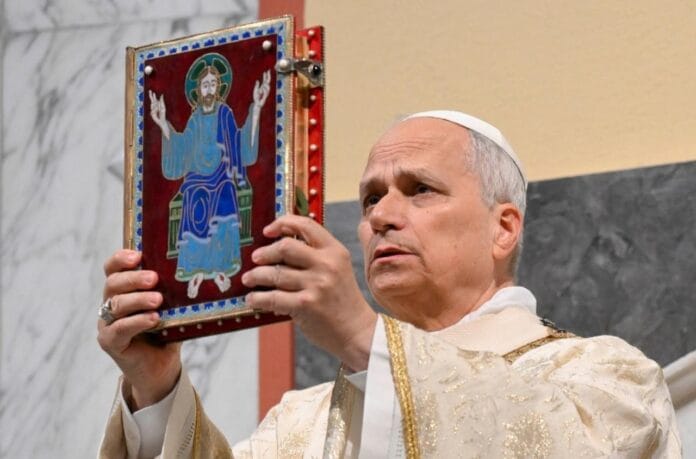
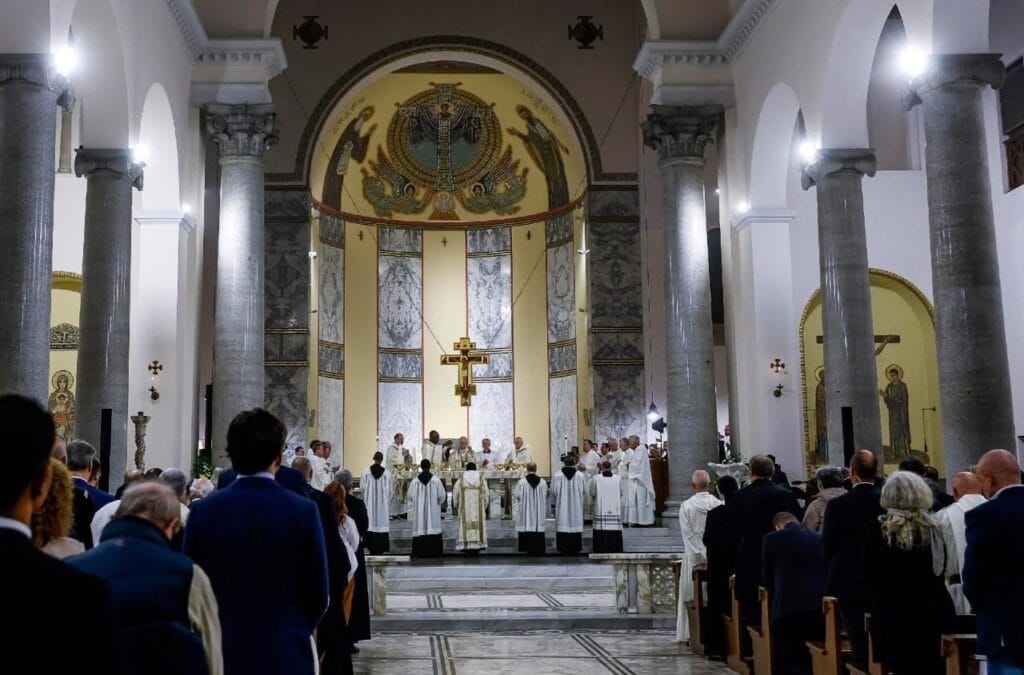
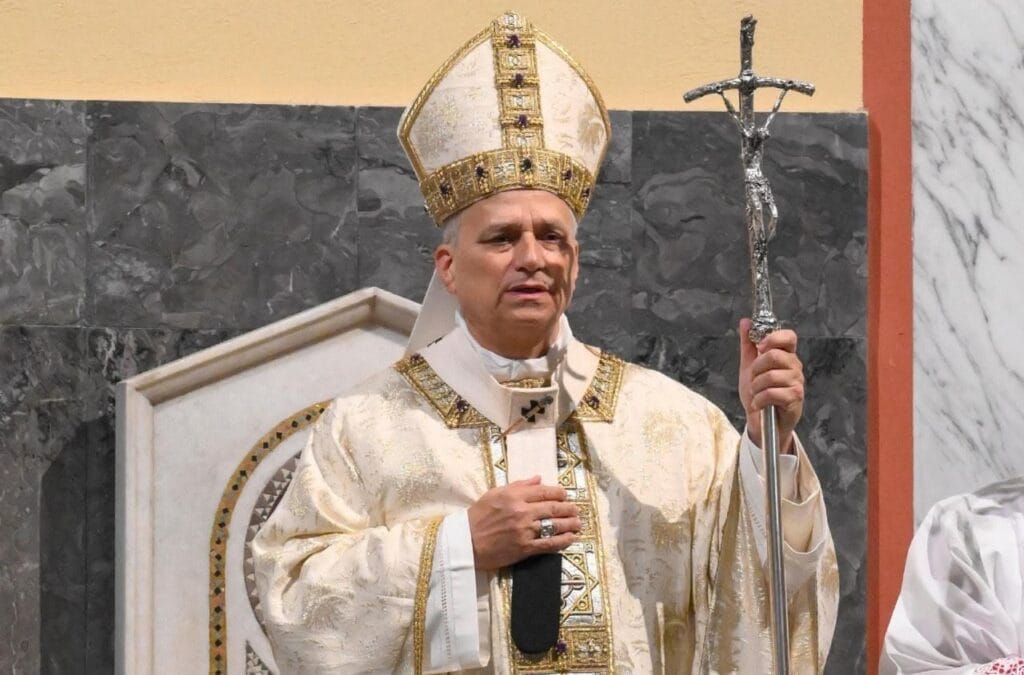
On November 11, 2025, at nightfall, the Aventine Hill was filled with a solemn and luminous chant. Pope Leo XIV, returning from Castel Gandolfo, went there to celebrate the 125th anniversary of the consecration of the Church of Saint Anselm — a small Roman basilica which has become, over time, the living symbol of the modern Benedictine world.
The event was not merely commemorative: it also marked a historical recognition of the audacious project launched at the end of the 19th century by Leo XIII. The latter had wanted to make Saint-Anselme a center of unity, a bridge between the scattered abbeys of Europe, Africa, America and Asia, in order to strengthen the Benedictine presence in a world in transition.
In an era marked by industrial and ideological revolutions, Leo XIII He already foresaw that Benedictine stability and wisdom could become a universal spiritual reference point. His intuition was confirmed by history: Saint-Anselme is today at once an international college, a liturgical center, and a community where prayer, research and teaching are intertwined.
The founders' intuition
To speak of Saint Anselm is to evoke a quiet revolution. Monks don't brandish manifestos, they don't build empires. Their weapon is... loyalty. Their driving force is prayer.
Beneath this apparent simplicity lies a profoundly innovative vision: that of a place that transforms the world silently, like leaven in dough.
THE Pope Leo XIV As he reminded us in his homily, "Monasticism has been a pioneering force since its origins." It brought light to places shrouded in darkness and solitude, founding monasteries in barren lands, humanizing landscapes and peoples. These havens of silence were often the first schools, the first libraries, the first clinics of the Western world.
A school for serving the Lord
When prayer becomes study
Even today, on the Aventine Hill, the spirit of Saint Benedict animates each cloister. The monastery, the Athenaeum and the Liturgical Institute form a unique ecosystem: a place where knowledge and faith nourish each other.
Monks from Africa, Asia, and Latin America mingle there — some in cassocks, others in civilian clothes, according to their vocations. Together, they study theology, liturgy, the history of rites, but also philosophy and comparative religious studies.
What do they have in common? They all seek to serve Christ through beauty, intellectual rigor, and... fraternal charity.
The Benedictine spirit can be summed up here in a well-known phrase: Ora et labora — prays and works. But at Saint-Anselme, this work takes root in love details: composing a Gregorian chant, translating a patristic text, accompanying a student in his inner doubts, welcoming a curious pilgrim.
A hive of a thousand accents
THE Pope used a powerful image: "the industrious beehive of Saint-Anselme".
Hive: the word expresses order, fertility and the incessant murmur of a living community.
At Saint-Anselme, each monk, professor or student plays his role like a bee in the hive: he brings his small part of light to nourish the entire community.
This diversity enriches the place: the chants resonate in Latin, but also in Swahili, Korean, and Spanish. The faces differ, the gestures too, but the liturgy unifies them in a single movement towards God.
THE Pope He sees in this polyphony a prophetic sign: in a fragmented world, Saint Anselm becomes a model of unity in difference. It is a school that speaks all languages without erasing any of them.
Knowledge in the service of faith
The Pontifical Athenaeum of Saint Anselm is not simply an ecclesiastical university. It is a "school of the service of the Lord," according to the expression in the Rule of Saint Benedict.
Here, studying is not about accumulating knowledge; it is about learning to contemplate.
Each course, each semester, each exam aims at a single end: to bring those who seek closer to God.
Knowledge thus becomes an act of charity, a bridge to encounter.
And that is why the Holy See sends not only monks, but also lay people, nuns, diocesan priests, and researchers in search of an incarnate theology.
A heart for the world
Praying in the midst of turmoil
«The sudden changes we are witnessing challenge and question us,» he said. Pope in his homily. It's hard not to agree with him.
Digital, Ecology, conflicts, migrations: the challenges are multiplying. Yet, from its red brick walls, Saint-Anselme offers a breath of fresh air.
Every day at dawn, the liturgy sets the spiritual heart of the Aventine beating. The chanting of psalms flows through Rome, down to the Tiber, and up to the domes of the Vatican. He reminds us that, even in a world saturated with noise, silence still has something to say.
The monastery does not isolate one from the world; it becomes its sentinel. There, amidst the olive trees and ancient stones, a universal prayer for humankind is born. women of our time.
The symbol of a living Church
Leo XIV invited the community to "become a beating heart in the great body of the Benedictine world".
The image is biological: the heart pumps blood, distributing life and strength to each limb. Similarly, Saint Anselm does not exist for himself, but to radiate.
What he receives in prayer, he redistributes through his monks, his students, his liturgists, his researchers.
This silent fecundity is measured not in numbers but in faces: those of former students who became abbots, bishops, musicians, teachers, or simply witnesses of peace Benedictine in their environment.
The legacy of a consecrated place
When discussing the consecration of the church, Leo XIV quoted Evangelii Gaudium And Sacrosanctum Concilium: two texts which remind us that every sacred building manifests the meeting of the visible and the invisible.
Saint-Anselme remains this boundary between stone and prayer: a place where space is transformed into hope, where time expands to welcome eternity.
Each vault, each hanging lamp speaks of a story and a commitment: that of every Benedictine, yesterday as today, to make his life a bridge between man and God.
Towards a shared light
THE Pope He concluded with a simple and luminous phrase: "We need Jesus.".
This straightforward confession resonates as the keystone of the entire speech.
It sums up the spirit of the beehive: everything begins with Him, everything returns to Him.
At Saint-Anselme, intellectual research does not turn away from God; it leads to Him.
And this is probably where the prophetic message sought by Leo XIV: to show that intelligence and faith, studies and love, contemplation and action are not opposed, but call to one another.
The industrious hive of Saint-Anselme, perched on its Roman hill, beats to the rhythm of a world in search of meaning.
She continues to transform the pollen of tradition into the honey of wisdom, offering the world a taste of eternity in gentleness of the present.