












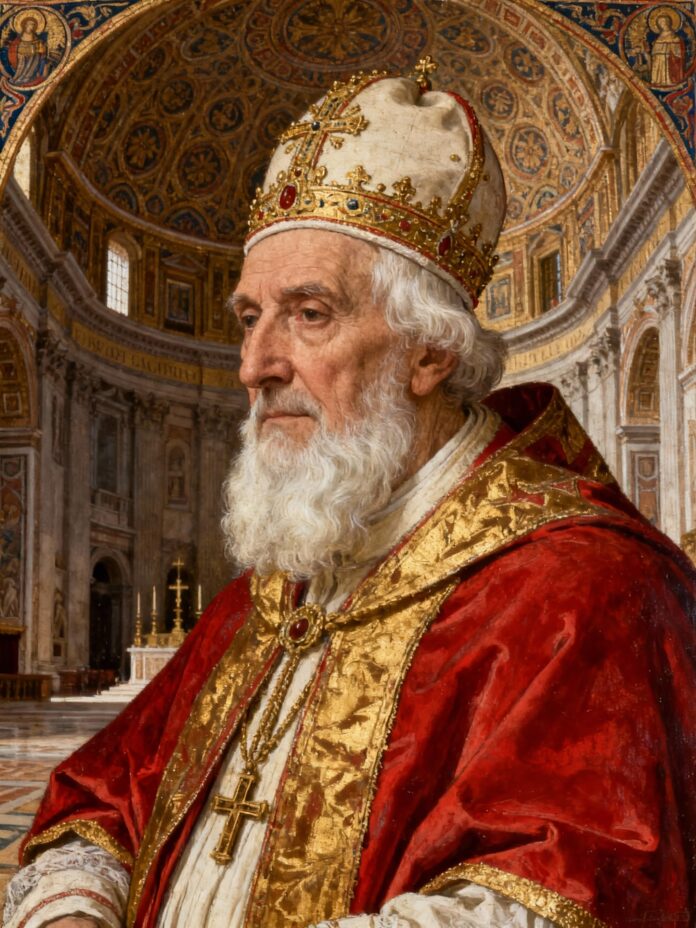
Pope In the 4th century, confronted with theological and linguistic divisions, Damasus I charted a path of reconciliation through dialogue. Facing the Arians who denied the divinity of Christ, he defended faith of Nicaea, while commissioning Jerome to produce the first major Latin translation of the Bible. A poet and pastor, he reorganized the veneration of martyrs in the Roman catacombs and engraved verses on the walls that still resonate today. faith. His memory, celebrated on December 11, reminds us that the unity of the Church depends on the clarity of doctrine and the beauty of witness.
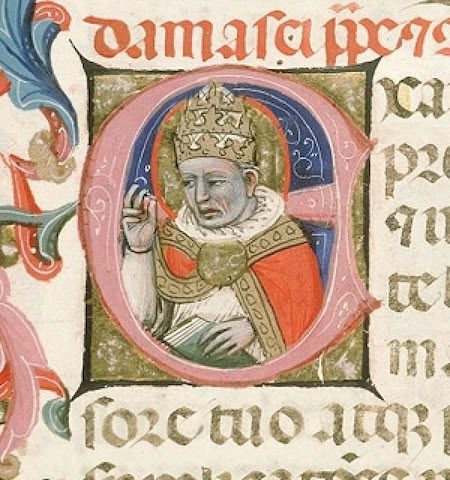
Rome, 366. The papal election descends into riot. Two camps clash in the basilicas, each with its own candidate. Damasus, son of a priest and a Roman cleric since childhood, emerges victorious from a contested election that leaves dead in the streets. His eighteen-year pontificate will transform this foundational violence into a work of doctrinal and liturgical unity. He defends faith A Trinitarian, he commissioned the Vulgate from Jerome, restored the catacombs, and composed epigrams that brought Latin poetry into the liturgy. Today, at a time when divisions still plague the Church and when understanding biblical texts remains a major pastoral challenge, Damasus reminds us that unifying does not mean standardizing, but rather offering a common foundation of clear doctrine and a language accessible to all.
A Roman cleric confronts the divisions of the Empire
Damasus was born around 305, son of Anthony, a priest attached to the Basilica of Saint Lawrence in Rome. Tradition holds that he grew up in the clergy, trained in the Latin rites and Greek texts still circulating in the Christian communities of Italy. In 366, upon the death of pope Liberation, two factions clash. Damasus, supported by the clergy The Roman majority was elected. His rival, Ursinus, gathered a minority that rejected his legitimacy. Bloody clashes erupted in the Basilica of Santa Maria in Trastevere. Sources speak of one hundred and thirty-seven deaths. Emperor Valentinian I intervened, exiled Ursinus, and confirmed Damasus. This initial violence cast a shadow over his pontificate, a fact for which his adversaries criticized him. But Damasus did not rule as an autocrat. He convened synods, consulted the bishops, and wrote clear doctrinal letters.
Arianism still dominates parts of the East. This heresy, condemned to Council of Nicaea In 325, he denied the full divinity of Christ and reduced the Son to a superior creature. Arian emperors reigned, bishops wavered. Damasus responded with doctrinal firmness. In 380, he convened a synod in Rome that reaffirmed the Nicene Creed and condemned all ambiguity concerning the Trinity. He supported Athanasius of Alexandria, exiled five times for his defense of the faith Orthodox. He sends legates to the East to encourage the faithful communities. His diplomatic efforts bear fruit: the Edict of Thessalonica, promulgated by Theodosius in 380, makes the Christianity Nicene was the official religion of the Empire. Damasus did not triumph through arms, but through the consistency of his word and the stability of his seat.
At the same time, another challenge arose: the liturgical language. Greek, long dominant in the Christian communities of Rome, was giving way to Vulgar Latin. The faithful no longer understood the texts read at Mass. The old Latin translations, disparate and sometimes flawed, sowed confusion. Damasus made a bold decision: to entrust Jerome, his secretary, with the complete revision of the Scriptures. Jerome, a scholar educated in Gaul and the East, was fluent in Hebrew and Greek. In 382, Damasus first commissioned him to revise the Gospels, then the Psalms, and finally the entire Old Testament. Thus was born the Vulgate, the Latin Bible that would become the standard for the Western Church for over a thousand years. Damasus would not live to see the work completed; Jerome finished it after his death. But the impetus came from the pope, which understands that unity comes through an accessible and reliable Word.
Damasus also reorganized the cult of the martyrs. Rome has dozens of catacombs where Peter, Paul, Lawrence, Agnes, Sebastian, and so many other witnesses of faith. Since the persecutions of Diocletian, these sites had been abandoned, their galleries collapsed, their frescoes faded. Damasus launched a vast restoration project. He had the passageways cleared, the vaults reinforced, and underground chapels created around the venerated tombs. He himself composed Latin epigrams, which he had engraved on marble plaques. These short, rhythmic inscriptions recount the lives of the martyrs, celebrate their courage, and invite pilgrims to prayer. About forty of them still survive today. Their style blends classical restraint with Christian fervor. Damasus thus became the first pope poet, the one who brings Latin literature into the liturgy and popular devotion.
He did not forget the living. He instituted processions to the tombs, established feast days for the martyrs, and encouraged the construction of basilicas above the catacombs. The Basilica of Saint Paul Outside the Walls, enlarged during his pontificate, now housed the tomb of the apostle. The Basilica of Saint Lawrence received a monumental crypt. Damasus wanted the veneration of the martyrs not to be an archaic relic, but a living pillar of faith community. It thus links memory and present, heroic past and current hope.
At the age of seventy-nine, Damasus died on December 11, 384. He had planned his tomb near the Catacombs of Callixtus, but refused to be buried there so as not to "profan the ashes of the saints." He was buried instead in a small nearby church, next to his mother and sister. On his tombstone, a final epigram proclaims his faith in the resurrection "He who walks on the water will raise Damascus from its ashes." pope Controversial at its inception, it left behind an immense legacy: a doctrinally unified Church, a Bible translated for the people, a renewed cult of martyrs, and liturgical poetry that would sing faith for centuries.
The poet of the catacombs and living memory
The most solidly attested historical fact remains the epigraphic work of Damasus. The inscriptions he composed and had engraved in the catacombs bear witness to a precise pastoral intention: to make the martyrs present to the faithful through poetic language. At the entrance to the crypt of Saint Sebastian, he wrote: «You who come seeking the bodies of Paul and Peter, know that here rest the saints.» Each verse guides the pilgrim, contextualizes the place, and invites prayer. Damasus invents nothing; he records the oral tradition and fixes it in marble. He clearly distinguishes what is attested from what belongs to pious legend, without, however, disqualifying the latter.
The best-known legend concerns the tomb of Peter. Divergent traditions circulate: some place the body beneath St. Peter's Basilica, others suggest a temporary transfer to the catacombs of St. Sebastian during the persecutions. Damasus decides as a poet, not a historian. He composes an epigram that honors both places without taking a definitive stance: "Here, Peter and Paul rested together." He does not say "are buried," but "rested," leaving the scholarly debate open while affirming the veneration legitimate. This pastoral prudence runs through all his epigraphic work. He does not manipulate memory, he respects and celebrates it.
Another legendary tale surrounds his relationship with Jerome. According to some medieval saints' lives, Damasus had a vision commanding him to entrust the Bible to Jerome. No contemporary source mentions this dream. The true account is more understated: Damasus knew talents Jerome, appreciating his exegetical letters, initially entrusted him with the revision of the Gospels as a test. Satisfied with the result, he expanded the commission. No miracle, but a pastoral discernment. Legend would later amplify this choice into a heavenly vision. Damasus himself would likely not have endorsed this overinterpretation.
The symbolic significance of his work transcends his century. By organizing the cult of the martyrs, he invented a form of Roman Catholicism where past and present are in constant dialogue. The catacombs become places of active memory, not of museums. The epigrams created a "liturgy of stone," where the written word complemented the oral rite. The Vulgate offered a common text for the entire Latin Church, enabling a unified theology and consistent preaching. Without Damasus, the linguistic divide between Greek and Latin might have split the Church earlier. His doctrinal caution regarding Arianism also prevented repressive excesses. He condemned error but welcomed those who returned to the faith. faith Orthodox. This pastoral style, firm but merciful, foreshadows the method of later great ecumenical councils.
Spiritual message
Damasus teaches us three essential virtues for today. First, doctrinal clarity in the service of unity. In a time when opinions diverge on everything, including within the Church, he reminds us that a common faith requires precise and shared words. This does not mean imposing clerical jargon, but translating revealed truth into accessible language. The Gospel of Matthew recounts Christ's promise: "I am with you always, to the very end of the age" (Mt 28,20). This presence is communicated through the Word proclaimed, understood, and prayed over. Damase embodies this mission of conveying meaning.
Next, respect for the memory and the saints who came before us. The catacombs restored by Damase are not historical monuments, but places of living communion with the witnesses of faith. Saint Paul writes to the Hebrews: «Since we are surrounded by such a cloud of witnesses, let us run with perseverance the race marked out for us» (He 12,1). Damasus puts this communion of saints into practice by making present, through poetry and liturgy, those who gave their lives for Christ. He invites us not to be amnesiac Christians, cut off from our roots.
Finally, creative audacity in the’evangelization. Commissioning a new translation of the Bible, composing verses for tombs, organizing popular processions: Damasus constantly innovates. He does not sacralize ancient forms to the point of freezing them. He adapts, translates, embellishes, without betraying the original text. faith. A concrete image sums up his work: that of the calligrapher copying an ancient text onto new parchment. The content remains the same, but the writing is renewed so that each generation can read it. This is what Damasus did for the 4th-century Church, and what he calls us to do for our own: to transmit faithfully by speaking the language of our time.
Prayer
Lord God, you raised up Saint Damasus to guide your Church in a time of division and the search for unity. He defended faith In your Holy Trinity, he offered your translated Word so that all might know you; he honored the memory of the martyrs so that their witness might inspire the living. Grant us, through his intercession, the grace to stand firm in faith without hardening our hearts, to proclaim your truth clearly without despising those who seek, to venerate your saints without forgetting the poor of today.
Grant us the wisdom of Damasus in the face of the debates that permeate our communities. May no quarrel over words break the communion you desire for us. Strengthen the translators, exegetes, and catechists who struggle to make your Word accessible in a world saturated with contradictory messages. May they find the right words, the eloquent images, and the pedagogical paths that open the Scriptures to the humblest.
Teach us also to celebrate our witnesses, the martyrs of yesterday and today, those who gave their lives in the Roman arenas as well as those who still die for your name in the media's silence. May their example rouse us from lukewarmness and launch us onto the paths of mission. May the beauty of the liturgy, the precision of the texts, and the depth of prayer unite us beyond our cultural or generational differences.
Finally, Lord, may we all bear a little of Damasus's poetic spirit. May it inspire us with words of praise, simple songs, and ritual gestures that honor your presence without confining them to lifeless formulas. Make us artisans of unity, builders of bridges between past and present, and faithful guardians of your Word. Through Jesus Christ our Lord. Amen.
To live
- Read a passage from the Vulgate (or your usual Bible translation) thanking God for the translators who have made the Scriptures available in your language.
- Visiting a church or a place of Christian memory (even virtually) and pray for the martyrs and saints who bore witness to faith in your region.
- Share a Bible quote or a verse with someone who is looking for meaning, taking the time to explain simply what it means to you.
Memory
Rome preserves several material traces of Damasus's influence. The Catacombs of Saint Callixtus, located along the Appian Way, still house some thirty Damasusian epigrams engraved in marble. The Crypt of the Popes, restored during his pontificate, features inscriptions in "Damassian" script, an elegant calligraphic style created by his engraver Furius Dionysius Filocalus. One can read: "Here lie the bodies of many saints. Damasus attests to this."«humility The subject matter contrasts with the majesty of the place.
The Basilica of Saint Lawrence Outside the Walls preserves the memory of the connection between Damasus and his father's parish. Tradition holds that Damasus served there as a deacon before his election. The tomb of the martyr Lawrence, adorned during his pontificate, still attracts pilgrims. A side chapel honors Damasus's family, particularly his sister Irene, consecrated to God, for whom he composed a touching funeral epigram: "She lived in chastity, served the poor, rested in peace of the Lord.»
The Basilica of Saint Paul Outside the Walls preserves a Damasusian inscription on the tomb of the Apostle Paul. It recounts Paul's journey to Rome, his martyrdom under Nero, and his influence on the nascent Church. Damasus always places the saints within their historical context, rejecting pious anecdotes detached from reality. This historical rigor makes him a precursor of critical hagiography.
At Saint Agnes Outside the Walls, a famous epigram recounts the martyrdom of the young Roman virgin. Damasus emphasizes her youth, her beauty denied to suitors, and her radical choice of Christ. The tone remains restrained, avoiding pathos. This stylistic restraint characterizes his entire body of epigraphic work. He seeks to move the reader, but through the truth of the testimony, not through rhetorical flourish.
Damasus's personal tomb was located in a now-vanished church near the Ardeatine Way. Nineteenth-century excavations uncovered fragments of his tombstone bearing the final epigram: "He who walks on water, who restores life to dead seeds, who can loosen the bonds of death, will raise Damasus from his ashes." This profession of faith in the resurrection It brings to a fitting close a life dedicated to proclaiming the living Christ.
In France, several parishes bear the name of Saint Damasus, particularly in Provence and Languedoc, regions where Roman Christianity took firm root. These dedications recall the influence of the Roman papacy in the structuring of local churches. Damasus is often depicted there in pope writer, holding a scroll or codex, symbolizing his role in the transmission of Scripture.
The liturgical feast of Saint Damasus, celebrated on December 11, the date of his death, was long observed with solemnity in Rome. The current Roman Martyrology lists him among the popes whose actions have profoundly shaped the life of the Church. Minor relics (bone fragments, burial cloths) circulate in a few Italian shrines, but without any significant popular devotion. Damasus remains more of a scholarly figure than a saint of mass devotion, which paradoxically reflects his character: he preferred quiet effectiveness to spectacular displays.
Liturgy
- Suggested readings: Wisdom 7,7-14 (Wisdom of Government); Psalm 111 (Blessed is the man who fears the Lord); Matthew 23:8-12 (The greatest will be your servant)
- Responsorial Psalm: Psalm 111 – «Blessed is the one who fears the Lord, who greatly delights in his commandments!»
- Opening song: Te Deum laudamus – a traditional hymn of thanksgiving often attributed to the time of Damasus
- Communion hymn: Panis angelicus or a simple Marian hymn evoking the Word transmitted
- Prayer collection: «Eternal God, you have given to your Church the pope Saint Damasus, that he may strengthen faith and organize the veneration of the martyrs; grant us, through his intercession, to persevere in the true faith and to worthily honor your saints.»
- Prayer over the offerings: «"Lord, may these gifts offered in memory of Saint Damasus obtain for us the grace to defend the truth with courage and to celebrate your glory with beauty."»