











Goldsmith to King Dagobert who later became a bishop, he forged a path where professional excellence and service to the poor are one (588-660)

A Limousin goldsmith's apprentice crafts a golden throne for King Clotaire II. With the leftover metal, he forges a second one and presents it to the astonished sovereign. This act of radical honesty propels Éloi to the heart of Frankish power, and then to the episcopal see of Noyon. Thirteen centuries later, his memory resonates in workshops, forges, and garages. He reminds us that integrity at work and generosity toward the marginalized are two sides of the same coin. Between the craftsman's hammer and the pastor's crozier, Éloi has forged a path where skill serves. compassion.
From the Chaptelat workshop to the royal treasure
Eloi was born around 588 in Chaptelat, near Limoges, into a family of peasant landowners who cultivated their own land. Unlike the large landowners of the time, his parents rejected the slave system. This work ethic profoundly influenced the young man. He entrusted the family farm to his brother and entered a royal mint as an apprentice goldsmith, a workshop that still practiced ancient Roman techniques. His mastery of enamels and fine gold chasing quickly attracted attention.
Around 613, King Clotaire II commissioned him to make a golden throne. Eloi presented two thrones, the second fashioned from the surplus gold he refused to keep. This act, unthinkable in an era rife with corruption, earned him the sovereign's absolute trust. He was summoned to Paris as royal goldsmith, Treasury official, and court advisor. In 629, Dagobert I entrusted him with the management of the Frankish kingdom's mints, located on the Quai des Orfèvres and near the present-day Rue de la Monnaie.
Appointed moneylender in Marseille, Eloi used his income and position to buy back slaves in the port. He decorated the tombs of Saint Genevieve and of Saint Denis, He created reliquaries for Saint Germain, Saint Severin, Saint Martin, and Saint Colombe, and forged numerous liturgical objects for the new Abbey of Saint-Denis. His frankness, free from flattery, and his peaceful judgment made him the confidant of the king, who even entrusted him with a diplomatic mission to the Breton king Judicaël.
This pious layman assiduously attended monastic services. In 632, he founded the monastery of Solignac south of Limoges, which would house more than one hundred and fifty monks under the dual rule of Saint Benedict and of Saint Columbanus. In 633, he transformed his own house on the Île de la Cité into the first women's monastery in Paris, entrusted to Saint Aure. A year after the death of Dagobert, whom he attended in his final moments, Eligius left the court in 640 with Saint Ouen, referendary councilor and chancellor. Both entered the clergy. On May 13, 641, they were jointly consecrated bishops: Ouen became Bishop of Rouen, Eligius Bishop of Noyon and Tournai.
His diocese extended as far as Kortrijk, Ghent, and Dutch Frisia. He attempted to evangelize the Antwerp region with mixed success. His sermons revealed the pagan superstitions still prevalent in these territories. Faithful to the spirituality of Saint Columbanus, he founded monasteries and regularly retreated to the oratory of Ourscamps-sur-Oise. He attended the Council of Chalon-sur-Saône, then traveled to Aquitaine, Uzès, and Marseille. He died in 660 in Noyon, on the eve of his departure for Cahors. Queen Saint Bathilde, whom he had supported in her trials, rushed to his bedside but arrived too late.
The double throne and the horse's foot
The first emblematic story concerns the two golden thrones. Chroniclers report that Eligius, commissioned to forge a throne for Chlothar II, presented two to the sovereign. He explained that he had used all the gold entrusted to him without stealing a single penny. This scene illustrates the honesty of craftsmanship elevated to a political virtue. It establishes the king's trust in a man of humble origins.
Medieval legend adds an equestrian miracle. Eloi, having become a symbolic farrier, shoes a recalcitrant horse by completely detaching its hoof, then miraculously replaces it. This image, painted in the church of Granges in Saône-et-Loire, symbolizes technical mastery pushed to the supernatural. It explains his patronage of blacksmiths, farriers, and by extension, mechanics, garage owners, and metalworkers.
These accounts, one historical and the other hagiographic, converge on the same message: professional excellence, driven by integrity, becomes a place of sanctity. The work The manual is not a curse but a space where God acts.
Work as a sacrament of truth
Eloi embodies sanctification through craft. In a society where the nobility often looked down on manual labor, he demonstrates that a craftsman can advise kings and become a pastor. His journey abolishes the divide between contemplation and action, between temple and workshop. He teaches that prayer does not excuse one from precision of movement or respect for materials.
The Gospel insists on loyalty in the little things (Luke 16,10). Eloi transforms this requirement into a lifestyle. Refusing surplus gold is practicing justice in transactions. Redeeming slaves with his own money is embodying the evangelical preference for the oppressed. Founding prosperous monasteries is multiplying places where prayer structures time and the work according to a pacified order.
Her life reminds us that professional integrity is a form of witness. In a world where corruption normalizes lies, honesty becomes prophetic. It heralds a Kingdom where transparency takes precedence over profit, where competence serves the common good rather than personal enrichment.

Prayer
Saint Eligius, you who knew how to forge gold without yielding to the temptation to embezzle it, teach us honesty in our work. May our hands work with care, may our words keep their promises, may our accounts reflect the truth. You redeemed slaves in the markets of Marseille: grant us the ability to see the invisible chains that bind our contemporaries and the courage to break them. You left the king's court to serve. the poor from Noyon: tear us away from the fascination of power and direct our ambition towards service.
May your memory awaken in us the awareness that the work A job well done honors God as much as prayer. May artisans, laborers, mechanics, all those who shape matter and repair objects, find in your example pride in their calling. Intercede that places of production may become spaces of dignity, where everyone receives a just wage and where creation flourishes without destroying Creation.
Protect us from complicit mediocrity and commonplace corruption. Forge in us an upright heart, skillful hands, and a will directed toward the common good. Amen.
To live
Verify the honesty of a transaction : examine an invoice, quote or expense report to ensure that nothing is inflated or misappropriated, even symbolically.
To value a craftsman or a technician : explicitly thanking a mechanic, plumber or repairman for the quality of their work, recognizing their competence as a service.
Spend ten minutes rereading Luke 16,10 : meditate on loyalty in the small things and identify a concrete area where to apply it this week.
Sanctuaries, relics and living memory
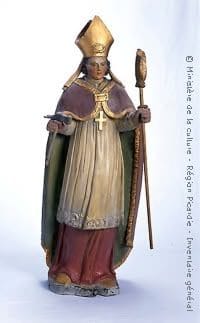
The relics of Saint Eligius rest in Noyon Cathedral, destroyed and rebuilt over the centuries. Paris preserves several traces of his memory. The Church of Saint Eligius, rebuilt in metal in 1967 in the ironworkers' and cabinetmakers' quarter, houses a statue of the saint created by Jean Puiforcat for the 1937 Universal Exposition. A church dedicated to him, destroyed in 1793, stood on Rue des Orfèvres, near the Mint. Notre-Dame de Paris, In the Sainte-Anne chapel, Parisian goldsmiths and jewelers placed his statue and restored his altar.
The monastery of Solignac, founded in 632, remains a major center of spirituality in the Limousin region. Its dual rule, Benedictine and Columbanian, made it one of the most prosperous monasteries of the 7th century. The Church of Saint-Henri in Le Creusot features a stained-glass window depicting Eligius in the guise of Henri Schneider, patron saint of metallurgical works, kneeling before the anvil. In Granges, Saône-et-Loire, a fresco represents the miracle of the horse's hoof, which was shod separately and then reattached.
His patronage extends to goldsmiths, blacksmiths, metalworkers, hardware merchants, locksmiths, farriers, farmers (through horses), carters, mechanics, and garage owners. The Diocese of the Armed Forces has chosen him as the patron saint of military mechanics, who are encouraged to combine technical skill with unwavering dedication. His feast day, December 1st, is celebrated in workshops and garages, where some still bless tools in his honor.
Liturgy
Readings : Wisdom 7,7-14 (wisdom is better than gold); Psalm 15 (the righteous dwell in the tent of the Lord); Matthew 25:14-23 (parable of the talents).
Entrance chant : Blessed is he who puts his faith in the Lord Or People of God, march joyfully.
Prayer God, who gave Saint Eligius the grace to serve your people through his work and his words, grant us to seek justice in our daily tasks.
Communion Antiphon : Well, good and faithful servant, enter into joy from your master.
Evening Hymn : In the heart of this world, the Lord sends us.
Intercession For all those who work with their hands, may their labor be recognized and fairly compensated.