


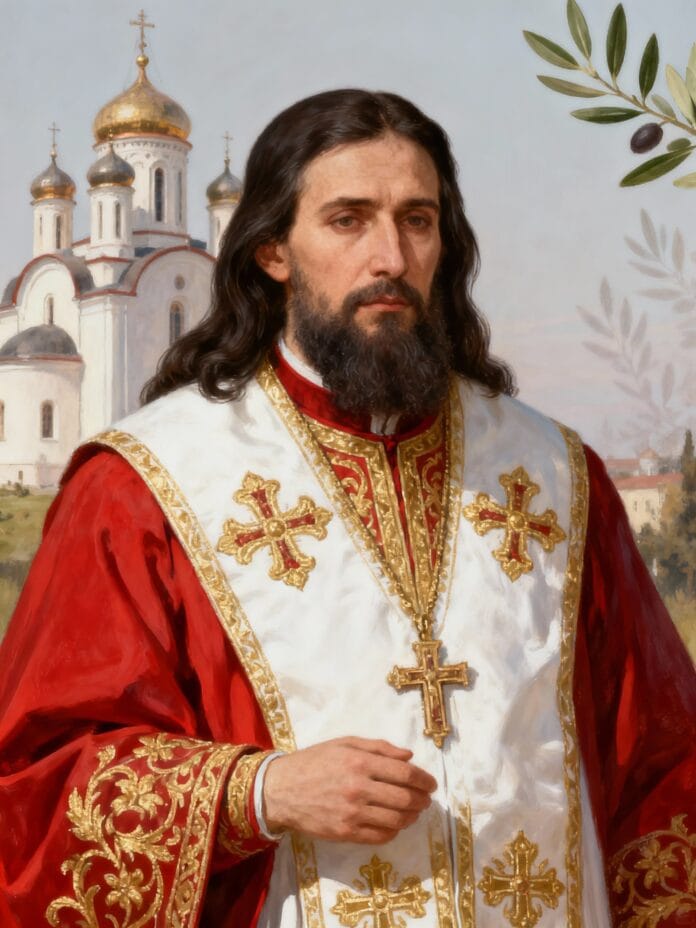
Saint Josaphat Kuncewycz (1580-1623), Basilian bishop and martyr in Vitebsk, craftsman of communion between East and West in the tumult of 17th century Ruthenia.
Born on a land divided between rites and empires, Josaphat Kuncewycz chose peace of unity at the cost of his life. Martyred in Vitebsk in 1623, he remains a powerful witness to reconciliation between Catholics and Orthodox. Today, while Ukraine still suffers from division and the war, His memory calls for the same fidelity: to unite without standardizing, to love without fearing the truth of the other.
A path towards unity
Fact: Jean Kuncewicz was born in 1580 in Volodymyr, Volhynia. His adolescence coincided with the Union of Brest (1596), marking the birth of the Greek Catholic Church.
Call: In search of inner unity, around 1600 he joined the Basilians in Vilnius, took the name Josaphat, and attached himself to the Byzantine liturgy united with Rome.
Mission: Ordained a priest, then Archbishop of Polotsk in 1617, he reformed church life, visited parishes, founded schools, and promoted educated and faithful priests.
Conflicts: In the tensions between Muscovy and Poland, His loyalty to Rome provoked the hostility of a part of the clergy Orthodox. He responds with dialogue, prayer and charity.
Martyrdom: On November 12, 1623, in Vitebsk, a mob beat him to death and threw his body into the Dvina River. He became a "martyr of unity": his fidelity to the Gospel prevailed over any national affiliation.
Legacy: Beatified in 1643 and canonized in 1867 by Pius IX, Josaphat is the first saint of the Eastern Rite. His tomb in St. Peter's Basilica in Rome still attracts pilgrims from Ukraine and the Slavic world.
The blood and light of a bridge
Established fact: The Chronicles confirm his assassination by a mob hostile to the union with Rome.
Related caption: It is reported that, found in the river, his intact body seemed to be bathed in a peaceful light.
Symbolic significance: This light becomes the sign of the luminous unity that God brings about in reconciliation. Jehoshaphat is not a political hero; he embodies the spiritual price of the communion of the Churches.
Spiritual message
Josaphat reminds us that theChristian unity It cannot be decreed; it is lived daily. He united the Byzantine liturgy with loyalty Roman Catholicism, without yielding anything to either side. To seek communion is to consent to die to oneself: his wounds were its seal. The Gospel according to John speaks of the shepherd who lays down his life for his sheep (Jn 10:11) — Jehoshaphat sealed his mission in these words. When everything invites one to choose a side, he teaches patience of God, who weaves peace between divided brothers.
Prayer
Lord Jesus, Prince of peace,
You gave Saint Josaphat the strength to love until death.
Teach us to seek the unity of believers with humility and truth.
Heal our hearts from hasty judgments and hopeless separations.
Make your Church a home where East and West recognize each other as brothers.
Through your Spirit, make us artisans of communion today.
Amen.
To live
- To offer a prayer for a divided people or church.
- To take a concrete step towards reconciliation within one's community.
- Read John 17:21 for ten minutes: "That they may be one, as we are one.".
Memory and places
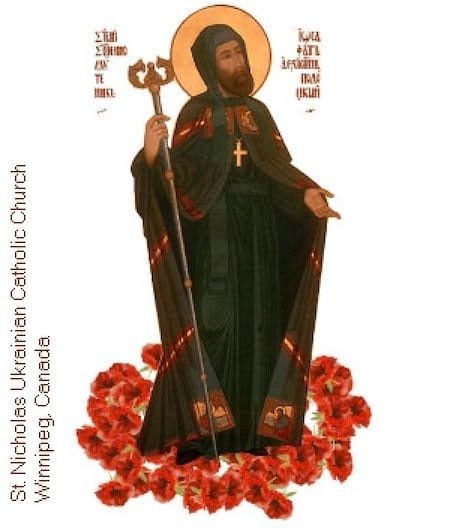
The liturgical memorial of Saint Josaphat is celebrated on November 12. His relics rest near the altar of Saint Basil in St. Peter's Basilica in Rome, a vibrant reminder of the blessing of the East in the heart of the West. UkraineThe city of Polotsk still bears witness to his episcopate; in Vilnius, the Basilian monastery of the Holy Trinity preserves its first cell. From the Greek Catholic parishes of America to Transcarpathian Ruthenia, his name remains linked to prayer for peace. The icons depict him as a Byzantine bishop, holding the cross and a red palm: signs of unity and fidelity.
Liturgy
- Readings/Psalm: Rm 12, 3-11; Jn 17, 20-26 — call to unity in Christ.
- Song/hymn: Ut unum sint — that all may be one.