












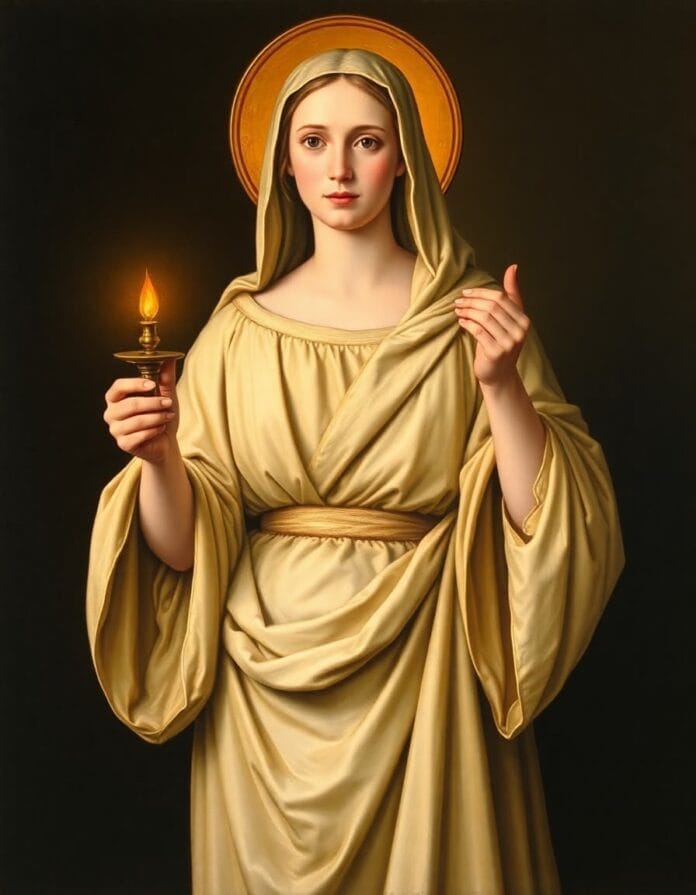
A virgin and martyr in Syracuse at the beginning of the 4th century, Lucy endured the persecution of Diocletian bearing a name that means light. Her ancient veneration spread from the Mediterranean to Scandinavia, where she dispelled the darkness of the northern winter. Before the judge who condemned her, she displayed unwavering fidelity: to please Christ alone. Her memory illuminates the long nights of doubt and hardship, offering believers a model of luminous constancy in the darkness of the world.
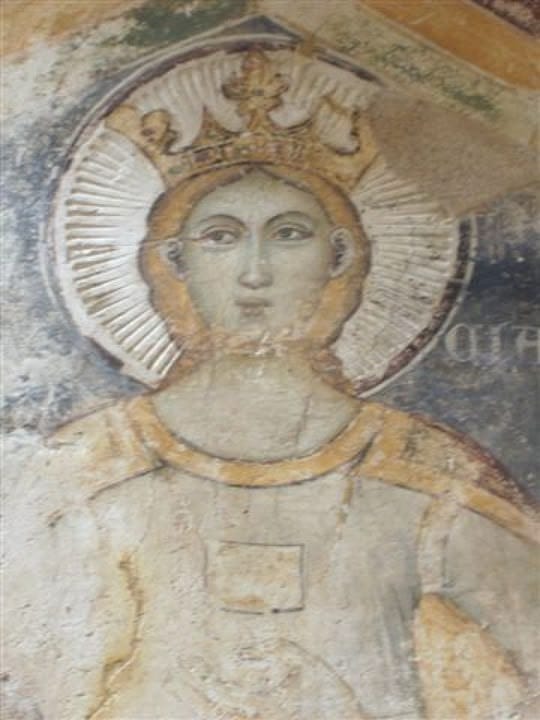
A young woman from Syracuse refused the advances of a suitor and kept her lamp lit to follow Christ. She died around 304, a victim of the last great persecution. Her name Latin, Lucia, has just come from luxLight. In the heart of winter, when the days grow shorter, the Church celebrates this martyr who walks through the night without trembling. Even today, in Sweden and Italy, candles are lit in her name. She reminds us that loyalty shines brighter when darkness threatens.
The vocation of a girl from Syracuse
Lucy was born around 283 into a wealthy family in Syracuse, a major Greek city in eastern Sicily. Her father died when she was a child. She grew up with her mother, Eutychia, a devout Christian in a still largely pagan empire. Around the year 300, her mother suffered from chronic hemorrhages that resisted treatment. Lucy heard about the miracles occurring at the tomb of Saint Agatha, a martyr of Catania who had died fifty years earlier. Mother and daughter embarked on a pilgrimage to Catania, about a hundred kilometers to the north.
At the sanctuary, Lucia prayed intensely. Saint Agatha appeared to her in a dream and announced Eutychia's imminent recovery. She also revealed that Lucia would become for Syracuse what Agatha had been for Catania: a source of glory and a protector. Her mother regained her health. Back in Syracuse, Lucia asked her mother to distribute her dowry and possessions to the poor. She refused the arranged marriage to a young pagan nobleman.
The rejected suitor denounced her to the proconsul Paschasius as a Christian. This was in the year 303 or 304, when Emperor Diocletian ordered the most violent persecution against the Church. The judge summoned Lucy. He demanded that she sacrifice to the gods of Rome. She flatly refused: «You obey the will of your princes, while I observe the will of my God night and day. You desire to please them, while I have no other ambition than to please Christ alone. Do then what seems useful to you, and I will do what will be useful for the salvation of my soul.»
Paschasius tried to break her resistance. He threatened to hand her over to a brothel, a place of prostitution, to defile her consecrated virginity. Lucy replied that a body violated by force did not defile a soul that remained faithful. The guards tried to drag her from the tribunal. According to ancient accounts, she became as still as a column, so heavy that even yoked oxen could not move her. The judge then ordered her to be burned alive on the spot. The flames moved away from her without touching her. Finally, a soldier struck her in the throat with a sword. She died praising God, around the year 305.
His body is buried in the catacombs of Syracuse. A church was dedicated to him as early as the 4th century. His name appears in the Roman Canon of the Mass, a sign of a veneration universal and precocious. Saint Gregory the Great, pope In the 6th century, his tomb is mentioned as a place of pilgrimage. In the Middle Ages, his relics were transferred to Constantinople, then to Venice after 1204. Part of them returned to Syracuse in the 20th century. Saint Thomas Aquinas cites his example twice in his Summa Theologica, when he deals with chastity and strength of soul in the face of persecution.
Legend and symbols of light
The hagiographic accounts of the 5th and 6th centuries elaborate on the documented events. They tell of Lucy tearing out her own eyes to send them to her suitor, who admired their beauty. God miraculously restored her sight. This legend explains why she is depicted holding two eyes on a platter or in a cup. She thus became the patron saint of the blind, ophthalmologists, and all those suffering from eye diseases. The symbolism transcends the anecdote: Lucy sees with the eyes of faith, an inner light that no violence can extinguish.
Another tradition states that she wore a crown of lit candles on her head to light her way as she brought food to Christians hiding in the catacombs. With her hands free, she could carry more provisions. This image has endured through the centuries and become central to Nordic celebrations of Saint Lucy. In Sweden, every December 13th, a young girl dressed in white and wearing a crown of lights leads the morning processions. She sings hymns while carrying saffron buns. The pagan festival of the winter solstice, a time when night reigns supreme, gives way to Lucy, the Christian symbol of light in the darkness.
The palm she often holds in Western art recalls her martyrdom. She joins the ranks of the strong virgins of the early Church, those who preferred death to denying Christ. The legend of her immobility before her executioners underscores a supernatural strength: God renders invincible the one who surrenders to Him. The flames that part from her evoke the three young men in the furnace of the Daniel's book. Lucy crosses the fire like Israel crosses the Red Sea.
Legendary accounts are not history in the modern sense. They express how Christian communities understood and celebrated Lucia's witness. They emphasize that consecrated virginity is not mutilation, but fullness: Lucia remains free because she belongs to Christ alone. They show that violence does not break the holiness, She reveals it. The young Sicilian woman becomes an archetype of loyalty unwavering.
In Corsica, twenty-nine sanctuaries were dedicated to her in the Middle Ages. In Southern Italy, especially in Sicily, her feast day is marked by nighttime torchlit processions. In Venice, in the church of San Geremia, her body rests beneath a marble altar. Pilgrims come there to implore healing and light. Lucia's influence has endured through the centuries without losing its radiance: she guides those who walk through the darkness of mourning, illness, and spiritual doubt. She carries a promise: dawn will come, even after the longest night.
Spiritual message
Lucia embodies inner clarity in the face of the world's darkness. She refuses to compromise her faith to please the powerful. Her response to the judge remains a timeless lesson: our choices reveal whom we wish to please. Do we seek the approval of trends, dominant ideologies, or social pressures? Or do we prefer to obey the voice of our conscience, enlightened by the Gospel? Lucia chooses Christ alone. This choice costs her earthly life, but it opens the door to eternal life.
Its name, light, teaches us that the holiness shines in the darkness. We often experience spiritual winters: doubts, trials, loneliness, the temptation of discouragement. As in Scandinavia where the days shorten until they almost disappear, our lives experience long nights. Lucia reminds us that loyalty Light a lamp that will never go out. Persevering prayer, charity Discreet and stubborn hope are like flames that resist the wind of adversity.
The symbol of the torn-out and then restored eyes invites us to look beyond appearances. True vision is not that of the retina, but that of the heart. To see with the eyes of faith, It is discerning God's presence in suffering, recognizing Christ in the poor, hoping against all hope. Lucia loses her human sight and receives a supernatural gaze. We too are called to renounce superficial judgments in order to acquire the wisdom that comes from above.
Finally, Lucie encourages us to remain firm in our convictions. The modern world often values moral flexibility, relativism, and easy compromise. Lucie shows that there are truths worth holding fast to: the dignity of the person, respect for life, loyalty Promises and selfless love are non-negotiable. Saint Lucy teaches us to become unshakeable pillars of the Gospel in a world that is faltering.
Prayer
Saint Lucy, you who carried the light of Christ in the night of persecution, intercede for us who are going through our own darkness. Teach us to keep our lamp lit even when the wind blows and threatens to extinguish it. Grant us grace to prefer loyalty to God rather than the applause of the world. May your courage inspire our daily lives: to refuse compromise where our faith is at stake, to stand firm in prayer when weariness tempts us, to love unconditionally when selfishness beckons.
You who distributed your wealth to the poor, make our hands generous and our hearts detached from material possessions. May we recognize the face of Christ in those who beg for our attention, our time, our compassion. Help us to see with the eyes of faith: not to judge according to appearances, but to discern the dignity of each person, the discreet presence of God in events, the hope hidden beneath trials.
You who walked through the fire unburned, sustain us in the trials that threaten to consume us. When illness strikes, when grief overwhelms us, when injustice wounds us, give us the strength to stand firm. May your virginity teach us inner freedom: to belong to Christ alone, to depend on no human idol, to live in truth without mask or compromise.
Saint Lucy, patroness of light, obtain for us healing from spiritual blindness: the pride that blinds us to our faults, the indifference that closes our eyes to the suffering of others, the materialism that prevents us from seeing the invisible. May our lives become transparent to God's love, a lamp on the lampstand to illuminate those around us, a star that guides us to Christ. Through your intercession, may we be worthy to enter the wedding feast and contemplate the light that has no end. Amen.
To live
- Light a candle Tonight, think of someone going through a difficult time, and pray for three minutes that they receive light and courage.
- Donate anonymously to a charity or to a person in need, imitating the generosity of Lucie who distributes her fortune to the poor.
- Meditate for ten minutes based on this statement by Lucie: "I have no other ambition than to please Christ alone," identifying an area of my life where I seek too much human approval.
Memorial of Saint Lucy
Syracuse preserves the oldest memory of Lucy. The catacombs where she was buried bear her name and remain a place of pilgrimage. A basilica dedicated to her dates back to the 4th century and was rebuilt after the earthquake of 1693. In Syracuse, the feast day of December 13th is marked by a solemn procession in which her silver statue is carried through the streets of the old city. Sicilians attribute many miracles to her, including the protection of Syracuse from famine and epidemics.
In 1040, the Byzantine general George Maniakes had Lucy's body transferred to Constantinople, then the capital of the Eastern Roman Empire. For over a century, her relics rested in the Hagia Sophia. In 1204, the crusaders of the Fourth Crusade captured Constantinople. The Doge of Venice, Enrico Dandolo, had Lucy's relics brought to his lagoon city. They were first placed in the monastery of San Giorgio Maggiore, then transferred in 1861 to the church of San Geremia in the Cannaregio district. The saint's body, preserved in a glass reliquary, attracts thousands of pilgrims each year. In 1955, part of the relics was returned to Syracuse for the 1650th anniversary of her martyrdom.
Sweden honors Saint Lucia in a spectacular way. Tradition dictates that December 13th, her feast day according to the old Julian calendar, is the shortest day of the year. At dawn, in every home, a young girl dressed in white and wearing a crown of lit candles brings breakfast to her family while singing a hymn to Saint Lucia. In schools, churches, and hospitals, processions of young girls in white, led by "Lucia," sing and distribute saffron buns shaped like cats (lussekatter). This custom, documented as early as the 18th century, replaced an ancient pagan festival linked to the return of light after the winter solstice.
Medieval Corsica boasts twenty-nine sanctuaries dedicated to Saint Lucy, a testament to her popularity on the island. In Ville-di-Pietrabugno, near Bastia, a parish church bears her name and solemnly celebrates her feast day. On the Italian mainland, Naples, Bergamo, and Verona have churches and confraternities dedicated to her. In Rome, a 6th-century mosaic in the Basilica of Saint Agnes Outside the Walls depicts her among the virgin martyrs.
Western art depicts Lucy holding a martyr's palm and a lit oil lamp, or a platter with two eyes. Caravaggio painted her martyrdom in 1608, an impressive canvas in which the executioner is about to strike her throat. Francesco del Cossa, a 15th-century painter from Ferrara, shows her serene, holding her eyes in a golden saucer. These representations have fixed in the collective memory the image of a courageous young woman who fears neither violence nor death.
In Venice, on December 13th, traditional sweets are still eaten in her honor, including eye-shaped biscuits. The city of Stockholm holds an annual competition to find the most beautiful Lucia, chosen from among the young women who will portray the saint in processions. The cult of Lucia, which originated on the Mediterranean shores, has adapted to Nordic cultures without losing its profound meaning. to bring light In the night, remain faithful despite adversity, hope against all odds.
Liturgy
- ReadingsIsaiah 60:1-6 (Arise, Jerusalem, shine forth: your light has come); Psalm 27 (The Lord is my light and my salvation); 2 Corinthians 4:6 (The God who said that light shines in the darkness has himself shone in our hearts); Matthew 5, 14-16 (You are the light of the world).
- Singing: «O lux beata Trinitas» (O blessed light of the Trinity) or «Tantum ergo» at the blessing of the Blessed Sacrament; in Sweden, the traditional hymn «Sankta Lucia» (Saint Lucia, you who bear the light).
- Liturgical color: Red (martyrdom) or white (virginity).
- Prayer«God, who gave Saint Lucy the strength to confess your name even unto martyrdom, grant us to persevere in faith despite the trials, and to walk in your light every day of our lives.»
- Intercession: For the sick eyes, the blind, ophthalmologists and all caregivers; for young girls and women victims of violence or human trafficking; for Christians persecuted throughout the world; for those who are going through the night of doubt or mourning.
- Liturgical gestureSolemn blessing of candles or oil lamps, given to the faithful as a sign of commitment to to bring light of Christ in their living environment.