







The captive who built a church: charity, healings and conversion of a kingdom.
From slave to spiritual mother of a nation
Nino was born at the beginning of the 4th century. Ancient sources, notably the historian Rufinus of Aquileia, are silent on her country of origin. Some traditions say she was from Cappadocia, others link her to Jerusalem. What matters is her brutal uprooting. A young Christian, she was captured during a raid and sold into slavery. The ancient trade routes led her to Iberia, a mountainous region of the Caucasus, between the Black Sea and the Caspian Sea.
She arrives at the court of King Mirian and Queen Nana in Mzkheta, near present-day Tbilisi. The Iberian kingdom lives under Persian influence and practices an astral cult. Nino discovers a world where local deities govern public life. She could blend in, hide her faith, survive. She chooses the opposite: to fully experience her baptism in slavery.
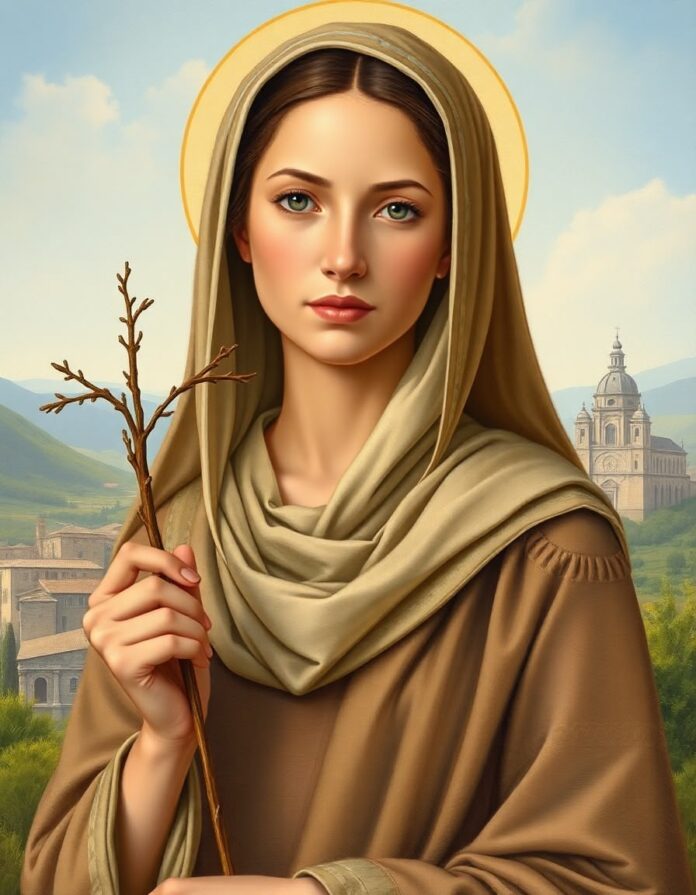
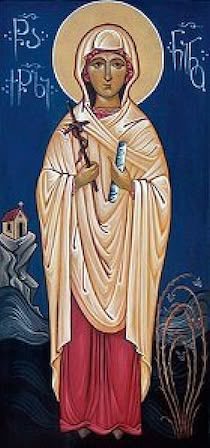
Her beauty struck the court. But it was her charity that distinguishes her. Nino takes care the sick, She consoles the afflicted and shares what little she has. She prays constantly, observing periods of fasting. The courtiers notice this different life. No complaint escapes her lips, no bitterness clouds her gaze. She wears a cross of intertwined vine branches, which she is said to have received from Married according to Georgian tradition.
One event changes everything. Queen Nana's child falls gravely ill. The doctors They declared themselves powerless. The idol priests multiplied their sacrifices without result. In desperation, Nino was summoned. She didn't touch the child, didn't utter any magic formula. She simply placed him under her cross and prayed to Christ. The child was instantly healed.
Queen Nana wants to reward Nino. Nino refuses all material goods. "I only want one thing: for you to know Christ who saved your son." The queen listens, asks questions, and receives instruction. She converts to Christianity. King Mirian remains distant. He observes his wife, notes the change, but hesitates. The ancestral gods have protected the kingdom for generations.
Mirian went hunting in the mountains with his entourage. A thick fog suddenly descended, so dense that nothing could be seen. The horses refused to move forward. Panic gripped the group. The king remembered Nino's words about Christ, the light of the world. In despair, he invoked this unknown God: "If you exist, God of Nino, dispel this darkness." The fog instantly lifted. The sun shone brightly. Mirian returned to the palace, shaken.
He summons Nino. "Tell me about your God." The slave teaches the king. She explains the Incarnation, the Passion, the Resurrection. Mirian decides to kiss faith Christian. But he wants to go further: to Christianize the entire kingdom. Nino guides him in this endeavor. The king sends a delegation to Constantinople to meet with Emperor Constantine. He requests a bishop to baptize his people.
Bishop John arrives from Antioch with priests. Nino actively participates in the’evangelization. She doesn't just convert the elite. She travels through the countryside, visits remote villages, teaches women, forms catechists. Her knowledge of the terrain, her closeness to ordinary people, her example of life make her the ideal apostle for this mountain people.
The king commissioned the construction of a cathedral in Mzkheta. A miracle accompanied the erection of the first column: it rose on its own, without human intervention, according to tradition. This prodigy finally convinced the skeptics. The mass baptism of the Iberian people was organized. Nino witnessed the birth of the Georgian Church, the fruit of his prayers as a slave.
She then withdrew to Bobdé, in the mountains of Kakheti. There she lived as a hermit, continuing her work of’evangelization among the rural population. A community formed around her. She died peacefully around 338-340, at the end of a life that transformed a nation. King Mirian had a cathedral built over her tomb.
Rufinus of Aquileia, writing around 400, recounts these events in his Ecclesiastical History. He emphasizes the striking contrast: an anonymous slave becomes the spiritual mother of a kingdom. The Georgian Church grew rapidly. By the 6th century, it already possessed its own liturgy and flourishing monasteries. Nino remains venerated as "equal to the apostles," a very rare title bestowed upon women in the Eastern tradition.
The vine cross and the miraculous pillar
Let us carefully distinguish between history and hagiography. It is an established fact that a Christian woman played a decisive role in the conversion of Iberia in the 4th century. Rufinus confirms this, and Georgian sources agree. It is also an established fact that King Mirian requested a bishop from Constantinople to baptize his people. Finally, it is an established fact that the Georgian Church dates from this period and venerates Nino as its founder.
Legend embellishes these events with marvelous details. According to the Georgian Life of Nino, written in the 7th century, she had a vision of the Virgin Mary. Married before leaving on a mission. Married He was given a cross made of intertwined vine branches tied together with his own hair. This cross accompanied Nino throughout his life. It served as an instrument for miraculous healings. Even today, the traditional Georgian cross reproduces this model: curved arms descending downwards.
Another legendary tale: the living pillar of Mzkheta. During the construction of the first cathedral, seven columns were to be erected. Six stood without difficulty. The seventh, taller than the others, resisted all efforts. The workers gave up for the night. Nino prayed all night before the fallen column. In the morning, the people discovered the column standing upright, raised by an invisible force. A light descended from it, healing the sick present. This column, christened "living" (sveti in Georgian, hence Svetitskhoveli, the name of the cathedral), becomes the symbol of faith Georgian.
The symbolic significance of these stories lies in their expression of a theology of weakness transformed into power. Nino possesses nothing, not even his freedom. His only strength is the cross, an instrument of death that has become a source of life. The vine branches evoke John 15: «I am the vine, you are the branches.» The connection made with the hair of Married emphasizes the maternal tenderness of the Church which gives birth through the Word.
The pillar that stands alone proclaims the gratuity of grace. L'’evangelization It is not a human creation, the result of strategies or means. It springs from contemplative prayer. Nino spends the night in spiritual vigil; God raises the column. This pattern runs throughout the history of the holiness God chooses the weak to confound the strong (1 Cor 1:27).
Georgian hagiographers add other miracles. Nino is said to have found Christ's tunic, brought to Georgia by a Jew from Jerusalem in the 1st century. This relic is supposedly buried beneath the Svetitskhoveli Cathedral. She is also said to have planted her cross with a vine, which took root and produced miraculous grapes. These accounts, historically unverifiable, attest to the veneration popular.
Georgian tradition also develops the Marian dimension. Nino was said to have been the niece of Juvenal, the Patriarch of Jerusalem. Raised in Jerusalem, she is said to have met an old woman named Sara who knew Married. This Sara supposedly told him about the life of the Mother of God. Nino then supposedly wanted to evangelize Georgia, a country that Married According to an apocryphal tradition, she herself would have chosen by lot from among the apostles as her share of the inheritance.
These embellishments do not diminish the historical truth of the core: a courageous woman carried Christ into a pagan kingdom. charity He opened hearts. His prayers obtained visible graces. The rest is a matter of pious memory, amplified to teach. The medieval legends surrounding Nino aimed to strengthen Georgian Christian identity in the face of Persian and Arab invasions. They fulfilled their purpose: to maintain faith in the ordeal.
Today, historians focus on verifiable facts. Believers also embrace the symbolic dimension of hagiographic narratives without confusing them with history. These two levels of interpretation enrich our understanding of Nino: a real woman and a spiritual figure.
When charity evangelizes better than speeches
Nino doesn't convert through eloquence. She doesn't debate with court philosophers. She doesn't force anyone. Her only weapon is concrete, daily, patient love. As a slave, she cares for the sick. As a prisoner, she comforts them. As a poor person, she shares. This consistency between her professed faith and her lived life puzzles those around her.
The Gospel resonates throughout her life: «Truly I tell you, whatever you did for one of the least of these brothers and sisters of mine, you did for me» (Matthew 25:40). Nino sees Christ in every suffering person. She doesn't engage in aggressive proselytizing. She simply radiates the divine presence that dwells within her. Miraculous healings attest to this presence but do not replace it. They confirm a holiness already visible in ordinary gestures.
Paul wrote: «If I speak in the tongues of men and angels, if I don't have charity, »I am a resounding gong or bronze” (1 Corinthians 13:1). Nino embodies this primacy of love. She doesn't need lengthy theological discourse to touch Queen Nana. Her selfless service speaks louder than any treatise. Charity possesses a force of’evangelization that no rhetoric can equal.
This lesson transcends centuries. Our Christian witness is first and foremost expressed through our actions. Contemporaries may never read the Catechism, but they observe the way we live. Are we, like Nino, visible signs of Christ's love? Does our faith concretely change our relationship with others, especially the most vulnerable?
Nino also teaches us patience evangelist. Between her arrival at court and the conversion of the kingdom, years passed. She didn't rush anything. She let grace She works on hearts. She respects everyone's freedom. This spiritual patience contrasts with our era of immediate results. Sowing faith requires time, consistency, and...’humility.
A concrete image: let's think of a garden. Nino is the gardener who waters patiently, removes weeds, and protects young shoots. She doesn't force the plants to grow. She creates favorable conditions: prayer, charity, example. God alone gives growth (1 Co 3, 7). Our role is to cultivate the soil of hearts with love and perseverance.
Prayer
Lord Jesus Christ,
You chose Saint Nino, a slave woman without power,
To bring the light of the Gospel to the kingdom of Georgia.
Through his humble testimony and his charity radiant,
She converted a king, a queen, and an entire people.
Give us grace to follow his example.
Grant us to live our faith consistently.,
Let our actions speak louder than our words.,
May our concrete love for the little ones
Become the visible sign of your presence among us.
Strengthen us in this ordeal as you strengthened Nino.
That no captivity, physical or moral,
Do not prevent us from radiating your joy and hope.
May our prayer become a source of healing
For those who suffer in body or soul.
Teach us patience Nino's evangelist.
Let's not look for immediate results,
But let us sow faithfully, day after day,
The seeds of the Kingdom are in our surroundings.,
Trusting your Spirit for growth.
Through the intercession of Saint Nino, equal to the apostles,
Bless the Church of Georgia and all the Churches of the East.
Fortified Christians persecuted,
Support the missionaries who proclaim your Name,
Rekindle in us zeal for your Gospel.
May Nino's vine-vine cross remind us
That you are the true vine and we are the branches,
That we can do nothing when we are separated from you.,
But united with you, may we bear abundant fruit.
Amen.
To live
- To perform a concrete service for a person in difficulty without to wait for of recognition: visiting a sick person, providing material assistance to a neighbor, prolonged listening to an isolated relative.
- Pray for 15 minutes for a person far from faith, by asking the Lord to touch his heart through charity Christians she meets.
- Examine our consistency To what extent do my daily actions reflect my faith? Where can I improve the alignment between what I believe and what I live?
Georgian pilgrimages and Eastern influence
Georgia honors Saint Nino as its patron saint and spiritual founder. Her tomb is located in Bodbe Cathedral, built in the 4th century on the site of her death. This sanctuary, situated in the Kakheti wine region, attracts thousands of pilgrims each year. A miraculous spring gushes forth at the foot of the hill, renowned for its healing properties. The faithful descend a long wooden staircase to pray and collect the holy water.
The Cathedral of Svetitskhoveli in Mzkheta remains the spiritual heart of Georgia. A UNESCO World Heritage Site, it traditionally houses the tunic of Christ and the miraculous pillar erected by Nino. Medieval frescoes depicting his life adorn the walls of the sanctuary. Every Georgian patriarch has been enthroned there since the 6th century. Major liturgical feasts bring together the Christian people of Georgia at this cathedral.
A small shrine near Svetitskhoveli marks the spot where Nino prayed. Rebuilt several times, it stands as a living testament to the memory of Georgian national baptism. Couples come here to ask for Nino's blessing before their wedding. Mothers bring their sick children, perpetuating the tradition of healings obtained through his intercession.
Georgian iconography depicts Nino holding her cross of vine branches. Dressed in a simple tunic, without royal ornaments, she embodies the’humility Missionary. Some icons show her teaching King Mirian and Queen Nana. Others depict her praying before the Svetitskhoveli pillar. Artists emphasize her gentle gaze and welcoming posture, a reflection of her charity legendary.
The Samtavro Monastery, also in Mzkheta, houses some of her relics. King Mirian and Queen Nana are buried there. This place illustrates the unbreakable bond between the saint and the rulers she converted. A grapevine planted in the monastery garden is said to be descended from the one from which Nino made his cross.
In the West, the veneration of Saint Nino remains discreet but not nonexistent. The Catholic Church mentions her in the Roman Martyrology on January 14th. A few parishes are dedicated to her, particularly in France where Georgian immigrant communities perpetuate her devotion. The Congregation of the Sisters of Saint Christian, founded in the 19th century in the diocese of Reims, bears her French name and is dedicated to education and the care of the sick, extending her charitable mission.
Georgian hagiographic literature devotes a central place to Nino. The Life of Saint Nino, written in Georgian in the 7th century, is one of the oldest texts in Georgian literature. It has been translated into Greek, Armenian, Arabic, and Slavic languages, testifying to its influence throughout the Christian East. Medieval Georgian poets celebrated her in verse, sometimes comparing her to Mary Magdalene, sometimes to... Married Mother of Christ.
Georgian liturgical chant, polyphonic and strikingly beautiful, includes several hymns to Saint Nino. These ancient melodies, passed down orally for centuries, still resonate in mountain monasteries. They evoke her gentleness, her courage, and her unwavering faith. Pilgrims sing them as they walk to Bodbe or Svetitskhoveli.
The feast of Saint Nino on January 14 (January 27 according to the old Julian calendar still used by the Georgian Orthodox Church) is marked by grand celebrations. The Patriarch presides over the Divine Liturgy in Svetitskhoveli. The faithful fast the day before, go to confession, and receive communion in large numbers. Processions carrying icons and relics wind through the streets of Mzkheta. Traditional Georgian dances fill the public squares. The entire nation honors the one who brought them Christ.
Liturgy
- Readings 1 Corinthians 1:26-31 (God chooses the weak); Matthew 25:31-40 (I was a prisoner and you visited me)
- Psalm Psalm 117 (116) – «Go into all the world and proclaim the gospel»
- Opening Song : «People of the Covenant» or hymn to Saint Nino from the Georgian tradition
- Preface Missionary Saints
- Communion hymn "Bread of life" or "We are the body of Christ"«
- Universal Prayer For missionaries, the Eastern Churches, the conversion of hearts, captives and prisoners